



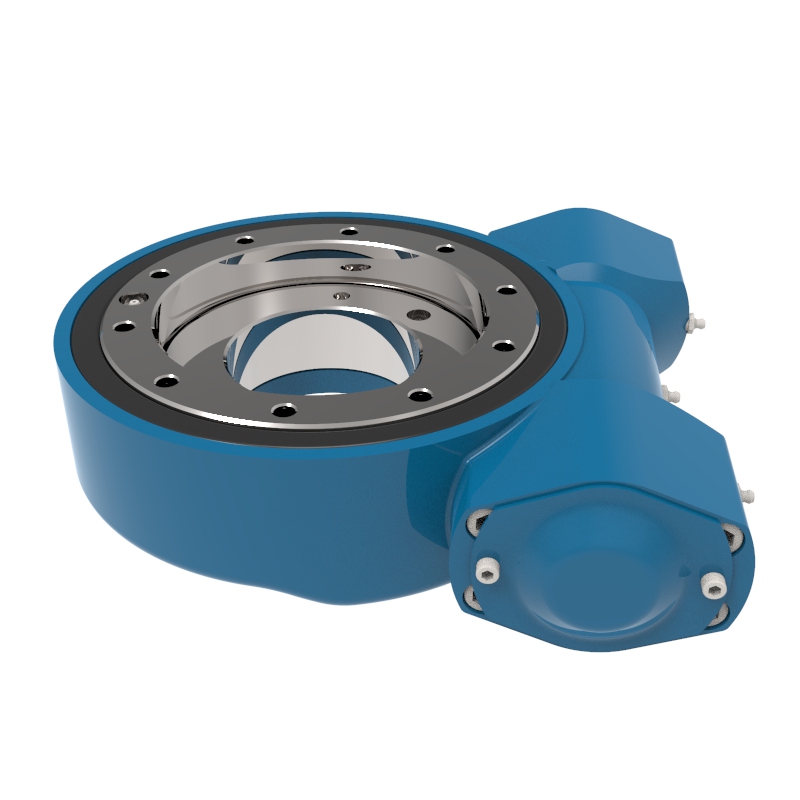
What is a planetary slew drive? It is a rotary drive assembly that combines a slewing bearing, gear reduction system, housing, and motor interface to rotate a load while carrying axial, radial, and overturning loads. Buyers often select it for equipment that needs controlled rotation with high output torque in a compact installation space.
The main sourcing risk is simple: two suppliers may quote the same-looking planetary slew drive with similar output torque, yet their ratings may describe very different operating conditions. One quote may state a short-duration peak value, while another may state a continuous working value. If the buyer compares only the largest number, the selected unit can be undersized for actual duty.
Luoyang Slewring Bearing Co., Ltd. supplies Slew Drive, slewing bearing, and customized slew drive solutions for equipment builders that need to match rotation performance with real load conditions. This article gives purchasing teams and engineers a quote-review method that separates torque, bearing capacity, duty, and environmental requirements before an order is released.
Start Every Quote Review With the Actual Operating Case
Do not begin by asking which unit has the highest quoted torque. Begin with what the machine does during a normal shift, a heavy cycle, and a fault or overload event. A drive that rotates an antenna slowly is evaluated differently from one that repeatedly starts, stops, reverses, and holds an off-center boom.
The first conclusion is that a supplier quote is only comparable when the duty inputs are comparable. The reason is that output torque alone does not show the bearing loads, cycle frequency, starting demand, mounting direction, or external moment applied to the housing. This method fits OEM sourcing, replacement projects, and new equipment design; it does not replace a full mechanical calculation when the machine has high safety consequences.
Information to provide before requesting a rating
- Rotating load: Identify the payload, attachment, counterweight, and any load that moves with the platform.
- Load position: State the distance between the load center and the rotation center. An offset load creates overturning moment, even when the vertical load appears moderate.
- Rotation pattern: Describe whether movement is one-way, reversing, indexing, continuous, or intermittent.
- Motor and control: Give the motor type, available input torque, speed range, start-stop frequency, and braking arrangement.
- Required holding behavior: Specify whether the mechanism must hold position without power, resist back-driving, or rely on an external brake.
- Mounting arrangement: Provide the mounting orientation, bolt pattern constraints, available installation envelope, and connected structure stiffness.
- Environment: State outdoor exposure, dust, moisture, salt air, temperature range, and corrosion expectations.
A practical example is a rotating platform with a load mounted far from the centerline. The motor may need only modest running torque once the platform is moving, but the bearing can still experience a demanding moment load. In that case, choosing only from a gearbox torque figure is not appropriate because bearing moment capacity may control the selection.
For a light platform where load is centered and motion is occasional, a smaller drive may fit. For a crane, forestry attachment, mining machine, or marine deck mechanism, the quote needs a clearer review of moment, shock, and operating cycle. If the drive must be designed around a nonstandard flange, housing, motor interface, or load condition, a Customized Slew Drive inquiry is more useful than forcing a standard catalog frame into the application.
Use a Side-by-Side Rating Comparison Before Choosing a Supplier
The most useful quote sheet separates continuous torque, peak torque, bearing moment capacity, and allowable duty cycle. These are related, but they are not interchangeable. Ask every supplier to complete the same fields and to state the condition behind each value.
The conclusion is direct: accept a comparison only when all four rating categories are visible. This approach works for buyers comparing suppliers, product series, or alternative drive sizes. It does not mean that the highest rating in each column can be combined into one operating condition, because some values may be limited by different thermal, structural, or life assumptions.
| Rating category | What it should mean in a quote | What the buyer should ask | Why it cannot replace another rating |
|---|---|---|---|
| Continuous torque | Output torque the drive can sustain during the stated normal operating duty. | At what speed, cycle pattern, temperature, lubrication condition, and service life assumption is this value stated? | It does not prove the drive can carry a high starting shock or a large external bearing moment. |
| Peak torque | Short-duration output torque allowed during starting, acceleration, upset load, or another defined event. | How long may peak torque be applied, how often may it occur, and what is the required recovery period? | It is not a normal running rating and should not be used as the machine's continuous load target. |
| Bearing moment capacity | The drive's ability to resist overturning moment applied through the supported structure. | What axial, radial, and moment loads are assumed together? Is the value static, dynamic, or both? | It does not establish motor-side torque capacity or allowable rotation frequency. |
| Allowable duty cycle | The permitted relationship between operating time, rest time, starts, reversals, and heat generation. | What cycle definition is used, and does it include frequent reversal, holding load, or continuous rotation? | It does not show whether the drive can withstand a single large shock or off-center load. |
When reviewing an offer, treat continuous torque as the baseline for normal work. Use peak torque as a controlled allowance for brief events, not as a selling-point number to compare without context. This is especially relevant for indexing tables, boom positioning systems, and equipment with repeated starts and stops.
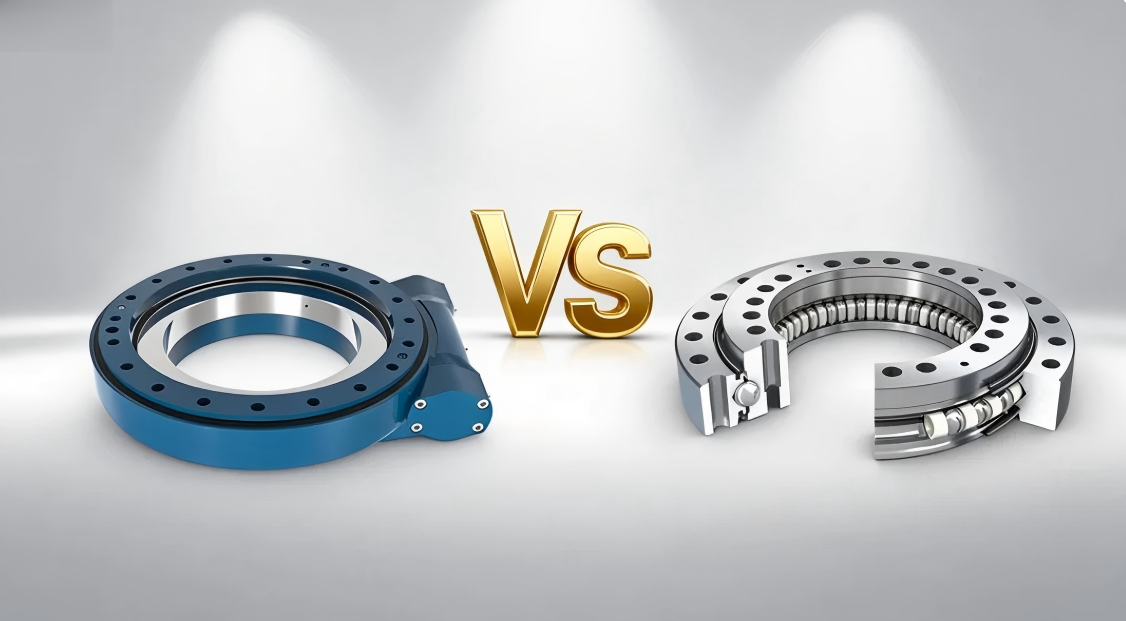
Moment capacity needs equal attention. A drive can have enough output torque to rotate a load and still be unsuitable if a long arm, elevated load, or cantilevered frame creates excessive overturning force. For high-load rotation systems, buyers may also need to compare the underlying bearing arrangement with a Heavy load slewing bearing option rather than evaluating the drive housing alone.
Duty cycle is often the missing line in a quotation. A unit used for occasional adjustment may perform well at a load level that would create heat or wear concerns in frequent reversing service. If the supplier does not state the operating basis, mark the number as “not normalized” rather than assuming it matches another vendor’s rating.
Request Your Custom Slew Drive or Bearing Spec
Tell us your load, speed, and environment — receive a tailored 100–5000 mm slewing drive or slewing bearing proposal with 3D drawings within 24 hours.
Build a Normalized Quote-Review Table for Every Candidate
A normalized table prevents a purchasing decision from becoming a comparison of incomplete catalog values. Send the same application data to each supplier, then enter answers exactly as received. Do not convert an undefined “maximum torque” figure into a continuous value yourself.
| Quote-review item | Supplier A | Supplier B | Supplier C | Decision rule |
|---|---|---|---|---|
| Continuous output torque and stated conditions | Request stated value and basis | Request stated value and basis | Request stated value and basis | Compare only if duty and operating conditions match. |
| Peak output torque and permitted duration | Request value and time limit | Request value and time limit | Request value and time limit | Reject a peak-only comparison for continuous service. |
| Axial, radial, and bearing moment limits | Request combined-load basis | Request combined-load basis | Request combined-load basis | Check all loads at the same mounting point and orientation. |
| Allowable duty cycle and starts or reversals | Request defined cycle | Request defined cycle | Request defined cycle | Match the machine’s normal and worst-case cycle. |
| Motor interface and input conditions | Confirm | Confirm | Confirm | Check that input torque and speed assumptions are identical. |
| Protection and corrosion requirement | Confirm stated level | Confirm stated level | Confirm stated level | Use the installation environment, not indoor assumptions. |
| Inspection, warranty, and delivery terms | Confirm documentation | Confirm documentation | Confirm documentation | Compare commercial scope after technical fit is established. |
Use this table in two stages. First, remove offers that lack a defined rating basis or cannot meet the load case. Second, compare price, lead time, warranty, and order terms among technically suitable options. This sequence fits a buyer who needs a defensible supplier decision; it does not eliminate the need to review drawings and acceptance requirements before production.
Common quote-review mistakes that create selection risk
- Using peak torque as the normal operating load: This may lead to overheating or shortened service life in repetitive work.
- Ignoring the load center: A payload located away from the rotation axis can control the bearing selection through moment load.
- Comparing values from different motor inputs: Gear reduction output depends on the input condition. A quoted drive rating must be tied to the proposed motor and control arrangement.
- Leaving duty cycle undefined: “Intermittent” does not tell an engineer how long the drive runs, rests, starts, or reverses.
- Checking only the drive envelope: A unit may fit physically but lack suitable bolt support, structural stiffness, or load capacity.
- Assuming an environmental rating without stating the site: Dust, rain, salt exposure, and corrosion conditions should appear in the inquiry.
For example, a solar tracking mechanism may operate at low speed but run daily outdoors. A heavy steering platform may have short movements but receive repeated reversals and shock loads. These applications should not be evaluated with the same rating emphasis, even if the requested output torque appears similar.
Match Supplier Evidence to the Risk in Your Application
Technical numbers need supporting quality evidence. Luoyang Slewring Bearing Co., Ltd. operates an ISO 9001:2015-certified facility and provides CE marking for the European market. Factory audit reports are available on request, which can help procurement teams review supplier qualification requirements before placing an order.
For rating-sensitive equipment, ask what inspection supports the quoted configuration. Our stated quality process includes CMM three-coordinate inspection and dynamic load testing for every slewing bearing. This is relevant when the drive must carry cyclic loads or when mounting accuracy affects the machine; it does not replace application-specific verification of the customer’s full structure and duty cycle.
The company has six production lines in an 8,000 m² manufacturing facility, with CNC machining centers and an experienced engineering team. Annual capacity is 100,000 sets. These facts matter when an OEM needs a supplier with defined production resources, but capacity alone should not be treated as proof that a specific model meets a particular overload case.
Material selection also needs to follow the work condition. Available materials include ductile cast iron, alloy steel, stainless steel, and forged alloy steel, selected according to load, speed, and environment. A corrosion-resistant material choice may fit outdoor or marine exposure, while a heavy cyclic-load design may require a different selection; the final choice still depends on the submitted application data.
Real project references can help a buyer identify relevant application scope. A South Korean port equipment manufacturer placed a repeat order for 20 WEA9-62-25HR single worm slew drives for port crane systems, with stated tracking precision of no more than 0.15 degrees, IP65 sealing, and self-locking behavior. That case supports discussion of crane-related rotation needs, but it should not be used as a universal rating claim for a different drive type or duty cycle.
For heavy reversing service, a Houston engineering machinery manufacturer ordered 150 WED17-104-25HR double worm slew drives for heavy-duty wheel steering systems. A Canadian forestry equipment manufacturer used 30 WED14-86-25BHR.5 double worm units for forestry grapple machines with stated precision of no more than 0.13 degrees. Buyers considering multi-contact designs can review the Double Worm Slew Drive range, while still confirming the exact torque and bearing requirements for their own machine.
Set Clear Commercial and Technical Boundaries Before Ordering
Once the preferred design is identified, confirm what is included in the quote. A good purchase specification should identify the drive model or custom drawing, rating basis, motor interface, mounting details, protection target, inspection documents, packing expectations, and acceptance criteria. This limits the risk of a technically correct drive being delivered with an unsuitable interface or missing commercial requirement.
Luoyang Slewring Bearing Co., Ltd. offers a standard-product MOQ of one set and a customized-product MOQ of five sets. Sample orders are welcome for testing and evaluation. This can suit a buyer who needs to validate installation or controls before a larger release; it does not mean every custom design can be approved without first agreeing the technical scope.
The stated standard production cycle is nine days, with technical proposals available within 24 hours and rapid prototyping available in three days. These are useful planning references for qualified requirements. Actual delivery commitments should still be confirmed against the selected design, quantity, documentation needs, and production schedule.
The company provides a two-year extended quality warranty, a 48-hour technical response commitment, and free replacement for confirmed manufacturing defects. Buyers should clarify how defects are identified, what evidence is required, and how site-related issues such as incorrect mounting, overload, or unsuitable duty will be separated from manufacturing defects.
Final buyer checklist for an equivalent technical comparison
- Describe the machine’s normal duty and worst expected event.
- Provide axial load, radial load, overturning moment, and load-center information.
- Request separate continuous torque and peak torque values with operating conditions.
- Request bearing moment capacity and state whether combined loads are evaluated.
- Ask for allowable duty cycle, starts, reversals, and holding requirements.
- Confirm motor input, mounting geometry, environmental protection, and corrosion conditions.
- Compare inspection evidence, warranty scope, MOQ, production timing, and documentation only after the technical ratings are normalized.
A planetary slew drive quote is a good fit when the supplier can show that torque, bearing capacity, and duty are matched to the same operating case. Luoyang Slewring Bearing Co., Ltd. can support standard and customized slew drive inquiries with material selection based on load, speed, and environment, along with documented quality and commercial terms. Send the operating data listed above to receive a quote that can be compared on like-for-like conditions.
Request Your Custom Slew Drive or Bearing Spec
Tell us your load, speed, and environment — receive a tailored 100–5000 mm slewing drive or slewing bearing proposal with 3D drawings within 24 hours.
 WhatsApp

 +8613903880726