



What is a customized slewing ring? It is a large-diameter bearing built to your load case, mounting pattern, and gearing needs instead of taken from a catalog. For tilt-heavy machines, the custom part is often the raceway, the contact angle, or the rolling-element layout.
The sourcing risk is simple. If you send a quote request with only an outside diameter and an axial load, you may get a ring that fits the bolts but fails under overturning moment. Fixing that after prototypes are built costs weeks.
This guide helps OEM engineers and buyers decide when a standard ring is enough and when a custom design is needed. It also lists the inputs a supplier needs to quote a tilt-load ring correctly. The goal is a shorter, cleaner path from early specification to supplier shortlist.
Why Tilt Moment Drives the Ring Choice
A slewing ring carries three load types at once: axial force, radial force, and tilting moment. Tilt moment is the one buyers most often underestimate. It comes from an offset load, such as a boom, a platform, a solar panel, or a rotating work head, acting at a distance from the bearing center.
Moment loads the raceway unevenly. One side of the ring is squeezed while the opposite side unloads. That uneven contact is what shortens life if the raceway geometry is wrong.
In my design work on heavy equipment, I have seen the same mistake repeat. The team sizes the ring on axial load, then discovers the moment case was ten times worse than the vertical weight suggested. Always size on the worst combined case, not on the static weight.
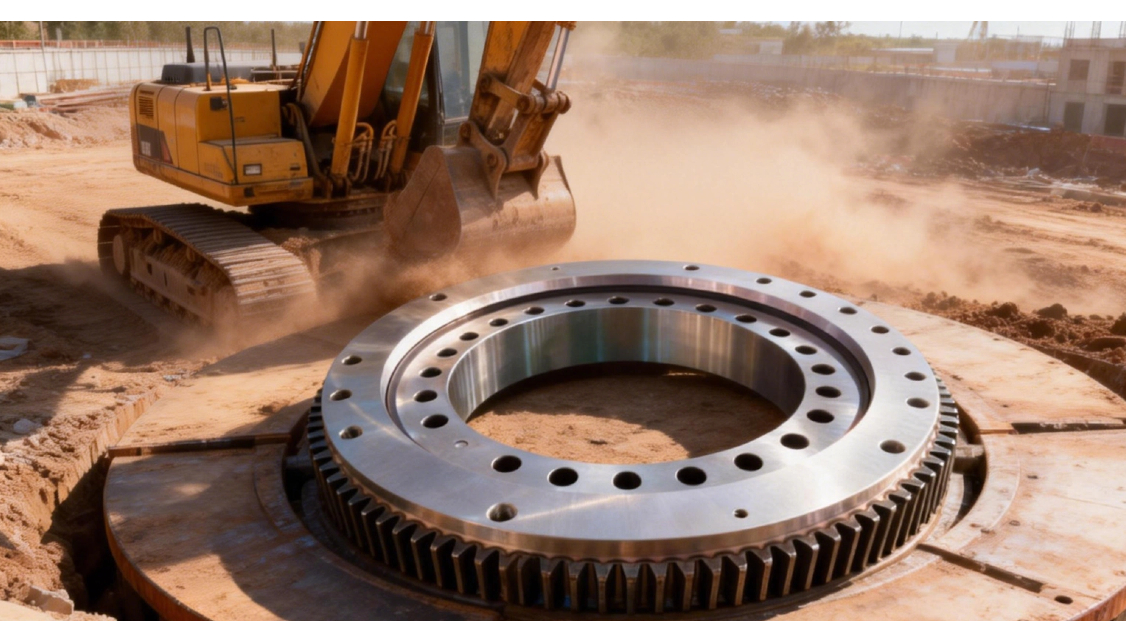
Three conditions make tilt moment critical:
- Long load offset: the load center sits far from the ring axis, as on a crane boom or a tall tracker array.
- Dynamic or shock loading: swinging, braking, or wind gusts create peak moments well above the steady value.
- Tight stiffness needs: the machine must hold its pointing angle or platform level under load.
When Combined Tilt Moment and Radial Load Require a Custom Raceway, Contact Angle, or Rolling-Element Arrangement
This is the decision boundary most selection guides skip. A standard ring works when its rated limit curve covers your extreme load point with margin. A custom design is justified when that point falls outside the catalog curve, or when moment and radial load together push one raceway too hard.
To test this, plot your extreme axial force and tilt moment against the supplier's static limit load curve. Apply the safety factor your application standard requires. Then check the radial load separately, because a high radial share changes which ring type fits.
| Load condition | Usually fits a standard ring? | Custom change to consider | Limit of this advice |
|---|---|---|---|
| Moderate moment, low radial, slow rotation | Yes, often a single-row four-point contact ball design | None, or only gear and mounting changes | Confirm against the limit curve with safety factor |
| Moderate to high moment, moderate radial | Sometimes, a double-row ball design | Raceway hardening depth or ball size adjustment | Check ball-to-raceway contact stress at peak load |
| High moment, tight stiffness or low tilt deflection | Often not | Crossed roller layout or adjusted clearance and preload | Needs a stiff mounting structure to benefit |
| High moment plus high radial load or shock | Rarely | Three-row roller arrangement with separate raceways for axial, radial, and moment loads | Larger section and heavier ring; confirm space envelope |
| Radial load dominates over axial | Rarely | Different contact angle or roller arrangement | Contact angle changes must be checked against axial capacity |
| Flexible housing or uneven flange | No ring change fixes this | Stiffen the structure first; then reassess | A custom ring cannot make up for a flexing mount |
Ring type matters here. Crossed Roller Slewing Bearings suit moderate moment where stiffness and compact height count. For the heaviest combined loads, Three-row Roller Slewing Bearings give each load type its own raceway.
A customized slewing ring is not always the answer. If your load point sits well inside a catalog curve, custom tooling only adds cost and lead time. Choose custom when the numbers say standard does not fit, not because the application feels demanding.
Design Inputs to Send Before Requesting a Quote
A supplier can only quote what you describe. Missing inputs cause either a conservative, expensive ring or a quote that gets revised after engineering review. The list below is what a tilt-load RFQ should carry.
- Load cases: axial force, radial force, and tilt moment for normal operation and for the worst extreme case (including wind, braking, or shock).
- Duty cycle: rotation speed, swing angle, starts and stops per hour, and expected service life in hours or cycles.
- Space envelope: maximum outside diameter, inside diameter, and total height.
- Mounting data: bolt circle, bolt count and grade, flange flatness, and structure stiffness.
- Gearing: external, internal, or no gear; module; and whether a drive is attached.
- Environment: temperature range, dust, salt spray, washdown, and any corrosion rating needed.
- Precision and backlash: allowed tilt deflection, rotational accuracy, and pointing tolerance.
- Quantity and schedule: prototype count, expected annual volume, and target delivery.
If you also need a drive on the ring, say so early. A Slew Drive combines bearing, gearing, and housing, and the tilt rating then depends on the whole assembly, not just the ring.
Request Your Custom Slew Drive or Bearing Spec
Tell us your load, speed, and environment — receive a tailored 100–5000 mm slewing drive or slewing bearing proposal with 3D drawings within 24 hours.
Supplier Capabilities That Matter for Tilt-Load Rings
Buyers should match supplier claims to a specific concern. Here is how the facts we can document map to a tilt-load project.
| Buyer concern | Supporting fact from Luoyang Slewring Bearing Co., Ltd. |
|---|---|
| Is the design experience real? | 15+ years focused on slew bearing and slew drive R&D, from three-row roller slewing bearing drawing design through worm gear drive mass production, validated across 2,000+ heavy-equipment projects |
| Will the part be inspected? | Every slew bearing passes CMM three-coordinate inspection and dynamic load testing; the stated failure rate is below the 0.5% industry standard |
| Is the quality system documented? | ISO 9001:2015 certified; CE marking for the European market; factory audit reports available on request |
| Can materials match the load? | Ductile cast iron, alloy steel, stainless steel, and forged alloy steel, selected per load, speed, and environment |
| Is there manufacturing capacity? | 6 production lines, an 8,000 m² facility, CNC machining centers, and annual capacity of 100,000 sets |
Our Slew Drive Quality Control page explains the inspection steps in more detail. Ask for the audit report if you need to verify the factory yourself.
Application Records Where Moment Loads Shape the Design
Our supplied customer cases are mostly slew drive orders, not bare rings. They still show the machine types where tilt moment and radial load set the specification. We cite them for application context only, not as proof of any particular ring rating.
- Houston, Texas engineering machinery manufacturer: 100 units of SEA21-125-25HR(2) for slewing platform and turntable systems, plus 150 units of WED17-104-25HR double worm slew drives for heavy-duty wheel steering.
- Solar trackers in South America and the US: SP-I 0229 spur gear slew drives for single-axis trackers in Brazil, Argentina, and Chile, and 50 units of SP-I 0841 for utility-scale trackers with IP65 protection for desert sites. Wind-driven moment is the main load concern in these designs.
- Marine and port cranes: 20 units of WEA17-104-25H-R-REV.D for UK shipboard cranes, and a 20-unit repeat order of WEA9-62-25HR-class worm slew drives from a South Korean port equipment maker (≤0.15° tracking precision, IP65 sealed, self-locking).
- British Columbia forestry equipment manufacturer: 30 units of WED14-86-25BHR.5 double worm slew drives for grapple machines, with ≤0.13° precision.
For tracker and turntable projects, the SP-I Slew Drive series is one of the product lines used in these cases. If your load case is closer to a crane or excavator, review the Excavator Slewing Bearing options before you decide on a custom route.
Common Mistakes When Specifying a Ring for Tilt Loads
- Sizing on weight alone. Static weight hides the moment. Always compute moment at the worst offset and the worst dynamic factor.
- Ignoring the mounting structure. A flexible flange or uneven seat causes edge loading. The ring then wears early even if its rating looks fine.
- Skipping the extreme case. Wind, emergency braking, and transport loads often set the peak moment. List them in the RFQ.
- Asking for custom when standard fits. Custom raceways add engineering time and a 5-set MOQ. Check the limit curve first.
- Leaving the environment out. Salt, dust, and washdown affect seals, material choice, and surface protection. Add them to the first inquiry.
- Treating the ring and drive separately. If a drive is attached, the gear stage and housing also limit tilt capacity.
Cooperation Terms and What Still Needs Agreement
The terms below come from our supplied business conditions. Items marked "to agree" are not fixed rules and need confirmation per project.
| Item | Supplied condition |
|---|---|
| MOQ | Standard products: 1 set. Customized products: 5 sets. Sample orders welcome for testing and evaluation. |
| Technical response | Technical proposal within 24 hours; 48-hour technical response |
| Lead time | 3-day rapid prototyping and a 9-day standard production cycle are our stated figures. Lead time for a specific custom ring is to agree at quotation. |
| Warranty | 2-year extended quality warranty; free replacement for confirmed manufacturing defects |
| Acceptance criteria | To agree: inspection items, test loads, and documents to ship with the parts |
| Responsibility split | To agree: who verifies mounting stiffness, bolt preload, and installation |
A simple path works well: send the inputs above, review the technical proposal, order a small sample set if the design is new, and then confirm volume terms. This is a suggested sequence, not a promise that every project follows the same steps.
If you are sourcing a customized slewing ring for a tilt-heavy machine, send us your load cases, space envelope, and environment details. Luoyang Slewring Bearing Co., Ltd. will review them and reply with a technical proposal. You can also look at our Customized Slew Drive page if your project needs a drive and ring supplied together.
Request Your Custom Slew Drive or Bearing Spec
Tell us your load, speed, and environment — receive a tailored 100–5000 mm slewing drive or slewing bearing proposal with 3D drawings within 24 hours.
 WhatsApp

 +8613903880726