



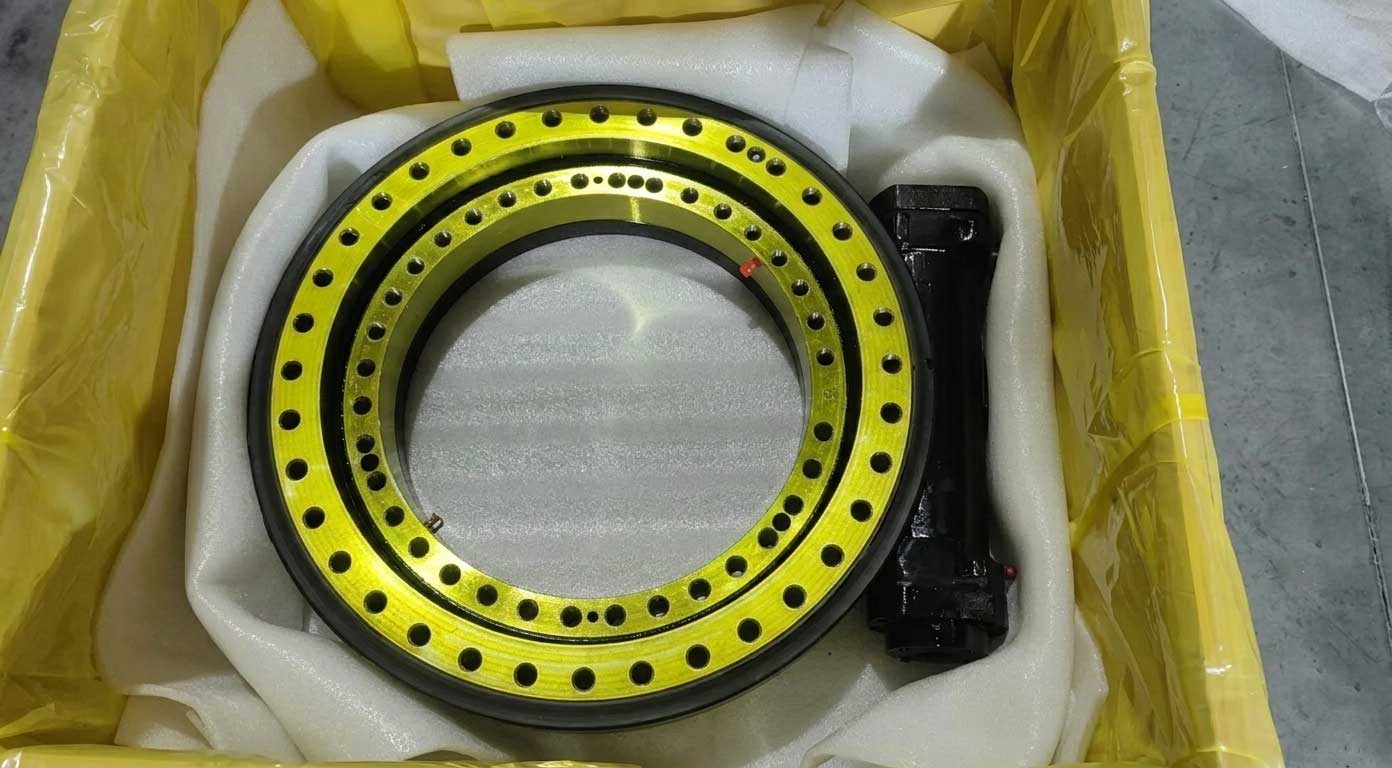
What is a slew drive? It is a compact rotation unit that combines a slewing bearing, a gear (usually a worm), a housing and a motor interface in one package. It turns a load and also carries that load's weight and overturning force. When you need a high torque slew drive, the real question is how the bearing and gear layout handle torque, tilting moment and shock together.
This article compares the main worm-drive bearing architectures for equipment designers at the specification stage. We focus on what each parameter affects and where a higher number does not mean a better fit.
What Each Key Parameter Actually Controls
Four terms come up in almost every slew drive datasheet. Reading them separately leads to wrong choices, so here is what each one drives in practice.
Output torque and torque density
Output torque is the turning force at the gear ring. Torque density is that torque relative to the drive's size and weight. A drive with higher torque density fits a tighter envelope, but it usually asks more of the housing, the mounting structure and the lubrication.
Tilting-moment capacity
Tilting moment is the overturning load from an offset weight, such as a crane boom or a platform with an off-center payload. It acts on the bearing raceways, not on the worm gear. A drive can have plenty of torque and still fail early if the bearing is undersized for the moment.
Shock resistance
Shock loads come from sudden starts, stops, wind gusts or a payload that swings. Larger rolling contact areas spread these loads better. Gear tooth contact must also survive them, so shock rating depends on both the bearing and the worm mesh.
Backlash and self-locking
Backlash is the free play between worm and gear. It matters when the load reverses or when you need tight positioning. Single worm drives are often self-locking, which holds the load without a brake. That same friction lowers efficiency, so you need a larger motor for the same output.
Specification Comparison of Worm-Drive Bearing Architectures
The table below gives general engineering tendencies for common constructions. These are qualitative ratings for comparison, not guaranteed values for any one product. Real limits depend on size, material, heat treatment and gear ratio, so always confirm against a drawing and load chart.
| Architecture | Torque density | Tilting-moment capacity | Shock resistance | Backlash | Service needs |
|---|---|---|---|---|---|
| Single worm with single-row ball bearing | Moderate | Moderate | Moderate | Low to moderate; self-locking | Lowest; periodic grease |
| Single worm with crossed roller bearing | Moderate to high | High for the envelope | Good | Low to moderate; self-locking | Low; grease and bolt checks |
| Double worm with roller bearing | High | High | Good to high | Can be set lower through the two-worm layout | Moderate; two meshes to inspect |
| Worm drive with three-row roller bearing (large or custom) | Highest in the group | Highest | High | Set by the gear stage, not the bearing | Highest; larger lubrication volume and inspection |
Three points follow from the table. First, roller raceways raise tilting-moment capacity far more than they raise gear torque. Second, backlash comes mainly from the worm mesh, so changing the bearing type will not fix a positioning problem. Third, every step up in capacity adds weight, cost and service points.
If your design sits between two rows, a customized slew drive can be sized to the actual load case instead of forcing a catalog step.
Request Your Custom Slew Drive or Bearing Spec
Tell us your load, speed, and environment — receive a tailored 100–5000 mm slewing drive or slewing bearing proposal with 3D drawings within 24 hours.
How Torque, Moment and Package Size Interact
Specification teams often check torque first and moment second. In real machines the two interact, and package size sits between them. Adding a roller bearing row increases the moment rating but also increases height and mass.
Here are the main interactions we see when reviewing designs:
- High moment, modest torque: A tall boom on a slow rotation axis. A crossed roller bearing style often gives enough moment in a compact height. A single worm may be enough for torque.
- High torque, modest moment: A flat turntable with heavy rotational inertia. Gear capacity governs, so a double worm slew drive can help, even if the bearing is not the largest option.
- High torque and high moment: Heavy cranes and mining machinery. Here three-row roller slewing bearings are the usual direction, and the package grows to match.
Self-locking also interacts with shock. A self-locking worm resists back-driving, but a sudden external load can still stress the teeth. If the machine sees wind or swinging loads, check the holding torque and consider a brake as well.
Environment changes the picture too. Our slew drives are available with protection up to IP66 and anti-corrosion ratings up to C4H, which matters for marine and desert sites. Sealing adds friction, so efficiency and motor size should be reviewed together with the sealing grade.
Common Misunderstandings and What to Verify
The most costly misunderstanding is treating "roller bearing" as a synonym for "more torque." Rollers raise load and moment capacity at the bearing. The torque the drive can deliver still depends on the worm, the gear ring, the housing and the motor. Also, ratings from different suppliers may use different safety factors, so they are not directly comparable.
Common mistakes in drive selection
- Choosing by peak torque and ignoring tilting moment at the mounting plane.
- Comparing static ratings from one supplier with dynamic ratings from another.
- Assuming self-locking removes the need for a brake in shock or vibration service.
- Specifying a very tight backlash without checking what accuracy the mounting structure can hold.
- Skipping a lubrication and service plan for the sealed housing.
What to request from a supplier
Ask for a load chart that shows axial load, radial load and moment together. Ask whether ratings are static or dynamic and what safety factor applies. Request inspection records for the gear and raceways.
On our side, every slewing bearing we build goes through CMM three-coordinate inspection and dynamic load testing. Details are on our slew drive quality control page. We work under an ISO 9001:2015 quality system, and we back drives with a 2-year extended warranty. Factory audit reports are available on request.
Worked Scenarios from Real Projects
Real orders show how these trade-offs play out. The cases below describe the stated application, not a universal rule.
- Port cranes, South Korea: A port equipment manufacturer placed a 20-unit repeat order for WEA9-62-25HR single worm slew drives. The requirements were tracking precision of 0.15° or better, IP65 sealing and self-locking. A single worm fit because holding the position without a brake was a core need.
- Forestry grapple machines, British Columbia: A forestry equipment maker ordered 30 WED14-86-25BHR.5 WED slew drives with a double worm layout and precision of 0.13° or better. Grapples reverse load often, so tighter backlash control mattered more than raw size.
- Slewing platforms, Houston, Texas: An engineering machinery manufacturer ordered 100 SEA21-125-25HR(2) units for turntable systems. Platform loads are mostly moment and inertia, so the bearing section drove the selection.
- Marine cranes, UK: Ocean Marine Systems ordered 20 WEA17-104-25H-R-REV.D units for shipboard cranes. Salt air and deck motion make sealing and corrosion protection part of the specification.
Specification Checklist Before You Request a Quote
A selection is only as good as the inputs behind it. Gather these items first, and the quote and drawing review will be faster and more accurate.
- Load case: axial, radial and tilting moment at the mounting plane, with peak values separated from steady values.
- Torque demand: starting torque, running torque and the inertia of the rotating mass.
- Duty: rotation speed, duty cycle, and the frequency of reversals or shocks.
- Accuracy: required backlash or tracking precision, and the stiffness of the mounting structure.
- Environment: temperature range, dust, water, salt exposure, and the sealing and corrosion grade needed.
- Envelope: maximum height, outer diameter and weight allowed.
- Holding needs: whether self-locking alone is enough or a brake is required.
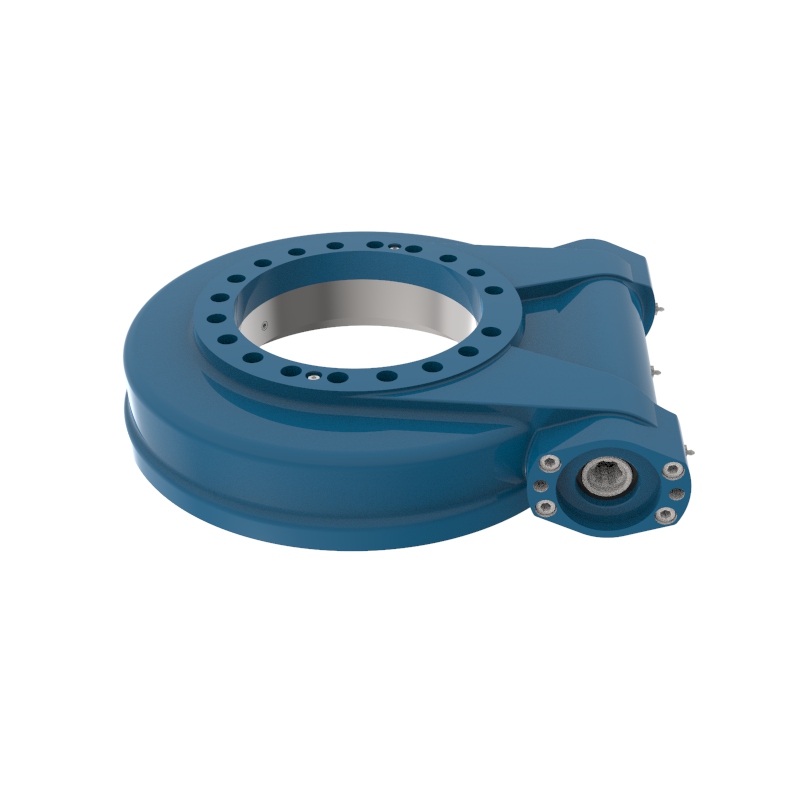
If your envelope is fixed and the load is high, the options narrow quickly. A worm gear slew drive with a roller bearing section may fit. In other cases a double worm or a custom bearing is the better route.
For standard products our minimum order is 1 set, and for customized products it is 5 sets. We return a technical proposal within 24 hours and respond to technical questions within 48 hours. Send your load case and envelope, and our engineers will tell you which architecture is worth detailed review for your high torque slew drive requirement. Our full slew drive range is a good place to start.
Request Your Custom Slew Drive or Bearing Spec
Tell us your load, speed, and environment — receive a tailored 100–5000 mm slewing drive or slewing bearing proposal with 3D drawings within 24 hours.
 WhatsApp

 +8613903880726