



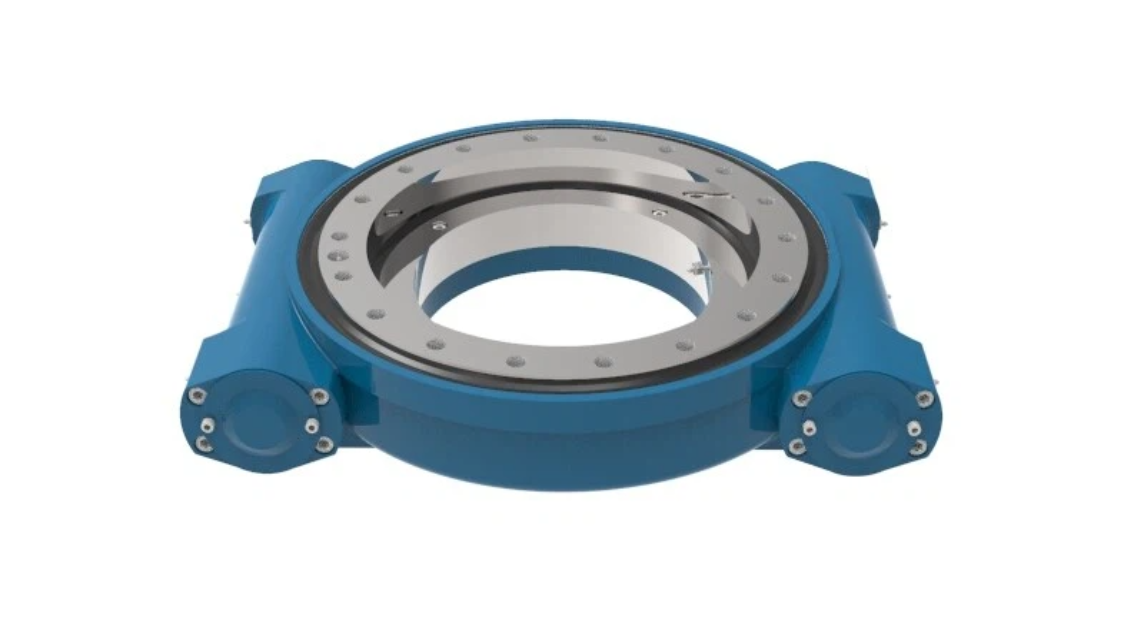
Double Worm Slew Drives: Enhancing Performance with Innovative Designs
What Are Double Worm Slew Drives?
Double worm slew drives are an advanced type of rotational drive mechanism that integrates two independent worm shafts working in conjunction with a single large worm wheel or slewing ring. Unlike traditional single worm slew drives, which rely on one point of contact to transfer torque and motion, the dual-worm configuration distributes mechanical load across two contact zones. This fundamental design difference allows double worm slew drives to achieve significantly higher torque density, enhanced load-bearing capacity, and superior operational smoothness.
These drives are specifically engineered for applications that demand both high power and high precision, such as heavy-lifting equipment, construction machinery, solar tracking systems, and wind turbine yaw controls. By effectively reducing backlash and increasing mechanical efficiency, double worm slew drives bridge the gap between brute-force rotational systems and fine positioning mechanisms. They represent a significant leap forward in slew drive technology, offering a compelling combination of strength, accuracy, and long-term reliability.
How Do Double Worm Slew Drives Work?
The operating principle of a double worm slew drive revolves around the coordinated action of two worm shafts engaging the same worm wheel. When input power—typically from a hydraulic motor or electric motor—is applied to the primary worm shaft, it rotates and drives the worm wheel. Simultaneously, the secondary worm shaft, which is mechanically synchronized or preloaded against the opposite flank of the worm wheel teeth, also engages and shares the load.
This dual engagement creates two primary benefits. First, torque capacity is effectively doubled because the input force is split between two worm shafts, reducing the load on any single gear tooth and allowing higher overall torque transmission. Second, backlash is virtually eliminated by adjusting the relative angular position of the two worm shafts, enabling them to firmly contact both sides of the worm wheel teeth. The result is a motion system with exceptional stiffness and positional accuracy, often achieving sub-arcminute precision.
Key Design Features of Double Worm Slew Drives
Double worm slew drives incorporate several innovative design elements that set them apart from traditional single worm slew drives. The table below highlights the main differences:
| Feature | Double Worm Slew Drive | Single Worm Slew Drive |
|---|---|---|
| Number of worm shafts | Two | One |
| Load distribution | Evenly distributed across two worm gears | Concentrated on a single worm gear |
| Torque capacity | Significantly higher (typically 80-100% more) | Standard (baseline) |
| Backlash / precision | Ultra-low backlash (≤1 arcmin achievable), high precision | Moderate backlash (3-5 arcmin typical) |
| Mechanical efficiency | Higher due to load sharing and reduced friction per contact | Moderate |
| Wear and tear | Reduced wear on each contact point; longer component life | Higher wear on single contact point; shorter lifespan under heavy loads |
| Durability in harsh environments | Excellent (can be enhanced with protective coatings or seals) | Good, but less robust |
| Typical applications | Heavy lifting, solar tracking, aerial platforms, wind turbines, robotics | Light to medium-duty applications, cost-sensitive projects |
In addition to the dual-worm configuration, high-quality double worm slew drives like LyraDrive's WED Slew Drive series are engineered with features such as:
Optimized housing geometry – Reduces overall weight while maintaining structural rigidity.
High-strength alloy materials – Ensure durability under cyclic and shock loads.
Preloaded bearing arrangement – Integrated bearings provide high overturning moment capacity and smooth rotation under eccentric loads.
Core Advantages of Double Worm Slew Drives
Double worm slew drives offer a range of quantifiable benefits that directly translate into improved equipment performance and lower total cost of ownership:
Enhanced load capacity – By distributing torque and radial forces across two worm shafts, the peak stress on any single gear tooth is reduced by nearly half. This allows the drive to handle static loads up to 30-50% higher than an equivalently sized single worm slew drive, with corresponding increases in dynamic torque ratings.
Improved accuracy and positioning – The dual preloaded engagement virtually eliminates backlash, enabling positioning repeatability within ±0.5 arcminute or better. For applications like solar tracking or antenna positioning, this precision directly translates into higher energy yield or signal accuracy.
Greater durability and reliability – Lower contact stress reduces the rate of wear and pitting. Mean time between failures (MTBF) for double worm slew drives is typically 2-3 times longer than single worm designs under comparable heavy-duty cycles.
Lower maintenance requirements – The robust design of double worm drives minimizes the need for frequent adjustments. Depending on the operating environment, periodic inspection and standard lubrication practices are typically sufficient to ensure long service life.
Quieter operation – The dual contact points and balanced load distribution reduce vibration and gear rattle, resulting in smoother, quieter motion. This is particularly beneficial in noise-sensitive environments such as residential solar installations or indoor material handling systems.
Compact system integration – Because double worm slew drives achieve higher torque in a smaller envelope, equipment designers can reduce overall machine footprint or free up space for other components.
Typical Applications of Double Worm Slew Drives
Double worm slew drives are highly versatile and are used across diverse industries where high torque, precision, and reliability intersect:
Solar tracking power stations – Both single-axis and dual-axis trackers rely on double worm slew drives for diurnal sun following. The ultra-low backlash ensures that photovoltaic panels or concentrated solar power (CSP) mirrors maintain optimal orientation with minimal error, increasing annual energy capture by 15-25% compared to fixed-tilt systems.
Arm rotation for crane trucks – Mobile hydraulic cranes require smooth, controlled slewing even when lifting maximum rated loads at full radius. Double worm slew drives provide the necessary holding torque and anti-backdrive characteristics, preventing uncontrolled rotation during lifting or in windy conditions.
Aerial platform chassis rotation – Boom lifts and scissor lifts use slew drives to rotate the upper platform. The high overturning moment capacity of double worm designs supports offset loads while maintaining smooth start/stop motion, enhancing operator safety and comfort.
Wind turbine yaw and pitch control – Utility-scale wind turbines use double worm slew drives to orient the nacelle into the wind (yaw) and adjust blade angles (pitch). The high reliability and fail-safe holding torque are critical for maximizing energy production while protecting the turbine from overspeed conditions.
Industrial robotics positioning – Heavy-duty robotic positioners for welding, assembly, or material handling benefit from the low backlash and high stiffness of double worm slew drives, enabling accurate indexing under varying load conditions.
Satellite and radar antenna positioning – Ground-based communication antennas require arcminute or sub-arcminute positioning accuracy. Double worm slew drives provide the necessary precision without the complexity and cost of multi-stage gearboxes.
Steering systems for heavy mobile equipment – Large agricultural sprayers, mining haulers, and port container carriers use double worm slew drives in their steering mechanisms to manage high radial and thrust loads while maintaining responsive control.
How to Choose the Right Double Worm Slew Drive for Your Application?
Selecting the appropriate double worm slew drive requires a systematic evaluation of operational, environmental, and mechanical parameters. Below are the key factors to consider:
| Selection Factor | Key Questions to Ask | Why It Matters |
|---|---|---|
| Load requirements | What are the static and dynamic axial loads, radial loads, and overturning moments? | Determines the required bearing capacity and gear strength. Overloading leads to premature failure. |
| Torque needs | What is the maximum input torque from your motor? What output torque is needed for rotation? | Matches the drive's torque rating to your power source and load inertia. |
| Precision / backlash | What is the allowable positioning error (in arcminutes or degrees)? | Solar tracking and antenna positioning often need ≤1 arcmin backlash; construction equipment may allow 3-5 arcmin. |
| Speed of rotation | What is the maximum rotational speed (rpm) required? | Higher speeds may require different lubrication and thermal management. |
| Duty cycle | How many hours per day or cycles per hour will the drive operate? | Continuous duty requires robust heat dissipation and longer-life components. |
| Environmental conditions | Will the drive be exposed to dust, rain, salt spray, extreme temperatures, or washdown chemicals? | Determine if additional protective coatings or sealing options are needed. |
| Mounting configuration | What are the bolt circle diameter, housing dimensions, and input shaft orientation? | Ensures mechanical compatibility with your existing or planned structure. |
| Input power source | Will you use a hydraulic motor, electric servo motor, or manual handwheel? | Determines the input shaft size, keyway, or coupling interface. |
| Holding / braking requirement | Does the application need to maintain position when power is off? | Double worm drives naturally resist back-driving, but some cases require an additional brake. |
| Maintenance access | Is the drive in a difficult-to-reach location? | Consider lubrication intervals and access points for inspection. |
Step-by-step selection process:
Calculate your total load – Sum the weight of the rotating structure, any live loads, and dynamic forces from wind or motion. Include a safety factor (typically 1.5–2.0).
Determine required torque – Torque = (Load moment × friction factor) / gear ratio efficiency. Consult a slew drive manufacturer's rating charts.
Specify backlash tolerance – For precise positioning, select double worm drives with preload adjustment. For general rotation, standard backlash is acceptable.
Define environmental protection – For outdoor or harsh use, discuss sealing and coating options with the supplier. For standard indoor use, basic protection may suffice.
Verify dimensional fit – Compare your available mounting space against the drive's envelope dimensions, bolt patterns, and output flange interface.
Request a custom design if needed – Standard off-the-shelf models cover many applications, but custom double worm slew drives can be engineered for unique bolt patterns, ratios, or environmental requirements.
Contact a trusted supplier – Provide your specifications to a manufacturer like LyraDrive for validation and a formal quotation.
By following this structured approach, you can avoid common pitfalls such as undersized drives (leading to premature wear) or oversized drives (adding unnecessary cost and weight).
LyraDrive: A High-Quality Supplier of Double Worm Slew Drives
LyraDrive is a professional and one-stop slewing bearing, slew drive, gear rings, and other machinery parts manufacturer in China. We specialize in providing customized, high-quality double worm slew drives tailored to meet the specific requirements of your application. Our WED Slew Drive series incorporates the latest dual-worm configuration innovations, ensuring superior performance and durability for demanding rotational applications.
If you are looking for a reliable supplier of slew drive solutions, please do not hesitate to contact us today. Our team of experts is ready to help you find the perfect rotary drive solution for your needs.
FAQ: Common Questions About Double Worm Slew Drives
Q1: What is the main difference between a double worm slew drive and a single worm slew drive?
A: A double worm slew drive uses two worm shafts to distribute load, offering 80-100% higher torque capacity, ultra-low backlash (≤1 arcmin), and better durability compared to a single worm slew drive. Single worm designs are more cost-effective for light-duty applications but cannot match the precision or heavy-load performance of double worm units.
Q2: Can double worm slew drives be used outdoors?
A: Yes, but you should discuss environmental protection with the manufacturer. While many double worm drives have robust housings, for harsh outdoor conditions (rain, salt spray, dust), additional sealing or protective coatings may be recommended. LyraDrive can advise on suitable options for your specific environment.
Q3: Are double worm slew drives self-locking?
A: Generally yes. Like all worm gear mechanisms, double worm slew drives have a natural self-locking property when the lead angle is sufficiently small. This prevents reverse rotation under load, acting as a built-in brake. However, for critical safety applications, an external brake is still recommended.
Q4: Are double worm slew drives customizable?
A: Yes. As a professional manufacturer, LyraDrive offers fully customized double worm slew drives to meet specific load, torque, precision, mounting dimensions, gear ratio, and environmental protection requirements.
Q5: What maintenance do double worm slew drives require?
A: Double worm slew drives require relatively low maintenance. Standard practices include periodic visual inspection (annually or bi-annually) for unusual noise or leakage, and regular lubrication according to the manufacturer's guidelines. The specific interval depends on duty cycle and operating conditions.
 WhatsApp
 sales@lyradrive.com
 +8613903880726