



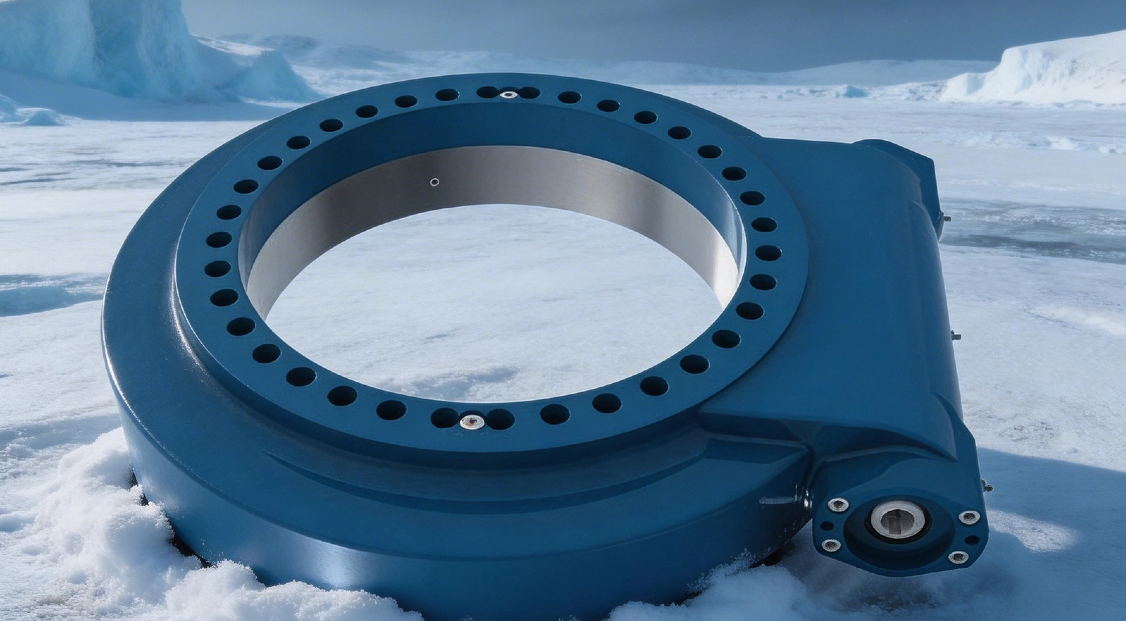
Slew Drive Applications in Extreme Cold
What is a Slew Drive?
A slew drive, also known as a slewing gearbox or rotary reducer, is a compact, high-performance mechanism designed to transmit rotational motion between two components while simultaneously supporting heavy loads. Think of it as a precision rotator that can handle immense weight and torque in a single, integrated unit.
It combines two critical elements into one housing: a slewing bearing (which handles axial loads, radial loads, and tilting moments) and a drive mechanism—typically a worm gear, but sometimes spur or helical gears. This integration is what makes slew drives so versatile and essential.
Common types of slew drives include:
orm Gear Slew Drive: The most common type, valued for its smooth operation, high reduction ratios, and self-locking capability.
Double Worm Gear Slew Drive: Offers even higher precision and near-zero backlash for demanding applications.
Spur Gear Slew Drive: Provides high efficiency and is ideal for applications requiring faster rotational speeds.
From solar trackers and crane booms to wind turbines and aerial work platforms, slew drives enable smooth, controlled rotation in countless machines worldwide.
How Does a Slew Drive Work?
The working principle of a typical worm gear slew drive is elegantly simple yet highly effective.
The Core Mechanism:
Power Input: An external hydraulic or electric motor connects to the worm shaft (the input shaft).
Gear Engagement: The rotating worm shaft, featuring a spiral thread, meshes with the teeth of the worm wheel. This worm wheel is integrated into the slewing bearing's rotating ring.
Motion Conversion: As the worm turns, it drives the worm wheel. This action converts the motor's high-speed, low-torque rotation into low-speed, high-torque rotation at the drive's output flange.
Rotation Output: The output flange then rotates the attached load—such as a solar panel array or a crane jib—with precise control.
A key feature of most worm gear slew drives is their self-locking property. Due to the friction angle between the worm and worm wheel, the drive cannot be back-driven by a force applied to the output side. This is a critical safety feature for applications like lifting equipment, ensuring the load stays in place even if power is lost.
Core Components and Design Features of Slew Drives
To appreciate their robustness, especially in harsh environments, it's helpful to understand the key components that make up a slew drive:
| Component | Function | Typical Design Features |
|---|---|---|
| Slewing Bearing | The heart of the drive, handling axial loads, radial loads, and tilting moments simultaneously. | Often a single-row or double-row ball bearing or a crossed roller bearing. The outer or inner race incorporates the main gear teeth. |
| Worm Shaft | The input component transmitting power from the motor. | Made from case-hardened alloy steel for high strength and wear resistance. Its thread is precision-ground for smooth engagement. |
| Housing | Encloses and protects all internal components, acting as a structural link. | Typically made from high-strength cast iron or steel. Provides precise mounting points for the drive and motor. |
| Sealing System | Prevents contaminants (dust, water, ice) from entering and retains lubricant. | Uses high-quality, multi-lip seals made from durable elastomers like polyurethane or FKM. |
| Lubrication | Reduces friction, dissipates heat, and protects against wear and corrosion. | High-performance grease or oil, specifically selected for the operating temperature range and load conditions. |
Essential Features of Slew Drives for Extreme Cold
When temperatures plummet, standard mechanical components face significant challenges. Materials can become brittle, lubricants thicken into a paste, and seals lose their elasticity. A slew drive intended for extreme cold environments (typically below -30°C / -22°F) must possess specific features to ensure reliable operation:
Low-Temperature Lubrication: This is the most critical factor. The drive must be filled with fully synthetic, low-temperature grease or oil that maintains its viscosity and protective properties in extreme cold, preventing metal-to-metal contact during startup.
Tough, Cold-Resistant Materials: Key components, particularly the housing and mounting bolts, must be made from steel alloys with high toughness and a low ductile-to-brittle transition temperature. Standard carbon steel can become dangerously brittle in severe cold.
Flexible Sealing Elements: Seals must be manufactured from specialized elastomers (like low-temperature FKM or silicone) that remain flexible and maintain a tight seal even when frozen. They must also accommodate different thermal contraction rates.
Enhanced Corrosion Protection: The combination of cold, moisture, and de-icing salts is highly corrosive. Enhanced surface treatments, such as phosphating or specialized paint systems, are essential for external parts.
Certified Performance: For critical applications like polar ships, the drive may need certification verifying its performance at rated loads in specified low temperatures.
Comparison: Extreme Cold vs. Standard Slew Drives
The differences between a standard drive and one engineered for extreme cold are significant. The table below highlights these key distinctions:
| Feature | Standard Slew Drive | Extreme Cold Slew Drive |
|---|---|---|
| Lubricant | Standard lithium-based grease. Can solidify in extreme cold, leading to immediate failure. | Fully synthetic, low-temperature grease (e.g., with PAO or ester base oils). Remains fluid and protective down to -50°C or lower. |
| Housing Material | Standard cast iron or structural steel. May become brittle and crack under impact at very low temperatures. | High-toughness, fine-grain steel or nodular cast iron certified for low-temperature service (e.g., with guaranteed impact values at -40°C). |
| Seals | Standard NBR (nitrile) rubber. Hardens and shrinks in extreme cold, leading to leaks. | Special low-temperature elastomers (e.g., FKM, low-temp NBR). Maintain flexibility and sealing force. |
| Surface Treatment | Basic paint coating. | Enhanced protection like phosphating or zinc-nickel plating to resist corrosion from salt and moisture. |
| Pre-Start Needs | Can often be started directly in moderate cold. | May require pre-heating in extreme cases, or is designed for immediate start with special lubricants. |
Key Application Areas for Slew Drives in Extreme Cold
The unique capabilities of cold-adapted slew drives enable critical operations in the world's most inhospitable regions.
Polar and Ice-Class Vessels
Perhaps the most demanding application is in azimuth thrusters for icebreakers and polar supply ships. These massive drives must operate submerged in freezing water, withstand impacts from ice, and provide the immense torque needed to maneuver vessels through sea ice. Their reliability is a matter of maritime safety and mission success.
Arctic and Alpine Renewable Energy
Solar power is increasingly vital in remote, cold regions. Solar tracking systems use slew drives to orient photovoltaic panels towards the low winter sun, dramatically boosting energy harvest. These drives must endure deep snow loads, icy winds, and repeated freeze-thaw cycles without jamming.
Cold-Climate Construction and Mining
In Northern Canada, Siberia, and high-altitude mines, heavy machinery like crane booms, excavators, and drill rigs rely on slew drives for rotation. These machines operate year-round where temperatures can stay below -40°C for weeks.
Aviation Ground Support
At airports in cold climate zones, aircraft deicing vehicles are essential. Their long, articulating booms are powered by slew drives, allowing operators to precisely and quickly spray deicing fluid over every part of an aircraft. Reliability is critical to minimize flight delays.
Scientific Research Infrastructure
Research stations in Antarctica and on Greenland's ice cap use rotating equipment like radar antennas, satellite dishes, and wind measurement masts. The slew drives here must function flawlessly for years in the coldest, driest conditions on Earth.
How to Choose the Right Slewing Drive for Extreme Cold Applications?
Selecting the correct slew drive for extreme cold is a critical decision that impacts safety, reliability, and operational costs. Here is a step-by-step guide to help you make the right choice.
Step 1: Define Your Environmental Parameters
Start by precisely defining the cold environment. What is the minimum sustained operating temperature? Are there rapid temperature swings? Will the drive be exposed to ice, snow, or de-icing salts? This information is the foundation of your selection. For example, a drive for an indoor Arctic research station has different needs than one mounted outside on an icebreaker deck.
Step 2: Determine Load and Performance Requirements
Calculate the maximum loads the drive will experience: axial load, radial load, and tilting moment torque. Also, define the required output torque, rotational speed, duty cycle, and precision (backlash requirements). This determines the necessary size, gear ratio, and drive type (worm, double worm, or spur gear).
Step 3: Scrutinize the Lubrication System
This is non-negotiable. Ask the manufacturer for the lubricant's technical data sheet. Verify its low-temperature performance, specifically the pour point and low-temperature starting torque. Ensure the lubricant is specified for at least 5-10°C below your lowest expected temperature to provide a safety margin.
Step 4: Verify Material and Component Suitability
Request material certifications for critical components, especially the housing. Look for guaranteed impact toughness values (like Charpy V-notch tests) at your minimum design temperature. Ask for confirmation that seals are made from low-temperature-grade elastomers and have been tested for flexibility at extreme cold.
Step 5: Assess the Manufacturer's Experience and Support
Choose a manufacturer with proven experience in extreme cold applications. Ask for case studies or references. Inquire about their ability to perform custom testing, such as running the drive under load in a cold chamber. Also, consider long-term support: how will you perform maintenance or get spare parts for a site in a remote, cold region?
LyraDrive: Your Partner for High-Quality, Extreme-Cold Slew Drives
At LyraDrive, we understand that reliable rotation is the foundation of your equipment's performance, no matter the environment. As a specialized manufacturer of slew drives and slewing bearings, we are committed to providing engineering excellence tailored to your specific needs.
Our extensive product portfolio includes a wide variety of drive types to suit diverse applications:
Worm Gear Slew Drives: Our core product, offering excellent self-locking, smooth operation, and high reduction ratios in a compact form.
Double Worm Gear Slew Drives: Designed for applications requiring even higher precision, zero backlash, and increased torque capacity.
Spur Gear Slew Drives: Ideal for high-speed positioning and applications where high efficiency is paramount.
While we produce high-quality drives for general industrial applications across all climate zones, we have a special focus on engineering solutions for the most challenging environments. We work closely with our clients to provide customized slew drives for extreme cold applications, whether for polar maritime projects, high-altitude solar farms, or Arctic construction machinery.
Our drives for extreme cold feature:
Selected Low-Temperature Materials: We source steels with guaranteed impact toughness at -40°C and below.
High-Performance Synthetic Lubrication: We fill our drives with premium, cold-resistant greases that ensure immediate lubrication and protection upon startup.
Robust Sealing Systems: We utilize advanced seal technologies and materials designed to remain flexible and effective in deep freeze conditions.
Rigorous Testing: Where required, we can validate drive performance under simulated cold conditions.
With LyraDrive, you gain more than just a component; you gain a partner dedicated to ensuring your products perform exceptionally, even when facing the harshest winter challenges.
FAQ of Slew Drive Applications in Extreme Cold
Q1: What is the most common cause of slew drive failure in extreme cold?
A: The most immediate and common cause is lubricant failure. Standard grease turns solid, preventing lubrication and causing high start-up torque, excessive wear, and potential seizure. Using the correct synthetic low-temperature lubricant is the most critical preventive measure.
Q2: Can a standard slew drive be used outdoors in a cold climate?
A: For occasional, light-duty use just below freezing, a standard drive might survive. However, for reliable, long-term operation in consistent sub-zero temperatures (below -20°C), a drive specifically engineered for extreme cold is essential to prevent failure and costly downtime.
Q3: How should I maintain a slew drive in winter conditions?
A: Key winter maintenance includes:
1) Regular visual inspection of seals for hardening or damage.
2) Checking for ice buildup around the gear mesh and carefully removing it.
3) Avoiding high-pressure washing with water, which can force moisture past seals.
4) Following the manufacturer's lubrication schedule using only the specified low-temperature grease.
The reference article also suggests checking lubrication every 100 operating hours and before/after long idle periods.
Q4: How do I know if the seals are suitable for extreme cold?
A: You must ask the manufacturer. Standard NBR rubber seals are generally not suitable. Look for drives specifying seals made from low-temperature grades of FKM, silicone, or specially formulated low-temperature NBR. The seal material should be confirmed for use at your minimum expected temperature.
Q5: Is self-locking affected by extreme cold?
A: The self-locking property itself (based on gear geometry) is not diminished by cold. However, increased resistance from solidified grease or ice could, in theory, make it harder to start rotation. More importantly, thermal contraction could slightly affect gear mesh, but proper design accounts for this. Always consult the manufacturer for torque requirements at low temperatures.
 WhatsApp
 sales@lyradrive.com
 +8613903880726