



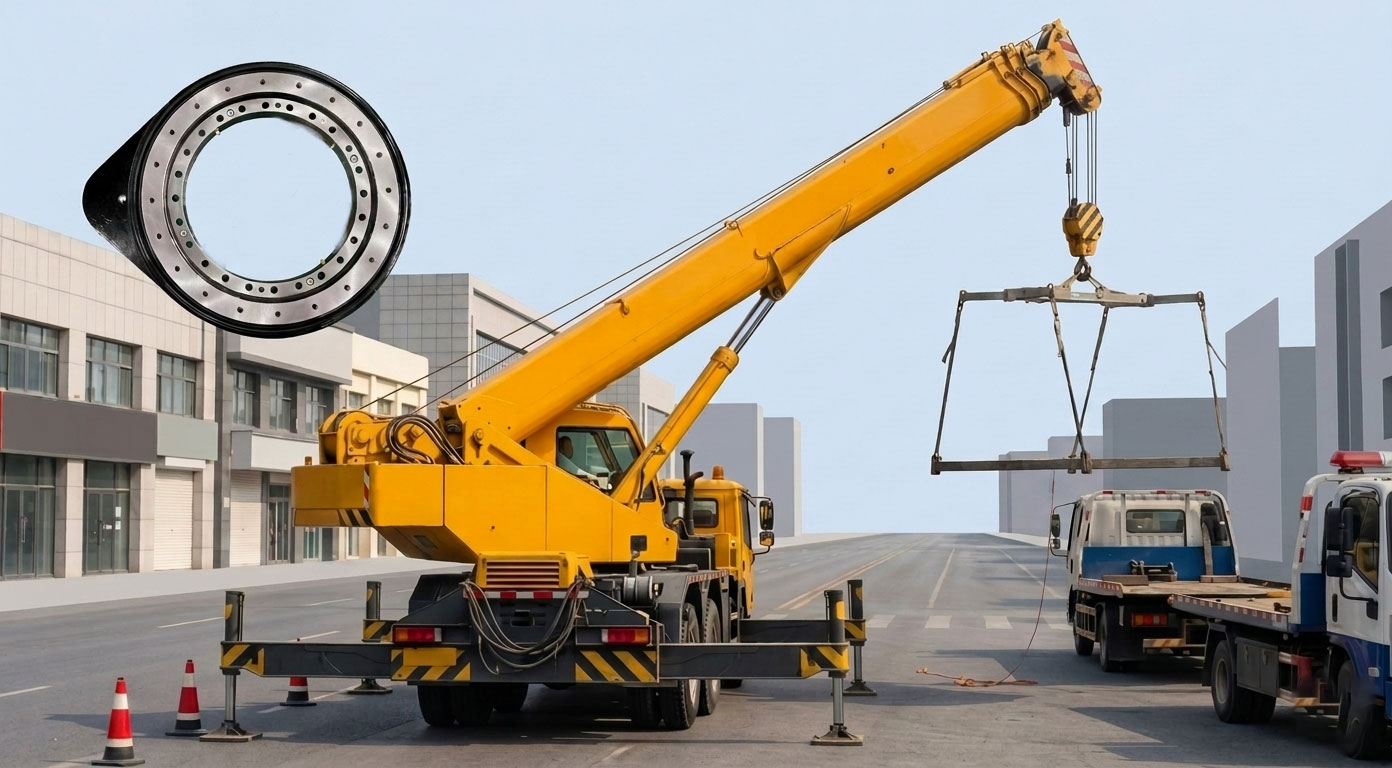
Spur Gear Slew Drive for Car Cranes
What Is a Spur Gear Slew Drive for a Car Crane?
A spur gear slew drive is a rotational power transmission device designed to handle heavy loads while enabling controlled rotary motion. In the context of a car crane—also known as a truck-mounted crane—this component sits between the crane's upper structure (the boom and cab) and the lower carrier (the truck chassis), allowing the crane to swing left and right.
The spur gear slew drive typically consists of a large-diameter spur gear (often integrated with a slewing bearing), a hardened pinion (input gear), a housing, and precision bearings. Unlike worm gear designs, the spur gear drive uses straight-cut teeth with the pinion axis parallel to the gear axis. This simple geometry delivers high efficiency and reliable performance for applications where rotational speed and frequent slewing are required.
For car cranes, the spur gear slew drive must withstand not only heavy vertical loads from the lifted load but also significant tilting moments and radial forces during boom extension and rotation. Its design prioritizes rigidity, durability, and smooth motion—critical for safe lifting operations.
Key Features of Spur Gear Slew Drives
Spur gear slew drives offer a distinct set of engineering features that make them well-suited for car crane applications:
High rotational efficiency – Typically 90–95% efficiency, far exceeding worm gear alternatives. This means less power loss, lower hydraulic or electric motor requirements, and reduced energy consumption during crane operation.
Compact axial height – The spur gear arrangement allows a low-profile design, which helps keep the crane's center of gravity low—improving vehicle stability during travel and lifting.
Zero or minimal backlash options – Precision-ground spur gears can achieve very low backlash, which enhances positioning accuracy when placing heavy loads.
High shock load tolerance – The large tooth contact area and through-hardened materials make spur gear slew drives resistant to sudden impact loads common in rough-terrain lifting.
Flexible input mounting – Hydraulic motors, electric motors, or even manual drives can be directly flanged to the input pinion shaft.
Sealing systems – Multi-lip rotary seals protect the internal gear and bearing from dust, mud, and moisture—critical for outdoor crane environments.
These features translate directly into real-world benefits: faster cycle times, lower fuel consumption, and more precise load placement.
How Does a Spur Gear Slew Drive Work in Car Cranes?
In a car crane, the spur gear slew drive converts input torque from a prime mover (usually a hydraulic motor) into controlled rotational motion of the crane's upper structure.
Here is the step-by-step working principle as applied in a car crane:
Step 1 – Input power generation
The crane operator actuates the slew control lever. A hydraulic pump sends pressurized oil to the hydraulic motor mounted on the slew drive's input pinion shaft.
Step 2 – Pinion rotation
The hydraulic motor rotates the hardened steel pinion. The pinion is mounted on high-capacity bearings inside the drive housing.
Step 3 – Gear engagement
The pinion meshes directly with the large internal or external spur gear ring. Because spur gears have teeth cut parallel to the axis of rotation, the entire tooth length engages simultaneously. This produces a smooth, continuous driving force without axial thrust loads.
Step 4 – Upper structure rotation
The large spur gear is bolted to either the moving or stationary part of the crane (depending on design). As the pinion turns, the gear ring rotates, carrying the crane's cab, boom, and lifted load with it. Typical car crane slew speeds range from 0.5 to 2 RPM.
Step 5 – Braking and holding
When the operator releases the slew control, a hydraulic or mechanical brake engages (usually on the motor or pinion shaft) to hold the crane's position against any unbalanced load moment.
Step 6 – Load moment management
The spur gear slew drive's internal bearing system—often a four-point contact ball bearing or crossed roller bearing—simultaneously manages vertical load, radial load, and tilting moment from the extended boom. The spur gear itself transmits only torque; the bearing handles all structural loads.
In modern car cranes, electronic slew controllers can modulate hydraulic flow to achieve smooth acceleration and deceleration, preventing load swing and improving operator safety.
Spur Gear vs. Worm Gear Slew Drive: A Technical Comparison
When selecting a slew drive for a car crane, two common mechanical designs come into consideration: the spur gear slew drive and the worm gear slew drive. Each has its own engineering characteristics, and understanding the differences is essential before deciding which fits a given application.
The table below provides a direct side‑by‑side comparison across key technical parameters.
| Parameter | Spur Gear Slew Drive | Worm Gear Slew Drive |
|---|---|---|
| Efficiency (typical) | 90–95% | 50–85% (higher at low ratios) |
| Self‑locking capability | No (requires external brake) | Yes (self‑locking with high ratio) |
| Maximum input speed | Up to 3000 RPM | Typically under 1500 RPM |
| Heat generation | Low | Moderate to high (due to sliding friction) |
| Backlash | Can be reduced to near‑zero | Inherently higher due to sliding contact |
| Tooth contact | Rolling contact | Sliding + rolling contact |
| Wear rate | Low (with proper lubrication) | Higher (depends on bronze worm wheel material) |
| Axial thrust | None | High (requires thrust bearings) |
| Noise level | Moderate (characteristic gear whine) | Low (quiet operation) |
| Cost for same torque rating | Generally lower | Higher (complex manufacturing, bronze wheels) |
Beyond the numbers, several fundamental engineering trade‑offs separate the two designs.
A worm gear slew drive achieves its self‑locking characteristic through a high reduction ratio and the friction between the worm and the worm wheel. This makes it attractive for applications where holding position without a brake is a priority, and where rotational speeds remain low. However, that same friction generates heat, limits duty cycles, and reduces overall efficiency. The worm wheel is typically made of bronze—an excellent material for sliding contact but expensive and subject to wear over time.
A spur gear slew drive, in contrast, operates primarily through rolling contact. The pinion and the large spur gear engage with minimal sliding friction, which is why efficiency stays high and heat buildup remains low. This design accepts higher input speeds and delivers smoother motion at faster slew rates. The trade‑off is that a spur gear slew drive offers no self‑locking capability; any holding function must come from a separate brake system.
Neither design is universally superior. The choice depends entirely on the operating profile—whether the priority is low‑speed holding, quiet operation, or high‑efficiency frequent slewing.
Why Spur Gear Slew Drive Is the Better Choice for Car Cranes
Now applying the technical comparison to the specific demands of car cranes, the spur gear slew drive clearly offers decisive advantages for most mobile lifting scenarios.
Reason 1 – Frequent slewing demands high efficiency
Car cranes often perform dozens or hundreds of slew cycles per shift—positioning loads, swinging to the truck bed, and rotating back. A worm gear slew drive would waste significant energy as heat in such a duty cycle. The spur gear's 90–95% efficiency means lower hydraulic power requirements, reduced fuel consumption, and cooler operation over long shifts.
Reason 2 – Higher slew speed improves productivity
Car crane operators value fast cycle times. Spur gear drives can comfortably achieve 1.5–2 RPM slew speeds, while worm drives with self-locking ratios are often limited to 0.5–1 RPM. The difference directly affects jobsite productivity.
Reason 3 – No heat-related duty cycle limitations
Worm gear slew drives generate substantial heat under continuous slewing. Many require cooling periods or reduced load after extended use. Spur gear drives, operating primarily with rolling contact friction, can run continuously without thermal derating—critical for intensive applications like scrap handling or concrete placement.
Reason 4 – Easier integration with hydraulic and electric drives
The spur gear's ability to accept higher input speeds allows direct connection to standard hydraulic motors (1000–2500 RPM) without a gear reduction stage. Worm drives often require additional speed reduction, adding cost and complexity.
Reason 5 – Lower total cost of ownership
While both designs require proper lubrication, spur gear drives have simpler manufacturing, widely available components, and predictable wear patterns. The absence of expensive bronze worm wheels also reduces replacement costs. For fleet operators maintaining multiple cranes, these savings add up.
The one trade-off to manage – Spur gear slew drives are not self-locking. Car cranes using them must incorporate a reliable brake system (hydraulic motor brake, disc brake, or spring-applied brake). This is standard practice in modern crane design and adds minimal cost compared to the performance gains.
For car crane applications—especially those with high duty cycles, productivity demands, and fuel cost sensitivity—the spur gear slew drive is the superior engineering choice.
Installation & Maintenance Best Practices
Proper installation and maintenance directly determine the service life and reliability of a spur gear slew drive in a car crane.
Installation Guidelines
Step 1 – Mounting surface preparation
The mounting surfaces on both the upper structure and carrier must be flat, clean, and free of burrs. Flatness should be within 0.1 mm per meter (0.004 in/ft) to prevent housing distortion.
Step 2 – Bolt selection and torquing
Use property class 10.9 or 12.9 bolts. Tighten in a star pattern to the torque specified by the slew drive manufacturer. Under-torquing leads to loosening under vibration; over-torquing can distort the gear housing.
Step 3 – Pinion alignment
The pinion and gear ring must have proper backlash (typically 0.1–0.3 mm) and tooth contact pattern. Use feeler gauges or dial indicators during alignment.
Step 4 – Hydraulic motor connection
Ensure the motor shaft and pinion bore are clean. Use flexible couplings if specified to avoid side loading on the pinion bearings.
Step 5 – Lubrication fill
Fill with the recommended grease or oil (often NLGI #2 lithium-based grease for spur gear slew drives). Do not over-grease, which causes overheating and seal damage.
Maintenance Best Practices
Regular inspection schedule (every 500 operating hours or monthly):
Check for abnormal noise (grinding, clicking) during rotation—indicates gear wear or bearing damage
Inspect seals for leakage; clean around the seal lip
Re-torque mounting bolts (many manufacturers recommend at 100 hours, then every 1000 hours)
Check backlash if positioning accuracy has degraded
Lubrication interval:
Grease-lubricated units: Regrease every 200–500 hours, or as specified. Pump new grease until old grease exits the relief valve.
Oil-lubricated units: Check oil level monthly; change every 2000 hours or annually.
Wear limits:
If backlash exceeds 0.5 mm (0.020 in), the gear set may need replacement.
Visible pitting or spalling on teeth means immediate replacement is required.
Common installation mistakes to avoid:
Using bolts that are too short (insufficient thread engagement)
Ignoring mounting surface flatness (causes housing cracking)
Mixing different grease types (incompatibility can cause thickening or separation)
Following these practices will typically yield 8–10 years of service life from a quality spur gear slew drive in car crane duty.
LyraDrive: Your Reliable Supplier of Spur Gear Slew Drives for Car Cranes
LyraDrive is a professional one-stop slewing device manufacturer majored in design and development, customized production, sales and service on slew drives and slewing bearings.
Lyradrive provides high quality and customized slew drives, slewing bearings and gear rings for truck crane, excavator, manlift and other applications. Each spur gear slew drive for car cranes is engineered with case-hardened and ground gearing, high-capacity bearings, and rugged sealing systems to withstand demanding mobile lifting environments.
Beyond standard catalog products, LyraDrive offers engineering support for custom bolt patterns, gear ratios, input shaft configurations, and corrosion protection packages. Whether you are retrofitting an existing crane or designing a new model, LyraDrive can deliver slewing solutions matched to your specific load, speed, and duty cycle requirements.
If you are looking for a slew drive supplier or need technical support, feel free to contact LyraDrive.
Frequently Asked Questions (FAQ)
Q1: Can I replace a worm gear slew drive directly with a spur gear slew drive on my existing car crane?
Not usually without modification. The two designs have different mounting dimensions, input speed requirements, and—most importantly—spur gear drives lack self-locking capability. You will need to add or upgrade the crane's braking system, modify mounting interfaces, and potentially change the hydraulic motor to match the spur gear's higher input speed capability. Consult with a supplier like LyraDrive for a retrofit engineering review.
Q2: Does a spur gear slew drive need a brake, or can it hold position by itself?
A spur gear slew drive cannot hold position on its own. Unlike a worm gear slew drive with a high ratio, spur gears are back-drivable—meaning a load moment can reverse-drive the pinion. Every car crane using a spur gear slew drive must include a separate holding brake, typically on the hydraulic motor, gearbox input shaft, or a disc brake on the slewing ring itself.
Q3: How often should I lubricate a spur gear slew drive on a car crane?
For grease-lubricated units operating in standard construction environments, regrease every 200–500 working hours. For harsh conditions (high dust, water exposure, extreme temperatures), reduce the interval to 100 hours. Always use the manufacturer-recommended grease type—mixing incompatible greases can cause thickening, channeling, and premature gear wear.
Q4: What is the typical service life of a spur gear slew drive in car crane use?
With proper installation, regular lubrication, and bolt torque checks, a quality spur gear slew drive typically lasts 8–10 years or 8,000–10,000 operating hours in standard car crane duty. Heavier service (continuous full-load slewing, shock loading) may reduce this to 5–6 years. The gear teeth and bearings are usually the first components to show wear; both are repairable or replaceable in well-designed units.
 WhatsApp
 sales@lyradrive.com
 +8613903880726