



Worm Gear vs. Spur Gear Slewing Drives: Similarities and Key Differences
Introduction
In heavy machinery, precision tracking systems, and aerial work platforms, converting power into stable, reliable, and controlled rotational motion is a fundamental engineering challenge. Worm gear slewing drives and spur gear slewing drives have emerged as two pimary, integrated solutions that power our modern world. From ensuring wind turbines yaw accurately into the wind to enabling solar trackers to follow the sun, and giving excavators and cranes their smooth rotation, these drives are indispensable across energy, construction, and automation. Understanding their core similarities and critical differences is the first step to selecting the optimal drive for your application.
What is a Worm Gear Slewing Drive?
A Worm Gear Slewing Drive is an integrated drive module that utilizes a worm gear set (worm and worm wheel) as its core transmission mechanism. The key to its operation lies in the interaction between the input worm shaft and the large worm wheel. When the worm shaft is rotated by a motor, it drives the worm wheel with a very high single-stage reduction ratio (often equal to the number of teeth on the wheel). This design inherently provides a self-locking feature due to the high friction angle in the gear mesh, meaning the output load cannot back-drive the input worm. This makes it exceptionally safe for holding positions. The entire system—worm gear set, large slewing bearing, seals, and housing—is combined into one compact, ready-to-install unit designed for high torque at low speeds.
What is a Spur Gear Slewing Drive?
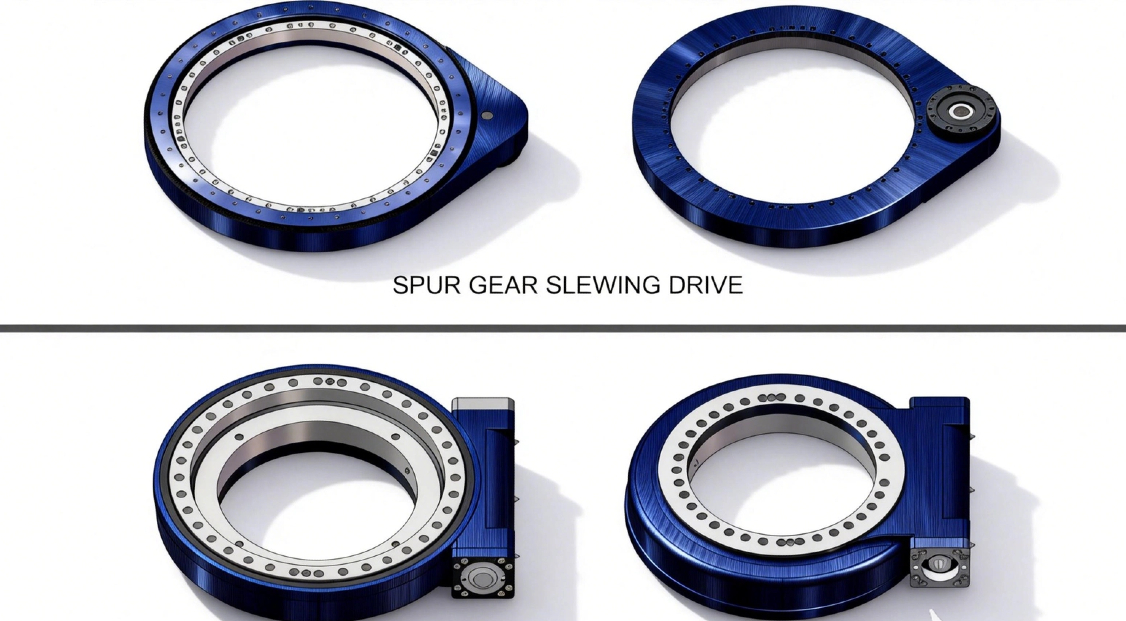
A Spur Gear Slewing Drive employs a parallel-axis gear set (a pinion and a large gear ring) for its primary drive. The motor-driven pinion meshes directly with the gear ring attached to the slewing bearing, causing rotation. Unlike worm gears, this spur gear interaction is highly efficient, with minimal energy loss, but it does not offer inherent self-locking. This allows for bidirectional power transmission. Its reduction ratio is smaller (gear ring teeth divided by pinion teeth) and is more suited for applications requiring higher rotational speeds and operational efficiency. Like its worm gear counterpart, it is a fully integrated module combining gears, bearings, and structure.
What are the similarities between them?
Despite different operating principles, worm gear and spur gear slewing drives share fundamental commonalities that define their utility:
Modular, Integrated Design: Both are "ready-to-mount" units that combine gearing, bearings, and structure, simplifying design, installation, and maintenance.
Core Load-Bearing Element: A high-performance slewing bearing is central to both designs, providing the capacity to handle combined axial, radial, and moment loads.
Primary Function: Their core purpose is to deliver controlled 360-degree rotation with speed reduction, torque multiplication, and heavy-load support.
Environmental Robustness: They are typically equipped with effective sealing for dust and water resistance, ensuring reliability in harsh conditions.
Space Efficiency: The compact, all-in-one design saves critical space in the host machinery.
What are the differences between them?
| Comparison Aspect | Worm Gear Slewing Drive | Spur Gear Slewing Drive |
|---|---|---|
| Core Principle | Sliding contact between worm and wheel. | Rolling contact between meshing gear teeth. |
| Transmission Efficiency | Relatively Low (30% - 45%). Higher energy consumption. | Very High (90% - 95%). Energy efficient. |
| Reduction Ratio | Very High in a single stage. | Moderate. High ratios may require complex designs. |
| Self-Locking | Inherently self-locking. Safe for static load holding. | Not self-locking. Requires an external brake. |
| Operational Speed | Low speed (typically ≤ 2-5 RPM). Prone to overheating at high speed. | High speed capable (often 40-60 RPM). |
| Precision & Backlash | Higher inherent backlash. Difficult to achieve high precision. | Can achieve high precision and low backlash (<0.01°). |
| Key Advantages | High ratio, self-locking, compact, right-angle input/output. | High efficiency, high speed, high precision, long life. |
| Key Limitations | Lower efficiency, heat generation, speed limits. | No self-lock, needs brake, complex for high ratios. |
The Application Fields
Based on their distinct characteristics, each drive type excels in different applications:
Typical Applications for Worm Gear Slewing Drives:
Safety-Critical, Static-Holding: Aerial work platforms, crane boom rotation, where self-locking ensures safety if power fails.
Low-Speed, High-Torque, High-Ratio: Solar trackers (single/dual axis), small wind turbine yaw systems.
Right-Angle Drive Configurations: The 90° input/output shaft orientation benefits specific mechanical layouts.
Typical Applications for Spur Gear Slewing Drives:
High-Efficiency, Continuous/High-Speed Operation: Rotary conveyors, large mixers, display turntables.
Precision Positioning & Control: Radar antennas, satellite communication dishes, high-end welding positioners.
Heavy-Duty Rotation without Self-Lock Requirement: Slewing mechanism for portal cranes, upper structure rotation for excavators.
The Advantages of Custom Slewing Drives
While standard drives meet general needs, customization unlocks full potential for advanced machinery. The benefits are clear:
Performance Optimization: Tailored design based on exact load spectra, speed profiles, and space constraints for optimal size-to-performance ratio.
Enhanced Reliability: Use of special materials, seals, and heat treatment for extreme conditions (temperature, corrosion, shock loads) extends service life.
Seamless Integration: Customized mounting flanges, interfaces, and features (e.g., integrated encoders) simplify final assembly into the host system.
Total Cost of Ownership (TCO): Although initial cost may be higher, superior efficiency, longer maintenance intervals, and lower failure rates lead to a better TCO.
LyraDrive: Your Partner for Customized Slewing Solutions
As a specialized manufacturer of high-precision slewing drives and slewing bearings, we understand that an outstanding slewing drive begins with a flawless bearing core. At LyraDrive, we go beyond supplying standard components. We partner with our clients to provide comprehensive technical support, from core bearing supply to complete drive solution consultation. Our precision slewing rings feature ultra-smooth ground raceways and high-accuracy hardened gear teeth (for worm or spur configurations), ensuring a stable, quiet, and robust rotational foundation for any drive system.
When you partner with LyraDrive, you gain:
Collaborative Engineering: Our engineers work alongside your team from the early design phase to ensure the slewing bearing parameters (gear specs, clearance, sealing) perfectly match your drive requirements and operating conditions.
Manufacturing Excellence: Stringent quality control across the entire process—from forging and heat treatment to precision machining—guarantees superior load capacity and durability.
Flexible Customization Capability: We respond swiftly to requests for special sizes, non-standard gear profiles, or unique mounting designs, providing the most cost-effective custom solutions.
On the path to choosing between worm and spur gear drives, let LyraDrive be your reliable foundation. We provide the professional core components to help your equipment achieve more stable, efficient, and enduring rotation.
 WhatsApp
 sales@lyradrive.com
 +8613903880726