



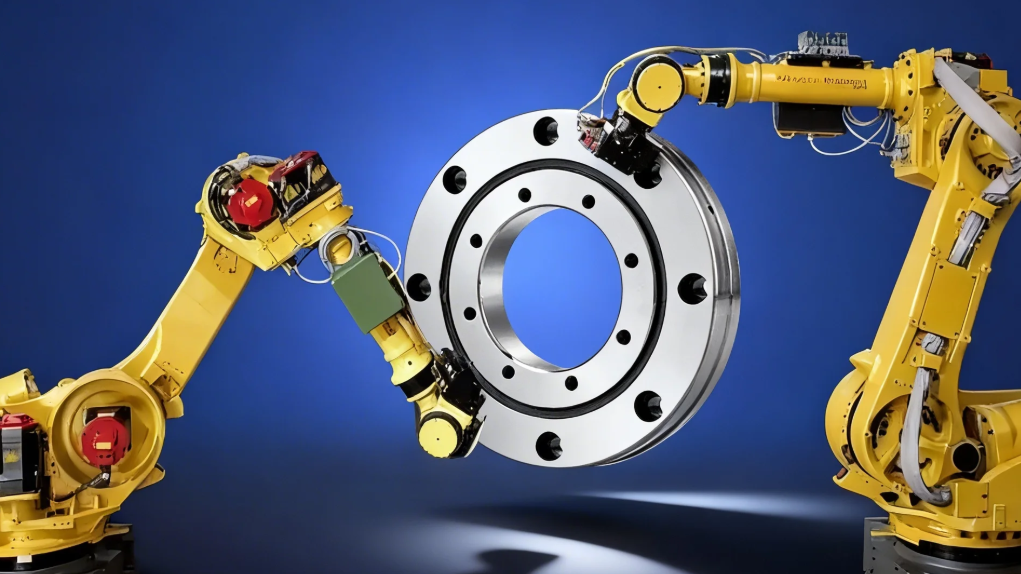
Where Are Slewing Bearings Used?
What Are Slewing Bearings?
Unlike standard bearings that primarily facilitate rotation between shafts and housings, slewing bearings are integral structural components. They are large-diameter bearings designed to handle complex combinations of loads—axial (thrust), radial, and tilting moment (overturning)—simultaneously while enabling precise, continuous, or intermittent rotation. Think of them as the robust "joint" or "turntable" that serves as the foundation for a machine's rotating superstructure. They often incorporate gear teeth (internal or external) directly on their rings, transforming them into all-in-one mechanical elements that bear load, facilitate rotation, and transmit torque.
How Do Slewing Bearings Work?
The core principle lies in the interaction between rolling elements (balls or rollers), raceways, and the gear teeth. The bearing's inner and outer rings are fixed to the stationary and rotating structures of the machine, respectively. The rolling elements, housed within the raceways, carry the massive loads by distributing them evenly. When rotation is required, a drive pinion (a small gear) engages with the gear teeth machined onto the bearing's ring. As the pinion turns, it drives the entire attached structure—be it a crane boom or a wind turbine nacelle—to rotate smoothly on the bearing's axis. This integrated design combines support, rotation, and drive into a single, compact, and highly efficient unit.
Main Types of Slewing Bearings
Choosing the right type is fundamental to performance and longevity. The primary classifications are based on rolling element arrangement and load capacity:
Single-Row Four-Point Contact Ball Bearings: The most compact and common type. A single row of balls can handle combined axial, radial, and moment loads from any direction. Ideal for applications with moderate loads but significant space constraints, such as smaller cranes and robotics.
Double-Row Ball Bearings: Featuring two independent rows of balls, this type offers significantly higher load capacity, especially for tilting moments, and greater rigidity than single-row designs. It's a versatile choice for many mobile cranes and material handling equipment.
Crossed Roller Bearings: Here, cylindrical rollers are arranged crosswise in a single row. This design provides extremely high precision, rigidity, and compactness under high overturning moments, making it perfect for machine tool turntables, industrial robots, and medical imaging equipment.
Three-Row Roller Bearings: The heavyweight champion for the most demanding applications. With separate rows of rollers dedicated to handling different load types (axial and radial), this design offers the ultimate in load capacity and stability. It is essential for massive equipment like heavy-duty mining excavators and large portal cranes.
Key Applications: Where Are Slewing Bearings Used?
Slewing bearings are fundamental components across industries where controlled rotation under significant load is paramount. Their applications can be systematically categorized by sector, each presenting unique engineering challenges that demand specialized bearing solutions.
4.1 Renewable Energy & Power Generation
This sector demands maximum reliability under harsh environmental conditions and complex, variable loads.
4.1.1 Wind Turbines
Yaw Bearings: Positioned between the tower and nacelle, these bearings rotate the entire nacelle to face the wind. They must withstand enormous tilting moments from wind loads and the nacelle's weight, while maintaining precise control for optimal energy capture. High corrosion resistance is critical.
Pitch Bearings: Located at the root of each blade, they adjust the blade's angle to regulate power output and manage loads. They operate under extreme bending moments and dynamic forces, requiring exceptional fatigue life and reliability, as failure can be catastrophic.
4.1.2 Solar Tracking Systems
Used in both single-axis and dual-axis solar trackers to orient photovoltaic panels toward the sun throughout the day. These bearings prioritize cost-effectiveness, low-friction operation for minimal drive power, and durability against dust, moisture, and temperature cycles.
4.2 Construction, Mining & Heavy Machinery
Here, slewing bearings are subjected to severe shock loads, contamination, and continuous high-stress cycles.
4.2.1 Earthmoving Equipment
Excavators: The slewing bearing is the machine's core, connecting the undercarriage and house. It handles extreme dynamic loads from digging and lifting, combined with shock loads. Robustness, high moment capacity, and effective sealing against dirt and debris are essential.
Other Equipment: Wheel loaders, telescopic handlers, and dredgers rely on similar heavy-duty bearings for superstructure rotation.
4.2.2 Lifting Equipment
Mobile Cranes/Truck-Mounted Cranes: The slewing bearing enables 360-degree rotation of the boom. Load capacity must accommodate both the lifted load's moment and dynamic forces from swinging. Compact design is often necessary to fit within the vehicle's footprint.
Tower Cranes: The bearing at the top of the tower (slewing ring) allows the jib to rotate. It is characterized by very large diameters and must handle immense cantilevered loads with high precision for safe material placement.
4.2.3 Mining Machinery
Bucket-Wheel Excavators & Stacker/Reclaimers: These continuous mining and bulk material handling machines use ultra-large diameter slewing bearings to support and rotate their massive booms, often under abrasive and dusty conditions.
4.3 Industrial Automation & Precision Machinery
Applications in this field emphasize accuracy, rigidity, and smooth motion over sheer load capacity.
4.3.1 Machine Tools & Indexing Tables
Used in CNC rotary tables, machining centers, and indexing fixtures. Crossed roller bearings are predominant due to their excellent rigidity, precise rotational accuracy (low runout), and compact cross-section, which is crucial for high-precision milling and turning operations.
4.3.2 Robotic Systems
Found in the base joints of heavy-duty industrial robots or in turntables for welding and assembly stations. They require a combination of precise motion control, compact design, and the ability to handle moment loads from the robot arm's extended reach.
4.3.3 Material Handling Turntables
Used in assembly lines, packaging, and sorting systems to rotate workpieces or pallets. Requirements often focus on smooth operation, reliability for high cycle counts, and customization to the specific platform design.
4.4 Aerospace, Defense & Maritime
These high-stakes applications prioritize performance, reliability, and often, operation in specialized environments.
4.4.1 Radar & Surveillance Systems
Slewing bearings provide the rotation for ground-based, naval, and airborne radar antennas. They must ensure exceptionally smooth and precise rotation at variable speeds for accurate tracking, often incorporating special materials or designs for low magnetic signature.
4.4.2 Missile Launchers & Weapon Systems
Require bearings with very high stiffness, rapid acceleration capability, and extreme reliability under demanding conditions.
4.4.3 Marine & Offshore Equipment
Applications include deck cranes, winches, and propulsion systems like azimuth thrusters. Bearings must have superior corrosion protection (e.g., seawater-grade coatings) and handle loads from vessel motion.
Table: Application-Specific Slewing Bearing Requirements
| Application | Primary Load Type | Key Requirements | Typical Bearing Type |
|---|---|---|---|
| Wind Turbine (Yaw) | High Tilting Moment | Ultimate reliability, corrosion resistance, large diameter | Double-Row Ball or Three-Row Roller |
| Excavator | Dynamic Shock Loads | Extreme robustness, high moment capacity, superior sealing | Three-Row Roller |
| Mobile Crane | Combined (Moment + Radial) | High load capacity, compact design, good stiffness | Double-Row Ball |
| CNC Rotary Table | Light-Moderate Moment | High precision, rigidity, low cross-section | Crossed Roller |
| Radar Pedestal | Light/Moderate, Dynamic | Ultra-smooth rotation, precise control, special environments | Single/Double-Row Ball (High Precision) |
Key Factors in Choosing a Slewing Bearing
Selecting the optimal slewing bearing is a multi-parameter engineering decision. A thorough analysis of all factors below is crucial for ensuring performance, longevity, and safety.
5.1 Load Analysis: The Foundation of Selection
Accurate load characterization is the first and most critical step.
5.1.1 Types of Loads:
Axial Load (Fa): Acts parallel to the axis of rotation (thrust).
Radial Load (Fr): Acts perpendicular to the axis.
Tilting Moment (M): A turning force that attempts to overturn the bearing. This is often the dominant load.
5.1.2 Load Conditions:
Static vs. Dynamic: Are the loads constant or do they vary during operation?
Load Spectrum: Define the magnitude, direction, and frequency of all loads over a typical work cycle. Software or manufacturer tools are often used for this complex analysis.
Shock Loads: Sudden, high-intensity loads (e.g., excavator digging) that significantly impact bearing life calculation and require a higher safety factor.
5.2 Kinematic & Operational Requirements
These parameters define how the bearing must move.
5.2.1 Motion Profile:
Rotation Speed: Is it slow-slewing (<10 RPM) or higher speed?
Operational Mode: Continuous rotation, partial oscillation (<360°), or intermittent indexing?
5.2.2 Precision & Stiffness:
Gear Quality: The accuracy of the machined gear teeth (e.g., AGMA class) affects meshing smoothness, noise, and load distribution on the pinion.
Running Clearance: The internal play between rolling elements and raceways. Preload (negative clearance) increases stiffness but also friction and heat generation.
5.3 Environmental & Installation Constraints
The operating and mounting environment dictates critical design features.
5.3.1 Harsh Environment Protection:
Sealing: Multi-labyrinth seals, rubber seals, or special compound seals protect against dust, water, and abrasive particles. An IP (Ingress Protection) rating may be specified.
Corrosion Protection: Coatings like zinc plating, Dacromet, or specialized paints are essential for marine, offshore, or chemically exposed environments.
5.3.2 Lubrication:
Type & Interval: Grease (standard) vs. oil (for high-speed or heat-dissipation needs). Manual re-lubrication points vs. automatic systems.
5.3.3 Structural Integration:
Mounting & Space: The available space constrains the bearing's cross-section height and diameter. The design of the connecting structures (housings) must ensure proper rigidity to avoid distortion that could prematurely fail the bearing.
5.4 Reliability, Life & Certification
5.4.1 Calculated Life (L10): Based on load analysis and bearing dynamic capacity, this predicts the number of rotations/hours before the first signs of material fatigue may appear in 90% of bearings.
5.4.2 Maintenance Requirements: Designed for lifetime lubrication or requiring periodic re-lubrication? Ease of maintenance access impacts total cost of ownership.
5.4.3 Standards & Certifications: Industry-specific standards may apply (e.g., ISO 6336 for gears, GL guidelines for wind energy, DNV certification for maritime).
How to Select the Right Slewing Bearing for Your Application
The selection process is a structured, iterative collaboration between the machine designer and the bearing specialist.
6.1 Phase 1: Data Collection & Conceptual Definition
6.1.1 Compile a Comprehensive Requirement Specification: Document all parameters from Section 5: load spectra, kinematic data, environmental conditions, interface dimensions, and life expectations.
6.1.2 Identify Critical Constraints: Determine the non-negotiable limits, such as maximum O.D., minimum gear torque, or a specific certification.
6.2 Phase 2: Preliminary Sizing & Type Selection
6.2.1 Type Selection via Load Profile:
Use the dominant load type to guide the initial choice (see table below).
6.2.2 Preliminary Sizing: Utilize manufacturer selection software or catalogs. Input the main loads and dimensions to get a preliminary bearing series and size.
Table: Bearing Type Selection Guide Based on Load
| Dominant Load Characteristic | Recommended Bearing Type | Primary Reason |
|---|---|---|
| High Tilting Moment, Compact Design | Single-Row Four-Point Contact Ball | Efficiently handles combined loads in all directions with minimal space. |
| High Tilting Moment & High Stiffness | Double-Row Ball | Two load-bearing rows provide higher moment capacity and rigidity. |
| Very High Tilting Moment, Extreme Rigidity | Crossed Roller | Line contact and cross arrangement offer supreme stiffness and precision. |
| Ultra-High Loads, All Types (Axial, Radial, Moment) | Three-Row Roller | Dedicated roller rows separately manage each load type for maximum capacity. |
6.3 Phase 3: Detailed Analysis & Customization
6.3.1 Technical Validation: Share the preliminary selection and full dataset with the bearing manufacturer's engineering team. They will perform detailed:
Static Safety Factor Check: Ensures no plastic deformation under maximum static load.
Fatigue Life Calculation (L10): Verifies the bearing meets the required service life under the actual load spectrum.
Gear Drive Analysis: Checks pinion/bearing gear interaction for tooth root safety and flank pressure.
6.3.2 Customization & Detailing: Finalize specifications:
Gear Specifications: Module, number of teeth, helix angle, heat treatment, and accuracy grade.
Sealing & Protection: Exact seal type and corrosion protection specification.
Lubrication: Initial grease type and re-lubrication plan.
Accessories: Specify mounting bolts, lubrication fittings, anti-creep devices, or sensors (e.g., for temperature or vibration monitoring).
6.4 Phase 4: Supplier Collaboration & Prototyping
6.4.1 Early Engagement: Partnering with a manufacturer from Phase 1 or 2 is highly advantageous. Our engineers can provide design-for-manufacturability feedback, optimize the overall system (bearing, structure, drive), and propose cost-effective custom solutions.
6.4.2 Prototype Testing: For critical or novel applications, manufacturing and testing a prototype bearing or a full-scale test rig can validate performance and de-risk the final design before full production.
LyraDrive:Your Customized Slewing Bearing Solution Partner
As a specialized manufacturer, we understand that off-the-shelf solutions rarely meet the complex demands of modern machinery. That's why we are committed to providing fully customized slewing drive and slewing bearing solutions.
Our core expertise lies in engineering and manufacturing high-performance components tailored to your exact specifications. Our slewing bearing range is designed to cover a vast spectrum of needs:
Light Load Slewing Bearings: For precision applications in automation and light-duty machinery where compactness and accuracy are key.
Heavy Load Slewing Bearings: Engineered for extreme-duty applications in mining, marine, and heavy construction, built to withstand the most punishing loads.
Truck Crane Slewing Bearings: Optimized for the specific load cycles, space constraints, and reliability requirements of mobile lifting equipment.
Excavator Slewing Bearings: Designed for the harsh, high-impact environment of excavation, ensuring durability, smooth operation, and long service life.
Our strength is not just in our product range, but in our collaborative engineering approach. We work alongside your team from the initial design phase, offering technical expertise to optimize the integration of the slewing bearing or drive system into your machine. This partnership ensures you receive a solution that delivers superior performance, reliability, and value—a solution crafted not just for an industry, but for your unique application.
 WhatsApp
 sales@lyradrive.com
 +8613903880726