



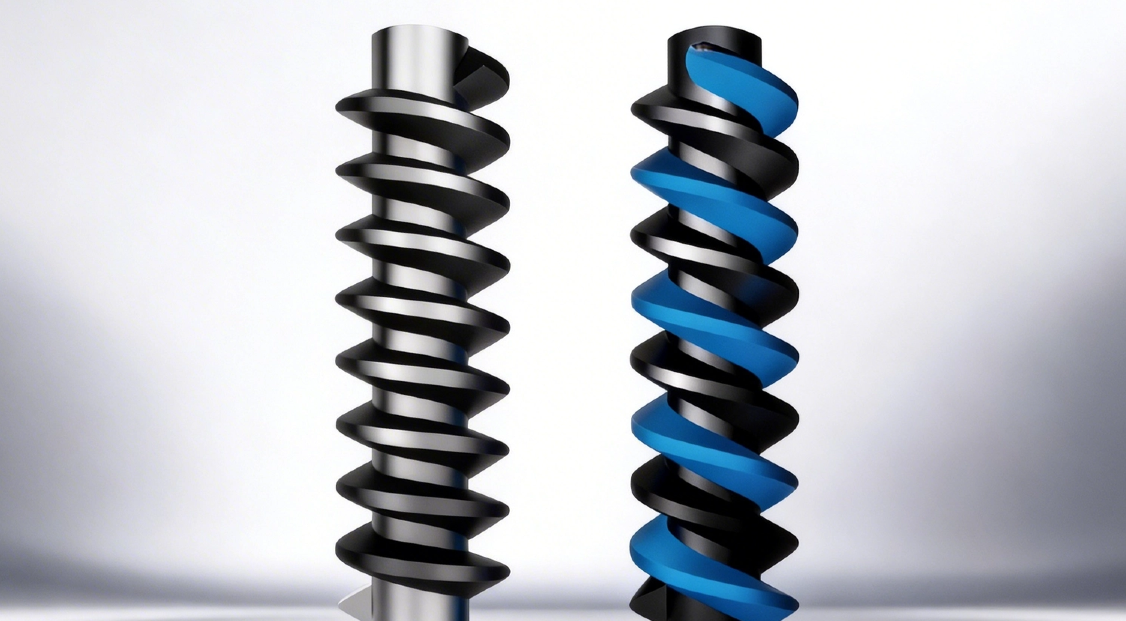
Difference Between Single-Start and Double-Start Worm Gears in Slew Drives
Choosing the right type of worm gear is a critical decision in mechanical design. The choice between single-start and double-start worm gears directly impacts the performance, efficiency, and longevity of your machinery, especially in applications involving slew drives. Selecting an inappropriate type can lead to inefficiency, unexpected wear, or even system failure. This article provides a clear breakdown of both types, their key differences, and ideal applications to help you make an informed decision for your project.
What Are Single-Start Worm Gears?
A single-start worm gear consists of a worm (the screw) and a mating gear (the wheel). The defining feature is the worm, which has a single, continuous helical thread winding around its circumference.
How it works: In one complete 360-degree rotation of the worm shaft, its single thread engages the teeth on the wheel, causing the wheel to advance by exactly one tooth. This mechanism provides a very high reduction ratio in a compact space. For instance, if the wheel has 40 teeth, one full turn of the worm results in only 1/40th of a turn of the wheel, creating a 40:1 gear ratio.
The simple, robust design makes single-start worm gears highly reliable for applications where motion control and holding position are paramount.
Applications of Single-Start Worm Gears
Due to their high reduction ratio and inherent self-locking capability (where the gear cannot drive the worm backward), single-start worm gears are preferred in scenarios demanding precise control, high torque, and safety.
Heavy-Duty Lifting and Hoisting Equipment: Their high torque output and ability to hold loads securely without additional brakes make them ideal for cranes, winches, and elevator systems.
Precision Positioning Systems: Used in rotary tables, antenna positioning, and telescope mounts where slow, accurate, and stable movement is required.
Conveyor Drives: Provide the controlled, powerful drive needed to move heavy materials at steady speeds.
Slew Drives for High-Load, Low-Speed Rotation: In slew drive applications, single-start worms are often chosen for solar trackers, heavy-duty construction cranes, or satellite communications where the primary need is to move or hold a massive load with extreme precision and reliability, rather than achieve rapid movement.
What Are Double-Start Worm Gears?
A double-start worm gear features a worm with two separate helical threads that run parallel to each other, typically offset by 180 degrees around the worm's circumference. The corresponding gear wheel is designed to mesh with both threads simultaneously.
How it works: With two threads engaging the wheel, each full rotation of the worm shaft advances the wheel by two teeth. This effectively doubles the "lead"—the linear distance the gear would move if it were a nut on the screw. Using the previous example, with a 40-tooth wheel, one worm rotation moves the wheel by 2 teeth, resulting in a 20:1 reduction ratio.
The dual-thread design increases the contact area and distributes the load more evenly across the gear teeth.
Applications of Double-Start Worm Gears
Double-start worm gears excel in applications that require a balance of speed, efficiency, and smooth operation, often where self-locking is less critical.
Automotive Steering Systems: Provide a smoother, more responsive feel by reducing friction and allowing quicker gear response.
Packaging and Printing Machinery: Enable faster operational cycles while maintaining precise movement control.
Industrial Mixers and Agitators: Offer efficient power transmission for continuous, moderate-speed operation.
Slew Drives for Faster, Smoother Rotation: In slew drives, double-start worms are advantageous for applications like surveillance camera systems, wind turbine yaw drives, or medical imaging equipment where faster slewing speed, improved operational efficiency, and reduced vibration are important benefits.
Key Differences Between Single-Start and Double-Start Worm Gears
| Feature | Single-Start Worm Gears | Double-Start Worm Gears |
|---|---|---|
| Number of Threads | One continuous helical thread. | Two separate, parallel threads. |
| Reduction Ratio & Speed | High reduction, low output speed. For a given wheel size, offers a larger gear ratio (e.g., 40:1). | Lower reduction, higher output speed. Provides about half the ratio of a comparable single-start (e.g., 20:1), leading to faster rotation. |
| Torque Output | Higher torque output due to the greater mechanical advantage from the higher reduction ratio. | Lower relative torque output compared to a same-size single-start gear, as the mechanical advantage is smaller. |
| Efficiency | Generally lower efficiency. The steeper thread angle creates more sliding friction, leading to greater heat generation and power loss. | Higher efficiency. The shallower effective lead angle reduces sliding friction, resulting in less heat and better power transmission. |
| Wear and Load Distribution | Load and wear are concentrated on a smaller contact area, which can lead to more localized wear over time. | Superior load distribution. The two threads share the load, reducing stress on individual gear teeth and often leading to longer service life. |
| Manufacturing Complexity | Simpler design, generally easier and less costly to manufacture. | More complex to machine due to the precision required to create and align the two parallel threads, often leading to higher cost. |
Summary: Choose single-start for applications prioritizing high torque, high reduction, self-locking, and precise positioning (e.g., slow-moving, heavy-load slew drives). Choose double-start for applications needing higher speed, improved efficiency, smoother operation, and better load distribution (e.g., faster-cycling, continuous-operation slew drives).
How to Choose: Single-Start or Double-Start Worm Gears?
Selecting the right worm gear type is pivotal for your system's performance and longevity. This decision should be guided by the core operational demands of your application. Below is a practical decision framework based on the key differences:
1. Primary Objective:
Choose Single-Start if your top priority is High Reduction & High Torque. This is ideal for moving or holding very heavy loads with precise, incremental motion.
Choose Double-Start if your top priority is Operational Speed & Efficiency. This is ideal for applications requiring faster cycle times and reduced energy loss or heat generation.
2. Key Application Considerations:
For Self-Locking & Holding: If the system must safely hold a position without a brake (e.g., a vertical load), the single-start's reliable self-locking characteristic is usually mandatory.
For Smooth, Continuous Operation: If the application involves constant back-and-forth rotation or higher-speed cycles, the double-start design offers smoother motion and better load distribution, which can enhance bearing life.
For Compactness vs. Performance: A single-start design achieves a high ratio in a compact space. A double-start may require slightly different gearing to achieve a similar ratio but rewards you with better efficiency.
3. Consultation with Experts:
The final choice often involves nuanced trade-offs. For critical applications, especially in slew drive integration where the worm gear interacts directly with the slew bearing and overall structural load paths, consulting with engineering specialists is essential. A manufacturer like LyraDrive can analyze your complete set of requirements—including exact load profiles, duty cycles, environmental conditions, and desired lifespan—to recommend and manufacture the optimal, integrated solution.
LyraDrive: Customised Slew Drive Solutions
LyraDrive is a professional one-stop slewing device manufacturer majored in design and development,
customized production, sales and service on slewing bearings and slewing drives. Our team has been deeply involved in the design, manufacturing and application of slewing drives, slewing bearings and worm gear drives for more than 15 years, majored in the design and manufacture WE slew drives, SE slew drives, SP series gear slew drives.
At LyraDrive, we understand that there is no one-size-fits-all solution in power transmission. The debate between single-start and double-start worm gears is just one example of the precise engineering choices that define performance. As a specialist manufacturer of slew drives and slew bearings, we integrate this deep understanding into every product we design.
Our core expertise lies in providing fully customized slew drive solutions. We don't just supply components; we engineer integrated systems tailored to your specific application requirements—whether it demands the immense holding power of a single-start design or the efficient, smooth operation of a double-start configuration. By controlling the entire manufacturing process of both the drive and the bearing, we ensure optimal gear meshing, perfect load distribution, and exceptional durability for your most challenging projects.
FAQs on Worm Gears
Q: Can a double-start worm gear be self-locking?
A: Self-locking capability depends on the lead angle and friction. While single-start designs are more reliably self-locking due to their steeper lead angle, some double-start designs with a sufficiently shallow lead angle can also exhibit this property. It is essential to consult with your gear provider, like LyraDrive, to confirm this characteristic for your specific operating conditions.
Q: Which is more durable, single-start or double-start?
A: Durability is application-dependent. While the double-start design distributes wear more evenly, the single-start design often uses more robust teeth due to the higher torque transmission. The correct material, heat treatment, and lubrication from a quality manufacturer are more critical to longevity than the start type alone.
Q: How do I choose the right type for my slew drive application?
A: The choice hinges on your primary performance needs. Start by defining your required output speed, torque, duty cycle, and whether holding a static load is critical. For slow, powerful, and locked positioning, lean toward single-start. For faster, smoother, and more efficient continuous rotation, consider double-start. Partnering with an experienced manufacturer like LyraDrive for a custom solution ensures all factors—from gear type to bearing selection—are optimized for your system's success.
Q: Does LyraDrive offer both types in their slew drives?
A: Yes. Our customised approach means we design and manufacture slew drives with the optimal worm gear configuration—single-start, double-start, or even multi-start—to precisely match the speed, torque, efficiency, and lifecycle requirements of your specific application
 WhatsApp
 sales@lyradrive.com
 +8613903880726