



What is a WED slew drive? It is a double-worm slew drive: a slewing bearing, a housing, and two worm shafts that mesh with the same gear ring. The extra worm adds stiffness and holding capacity, but it also adds parts, alignment work, and cost.
So the real question for a designer is not "is it better?" It is "does my duty cycle need it?" This article gives a practical way to answer that, based on engineering reasoning and the project cases we can document.
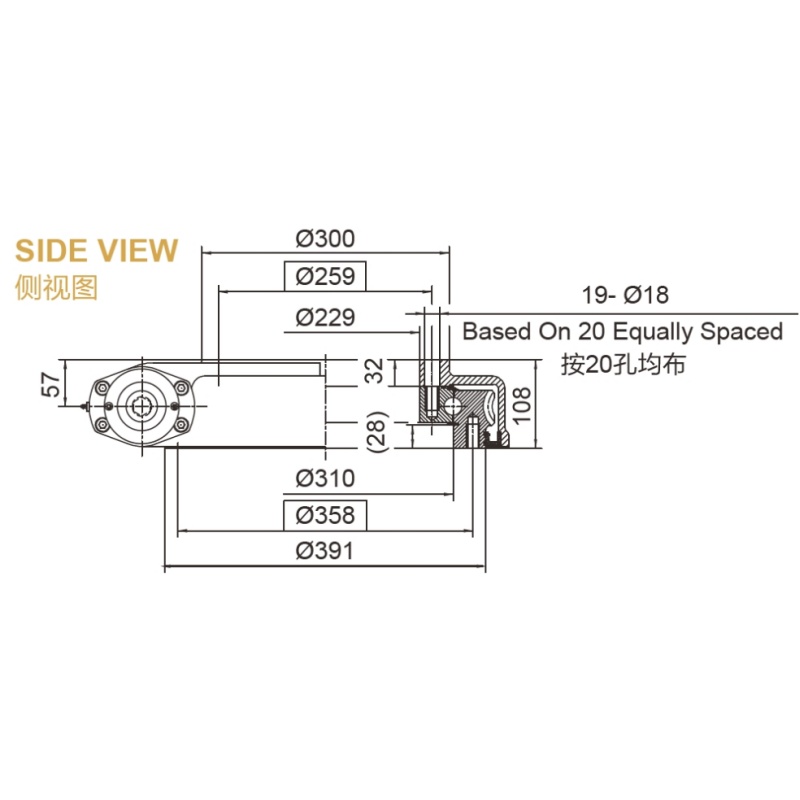
What the Second Worm Changes in Practice
A standard worm gear slew drive uses one worm to turn the gear ring. A double worm slew drive uses two. Both worms share the load, and each can be driven by its own motor or by a linked drive train.
Three effects follow from this layout. These are design-level observations, not test results from any one product:
- Load sharing: tooth contact is spread across two mesh points, which lowers the load on each.
- Stiffness: two supports around the ring can reduce angular deflection when the load is uneven or shifts suddenly.
- Holding behavior: self-locking is a trait of worm gearing in general. Two meshes give you more margin against back-driving. They do not replace a brake where safety rules call for one.
The cost is plain. You get a larger housing, more machining, a second motor interface, and more to adjust at assembly. If the application never uses the extra margin, you pay for it anyway.
Boundary Analysis: When Double-Worm Stiffness Justifies the Complexity
The table below shows our engineering reading of three machine types. It is a screening tool, not a guarantee. Your actual load case, duty cycle, and safety standard decide the final answer.
| Application | Load pattern that favors double-worm | Where a single worm is usually enough | Main limit of this judgment |
|---|---|---|---|
| Concrete boom pumps | Long boom, high overturning moment, pulsing loads from the concrete line | Short boom, light slewing loads, low duty | Boom length and pulsation are not covered by a simple torque rating |
| Aerial work platforms | Large platform reach, wind exposure, strict positioning at height | Compact lifts with light baskets and low swing speed | Safety codes may require extra braking regardless of drive type |
| Excavators | Heavy, shock-prone digging, swing on slopes, long duty hours | Small machines with intermittent swing | Many excavators use other swing systems, so compare architectures first |
Boom pumps
A pump boom carries a moving mass plus the reaction of pumped concrete. The slewing stage sees repeated start-stop loading at the end of a long lever arm. Here, a double-worm layout is worth a close look because stiffness and holding both matter. For compact designs, review our pump truck slewing drive options first.
Aerial platforms
Platform position matters more than raw torque. Small angular errors at the pivot grow into large movement at the basket. Double-worm helps where reach and wind loads are high. For lighter lifts, a single-worm aerial work vehicle slew drive or a manlift slew drive may be the better balance of cost and size.
Excavators
Digging creates shock loads and uneven torque. A double-worm design is a candidate when the machine works long hours in hard material. One documented example is an Australian heavy equipment manufacturer that uses our HWE21-94-25HR.1 double worm slew drives in mining excavators. The bearing side matters too, so check the matching excavator slewing bearing requirements early.
When not to choose it
- The load is light and steady, and a single worm has clear margin.
- Envelope or weight limits are tight, and the larger housing will not fit.
- The machine has no need for high holding stiffness, and cost is the top priority.
Request Your Custom Slew Drive or Bearing Spec
Tell us your load, speed, and environment — receive a tailored 100–5000 mm slewing drive or slewing bearing proposal with 3D drawings within 24 hours.
What Our Project Cases Show, and What They Do Not
We can point to real double-worm orders. They show where buyers have chosen the configuration. They do not prove an industry-wide shift, and we do not claim one.
| Customer / region | Model and quantity | Application |
|---|---|---|
| Australian heavy equipment manufacturer | HWE21-94-25HR.1 | Mining excavators |
| Houston, Texas engineering machinery manufacturer | 150 units of WED17-104-25HR | Heavy-duty wheel steering systems |
| British Columbia, Canada forestry equipment manufacturer | 30 units of WED14-86-25BHR.5 | Forestry grapple machines, tracking precision of 0.13° or better |
What do they have in common? Each machine sees heavy or uneven loading, and each needs a drive that holds position. That pattern fits the engineering logic above.
What can we not conclude? None of these cases is a boom pump or an aerial platform. They also do not tell us that a single worm would have failed. Other factors could have driven the choice, such as an existing design platform or a customer's past experience. Treat the cases as scoped illustrations, not proof.
Cost, Complexity, and Common Mistakes
The price of a double-worm drive is more than the unit quote. It includes motor interfaces, mounting accuracy, and service steps. Compare total installed cost, not catalog price alone.
Mistakes we see in concept-stage selection
- Choosing by peak torque only. Duty cycle, shock factor, and moment load matter as much.
- Ignoring the mounting structure. A stiff drive on a flexible frame loses its advantage.
- Assuming self-locking removes the need for a brake. Follow the safety standard for your machine class.
- Skipping the bearing check. The drive and the slewing bearing inside it must both fit the moment load.
- Over-specifying. A double worm on a light, intermittent duty adds cost with no gain.
A Short Evaluation Checklist Before You Request a Quote
Work through these steps before you pick an architecture. Each one affects a specific decision.
- Define the moment and axial load. This sets the bearing size and tells you whether one worm has margin.
- List the shock and start-stop events. Frequent shocks favor load sharing between two worms.
- State the positioning need. A tight angle requirement, like the 0.13° in the forestry case, points to a stiffer drive. Confirm what precision your own machine needs.
- Check holding requirements and safety rules. Decide whether self-locking alone is acceptable or a brake is mandatory.
- Measure the envelope and weight limit. This tells you whether the larger housing is even possible.
- Define the environment. Our drives can be specified with protection up to IP66 and anti-corrosion ratings up to C4H. Ports, mines, and marine decks may need these.
Uncertainties and Signals That Would Change the Answer
Some questions stay open until you test. How much stiffness does your boom or platform really need? How does the mounting frame flex under load? Does a motor pair with synchronized control suit your hydraulic or electric system?
Prototype data would change the conclusion. If a single-worm sample meets your backlash, deflection, and holding targets in testing, the simpler drive wins. If it falls short under shock loads, double-worm becomes the justified choice.
How Lyra Drive Supports This Decision
Luoyang Slewring Bearing Co., Ltd. has focused on slew bearing and slew drive design for more than 15 years, across 2,000+ heavy-equipment projects. Our ISO 9001:2015-certified facility runs CMM three-coordinate inspection, and every slew bearing also goes through dynamic load testing. You can read more on our slew drive quality control page.
We can send a technical proposal within 24 hours and respond to technical questions within 48 hours. Standard products start at an MOQ of 1 set, and customized slew drive orders start at 5 sets. Rapid prototyping takes 3 days, and the standard production cycle is 9 days. We also provide a 2-year extended quality warranty and free replacement for confirmed manufacturing defects.
If you want to compare architectures, review our WED slew drive range alongside the single-worm and spur options on our slew drive page. If you are looking for a WED slew drive supplier, contact us with your load case and duty cycle, and we will send you the latest quotation.
Request Your Custom Slew Drive or Bearing Spec
Tell us your load, speed, and environment — receive a tailored 100–5000 mm slewing drive or slewing bearing proposal with 3D drawings within 24 hours.
 WhatsApp

 +8613903880726