



As a mechanical design engineer with over 30 years in heavy machinery, I often see teams confuse a standalone worm gear with a complete S slew drive. A worm gear is a component; an S slew drive is a fully integrated, ready-to-mount rotational system. Understanding this distinction is fundamental to designing reliable, cost-effective, and safe equipment.
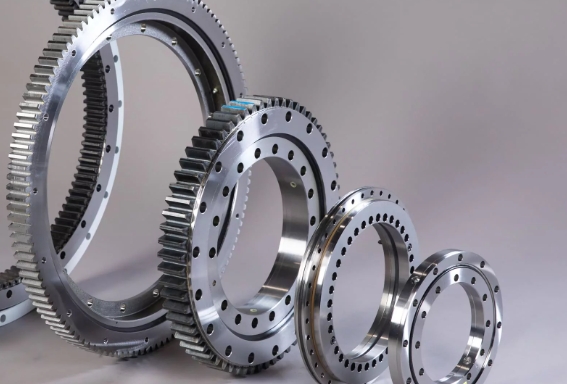
A worm gear is a set of gears consisting of a worm (the screw) and a worm wheel (the gear). It excels at transmitting torque at a high ratio in a compact space. However, it cannot, on its own, support the complex loads of a rotating platform. An S slew drive, like those we manufacture at Luoyang Slewring Bearing Co., Ltd., incorporates a worm gear set into a robust assembly with a slewing bearing and a protective housing. This creates a complete solution for both transmitting torque and bearing heavy, combined loads.
This article will break down the precise mechanical differences between these two concepts, explaining how the integrated design of a slew drive delivers performance that a simple gearbox cannot match.
Component Breakdown: Slew Drive vs. Standalone Worm Gearbox
Thinking an S-series drive is just a worm gearbox is like thinking an engine is the same as a car. The gearbox is a critical part, but it's the integration with other key components that creates a functional system. Let's compare them side-by-side.
A standalone worm gearbox is designed to be a power transmission component within a larger machine. An S slew drive is the machine's rotational core.
-
The Drive Mechanism: Hourglass Worm vs. Cylindrical Worm
Standard worm gearboxes often use a cylindrical worm. Our S-series slew drives utilize an hourglass (or globoid) worm. The unique, curved profile of the hourglass worm engages multiple teeth on the slewing ring simultaneously. This increased surface contact distributes the load more effectively, resulting in significantly higher torque capacity, greater shock resistance, and smoother rotation compared to the single-point contact of a cylindrical worm. -
The Load-Bearing Structure: Integrated Slewing Bearing vs. None
This is the most significant difference. A worm gearbox has small bearings to support its input and output shafts against rotational forces. It has no provision to support the equipment mounted to it. An S slew drive, by contrast, is built around a large-diameter Slewing Bearing. This bearing is specifically engineered to handle a combination of high axial loads, radial loads, and strong tilting moments simultaneously. It is the structural foundation that allows a crane to lift tons or a solar tracker to withstand high winds. -
The Assembly: Enclosed Housing vs. Open Components
An S slew drive is delivered as a pre-assembled, fully enclosed unit. The housing not only protects the precision worm and bearing from dust, moisture, and debris but also contains the lubrication, simplifying maintenance. Our drives offer protection up to IP66, making them suitable for harsh industrial and outdoor environments—a feature validated in desert solar farms in the US and on marine cranes for our UK customers. A worm gear set, by itself, is just two open components that require the end-user to design and fabricate a custom housing, sealing, and bearing support system.
A System Engineered for Complex Loads
The primary function of a worm gearbox is to transmit torque. The primary function of an S slew drive is to rotate a heavy structure smoothly and safely under combined loads. The integrated slewing ring is what makes this possible.
Imagine a truck-mounted crane. The boom's weight exerts a massive downward axial load and a tilting moment that tries to pry the turret off the truck. A standard gearbox would fail instantly under these forces. Our WEA series slew drives, used by a Netherlands-based material handling equipment manufacturer for their truck cranes, are designed for exactly this scenario. The internal heavy load slewing bearing absorbs these complex loads, while the hourglass worm provides the high torque needed to rotate the boom with precision.
We see similar demands in other heavy industries. For an Australian heavy equipment manufacturer, our HWE21 double worm slew drives provide the immense torque and load-holding capacity required for the rotating upper structure of mining excavators. These applications involve constant shock loads and torsional stress that only a purpose-built slew drive can endure.
Common Load Types Handled by Slew Drives
When selecting a rotational system, engineers must account for all forces. A slew drive is purpose-built to manage them all in one package.
| Load Type | Description | Handled by Worm Gearbox? | Handled by S-Slew Drive? |
|---|---|---|---|
| Output Torque | The rotational force generated to move the load. | Yes (Primary Function) | Yes (Primary Function) |
| Axial Load | Force parallel to the axis of rotation (e.g., the weight of the structure). | No | Yes (Via Slewing Bearing) |
| Radial Load | Force perpendicular to the axis of rotation (e.g., side loads). | No | Yes (Via Slewing Bearing) |
| Tilting Moment | A bending force that tries to overturn the rotating structure (e.g., wind on a solar panel or an off-center lift). | No | Yes (Via Slewing Bearing) |
Request Your Custom Slew Drive or Bearing Spec
Tell us your load, speed, and environment — receive a tailored 100–5000 mm slewing drive or slewing bearing proposal with 3D drawings within 24 hours.
Precision, Control, and Self-Locking in Demanding Applications
Beyond raw strength, applications like robotic automation, satellite tracking, and port machinery demand high rotational accuracy. The design of an S slew drive delivers a level of precision that is difficult and expensive to achieve by assembling separate components.
The close meshing of the hourglass worm and the precision-ground slewing ring allows for minimal backlash (the "play" between gear teeth). For a South Korean port equipment manufacturer, we supplied WEA9 slew drives for their crane systems that achieved a tracking precision of ≤0.15°. This accuracy is critical for positioning containers safely and efficiently. Similarly, our WED14 double worm drives used in forestry grapple machines in British Columbia, Canada, provide ≤0.13° precision, allowing operators to manipulate logs with extreme accuracy.
Another inherent benefit of the worm gear geometry is its self-locking capability. Under most gear ratios, the worm can drive the gear, but the gear cannot back-drive the worm. This acts as a natural brake, holding the load in place without continuous power to the motor. This is essential for safety and energy efficiency in applications like aerial work platforms and crane systems.
Sourcing an S-Series Drive: A Checklist for Engineers
Attempting to build your own rotary system by combining a separate worm gearbox, a large bearing, and a custom housing introduces significant risks. Misalignment between the gear and bearing can cause premature wear and catastrophic failure. Sealing the assembly against the elements is complex. The design, fabrication, and assembly time adds considerable cost.
An integrated S slew drive from a specialized manufacturer like Luoyang Slewring Bearing Co., Ltd. eliminates these variables. Our process, certified under ISO 9001:2015, ensures every component is perfectly matched and aligned. But before you issue an RFQ, use this checklist to define your requirements.
Buyer's Decision Checklist
- Define All Loads: What are the maximum axial, radial, and tilting moment loads your application will experience, both static and dynamic?
- Specify Performance Needs: What is the required output torque, speed, and duty cycle? Is high precision (low backlash) critical?
- Assess the Environment: Will the drive operate indoors or outdoors? Does it need to be sealed against dust, water, or corrosive agents? Specify the required IP rating (e.g., IP65, IP66).
- Confirm Mounting and Interface: How will the slew drive mount to your equipment? What type of motor will be used (hydraulic or electric)?
- Verify Supplier Quality: Does the manufacturer have a documented quality management system? Can they provide factory audit reports? Do they perform critical inspections? At our facility, every slew bearing undergoes CMM three-coordinate inspection and dynamic load testing to ensure it meets specifications. This rigorous Slew Drive Quality Control is why our failure rate is below the 0.5% industry standard.
- Evaluate Technical Support: Can the supplier provide a detailed technical proposal quickly? We guarantee a proposal within 24 hours. What is their warranty and post-sales support policy? We stand behind our products with a 2-year extended quality warranty.
By treating the S slew drive as the complete, integrated system it is, you can simplify your design process, reduce assembly time, and significantly improve the reliability and performance of your equipment.
Request Your Custom Slew Drive or Bearing Spec
Tell us your load, speed, and environment — receive a tailored 100–5000 mm slewing drive or slewing bearing proposal with 3D drawings within 24 hours.
 WhatsApp

 +8613903880726