



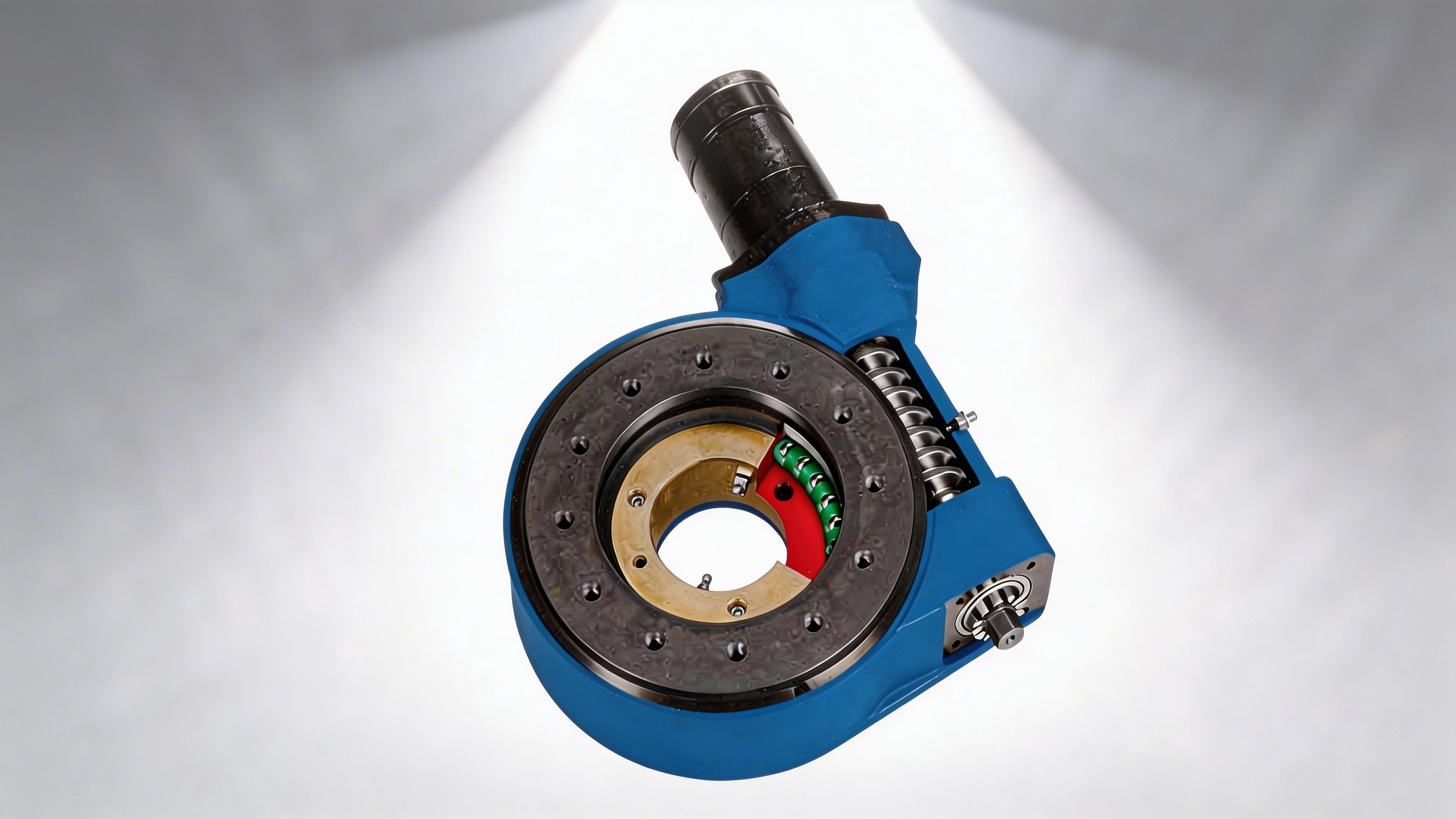
What is the Basic Structure of the Slew Drive?
In the competitive field of slew drive equipment, continuous innovation is key to meeting the demanding needs of modern industry. Through years of in-depth research and technological breakthroughs, LyraDrive has grown into a core provider of high-performance solutions. Our product line, particularly our high-protection sealed slew drives, covers a wide structural variety and has set an industry benchmark for environmental adaptability and reliable quality in many harsh application scenarios, from offshore drilling platforms to desert solar farms.
To truly appreciate the engineering behind a high-quality slew drive, one must first understand its fundamental architecture, the function of each component, and the critical role of materials science in its performance and longevity.
What is Slew Drive?
A slew drive is a compact, planetary or worm-gear style mechanism designed to simultaneously handle significant radial and axial loads while providing precise rotational control. It functions as the critical "rotary joint" and "power transmission unit" in one, enabling heavy machinery to rotate smoothly and accurately. Unlike simple bearings, a slew drive actively controls the rotation, positioning, and holding of heavy loads. For instance, it allows a crane's boom to swing under load or a massive solar array to track the sun across the sky with precision.
How Does a Slew Drive Work?
The operating principle of a typical worm-gear slew drive is elegantly simple yet highly effective. The drive consists of a worm shaft (connected to a hydraulic motor or electric motor) that meshes with the teeth of a large slewing ring bearing.
1. Input: A motor turns the worm shaft.
2. Reduction & Translation: The rotating worm, which is threaded like a screw, engages the gear teeth on the circumference of the slewing ring. As the worm turns, its threads push against the gear teeth, causing the slewing ring to rotate.
3. Output: This rotation is transferred to the machinery platform bolted to the rotating race of the slewing ring.
This design is favored because it offers a high torque multiplication (reduction ratio) within a very compact housing. Critically, the worm gear design is often self-locking, meaning the worm can turn the gear, but the gear cannot turn the worm. This provides an inherent braking system, preventing the load from back-driving the motor when power is cut—a vital safety feature in applications like cranes and aerial lifts.
Key Applications of Slew Drive
Because of their unique combination of load handling, precision, and self-locking capability, slew drives are indispensable across a wide range of industries.
Table 1: Common Applications by Industry
| Industry | Typical Applications | Primary Function |
|---|---|---|
| Construction & Heavy Lifting | Mobile cranes, crawler cranes, excavators, aerial work platforms, concrete pump trucks. | Safe and controlled rotation of heavy loads, booms, and platforms. |
| Renewable Energy | Solar PV tracking systems (single‑axis & dual‑axis), concentrated solar power (CSP) plants, wind turbine yaw drives. | Precisely following the sun for maximum energy capture; orienting wind turbines into the wind. |
| Material Handling & Ports | Stacker‑reclaimers, ship loaders/unloaders, harbor cranes, industrial manipulators. | Precise positioning of bulk materials and cargo during loading/unloading. |
| Specialty & Industrial | Mobile drilling rigs, mining shovels, radar and antenna systems, missile launchers, medical equipment (e.g., CT scanners). | Providing controlled, smooth rotation in demanding environments. |
The Basic Structure of the Slew Drive
The performance and reliability of a slew drive depend entirely on the quality and integration of its core components. A complete slew drive assembly is a precision-engineered gearbox. As illustrated in the diagram from our reference material, the basic structure is composed of two primary functional parts: the slewing support and the slew drive mechanism.
The slewing support (typically a slewing ring bearing) connects the rotating part of the machine to its stationary base. It provides the necessary constraints for rotational movement while withstanding the complex forces involved: vertical loads, horizontal radial loads, and the significant overturning moment caused by a heavy load extended on a boom. The slew drive component (the worm and housing) is the power transmission unit that actively drives the rotating part relative to the stationary base.
Slew Drive Support Device
The support device is critical for stability and durability. It is mainly divided into column type and rotating disk type systems.
Column Type: Found in older or specialized cranes, this can be either a rotating column (where the column turns with the machinery) or a fixed column (where a "bell jar" structure rotates around a stationary column). While robust, these designs are less compact than modern alternatives.
Rotating Disk Type: This is the dominant configuration in modern equipment. It uses a large, integrated rolling element bearing—the slewing ring. The inner and outer races of this bearing are bolted with high-strength steel bolts to the machinery's chassis and rotating platform. This design offers superior compactness, load distribution, and ease of assembly.
Table 2: Comparison of Slewing Bearing Types in Disk-Type Supports
| Bearing Type | Load Characteristics | Typical Application |
|---|---|---|
| Single Row Ball Bearing | Handles moderate axial, radial, and moment loads. Most common and cost-effective design. | Small to medium excavators, truck-mounted cranes, solar trackers. |
| Double Row Ball Bearing | Increased load capacity and stability compared to single row. | Larger cranes, aerial work platforms. |
| Crossed Roller Bearing | Excellent moment load rigidity due to cylindrical rollers arranged perpendicularly in V-shaped grooves. | Precision applications like robotics, medical equipment, and military hardware where minimal deflection is critical. |
| Three Row Roller Bearing | Highest load capacity. Axial and radial loads are handled by separate roller sets. | Very large, heavy-duty applications like port ship-to-shore cranes, large stacker-reclaimers, and offshore cranes. |
The Main Part: The Drive Mechanism
Beyond the support structure, the drive components are the heart of the system. The materials used here are paramount to performance and lifespan.
Power Source: Most slew drives are powered by electric motors (for stationary applications) or hydraulic motors (for mobile, high-torque applications).
Gearing & Materials: The final stage of drive almost universally uses a gear-on-gear interface. According to our reference article, extensive testing has shown that material choice is critical. While many drives use standard steel and phosphor bronze, chill-cast nickel-phosphor bronze has been proven to rank first in resistance to wear and deformation for the worm gear. This is why LyraDrive often recommends and utilizes advanced materials for high-cycle or high-stress applications.
Table 3: Typical Material Properties for Slew Drive Components
| Component | Common Material | Advanced Material (e.g., LyraDrive Options) | Key Property |
|---|---|---|---|
| Worm Shaft | Alloy Steel (e.g., 42CrMo) | Case-hardened alloy steel | High surface hardness, core toughness, wear resistance. |
| Worm Gear (Ring) | Phosphor Bronze | Chill-Cast Nickel-Phosphor Bronze | Superior anti-friction properties, excellent resistance to wear and deformation under load. |
| Housing | Nodular Cast Iron (e.g., QT450) | High-grade fabricated steel | Structural rigidity, vibration damping, and corrosion resistance. |
| Seals | Standard Nitrile (NBR) | Polyurethane (PU) or Viton (FKM) | Superior resistance to ozone, UV, extreme temperatures, and abrasion. |
Furthermore, to ensure reliable operation and prevent mechanical overload, a torque limiter is often integrated into the transmission system. Depending on the machine's design, the complete slew drive unit can be mounted either on the rotating part of the crane (driving against a fixed gear ring) or on the non-rotating part (driving a rotating gear ring). Both configurations are valid and chosen based on the specific engineering and spatial requirements.
LyraDrive: Your Customised Slew Drive Manufacturer
At LyraDrive, our expertise extends far beyond supplying standard, off-the-shelf components. We are a specialized manufacturer of high-precision slew drives and slewing bearings. We understand that every application presents unique challenges, whether it's a space constraint, an extreme environmental condition, or a specific load-handling requirement.
That's why we focus on being your partner for customised solutions. Our engineering team works directly with you to design and manufacture a drive that integrates seamlessly into your machinery. Our extensive product range includes, but is not limited to:
Single Worm Slew Drives: The workhorse for most industrial and mobile applications, offering reliability and high torque.
Double Worm Slew Drives: Providing even higher reduction ratios and increased torque capacity in a compact package.
Spur Gear Slew Drives: Ideal for applications requiring high rotational speeds and precise positioning without the need for self-locking.
Whether you need a single prototype or a high-volume production run, LyraDrive is committed to precision, durability, and performance. From advanced material selection to rigorous testing, every product is built to exceed expectations. When you choose LyraDrive, you are not just buying a component; you are selecting a partner dedicated to the success of your project with engineering excellence and reliable quality. For the best in custom-engineered rotary solutions, LyraDrive is your ideal partner.
 WhatsApp
 sales@lyradrive.com
 +8613903880726