



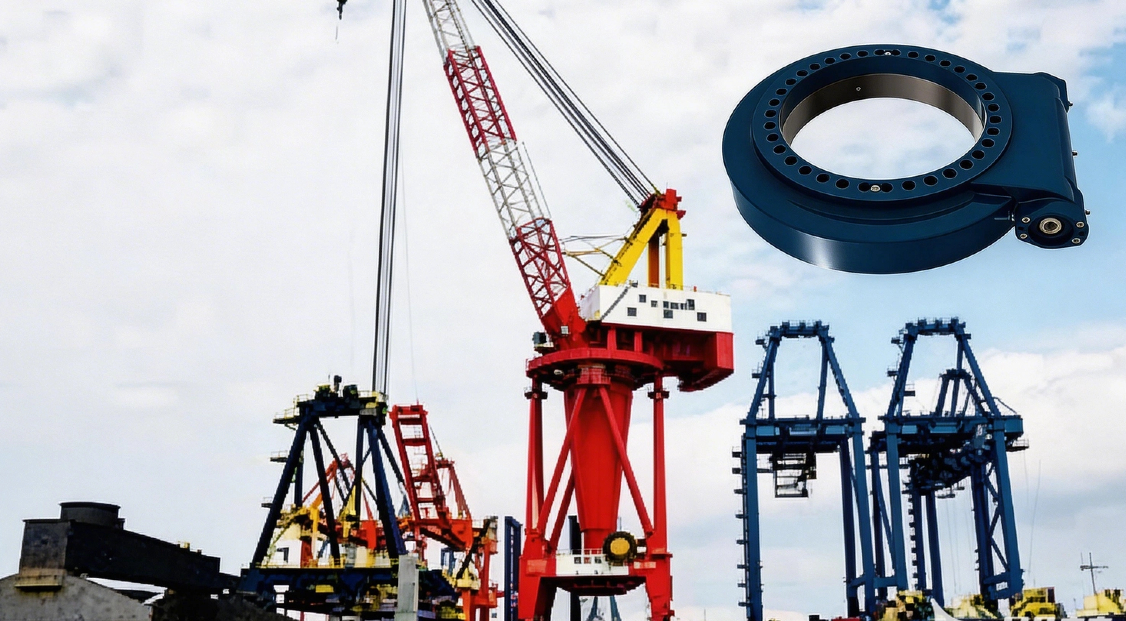
Powering Port Operations: The Role of Slew Drives in Material Handling Cranes
Ports are the bustling hubs of global trade. Every day, massive cranes unload and load countless containers, demanding equipment that combines immense power with pinpoint precision. At the heart of these material handling cranes, enabling them to rotate and operate smoothly, is a critical component: the slew drive. These compact, powerful units are essential for handling heavy loads and enduring the harsh, corrosive conditions found in ports worldwide.
What is Slew Drive in Material Handling Cranes?
A slew drive, also known as a slewing drive, is a gearbox-style mechanism designed to facilitate controlled rotation and positioning of heavy loads. In the context of a material handling crane, it is the core component that allows the crane's superstructure—the boom and the operator's cab—to rotate smoothly on its undercarriage. This rotational movement is fundamental for picking up cargo from a ship and swinging it onto a truck or a storage yard.
Essentially, a slew drive combines several key elements into one robust unit:
A slewing bearing (or slew ring): A large-diameter bearing that handles axial, radial, and tilting moment loads.
A drive mechanism: Typically a worm gear, which provides high reduction ratios and self-braking capabilities.
A housing: Which protects the internal components from the environment.
This integration creates a single, ready-to-install unit that simplifies crane design and enhances reliability.
How Does a Slew Drive Work in Material Handling Cranes?
The operation of a slew drive is a study in mechanical efficiency. It converts power from a motor—which can be hydraulic, electric, or pneumatic—into high-torque rotational force.
Here’s a simple breakdown of the process:
1. Power Input: The motor turns a worm shaft (the input).
2. Gear Reduction: The worm shaft meshes with a worm wheel that is integrated into the slewing bearing. This interaction creates a significant gear reduction, meaning a high input speed is transformed into a slow, powerful output rotation. This provides the immense torque needed to swing a crane loaded with heavy containers.
3. Controlled Rotation: As the worm wheel turns, the entire attached structure—the crane’s boom—rotates with precision. The unique design of a worm gear set often provides a natural braking effect, preventing the load from drifting or back-driving, which is crucial for safety.
4. Load Management: While the rotation happens, the integrated slewing bearing simultaneously manages all the complex forces: the weight of the load (axial load), the force pushing the crane sideways (radial load), and the tipping force (tilting moment).
Design Features of Slew Drives in Material Handling Cranes
Slew drives used in demanding port operations are distinguished by several key design features that ensure longevity and performance:
High Load Capacity: They are engineered to support substantial tilting moments—the force that tries to tip the crane over—ensuring stability even with maximum loads.
Corrosion Resistance: Given the saltwater environment, critical components are treated with advanced coatings like zinc-rich primers and durable topcoats. Seals and gaskets are used to prevent salt-laden air and moisture from penetrating the drive.
Robust Gear Systems: Precision-cut worm gears or spur gears are used to ensure smooth, efficient power transmission with minimal backlash, allowing for accurate load placement.
Integrated Sealing: High-quality, multi-lip seals protect the internal grease and gears from contaminants like water, dust, and salt.
Optional Features: Drives can be equipped with encoders for precise position feedback and fail-safe brakes for additional operational safety and control.
Advantages of Using Slew Drives in Material Handling Cranes
Choosing a high-quality slew drive offers significant benefits for port crane operations:
Precision and Control: Operators can place loads with incredible accuracy, thanks to the smooth, controlled motion and minimal backlash provided by the drive.
High Efficiency in a Compact Package: Slew drives deliver immense torque and load-bearing capacity without requiring a large, complex mechanical system, saving valuable space on the crane.
Reliability and Durability: Built to withstand continuous, heavy-duty cycles and harsh weather, they minimize downtime and maintenance costs.
Enhanced Safety: The inherent self-locking property of many worm gear designs prevents uncontrolled load descent or rotation, adding a critical layer of safety.
Simplified Installation: As a pre-assembled unit, a slew drive is easier and faster to install compared to building a rotation system from separate components.
What Challenges Do Slewing Drives in Material Handling Cranes Face?
Despite their robust construction, slew drives in port environments encounter formidable challenges:
Extreme Environmental Exposure: Constant contact with corrosive salt water, high humidity, and driving rain can lead to rust, seal degradation, and lubrication breakdown.
Shock Loads and Dynamic Forces: The sudden impacts from lifting and moving heavy containers create severe shock loads that can stress gears and bearings beyond normal operating conditions.
Continuous Operation: Ports operate around the clock. This near-constant duty cycle generates heat and wear that can shorten the lifespan of standard components.
Contamination: Airborne grit and dust can mix with grease, forming an abrasive paste that accelerates wear on gear teeth and bearing raceways.
Uneven Load Distribution: Off-center or dynamic loads can create uneven pressure on the slew bearing, potentially leading to premature failure if the drive is not adequately designed.
Custom Slew Drives in Material Handling Cranes at LyraDrive
At LyraDrive, we understand that no two port operations are exactly alike. The challenges outlined above—from saltwater corrosion to extreme shock loading—require equally specific solutions. That’s why we specialize in engineering custom slew drives designed to meet the unique demands of your material handling cranes.
We don't just offer products; we provide engineered solutions. Our team works closely with you to analyze your specific crane type, operational loads, environmental conditions, and space constraints. The result is a custom slew drive that integrates seamlessly with your equipment, providing enhanced performance and durability exactly where you need it.
Our comprehensive range of standard and custom-built products includes:
Worm Gear Slew Drives: Ideal for applications requiring high reduction ratios, smooth operation, and self-locking capabilities.
Double Worm Slew Drives: Offering even greater reduction and torque capacity for the most demanding heavy-lift cranes.
Spur Gear Slew Drives: A perfect choice when higher rotational speeds and maximum efficiency are required.
Slewing Bearings: As a foundation of our drive units, we also offer high-capacity slewing bearings (slew rings) for integration into larger systems or replacement needs.
Whether you need a drive with a special corrosion-resistant coating for a seaside crane, a modified gear ratio for precise control, or a completely unique mounting configuration, LyraDrive has the engineering expertise to deliver. We turn the challenges of your environment into the driving force behind our custom solutions.
FAQ About Slew Drives in Material Handling Crane
Q: What is the main difference between a slew drive and a slew bearing?
A: A slew bearing (or slewing ring) is the bearing component that allows rotation and supports the load. A slew drive is a complete, pre-engineered system that includes the slew bearing, a drive mechanism (like a worm gear), and a housing, providing a ready-to-install rotational solution.
Q: How often should a slew drive in a port crane be maintained?
A: Maintenance frequency depends on usage intensity and environmental conditions. However, given the harsh port environment, regular inspections and re-lubrication are typically recommended every 3 to 6 months or according to the manufacturer's specifications.
Q: Can a slew drive be repaired, or does it need to be replaced entirely?
A: This depends on the extent of the damage. While some issues like seal replacement or gear adjustments can be handled, major internal wear often requires a complete replacement to ensure safety and reliability. LyraDrive can advise on the best course of action for your specific situation.
Q: How do I choose the right size slew drive for my crane?
A: Selection is based on calculating the applied loads: maximum axial load, radial load, and the critical tilting moment. You also need to consider duty cycle, environmental factors, and required rotational speed. Consulting with an engineer, like the team at LyraDrive, is essential for proper selection.
Q: What makes a slew drive "custom"?
A: A custom slew drive can involve modifications to standard designs, such as altered gear ratios, special mounting flanges and bolt patterns, unique seal materials for chemical resistance, enhanced corrosion protection coatings, or integrated feedback devices like encoders for smart operation.
By understanding the critical role of the slew drive, you can appreciate the engineering that keeps global trade in motion. For a solution built to master your port's toughest challenges, trust the expertise and customization capabilities of LyraDrive.
 WhatsApp
 sales@lyradrive.com
 +8613903880726