



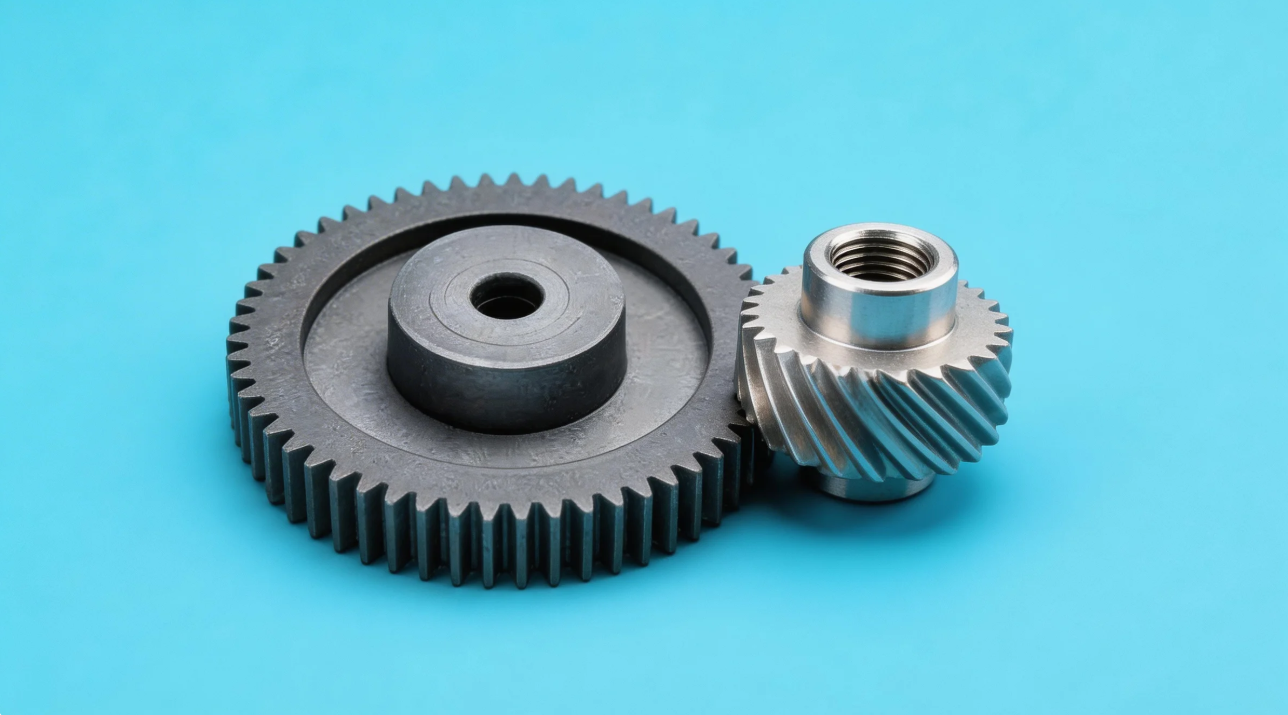
The Difference Between Spur and Helical Gears in Slew Drives
When designing or selecting a slew drive, one of the most fundamental decisions you will face is the gear type: spur or helical. Both serve the same basic purpose—to transmit rotational power—but their characteristics, performance, and ideal applications differ significantly.
This article explains everything you need to know, from the basics of slew drives to a detailed comparison of spur and helical gears, and finally, how to choose the right one for your project.
What is Slew Drive?
A slew drive is a compact, gear-based actuation system designed to manage slow-speed, heavy-load rotational positioning. It is essentially a rotary actuator that combines a driving pinion, a housing, and a large-diameter output bearing into a single, sealed unit.
Slew drives are the core rotating component in a wide range of equipment, including:
Solar tracking systems – moving solar panels to follow the sun.
Cranes and aerial lifts – rotating booms and personnel platforms.
Wind turbine pitch control – adjusting blade angles for optimal power.
Heavy-duty automation – positioning robotic arms and rotary tables.
Mobile equipment – swing drives for excavators and diggers.
How Does a Slew Drive Work?
A slew drive operates on a simple principle: power input, speed reduction, and high-torque output.
An electric or hydraulic motor connects to the drive’s input flange. The motor spins a worm shaft (in worm gear slew drives) or a small pinion gear (in spur gear slew drives). This pinion engages with the large gear teeth cut directly into the integrated bearing race. The bearing then rotates, turning the connected load with high precision and strong holding torque.
The gear teeth on the large bearing ring are the critical interface where motion and force are transferred. This is where the choice between spur and helical gears becomes crucial.
What Are Gears?
Gears are toothed mechanical components that work in pairs to transmit torque and change speed or direction. Think of them as the muscles and bones of mechanical motion. They are defined by features such as tooth size (module), tooth shape (pressure angle), and tooth orientation.
In a slew drive, the gear is not a separate wheel. It is a ring of teeth machined directly onto the bearing race. This integrated design saves valuable space and ensures perfect concentricity between the rotation axis and the driven load.
The Main Types of Gears
While many gear types exist, slew drives primarily utilize two configurations for the large output ring due to their proven performance and manufacturability:
Spur Gears – Teeth are straight and cut parallel to the axis of rotation.
Helical Gears – Teeth are cut at an angle to the axis of rotation.
Other gear types, such as worm gears, relate specifically to the input pinion stage and are a separate topic. This article focuses exclusively on the large output ring gear.
Spur Gears in Slew Drives: Key Features
Spur gears are the most common and traditional gear type found in industrial drives.
Appearance – The teeth are straight and parallel to the bearing axis. This gives the gear ring a classic “cogwheel” look that is instantly recognizable.
Manufacturing – Spur gears are easier and more economical to cut. This makes spur gear slew drives a highly cost-effective solution, especially for high-volume or budget-sensitive projects.
Efficiency – Spur gears generate no axial thrust. All the force is radial, meaning it acts perpendicular to the shaft. This results in very high transmission efficiency, often exceeding 95%. Minimal power is lost as heat.
Performance – Spur gears are strong and reliable at low to medium speeds. However, because the entire tooth face engages at once, the gear teeth make full contact instantly. This can generate noticeable noise and vibration at higher speeds.
Helical Gears in Slew Drives: Key Features
Helical gears represent a performance upgrade for more demanding applications where smoothness and strength are priorities.
Appearance – The teeth are cut at a precise angle. This creates a gradual, diagonal engagement pattern along the tooth face.
Smoothness – Unlike spur gears, helical teeth engage progressively. One end of the tooth touches before the other, allowing the load to transfer smoothly. This results in much quieter and vibration-free operation.
Strength – The angled tooth provides a longer contact line during meshing. For the same tooth size and ring diameter, a helical gear can handle higher loads than a spur gear because the force is distributed over a greater area.
Axial Thrust – The tooth angle generates a force along the axis of the bearing, called axial thrust. This force must be managed by stronger bearings within the slew drive housing. It is an essential design consideration that adds complexity but enables higher performance.
The Difference Between Spur and Helical Gears in Slew Drives
To help you see the difference clearly, here is a direct comparison:
| Feature | Spur Gear Slew Drive | Helical Gear Slew Drive |
|---|---|---|
| Tooth Orientation | Straight, parallel to axis | Angled, diagonal to axis |
| Noise & Vibration | Higher. Teeth make full contact instantly, causing impact. | Lower. Teeth mesh gradually, reducing vibration. |
| Load Capacity | Good for radial loads and moderate torque. | Superior. Longer contact line distributes weight better. |
| Transmission Efficiency | Very High (Up to 95%). No axial friction loss. | Slightly Lower (90-93%). Some torque is lost to axial thrust. |
| Axial Thrust | None. Simple bearing design. | Present. Requires robust thrust bearings. |
| Manufacturing Cost | Lower. Simple cutting process. | Higher. Complex machining and stronger housing required. |
| Precision Retention | Good for general use. | Excellent. Gradual wear maintains accuracy longer. |
Summary – Spur gears are strong, simple, and highly efficient. Helical gears are smoother, quieter, and capable of higher loads, but they require more complex system design to handle axial forces.
How to Choose: What Type of Gear is Right for Your Slew Drive?
There is no single “best” gear. The right choice depends entirely on your application’s priorities and operating conditions.
Choose a Spur Gear Slew Drive if:
Your budget is a primary concern.
The application runs at low speeds with intermittent rotation.
You need maximum energy efficiency, such as in battery-powered equipment.
Noise is not a critical issue, for example in industrial machinery located away from personnel.
You want the simplest, most reliable mechanical solution with minimal maintenance.
Choose a Helical Gear Slew Drive if:
Low noise is mandatory, such as in equipment near operators, medical devices, or high-end automation.
The system runs continuously at moderate to high speeds.
You need the highest possible load capacity within a compact size.
You want to maintain precision over a very long service life.
Your equipment experiences shock loads; helical gears absorb shock better than spur gears.
Always consider the full picture: installation space, rated output torque, duty cycle, and environmental factors. A gear that is perfect for a slow-moving solar tracker may be completely wrong for a high-speed automation line.
LyraDrive Slew Drive Manufacturing Capabilities
At LyraDrive, we specialize in engineering and manufacturing high-performance rotation solutions. Our product lines are designed to meet the exact needs of modern automation, renewable energy, and heavy machinery.
Our Core Products:
Slew Drives – We produce two main types:
Worm Gear Slew Drives: Ideal for high reduction ratios and applications requiring self-locking.
Spur Gear Slew Drives: Available with either spur or helical gear configurations on the output ring, depending on your performance requirements.
Slew Bearings – We also manufacture high-capacity slewing bearings, with or without integrated gears, for custom OEM integration.
Why Choose LyraDrive?
With years of engineering experience, we do not simply sell standard components. We provide custom engineering solutions. Whether you need the raw efficiency of a spur gear or the silent strength of a helical gear, our team can engineer the exact tooth geometry, housing strength, and sealing system to match your specific working conditions.
Unsure which gear profile fits your next project? Contact our engineers. We will analyze your load requirements, speed, duty cycle, and environmental factors to recommend the most cost-effective and reliable slew drive solution.
FAQ on Spur and Helical Gears in Slew Drives
Q1: Can a helical gear slew drive replace a spur gear unit without changing the motor?
A: Not directly. Helical gears produce axial thrust, which the drive housing must be designed to support. Additionally, the slightly lower efficiency of helical gears may require a small increase in input motor torque to achieve the same output power.
Q2: Are helical gear slew drives always more expensive?
A: Generally, yes. The cutting process is slower, and the slew drive housing requires stronger bearings to manage thrust loads. However, modern CNC machining has narrowed the cost gap, making helical gears accessible for many mid-range applications.
Q3: Does LyraDrive offer both gear types?
A: Yes. LyraDrive offers custom slew drives with either spur or helical gear cutting on the output ring. We recommend the optimal type based on your specific application data.
Q4: Which gear type lasts longer?
A: For the same material hardness and lubrication conditions, helical gears often maintain their original precision longer. This is because the gradual engagement reduces point stress and distributes wear more evenly across the tooth surface.
Q5: What about backlash? Can both types achieve low backlash?
A: Yes, both spur and helical gears can be manufactured with low backlash. However, helical gears are often preferred for ultra-precision positioning applications because their continuous, overlapping meshing allows for tighter preloading without sacrificing smoothness.
Q6: Do helical gears always run quieter?
A: Yes. This is one of their defining advantages. The progressive engagement eliminates the instantaneous impact found in spur gears, significantly reducing operating noise and vibration.
Need a reliable partner for your rotating equipment? LyraDrive provides turnkey slew drive solutions tailored to your application. Contact us today for a free engineering consultation on your gear selection.
 WhatsApp
 sales@lyradrive.com
 +8613903880726