



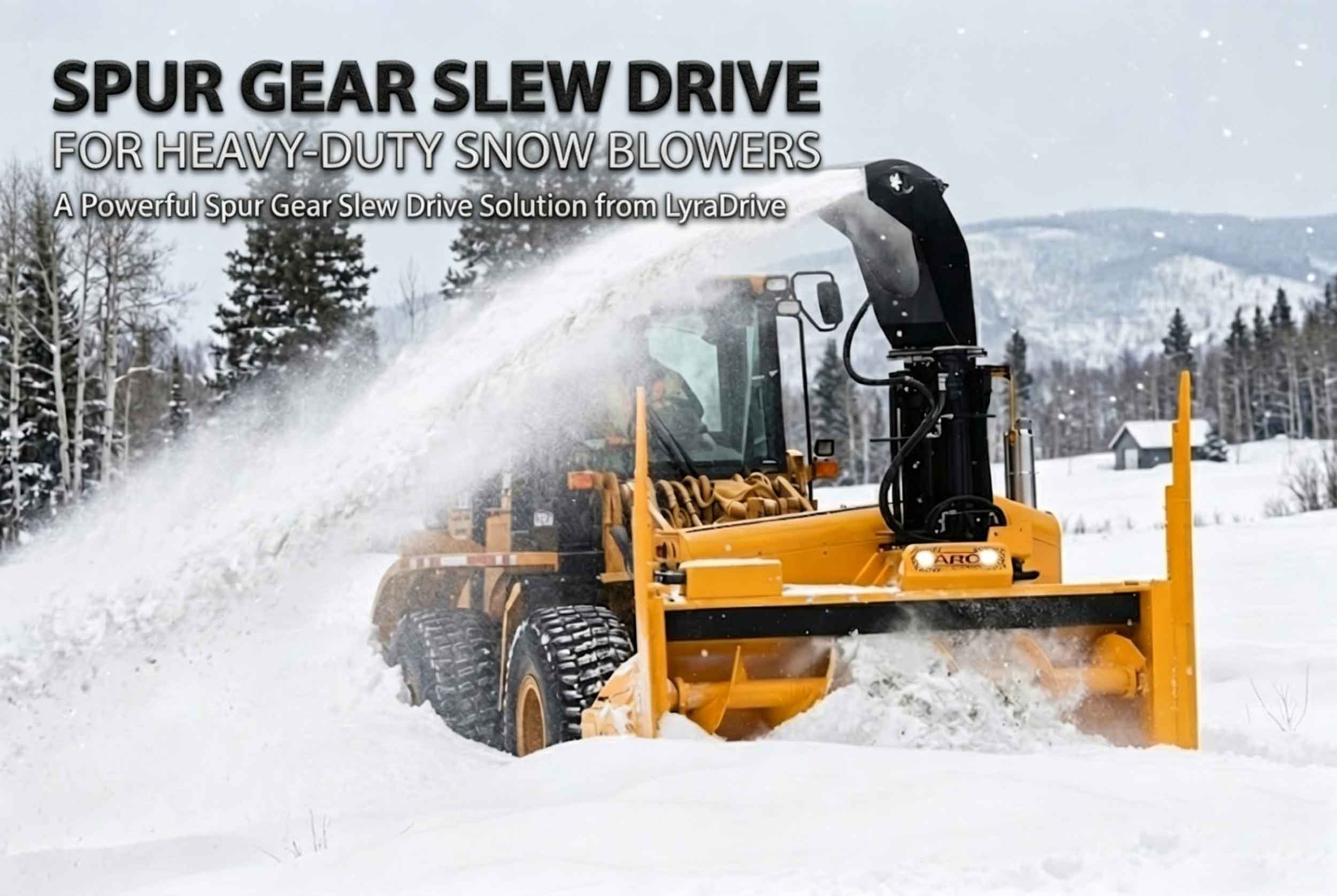
Spur Gear Slew Drives for Heavy-Duty Snow Blowers
When winter weather brings sub-zero temperatures, heavy snow accumulation, and icy conditions, municipal and industrial clearing operations rely heavily on heavy-duty snow blowers. These high-performance machines must operate continuously in harsh, freezing environments, clearing thousands of tons of dense, packed snow and solid ice from airport runways, highways, and urban streets.
In these demanding conditions, equipment reliability depends entirely on the performance of its critical mechanical components. Among these, the rotation system responsible for controlling the directional movement of the discharge chute is vital to overall operational efficiency. While equipment designers historically evaluated several rotational mechanisms, the spur gear slew drive has established itself as the modern industry standard for snow removal applications.
This comprehensive guide explores the engineering principles, operational advantages, selection criteria, and maintenance frameworks of spur gear slew drives explicitly designed for heavy-duty snow blowers.
What is a Spur Gear Slew Drive for a Snow Blower?
A spur gear slew drive is an integrated, fully enclosed rotational assembly engineered to transmit high output torque while simultaneously supporting high axial, radial, and overturning moment loads. In heavy-duty snow removal equipment, this specialized drive serves as the critical structural and mechanical pivot that connects the stationary main chassis or blower head housing to the articulating, high-velocity discharge chute.
The mechanical process begins when input power from the motor flows directly into the driving pinion gear. This pinion utilizes a parallel axis mesh to drive the internal or external gear ring of the slewing bearing. This sequence effectively converts input torque into smooth, controlled rotational movement for the discharge chute. Mechanically, the system comprises a high-precision slewing ring bearing integrated with straight-cut cylindrical gear teeth machined along either its internal or external perimeter. This gear ring meshes precisely with a heavy-duty driving pinion gear shaft supported by rugged internal bearings. The entire gear mesh mechanism is protected by a cast iron or high-strength steel housing.
Unlike worm gear drives, which utilize a perpendicular screw-thread design, a spur gear configuration features a parallel axis layout where the teeth mesh parallel to the rotational axis. This design minimizes internal friction, allowing for high-efficiency rotational power transmission.
Key Features of a Spur Gear Slew Drive for Snow Blowers
To function reliably in sub-zero environments, a spur gear slew drive designed for snow removal equipment incorporates several distinct engineering features:
High Thermal Resilience Metallurgical Engineering
Extreme cold can cause standard carbon steels to become brittle, increasing the risk of structural failure under sudden impact. Slew drives engineered for arctic conditions utilize specialized low-temperature alloy steels, such as 42CrMo or 50Mn. These materials undergo precise heat treatment processes to maintain material toughness and fatigue resistance at temperatures as low as -40°C.
Parallel Axis Gearing Layout
The straight-toothed cylindrical gear profile transfers mechanical forces directly across the pitch circle line without generating the high axial thrust forces common in bevel or worm gear configurations. This parallel load distribution reduces internal structural stress on the housing, resulting in smooth, predictable rotation even when under load from dense, wet snow.
Advanced Environmental Ingress Protection
Melting snow, pulverized ice crystals, and corrosive highway de-icing salts present a significant threat to internal bearings and gear teeth. High-performance winter drives feature advanced multi-lip rotary seals rated to IP65 or IP66 standards. These specialized elastomer seals remain flexible in extreme cold, containing premium internal lubricants while preventing moisture, ice, and salt brine from entering the internal raceways.
How Does a Spur Gear Slew Drive Work in a Snow Blower?
The mechanical operation of a spur gear slew drive in a heavy-duty snow blower involves a straightforward, direct power transmission sequence:
First, Input Power Generation: The snow blower’s primary hydraulic system or auxiliary electric servo motor delivers input rotational torque directly to the drive's pinion shaft.
Second, Direct Gear Meshing: As the pinion gear rotates, its precision-machined, hardened teeth mesh directly with the internal or external straight teeth cut into the large slewing ring bearing.
Third, Rotational Output Transfer: The stationary ring of the slewing bearing is bolted securely to the snow blower's main frame structure, while the rotating ring is anchored directly to the base of the discharge chute assembly.
Finally, Controlled Chute Articulation: This parallel tooth engagement transfers rotational power with high mechanical efficiency, turning the discharge chute smoothly and adjusting the trajectory of flying snow up to 360 degrees.
This direct-drive design enables rapid deceleration, immediate stopping, and instant directional reversals. This responsiveness allows operators to quickly adjust the discharge angle to match changing street conditions, roadside obstacles, or wind directions.
Key Advantages: Spur Gear Slew Drive vs. Worm Gear Slew Drive in Snow Removal
When evaluating alternative rotational technologies for industrial snow clearing equipment, the spur gear design offers undeniable performance benefits:
Mechanical Efficiency: Spur gears offer very high efficiency (95% to 98%), while worm gears are typically moderate to low (40% to 70%).
Operating Speed: Spur gears are ideal for rapid adjustments, whereas worm gears are constrained by sliding friction.
Heat and Condensation: Spur gears have negligible thermal cycles; worm gears create high internal friction heat.
Shock Load Resistance: Spur gears provide high impact energy absorption, while worm gear threads are vulnerable to shearing.
Superior Rotational Speed and Efficiency
Spur gears operate primarily through rolling contact rather than sliding contact. This yields a mechanical efficiency of up to 98%, allowing for significantly faster rotational speeds at lower input power levels. This enables the discharge chute to pivot across its full range of motion almost instantly.
Anti-Freezing Operation and Moisture Control
Worm gear drives rely on sliding friction, generating localized heat during operation. When the machine stops in freezing air, this cooling can cause internal condensation that freezes and locks the gear mechanism. Spur gear drives generate minimal frictional heat, keeping internal temperatures stable and reducing the risk of ice binding.
High Shock Load and Impact Energy Absorption
During high-capacity snow clearing, the discharge chute can experience sudden, violent shock loads from hitting solid ice or hidden curbs. While worm gear threads are susceptible to stress concentration and shearing, the robust, wide-tooth geometry of a spur gear drive distributes impact energy across multiple teeth simultaneously.
Typical Applications: Where is the Spur Gear Slew Drive Deployed in Snow Blowers?
Spur gear slew drives are used across several critical sub-systems within industrial and municipal snow removal machinery:
High-Capacity Discharge Chute Positioning
The primary application is managing the 360-degree rotation of oversized discharge chutes. These chutes must continuously redirect a high-volume stream of heavy snow away from traffic lanes or into haul trucks. Placed directly between the main blower chassis and the discharge chute assembly, the drive provides the speed needed for adjustments and the holding torque required to resist high aerodynamic backpressure and intense overturning moments.
Front-End Cleaving and Cutting Head Articulation
On large-scale runway sweepers and highway blowers, the entire front cutting head or auxiliary broom must pivot to follow pavement banking or clear angled snowbanks. Heavy-duty spur gear slew drives are integrated into these structural pivot points to tilt, angle, and lock heavy front attachments in position under extreme forward thrust loads.
How to Choose the Right Spur Gear Slew Drive for a Snow Blower?
Selecting the proper spur gear slew drive requires careful engineering analysis:
Dynamic Overturning Moment Calculations: Calculations must account for more than just static weight. Engineers must factor in the maximum overturning moment torque generated by the aerodynamic force and backpressure of dense snow moving through the chute at high velocities.
Low-Temperature Environmental Specifications: Ensure all components—including steel alloys, rolling elements, and seals—are certified for low-temperature impact testing at the machine's minimum operating temperature.
Backlash and Vibrational Management: Specifying a drive with controlled, precision-calibrated internal backlash helps ensure smooth operation and reduces wear on gear teeth while preventing binding due to thermal contraction.
Maintenance Best Practices for Extending Spur Gear Slew Drive Longevity in Winter Conditions
To maximize service life and prevent downtime, maintenance teams should follow a structured routine:
Seasonal Lubrication Protocol
Standard industrial greases can freeze in sub-zero conditions, causing potential gear binding. Maintenance teams should clean out the housing before winter and inject premium low-temperature synthetic lubricants containing extreme-pressure (EP) additives that maintain a consistent film at temperatures down to -40°C.
Salt Residue Flushing and Seal Inspections
Equipment is often exposed to corrosive de-icing salts. After shifts, the exterior housing should be rinsed. Personnel should also inspect rubber lip seals for cracks or signs of weeping grease, as damaged seals must be replaced immediately to prevent corrosive water from infiltrating the internal raceways.
LyraDrive: Your Trusted Partner for Custom Spur Gear Slew Drives in Snow Removal Equipment
When standard components cannot meet the unique performance or environmental requirements of specialized machinery, LyraDrive provides precision-engineered solutions. As a global manufacturer specializing in the engineering, production, and sale of advanced rotational systems, LyraDrive manages the entire product lifecycle—from initial engineering and custom metallurgy to precision tooth cutting and rigorous low-temperature testing.
We specialize in developing custom spur gear slew drives optimized for high-capacity snow blowers and winter maintenance equipment. Our engineering team collaborates directly with OEM design teams to deliver tailored torque profiles, custom mounting bolt configurations, specialized anti-corrosion coatings, and modular interfaces that seamlessly integrate into your existing machine chassis.
Enhance your equipment's winter reliability, optimize directional control, and reduce field maintenance costs with field-proven rotational technology. Contact the LyraDrive engineering desk today to consult with a specialist or download our latest product catalog!
FAQs About Spur Gear Slew Drives for a Snow Blower
Q1: Why are spur gear slew drives preferred over worm gear drives for high-capacity snow blower chutes?
A: They require rapid chute rotation. Spur gear drives deliver faster speeds and high mechanical efficiency (over 95%), and they dissipate heat easily to prevent internal condensation from freezing and binding the gears.
Q2: How do LyraDrive spur gear slew drives prevent moisture from melting snow from entering the gear assembly?
A: Our drives feature specialized, low-temperature resilient multi-lip seals (rated up to IP66) that remain flexible in freezing conditions, blocking water and corrosive highway salt brines from infiltrating internal raceways.
Q3: Can a spur gear slew drive handle the vibration and shock when a snow blower strikes solid ice?
A: Yes. LyraDrive components use high-strength alloy steels with precision induction hardening, creating a wear-resistant surface while preserving a shock-absorbing core that resists fracturing under impact.
Q4: What type of grease should be used for a spur gear slew drive operating in extreme winter conditions?
A: We recommend premium low-temperature synthetic lubricants containing extreme-pressure (EP) additives that maintain viscosity and do not harden at temperatures as low as -40°C.
Q5: Is it possible to retrofit a custom LyraDrive spur gear slew drive onto an existing snow blower design?
A: Yes. LyraDrive offers flexible customization, including custom bolt patterns and modular motor flanges, allowing equipment owners to upgrade rotational systems without extensive chassis redesign.
 WhatsApp
 sales@lyradrive.com
 +8613903880726