



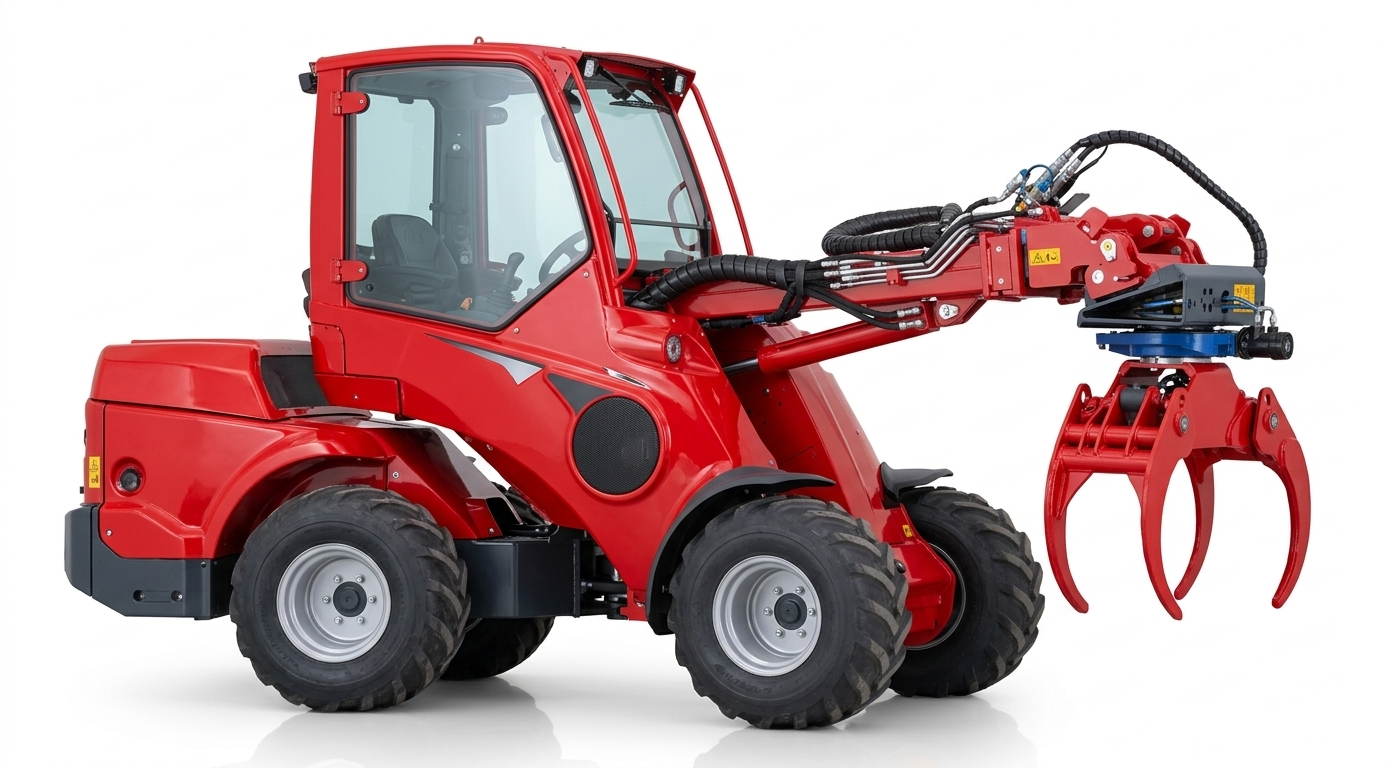
Spur Gear Slew Drive for Multi-function Grab Machine
What is a Spur Gear Slew Drive in a Multi-function Grab Machine?
A spur gear slew drive is a compact, high-torque rotational bearing and gearbox combination. Unlike worm gear slew drives that rely on a sliding action, the spur gear version uses straight-cut teeth (spur gears) to transfer motion. In a Multi-function Grab Machine, this drive is typically mounted at the upper structure (the excavator base) or directly on the rotating head of the grapple.
Essentially, it is the "wrist" of the machine. The drive supports the entire hanging weight of the grab plus the payload (e.g., 2 tons of scrap metal) while providing 360-degree continuous rotation. The "spur gear" designation refers to the internal or external ring gear that meshes with a pinion, driven by a hydraulic or electric motor.
The Critical Role of the Spur Gear Slew Drive in Multi-function Grab Machines
The role of this component extends far beyond simple rotation. In a multi-function grab machine, the slew drive performs three critical functions:
A. Load Management
The grab machine often operates in dynamic, shock-loading conditions. When the grab bites into a pile of construction debris, the reaction torque is transmitted directly to the slew drive. The spur gear design distributes these forces across multiple teeth, preventing catastrophic failure.
B. Precision Positioning
Unlike traditional excavators, grab machines often need to dump material into narrow hoppers or trucks. The low backlash characteristic of a well-made spur gear slew drive allows the operator to stop the grab at an exact angle.
C. Safety Redundancy
A seized or failed slew drive can cause the grab to drop its load or swing wildly. A high-quality spur gear slew drive provides a safety margin through its material hardness and design, ensuring that even under extreme wear, the grab remains controllable.
How Does a Spur Gear Slew Drive Work in a Multi-function Grab Machine?
Understanding the mechanics requires a look at three sub-systems:
Step 1: Power Input
A hydraulic motor (most common) or electric motor is mounted to the input shaft of the slew drive. This motor spins at high RPM but low torque.
Step 2: Gear Reduction
Inside the drive housing, a series of spur gear stages (typically 2 to 4 stages) reduce the speed while multiplying torque. For example, a 2000 RPM input might be reduced to 2 RPM at the output ring gear. The final stage is a pinion gear that meshes with a large diameter spur gear ring.
Step 3: Rotation and Support
The large ring gear is integrated with a cross-roller or ball bearing. As the pinion turns, it walks around the stationary ring gear (or vice versa, depending on design). This causes the upper part of the grab machine to rotate. The bearing simultaneously handles axial (vertical), radial (horizontal), and tilting moment loads.
Key distinction from worm drives: Spur gears offer efficiency (95%+ vs. 70% for worm) but do not self-lock. This is ideal for grab machines, where continuous free-wheeling is not an issue because the brake is in the motor or valve system.
The Key Features of the Spur Gear Slew Drive in Multi-function Grab Machine
When specifying a spur gear slew drive for a grab machine, look for these non-negotiable features:
High Moment Load Capacity – The drive must resist the tilting force when the grab is fully loaded and extended to the side.
Integrated Bearings – Cross-roller bearings are preferred over ball bearings for their rigidity and ability to handle shock loads.
Double-row Gearing – For heavy-duty applications, a double-row spur gear arrangement increases tooth contact area, reducing wear.
Sealing System – Triple lip seals (nitrile or polyurethane) to keep out dust, water, and abrasive fines.
Internal Lubrication Circuit – Ports for grease or oil bath lubrication to ensure the spur teeth never run dry.
Key Advantages of a Spur Gear Slew Drive in Multi-function Grab Machines
Why choose spur gear over planetary or worm gear slew drive (insert internal link here)? Here are the tangible advantages:
| Feature | Benefit for Grab Machine |
|---|---|
| High Efficiency | Lower hydraulic power loss means faster rotation and less fuel consumption. |
| Constant Velocity | No stick-slip effect at low speeds, allowing smooth micro-rotation. |
| Easy to Manufacture | Spur gears are simpler to produce to high tolerances, reducing cost. |
| Excellent Heat Dissipation | Open tooth meshing allows heat to escape, critical in continuous duty cycles. |
| Servicability | Inspection ports allow visual check of tooth wear without full disassembly. |
Furthermore, a spur gear slew drive handles reversible loads well. When the grab releases a heavy load quickly, the back-driving force is managed by the gear teeth without damaging the motor.
Design and Material Focus: Built for Harsh Spur Gear Slew Drive Environments
The environment of a scrap yard or bulk port is brutal. Dust, humidity, temperature extremes (-20°C to +50°C), and abrasive particles are the norm. Therefore, the materials matter.
Gear Steel: High-quality spur gear slew drives use 42CrMo4 or equivalent alloy steel, through-hardened to 55-60 HRC on the tooth surface, with a softer core (30-40 HRC) to absorb impacts. This case-hardened process prevents tooth fracture under shock loads.
Bearing Raceways: Induction hardened to 58-62 HRC to prevent brinelling (surface indentation).
Corrosion Protection: For marine grab machines (e.g., unloading salt from ships), a zinc-nickel coating or two-component epoxy paint is mandatory.
Working with an experienced supplier ensures these material specifications are met. For instance, LyraDrive engineers their spur gear slew drives for multi-function grabs with IP66-rated seals and stainless steel fastener options, along with customized tooth profiles to reduce stress concentration in high-impact applications.
How to Choose the Right Spur Gear Slew Drive for Your Multi-function Grab Machine?
Selecting the wrong slew drive leads to premature failure within months. Follow this 5-step checklist:
Step 1: Calculate the Static Moment Load (M)
Formula: M = Load (kg) × Distance (m) from rotation center. Add a safety factor of 1.5 for dynamic impacts.
Step 2: Determine the Required Output Torque
Given the grab's operating pressure (bar) and motor displacement (cc/rev), calculate the torque needed to overcome the load inertia.
Step 3: Check the Gear Ratio
Too high a ratio means slow rotation; too low means the motor cannot start the load. Most grab machines use ratios between 1:50 and 1:200.
Step 4: Environmental Protection
Dusty environment → Extra labyrinth seals.
Wet environment → Stainless steel output shaft.
Step 5: Integration with Your Existing Hydraulic Motor
Does the slew drive's input shaft match your motor's spline or keyway? Custom adapters may be needed.
Pro Tip: Always request a torque vs. speed curve from the manufacturer. A reliable supplier will provide this data for your specific grab machine model, including FEA analysis of the housing under maximum tilting moment.
Essential Maintenance Practices for Your Spur Gear Slew Drive
A neglected slew drive is the number one cause of unscheduled downtime. Implement this maintenance schedule:
Daily (Operator Checklist)
Listen for grinding or clicking noises during rotation – indicative of tooth debris.
Check seals for grease leaks or ingress of dirt.
Verify that the rotation is smooth; jerky movement suggests bearing damage.
Monthly (Preventive)
Grease replenishment: Use NLGI #2 lithium grease with EP additives. Pump until fresh grease exits the purge valve (to expel contaminated old grease).
Torque check: Tighten housing mounting bolts to specified value (e.g., 400 Nm for M24 bolts). Loose bolts cause flexing and gear misalignment.
Quarterly (In-depth)
Sample the grease for metal particles. A magnetic plug can capture ferrous wear debris.
Measure backlash. Place a dial indicator on the grab arm and rotate back-and-forth. Acceptable backlash is typically 0.5-1.5 mm at the periphery for a used drive.
Annual (Overhaul)
Disassemble, clean, and inspect all spur gear teeth for pitting or spalling.
Replace cross-roller bearing if radial play exceeds 0.3 mm.
LyraDrive: Custom Spur Gear Slew Drive Manufacturer for Multi-function Grab Machines
LyraDrive is a professional slew drive supplier designing and delivering slew drives that are customizable, high-quality, and competitively priced. The company delivers full‑scope customized slew drive solutions to match your unique application requirements.
What sets LyraDrive apart is its commitment to personalized customization across all core parameters, including dimensions, output torque, gear ratio, mounting flange, input shaft, housing structure, material, sealing grade, protection level, and motor integration. The customizable slew drives cover a size range from 100 mm to 5000 mm, with precision grades reaching P0, P6, P5, P4, and even P2 for high‑precision applications.
Whether you need drives for heavy‑load machinery, high‑speed automation, corrosion‑resistant marine environments, dust‑proof construction sites, or medical‑grade clean conditions, LyraDrive tailors every detail to deliver stable, reliable, and long‑lasting performance.
With worm slew drives, spur gear slew drives, and worm gear drives, LyraDrive includes a wide range of solutions for steering, turning, and swiveling applications. For multi-function grab machine owners specifically, LyraDrive offers:
Bespoke spur gear geometries – Modified tooth profiles to increase contact ratio for shock loads.
Integrated rotation sensors – Built-in encoders for automation-ready grab machines.
Short lead times – Typically 4-6 weeks for a custom slew drive.
Just submit your requirement via email, and LyraDrive will offer a design with 3D files. This digital twin approach allows your engineering team to verify the fit before machining a single component.
FAQs about Spur Gear Slew Drive for Multi-function Grab Machine
Q1: Can I replace a worn worm gear slew drive with a spur gear version on my existing grab machine?
Yes, but you must modify the braking system. Worm drives self-lock; spur gears do not. Install a hydraulic holding valve or spring-applied parking brake on the motor to prevent the grab from free-falling when the hydraulic pressure is removed.
Q2: How do I know if my spur gear slew drive has tooth damage?
Listen for a "clunking" sound at the same rotation point. Also, check the grease: silver/gray paste indicates steel wear; brass-colored particles suggest bearing cage failure. A vibration analysis sensor (accelerometer) mounted on the housing can detect early-stage pitting.
Q3: What is the typical lifespan of a spur gear slew drive in a scrap metal grab machine?
*In heavy scrap duty (8 hours/day, 5 days/week), expect 3-5 years before needing a major rebuild. In lighter duty (wood chips or grain), 7-10 years is common. Proper lubrication doubles lifespan.*
Q4: Are there maintenance-free spur gear slew drives?
*Not truly. Some manufacturers offer "lifetime lubricated" sealed units, but in abrasive grab machine environments, the seals fail within 2 years. Always choose a re-greasable design with a purge port.
Q5: How does LyraDrive ensure the spur gear teeth mesh perfectly under misalignment?
*LyraDrive uses a patented housing design with integrated spherical seats that allow the pinion housing to self-align by ±0.5 degrees. This prevents edge loading (contact only on the tooth ends), which is a common failure mode in rigidly mounted slew drives
 WhatsApp
 sales@lyradrive.com
 +8613903880726