



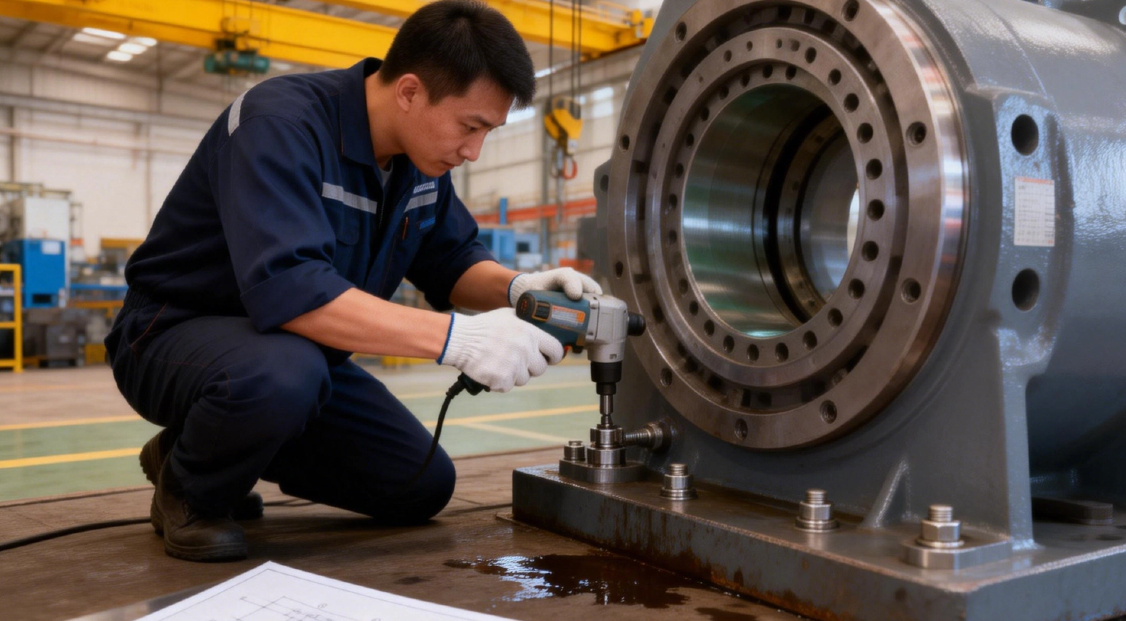
Slewing Bearing Installation Problems and Solutions
Slewing bearings are the crucial rotating joints in heavy machinery. Their performance and lifespan depend heavily on one often-overlooked factor: correct installation. Even the highest quality bearing can fail prematurely if installed improperly. This guide explains what slewing bearings are, how they work, details the most common installation mistakes, and provides clear solutions to ensure reliable, long-lasting operation.
What is a Slewing Bearing?
A slewing bearing is a large, ready-to-install bearing designed to handle immense loads while allowing for smooth, controlled rotation. Unlike standard bearings that mainly support a shaft, slewing bearings are built to manage combined loads—simultaneously supporting weight (axial load), sideways forces (radial load), and tipping moments.
They are essential components in a wide range of heavy-duty applications, including:
Construction Equipment: Excavators, mobile cranes
Renewable Energy: Wind turbine yaw and pitch systems, solar trackers
Material Handling: Stacker-reclaimers, rotary conveyors
Industrial Machinery: Turntables, welding positioners
How Does Slewing Bearing Work?
Think of a slewing bearing as a robust, precision-made "washer" that sits between two structures. Its core parts work together to minimize friction and enable rotation under heavy load:
Inner and Outer Rings: Two large steel rings. One is bolted to the stationary part of the machine (e.g., a crane's undercarriage), and the other to the rotating part (e.g., the crane's cab).
Rolling Elements: Balls or rollers that sit in machined grooves called raceways between the rings. They carry the load and roll smoothly to allow movement.
Gear Teeth: Often integrated directly onto one of the rings. A small pinion gear from a motor meshes with these teeth to drive the rotation.
Seals: Rubber seals that keep lubricating grease inside and dirt, water, and debris out.
Mounting Holes: Holes for bolts that securely fasten the entire bearing assembly to the machine structure.
The Common Issues of Slewing Bearings Installation
Most slewing bearing failures can be traced back to mistakes made during installation. Here are the most frequent and critical issues:
Dirty or Uneven Mounting Surface: If the machine frame where the bearing sits has dirt, old paint, weld spatter, or is not flat, the bearing rings will be forced into a distorted shape when bolted down. This creates internal stress points.
Incorrect Bolt Tightening: This is a major culprit. Mistakes include not using a torque wrench, tightening bolts in a circle (which warps the ring), or skipping the recommended multi-stage tightening process. This leads to uneven clamping force.
Misalignment: If the bearing is not perfectly centered or is tilted relative to the machine's axis of rotation, the load is concentrated on a small section of the rolling elements instead of being evenly distributed.
Ignoring the "Hard Spot": Most large slewing bearings have a localized hardened zone, usually marked with an "S" or "HS." This area is less flexible and must be positioned in a low-load zone of the machine's operation. Placing it in a high-stress area risks cracking.
Inadequate Lubrication at Startup: Failing to properly lubricate the raceways before the first rotation causes immediate metal-to-metal contact, scoring the surfaces from day one.
The Solutions for Improper Slewing Bearings Installation
Preventing the issues above requires a careful, step-by-step approach. Follow this proven procedure:
Prepare the Surface (Most Important Step): Clean the mounting surface meticulously. Remove all rust, paint, and debris. Use a straightedge to check for flatness across the entire contact area. Grind down any high spots.
Handle with Care: Lift the bearing using its provided lifting lugs or with soft slings around the ring—never by the cables or seals.
Position Strategically: Before lowering the bearing, identify the marked hard spot. Consult your machine drawings to orient this hard spot into the designated area of minimum load.
Follow the Bolting Protocol:
a. Use clean, dry bolts of the specified grade.
b. Start all bolts by hand.
c. Using a calibrated torque wrench, tighten the bolts in a star or cross pattern (like tightening a car wheel). This spreads pressure evenly.
d. Tighten in three stages (e.g., 30%, 60%, then 100% of the final torque value), following the star pattern each time.
Lubricate and Check: Before the first rotation, pump the correct type of grease into all fittings until fresh grease purges from the seals. After installation, rotate the bearing by hand; it should move smoothly and quietly.
LyraDrive Ensures Proper Slewing Bearing Installation
At LyraDrive, we know that a great product is only as good as its installation. That’s why our commitment to quality extends beyond manufacturing.
Our Proactive Support Includes:
Clear Documentation: Every LyraDrive slewing bearing comes with detailed, easy-to-understand installation guides that specify exact torque values, hard spot orientation, and lubrication requirements.
Precision Engineering: We manufacture our bearings to exacting tolerances. This consistency and quality make proper installation more straightforward and reliable.
Expert Technical Support: Our engineering team is ready to assist. We can provide pre-installation consultation, review your mounting design, and offer solutions to prevent common problems before they occur.
We don't just sell bearings; we deliver complete reliability solutions. Partnering with LyraDrive gives you more than a component—it gives you the confidence of optimal performance, maximized equipment uptime, and expert support.
FAQ: 10 Common Questions About Slewing Bearing Installation
Q1: How can I tell if my mounting surface is flat enough?
A: Use a precision straightedge and a feeler gauge. The maximum allowable gap between the straightedge and the surface is typically specified by the bearing manufacturer (e.g., 0.1 mm per meter). If a feeler gauge slides through, the surface needs to be re-machined.
Q2: Why is a torque wrench absolutely necessary?
A: Bolts tightened by "feel" or with impact wrenches are almost always uneven, causing distortion. A calibrated torque wrench ensures even, manufacturer-specified clamping force, which is critical for maintaining the bearing's roundness and load capacity.
Q3: What happens if I tighten the bolts in a circle instead of a star pattern?
A: Tightening in a circle warps the bearing ring, making it oval. This creates uneven load paths on the rolling elements, leading to premature wear, increased noise, and potential brinelling (dent marks) on the raceways.
Q4: Where do I find the "Hard Spot," and why is its position so important?
A: The hard spot is a localized, induction-hardened zone on the bearing ring, clearly marked with an "S," "HS," or a painted dot. Its material is less ductile. If placed in a high-stress area, it can become a focal point for crack initiation and catastrophic failure. Always position it in the designated low-load zone per the machine's design.
Q5: Can I use any high-grade grease for initial lubrication?
A: No. Always use the grease type specified by the bearing manufacturer. Their recommendation is based on the optimal viscosity and additives for the bearing's internal clearances, operating temperature, and speed to ensure proper lubricant film formation.
Q6: Is it okay if the bearing feels a little stiff when I rotate it by hand after installation?
A: A slight, uniform resistance is normal, especially in new bearings with seals. However, any grinding, catching, or areas of significantly higher resistance indicate a problem such as misalignment, contamination, or improper seating. Investigate before operation.
Q7: What should I do if I discover dirt got into the bearing during installation?
A: Stop immediately. Do not rotate the bearing. If possible, carefully disassemble and clean the bearing completely with solvent, dry it thoroughly, and re-lubricate. If contamination is severe or disassembly is not feasible, consult the manufacturer, as the bearing may be compromised.
Q8: How often should I re-torque the mounting bolts?
A: Re-check the bolt torque after the first 50-100 hours of operation, as initial settling can occur. Thereafter, include bolt torque checks in your routine periodic maintenance schedule (e.g., every 500-1000 operating hours or as recommended).
Q9: Can I install a slewing bearing without alignment pins or dowels?
A: While it is technically possible, it is strongly discouraged. Alignment pins/dowels guarantee perfect centering and prevent any shifting during the bolting process. Without them, achieving and maintaining perfect alignment is much more difficult and increases the risk of misalignment.
Q10: Who should I contact if I'm unsure about any step in the installation process?
A: Always contact the bearing manufacturer or your supplier first. At LyraDrive, our technical support team is specifically trained to provide installation guidance. Providing us with photos or details of your setup allows us to give the most accurate advice to prevent costly errors
 WhatsApp
 sales@lyradrive.com
 +8613903880726