



Application Of Slewing Bearing On Positioner
In many workshops and factories, positioners are essential tools that make complex manufacturing tasks, like welding large parts, safer and more efficient. They work by holding and rotating heavy workpieces so operators can work on them from the best angle. At the heart of this reliable movement is a powerful component called a slewing bearing.
What is Slewing Bearing?
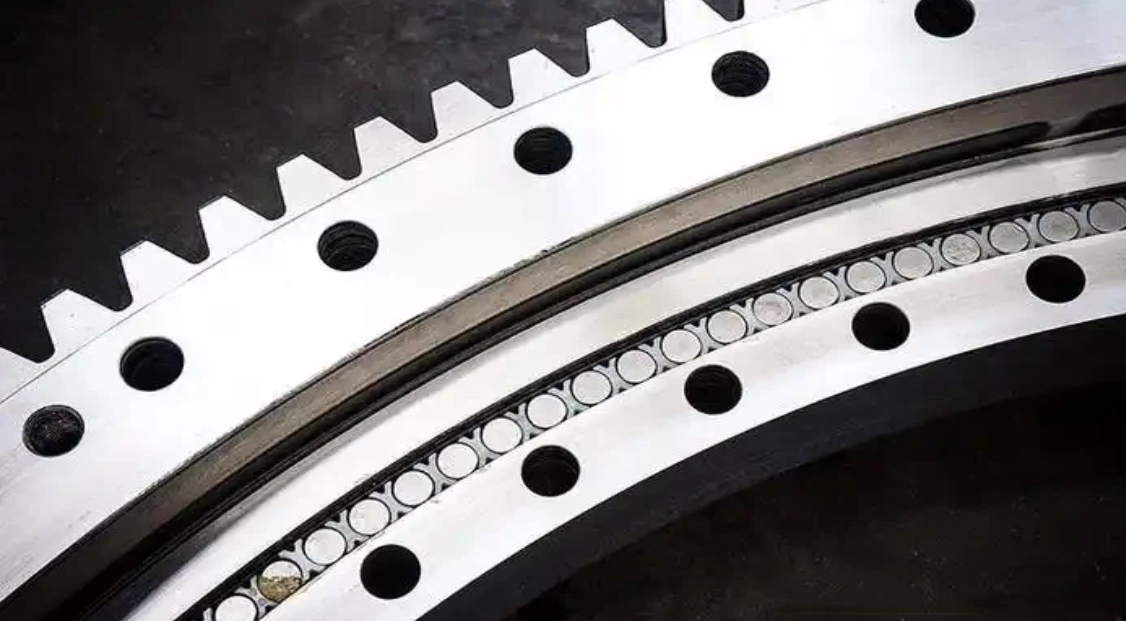
Think of a slewing bearing as a super-strong, heavy-duty turntable. It's a large, flat ring, packed with rolling elements, designed to be bolted directly between two structures. Its job is to allow one part (like a machine's rotating platform) to turn smoothly on top of another (the fixed base), while supporting very heavy loads from all directions – up and down, side to side, and twisting forces. It's this ability to handle combined loads that makes it perfect for heavy-duty positioners.
In Which Types of Positioners are Slewing Bearings Commonly Used?
Slewing bearings are the core of rotation in many different positioners. You'll commonly find them in:
Welding Positioners: The most common type. They rotate and tilt large weldments for easier access.
Manipulators: Often paired with a boom, these provide both rotation and movement for handling very large or awkward parts.
Headstock/Tailstock Positioners: Used for rotating long, cylindrical parts like pipes or shafts during machining or welding.
Tilting Positioners: Designed to tilt a workpiece for overhead or gravity-position welding.
Indexing Tables: Used in automated production to rotate a part to precise, repeated positions for machining or assembly.
Model and Specification of Slewing Bearing Used on Different Positioners
The best slewing bearing for the job depends on the type of positioner and the loads involved. Here's a simple guide:
| Positioner Type | Typical Load & Motion | Recommended Slowing Bearing Type |
|---|---|---|
| Standard Welding Positioner | Heavy, often off-center loads; 360° rotation. | Double Row Ball Bearing (e.g., 02 series). Handles heavy weight and tilting forces well. |
| High-Precision Indexing Table | Moderate weight; requires extremely accurate, rigid positioning. | Crossed Roller Bearing (e.g., X/CR series). Offers top precision and stiffness. |
| Heavy-Duty Manipulator | Very heavy, dynamic loads with potential for shock. | Three Row Roller Bearing (e.g., 13 series). Maximum strength for the toughest jobs. |
| Light-Duty / Benchtop Positioner | Lighter workpieces; cost-sensitive applications. | Single Row Ball Bearing (e.g., Q/01 series). A reliable and economical choice. |
Key Specs to Consider: Size (inner/outer diameter), load capacity (the most important!), gear type (for the drive motor), and sealing (to keep out weld spatter and dirt).
How Does Slewing Bearing Work on Positioner?
The operation is straightforward but powerful:
It's the Foundation: The bearing is bolted between the positioner's base (stationary) and its table or head (rotating).
It Gets Powered: An electric or hydraulic motor spins a small pinion gear.
It Transmits Force: This pinion gear meshes with larger gear teeth that are cut directly into the slewing bearing's ring.
It Creates Motion: As the pinion turns, it drives the entire bearing—and the workpiece attached to it—to rotate smoothly.
It Holds Everything Up: Throughout this, the bearing's internal balls or rollers carry all the weight and forces, keeping everything stable.
The Advantages of Slewing Bearings in Positioner
Using an integrated slewing bearing is better than building a rotation system from separate parts. Here’s why:
All-in-One Design: It combines support, rotation, and drive connection in one compact unit, saving space and simplifying your machine design.
Built for Heavy Loads: It's engineered from the ground up to handle the large, unbalanced loads typical in industrial work.
Precision & Smoothness: It provides steady, controlled movement, which is crucial for achieving high-quality, consistent welds or machined parts.
Durability & Easy Care: Made from tough materials and sealed against contaminants, it's built to last with simple, regular lubrication.
LyraDrive Can Provide High-Performance Slewing Bearings for Your Positioner
Choosing the wrong bearing can lead to a positioner that is shaky, imprecise, or breaks down too soon. The right bearing is the key to reliability and performance.
That's where LyraDrive makes the difference. We are experts in slewing drive and slewing bearing solutions. We'll work with you to analyze your specific positioner's needs—its load, motion, and work environment—to select the perfect slewing bearing.
When you partner with LyraDrive, you get:
Expert Matching: We help you choose the correct type, size, and specifications for long life and peak performance.
Quality You Can Trust: Our bearings are manufactured to high standards for durability in tough industrial settings.
Ongoing Support: We provide the technical guidance you need for a successful installation and operation.
Don't let the wrong bearing limit your equipment. Choose LyraDrive for the robust, precise rotational foundation your positioner needs to excel
 WhatsApp
 sales@lyradrive.com
 +8613903880726