



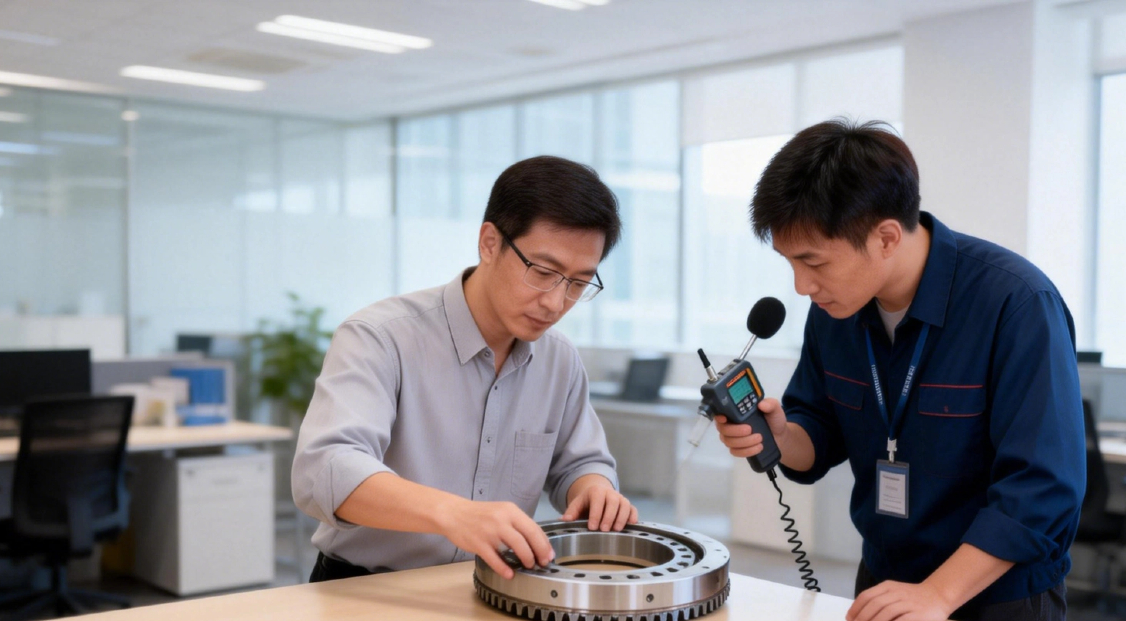
How to Solve the Noise Problem in the Operation of a Slewing Bearing?
The smooth, quiet hum of a slewing bearing is a sign of healthy operation. But when this sound turns into grinding, clicking, or rumbling, it’s more than just a nuisance—it's a clear signal that something is wrong. Unusual noise often points to accelerated wear, potential misalignment, or imminent failure, threatening equipment uptime and safety. This guide will help you understand why slewing bearings make noise and, more importantly, how to diagnose and solve these problems to restore quiet, reliable performance.
What is Slewing Bearing?
A slewing bearing (also called a turntable bearing) is not a typical small bearing. It’s a large-diameter, ready-to-mount mechanical component that acts as a robust “rotating joint” between two structures. Unlike standard bearings that primarily support a shaft, a slewing bearing is designed to handle combined loads—simultaneously managing axial force (thrust), radial force, and tilting moment loads—while enabling smooth, controlled rotation.
Key Components: A typical slewing bearing consists of an inner ring and an outer ring (one often with integrated gear teeth), rolling elements (balls or rollers), spacers or cages to separate them, and sealing systems to keep grease in and contaminants out.
Common Applications: You'll find them at the heart of countless heavy-duty machines, including cranes (for boom rotation), excavators (for the upper structure swing), wind turbines (in yaw and pitch drives), solar trackers, and medical imaging equipment.
What are the Characteristics of Slewing Bearings?
Slewing bearings are defined by several unique features that set them apart:
High Load Capacity: Their large size and optimized raceway design allow them to support immense weights and complex load combinations in a compact space.
Integrated Functionality: They often incorporate gear teeth (internal or external) directly on one of the rings, combining bearing and drive functions into one unit.
Slow-Speed, High-Torque Operation: They are engineered for precise, powerful rotation at low speeds rather than high-speed spinning.
Modular & Ready-to-Mount: Supplied as a complete, pre-assembled unit with mounting holes, they simplify machine design and installation.
How Does Slewing Bearing Work?
The principle is elegant in its simplicity. The inner and outer rings are fixed to the two machine structures that need to rotate relative to each other (e.g., a crane’s cab and undercarriage). The rolling elements (balls or rollers) sit in precision-machined raceways between these rings. When force is applied—typically via a pinion gear meshing with the bearing’s gear teeth—these rolling elements roll smoothly along the raceways, minimizing friction and enabling the two structures to rotate with remarkable efficiency and stability under heavy load.
What are the Causes of Noise in Slewing Bearings During Operation?
Noise is a symptom. Identifying the specific sound can point to the root cause:
| Type of Noise | Possible Causes | Likely Source |
|---|---|---|
| Grinding or Scraping |
| Direct metal-to-metal contact and abrasive wear. |
| Clicking or Popping |
| Elements hitting damaged spots as they roll. |
| Irregular Rumbling |
| Unstable movement and uneven load distribution. |
| Constant Howling |
| Excessive friction or slippage within the bearing assembly. |
Other Common Culprits:
Loose Mounting Bolts: Can cause creaking or knocking sounds and are a serious safety risk.
Gear Meshing Issues: Noise from the pinion gear (not the bearing itself) due to improper backlash, wear, or misalignment.
Corrosion: Rust on raceways or rolling elements disrupts smooth rolling.
How to Solve the Noise Problem in the Operation of Slewing Bearings?
Addressing noise requires a systematic approach, from simple checks to major interventions.
Step 1: Inspection & Diagnosis
Visual Check: Inspect seals for damage and look for signs of grease leakage or corrosion.
Listen & Feel: Use a mechanic’s stethoscope to locate the exact source of the noise. Feel for vibrations during operation.
Check Lubrication: Verify the grease type and quantity. Old, contaminated grease often turns black and gritty.
Torque Check: Use a calibrated torque wrench to verify all mounting bolts are tightened to the manufacturer's specification.
Step 2: Corrective Actions
For Lubrication Issues: Purge and re-lubricate thoroughly with the correct, high-quality grease specified for slewing bearings. Clean the grease nipples before injecting new grease until fresh grease is seen purging from all seals.
For Contamination: If debris has entered, a complete disassembly, professional cleaning, and re-greasing may be necessary. Investigate and fix the failed seal.
For Minor Wear & Noise: Increasing lubrication frequency can sometimes cushion early-stage wear and reduce noise temporarily, but this is not a permanent fix.
For Major Damage: If inspection reveals pitting, spalling (flaking), cracks, or severe brinelling on raceways or rolling elements, bearing replacement is the only reliable solution. Continuing operation will lead to catastrophic failure.
Step 3: Prevention is Key
Follow a Strict Lubrication Schedule. This is the single most important maintenance task.
Ensure Proper Installation. Use a precision level to confirm the mounting surface is flat and rigid. Tighten bolts in a star pattern to the correct torque.
Perform Regular Inspections. Make visual and auditory checks part of routine equipment maintenance.
LyraDrive Can Provide the Optimal Design and Solution for Your Slewing Bearings
At LyraDrive, we understand that a quiet bearing is a healthy, long-lasting bearing. Noise problems often stem from inherent weaknesses in design, material quality, or manufacturing precision. This is where our commitment to excellence provides the definitive solution.
We build high-performance slewing bearings and slew drives that are engineered to operate quietly and reliably from day one. Our products feature ultra-smooth, hardened raceways finished to micro-level precision, minimizing friction and vibration at the source. We utilize premium-grade rolling elements and advanced sealing systems to exclude contaminants effectively. Furthermore, our technical support team provides comprehensive guidance on optimal installation practices and maintenance schedules tailored to your specific application.
Choosing LyraDrive means investing in foundational reliability. We provide not just a component, but a guarantee of smoother operation, reduced downtime, and long-term peace of mind. Let us help you eliminate noise at its root cause
 WhatsApp
 sales@lyradrive.com
 +8613903880726