



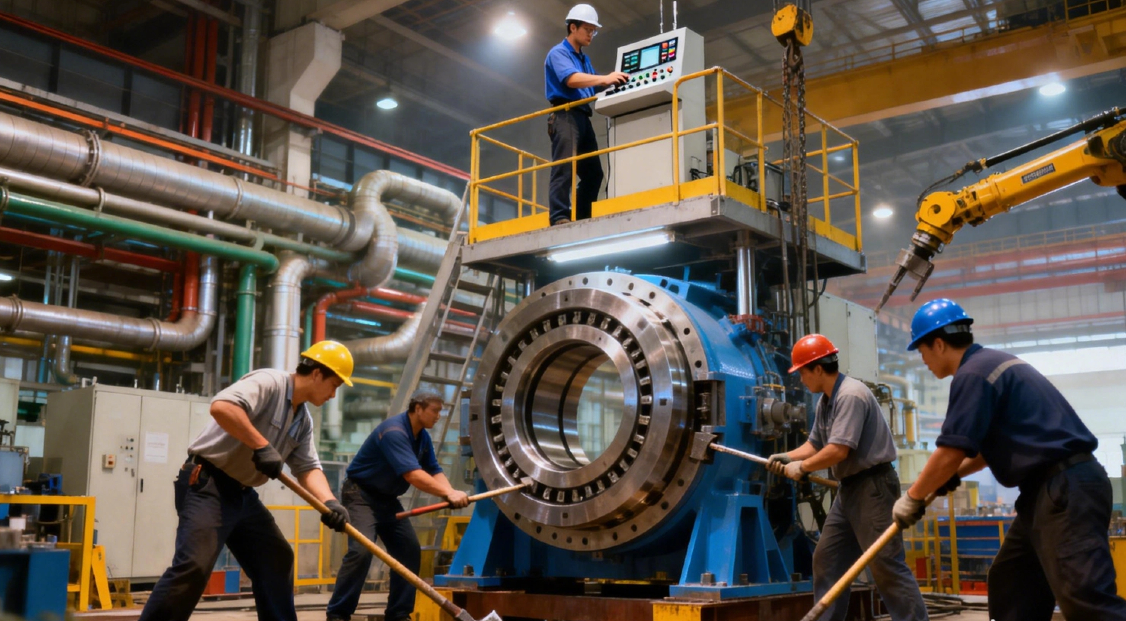
Slewing Bearing Installation Problem
What is Slew Bearing?
A slewing bearing is a large, heavy-duty bearing that allows smooth rotation between two objects under immense weight. It's the core component that handles the combined loads (like axial, radial, and tilting forces) in a rotating joint. Unlike a regular bearing, it's often a massive, flat ring with gear teeth on its side for direct drive. You'll find it at the heart of machinery like excavators, cranes, and wind turbines, where it enables parts to swing or turn reliably.
In which fields are slew bearings primarily used?
It is a fundamental component across several key industries:
Construction & Heavy Machinery:
This is the most common application. Slew bearings are essential in excavators (for 360° upper-structure rotation), mobile and tower cranes, and concrete pump trucks.
Renewable Energy:
They are critical in wind turbines (connecting the nacelle to the tower for yaw control) and solar tracking systems (tilting panels to follow the sun).
Defense & Aerospace:
Used in the turret rotation mechanisms of tanks and armored vehicles, as well as in radar antennas and satellite communication bases.
Material Handling:
Found in port cranes (container, gantry), stacker-reclaimers, and large mining equipment.
Industrial Automation:
Integral to heavy-duty welding positioners, rotary tables, and automated assembly lines.
In essence, from enabling an excavator to swing its arm to allowing a massive wind turbine nacelle to face the wind, the slew bearing is the crucial component that makes controlled, heavy-duty rotation possible.
What are the common issues and key precautions during the installation of a slew bearing?
Putting in a slewing bearing might look straightforward, but small mistakes during setup cause most early failures. Think of it like building a house—if the foundation isn't level and solid, problems will show up quickly. Here are the usual trouble spots:
First, a wobbly or uneven base is the biggest issue. If the surface where the bearing sits isn't flat, the bearing gets twisted when bolts are tightened. This bending puts extreme pressure on just one section of the balls or rollers inside. It's like a chair with one short leg—all your weight goes to one point. This leads to premature dents in the raceway, strange noises, and uneven wear.
Second, bad bolt tightening is a close second. People often use impact wrenches or guess the tightness. Bolts that are too loose will shake free from vibration. Bolts tightened in the wrong order or way too tight can warp the bearing's ring. Both situations are bad. Loose bolts are a major safety risk, while warping makes the bearing turn stiffly and wear out fast.
Third, dirt and contamination sneak in easily. A single grain of sand or a metal speck that gets trapped inside the bearing during installation acts like sandpaper. It grinds away at the perfectly smooth raceways every time the bearing turns. This contamination is a death sentence for precision surfaces and often comes from a dirty work area or not cleaning the mounting surfaces properly.
Finally, forgetting the initial re-tightening is a classic oversight. After the machine runs for a short time (like 50-100 hours), things settle. Metal surfaces seat against each other, and initial stretch happens in the bolts. If you don't stop and re-tighten all the bolts to the correct torque after this break-in period, they will become too loose, and all the problems of a loose bearing will start.
How to Install the slew bearings in the right way?
Doing it right is all about careful preparation, a methodical process, and a simple final check. Follow these steps for a reliable, long-lasting installation.
Step 1: Preparation is Everything
Start with a spotlessly clean work area. Unpack the bearing only when you're ready to install it. The most critical task is checking the mounting surface. Use a precision straightedge and a feeler gauge. The surface must be flat according to the bearing manufacturer's specification—usually less than the thickness of a few sheets of paper over the whole area. If it's not flat, fix it before proceeding. Also, clean the machine's mounting surface and the bearing's mating surface with a lint-free cloth. Have the correct high-strength bolts, washers, and a calibrated torque wrench ready.
Step 2: The Step-by-Step Mounting Process
1. Placement: Carefully lower the bearing onto the mounting surface. Do NOT roll it into position, as this can damage the rolling elements or seals.
2. Alignment: For geared bearings, roughly align the gear teeth with the drive pinion. Insert a few guide bolts or dowels to hold it in place.
3. Bolt Tightening -The Golden Rule:
This is the most important step. Never use an impact wrench.
Lubricate: Put the specified lubricant (like moly paste) on the bolt threads and under the bolt head. This ensures an accurate torque reading.
Lubricate: Put the specified lubricant (like moly paste) on the bolt threads and under the bolt head. This ensures an accurate torque reading.
Final Pass: Go back and tighten every bolt to 100% of the final torque, again in the star pattern.
Step 3: Final Checks and Break-in
Once bolted down, try to rotate the bearing by hand or with a slow drive. It should turn smoothly without any binding or gritty feeling. For geared bearings, check the gear mesh. Next, comes the crucial step most people miss: the break-in re-tightening. Run the machine under light load for its initial working period (check your manual, often 50-100 hours). Then, STOP. Using the same star pattern, go back and re-tighten every single mounting bolt to the full 100% torque. This corrects the natural settling that occurs and locks everything in place securely. Finally, fill the bearing with the exact type and amount of grease specified in the manual.
Remember, taking an extra hour to install the bearing correctly can add thousands of hours to its life. It's the simplest way to prevent costly downtime and ensure your machine runs smoothly for years to come.
Custom Slewing Bearings
Proper installation is the foundation of long-term performance. As a specialist manufacturer of slew drives and bearings, LyraDrive provides more than just reliable components.
We offer clear, practical installation guidance—including torque specifications and alignment tips—tailored to your application. Our bearings are designed for easier mounting, and our technical team is ready to support your project from planning to startup.
Choose LyraDrive for products engineered to work perfectly, backed by the expertise to ensure they're installed right the first time. Let's build a solid foundation for your machine's motion together.
 WhatsApp
 sales@lyradrive.com
 +8613903880726