



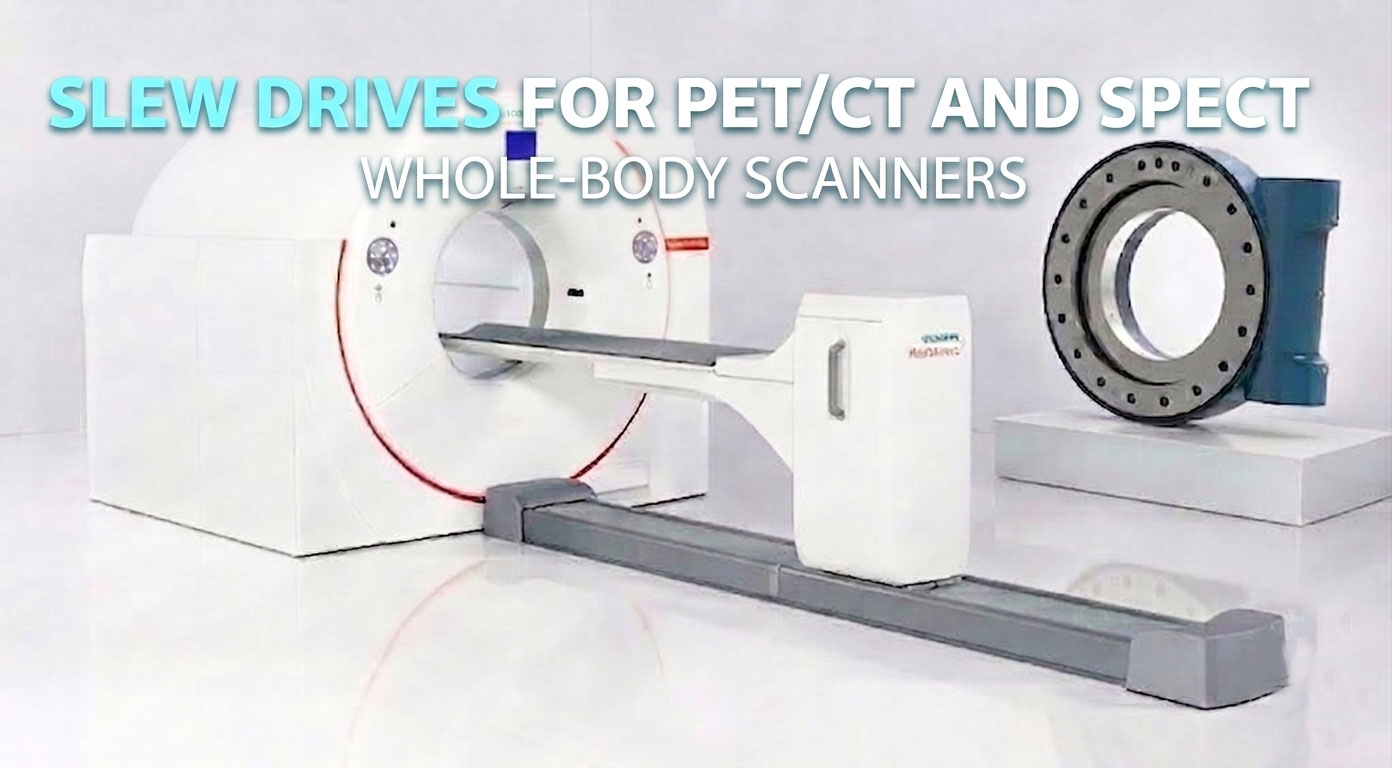
Slew Drives for PET/CT and SPECT Whole-Body Scanners
What Is a Slew Drive in PET/CT and SPECT Whole-Body Scanners?
In nuclear medicine, PET/CT and SPECT whole-body scanners are advanced imaging systems used to detect cancer, heart disease, and neurological disorders. These machines rely on a rotating detector ring that moves around the patient to capture gamma rays emitted by radioactive tracers. At the heart of this rotation mechanism is a slew drive – a compact, high-precision rotary actuator that enables smooth, accurate, and reliable motion. Unlike conventional bearings or gearboxes, a slew drive is specifically designed to handle heavy loads, provide precise positioning, and maintain stability over millions of cycles. LyraDrive engineers will guide you through how slew drives work in whole-body scanners, covering their key features, types, advantages, selection criteria, maintenance practices, and why choosing the right manufacturer matters.
How Does a Slew Drive Work in a Whole-Body Scanner?
Rotary Motion of the Detector Ring
In a whole-body scanner, the detector ring weighs anywhere from several hundred kilograms to over one ton. The slew drive is mounted either inside the gantry or at its base, driving the entire ring in a precise circular path around the patient. Using a worm or planetary gear mechanism, the slew drive converts the motor's high-speed rotation into low-speed, high-torque motion, allowing the detector ring to rotate smoothly at speeds as low as 1° to 3° per second.
Angular Positioning and Holding
During SPECT imaging, the detector must stop at specific angles – such as 60°, 90°, or 120° – and remain stationary for one to two minutes to collect sufficient gamma ray counts. The slew drive features an integral braking or self-locking mechanism that holds the detector ring firmly in place against gravity, preventing any unwanted movement that could blur the image. This holding capability is essential for static acquisition modes.
Coordination with the Drive Motor
The slew drive works in tandem with a servo or stepper motor. The motor provides rotational input, while the slew drive multiplies torque and reduces speed through its gear ratio, typically 200:1 or higher. This combination allows the motor to operate at its optimal speed range while the slew drive delivers smooth, vibration-free motion at the output. The result is precise control over acceleration, deceleration, and positioning – all critical for high-resolution imaging.
What Are the Key Features of a Slew Drive for Medical Imaging?
Large Hollow Bore
One of the most distinctive features of a slew drive for whole-body scanners is its large hollow bore. The center hole – typically 60 cm to 80 cm in diameter – allows the patient and examination table to pass through the slew drive without interference. This hollow design also provides space for cables, cooling lines, and other ancillary components, keeping the gantry compact and streamlined.
Zero or Ultra-Low Backlash
Backlash, or the slight play between gear teeth, can cause positioning errors and image artifacts. A high-quality slew drive for medical imaging achieves zero or ultra-low backlash – often below 0.05° or even into the arc-second range. This precision ensures that the detector ring stops exactly where commanded, image slices align perfectly during reconstruction, and no motion-induced blurring occurs.
Self-Locking at Any Angle
Unlike many other rotary devices, a worm-type slew drive is inherently self-locking. This means that when the motor stops, the slew drive cannot be back-driven by external forces – including gravity acting on an unbalanced detector ring. This self-locking feature eliminates the need for external brakes or holding circuits, simplifying the system design and improving safety.
Low-Noise Operation
Scanning rooms require a quiet environment to keep patients calm and facilitate communication. A well-designed slew drive operates below 55 to 60 decibels – quieter than normal conversation. This low noise level is achieved through precision-ground gears, proper lubrication, and rigid housing construction that dampens vibrations.
Main Types of Slew Drives for Scanners
Worm Gear Slew Drive
The worm gear slew drive is the most common type used in PET/CT and SPECT scanners. It consists of a hardened worm (input) that turns a worm wheel (output). This design offers three major advantages: high reduction ratios (up to 200:1 or more), inherent self-locking, and compact axial height. The main trade-off is slightly lower efficiency (60-80%) compared to planetary designs, but efficiency is rarely a concern in slow-moving medical imaging applications.
Planetary Gear Slew Drive
For scanners that require faster rotation or continuous motion modes, a planetary gear slew drive may be used. This design uses sun, planet, and ring gears to achieve high reduction ratios with greater efficiency (up to 97%) and even lower backlash. However, planetary slew drives are not inherently self-locking, so an external brake is required. They are typically found in hybrid imaging systems where both slow static acquisition and faster dynamic scanning are needed.
Custom-Engineered Slew Drive
Many scanner manufacturers opt for a customized slew drive rather than an off-the-shelf model. A customized slew drive can be optimized for specific bore diameters, mounting interfaces, housing shapes, and precision grades. For example, a customized slew drive might reduce axial height to just 10-15 cm, allowing the gantry to be slimmer and more patient-friendly. Customization also allows integration of encoders, limit switches, and lubrication ports exactly where needed.
Advantages of Using a High-Quality Slew Drive
Improved Image Quality
The slew drive's smooth, vibration-free motion directly translates to sharper images. Any jerk, stick-slip, or uneven rotation would introduce motion artifacts – appearing as streaks or blurring in the reconstructed image. A high-quality slew drive eliminates these sources of error, helping radiologists make accurate diagnoses.
Compact Equipment Design
By integrating the bearing, gearbox, and housing into a single unit, the slew drive reduces the number of separate components needed. This integration allows scanner designers to build slimmer gantries, larger patient openings, or more room for other subsystems. A well-chosen slew drive can reduce the overall gantry depth by 20-30% compared to traditional bearing-and-pinion designs.
Reduced Maintenance Frequency
A sealed slew drive keeps lubricant in and contaminants out. In a medical environment – where dust, lint, and cleaning fluids are present – this sealing is critical. A high-quality slew drive can operate for five to ten years or millions of cycles before requiring regreasing or seal replacement. This long maintenance interval reduces equipment downtime and service costs.
Enhanced Patient Experience
Patients undergoing a whole-body scan may already feel anxious or claustrophobic. A slew drive that moves quietly, starts and stops smoothly, and holds position without jerking contributes to a calmer experience. Additionally, the compact size enabled by a slew drive allows for a more open gantry design, reducing the feeling of confinement.
How to Select the Right Slew Drive for Your Scanner?
Load and Torque Calculation
The first step in selecting a slew drive is calculating the loads. Consider the weight of the detector ring, any off-center mass (which creates a tilting moment), and the required acceleration torque. The slew drive must have a rated output torque that exceeds the maximum demand by a safety factor of at least 1.5 to 2.0.
Precision Class Selection
Imaging resolution determines the required precision of the slew drive. For standard SPECT scanners, a slew drive with backlash under 0.1° may suffice. For high-resolution PET/CT or for systems used in radiation therapy planning, a slew drive with backlash below 0.02° or even arc-second precision (P2 grade) is necessary. Always match the slew drive's precision to the scanner's spatial resolution specification.
Installation Space Constraints
Measure the available space inside the gantry carefully. The slew drive's outer diameter, axial height, and mounting flange pattern must fit within the allocated envelope. If space is extremely tight, a custom slew drive with reduced height or an integrated mounting interface may be the best solution.
Environmental Compatibility Requirements
Although medical scanners operate in clean indoor environments, they still face unique challenges: exposure to disinfectant sprays, electromagnetic interference (EMI) from other electronics, and the need for non-magnetic materials in MRI-adjacent areas. Specify a slew drive with appropriate seals (IP65 or higher), EMI shielding, and non-corrosive coatings if needed.
Maintenance Tips for Slew Drives in Scanners
Lubrication Schedule Management
A slew drive in a scanner typically uses a high-grade lithium or synthetic grease. The lubrication interval depends on duty cycle – for a scanner performing 20-30 whole-body scans per day, regreasing every two to three years is common. Always use the lubricant specified by the slew drive manufacturer, and never mix different grease types.
Backlash Inspection and Adjustment
Over time, normal wear can increase backlash in a slew drive. An annual backlash check – using a dial indicator or encoder feedback – helps detect wear early. Many worm gear slew drives allow backlash adjustment by moving the worm closer to the wheel. If backlash exceeds the scanner's specification, adjust or replace the slew drive promptly.
Seal Inspection
The seals on a slew drive keep grease in and contaminants out. Inspect the seals annually for cracks, hardening, or extrusion. If a seal fails, grease can leak onto the gantry floor – a slip hazard – or contaminants can enter, accelerating wear. Replace seals at the first sign of deterioration.
Abnormal Noise Diagnosis
A healthy slew drive produces a smooth, low-pitched hum. Any grinding, clicking, or irregular noise indicates a problem. Common causes include insufficient lubrication, debris in the gear teeth, or bearing damage. Investigate unusual noises immediately – continued operation could lead to catastrophic failure and expensive downtime.
Conclusion
The slew drive may be hidden inside the gantry, out of sight of patients and clinicians, but its role is anything but minor. It enables the precise, smooth, and reliable rotation that turns raw gamma ray counts into diagnostic-quality images. From the large hollow bore that accommodates the patient to the ultra-low backlash that ensures image accuracy, every feature of a medical-grade slew drive is engineered for one purpose: helping clinicians see clearly what lies within. When you choose a slew drive for a PET/CT or SPECT whole-body scanner, you are choosing the foundation upon which accurate diagnosis rests.
LyraDrive: Custom Slew Drive Manufacturer in China
LyraDrive is a professional slew drive supplier designing and delivering slew drives that are customizable, high-quality, and competitively priced, offering full-scope customized slew drive solutions to match your unique application requirements. We support personalized customization across all core parameters, including dimensions, output torque, gear ratio, mounting flange, input shaft, housing structure, material, sealing grade, protection level, and motor integration. Our customizable slew drives cover a size range from 100 mm to 5000 mm, with precision grades reaching P0, P6, P5, P4, and even P2 for high-precision applications. Whether you need drives for heavy-load machinery, high-speed automation, corrosion-resistant marine environments, dust-proof construction sites, or medical-grade clean conditions, we tailor every detail to deliver stable, reliable, and long-lasting performance.
Why Choose LyraDrive? We take a customization-first approach – every drive is built to your exact specifications. Our medical-grade precision ensures P2-level accuracy for imaging equipment. We offer competitive pricing, delivering high quality without the premium markup. And with fast turnaround, we move from your requirement to 3D design at your pace.
With worm slew drives, spur gear slew drives and worm gear drives, LyraDrive includes a wide range of solutions for steering, turning and swiveling applications. Just submit your requirement via email, and we will offer a design with 3D files. Contact LyraDrive today – send your requirements to [your email address] and get a customized solution built precisely for your application.
FAQs About Slew Drives for Scanners
Why can't a scanner use ordinary bearings instead of a slew drive?
Ordinary bearings provide rotation but no driving torque – they simply reduce friction. A scanner requires both rotation and the ability to position the detector ring precisely under motor control. A slew drive integrates the bearing, gear reduction, and housing into one unit, delivering torque, holding capability, and precision that ordinary bearings cannot provide. Attempting to use bearings alone would require a separate motor, gearbox, and brake – increasing complexity, space, and cost.
What is the typical service life of a slew drive?
A properly specified and maintained slew drive in a whole-body scanner typically lasts 10 to 15 years or 3 to 5 million rotational cycles. Factors that extend life include proper lubrication, clean operating environments, and operation within rated loads. Factors that reduce life include overloading, contaminated grease, or running with excessive backlash. Many scanner manufacturers design their systems so that the slew drive outlasts the expected service life of the scanner itself.
Can slew drives from different brands be interchanged?
Physical interchange – matching bolt patterns, shaft diameters, and bore sizes – is sometimes possible if both brands follow common standards. However, functional interchange is more complex. Different brands may have different backlash specifications, torque ratings, or thermal characteristics. Even if a slew drive bolts on, it may not perform identically. For medical imaging equipment, always replace a slew drive with the same brand and model originally specified, or work with an engineer to validate any alternative.
How can you tell if a slew drive needs early replacement or repair?
Watch for these warning signs: increased image artifacts or blurring that cannot be corrected by software; unusual grinding or clicking noises from the gantry; visible grease leakage around the slew drive seals; increased backlash detected during routine measurements; or erratic positioning where the detector ring does not stop at the commanded angle. If any of these occur, inspect the slew drive immediately. Early replacement or repair is almost always less expensive than a catastrophic failure that damages other gantry components.
 WhatsApp
 sales@lyradrive.com
 +8613903880726