



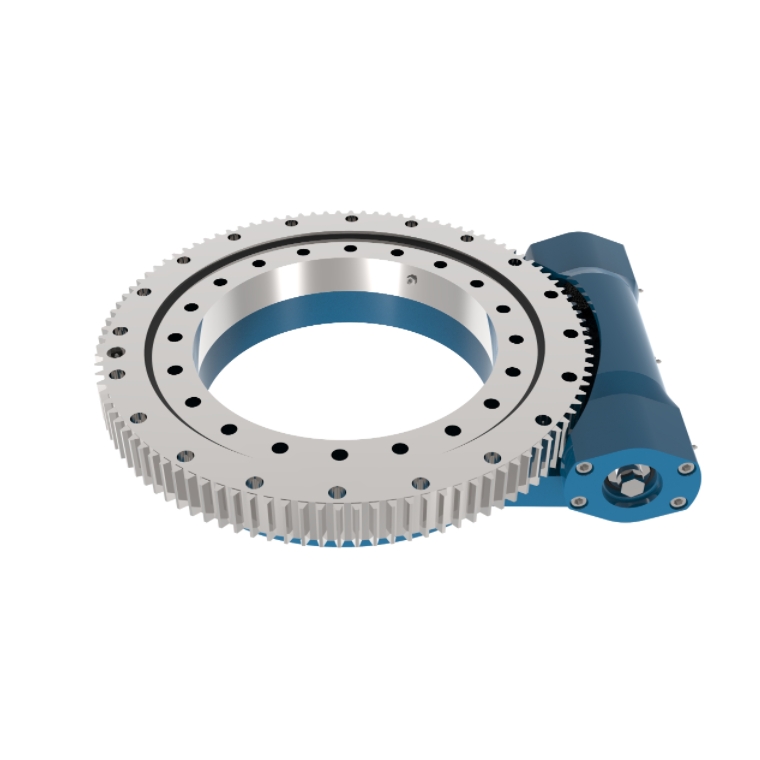
What is a slew drive? It is a compact rotation unit that combines a slewing bearing, a gear set (usually a worm or spur gear), a housing and a motor interface in one sealed assembly. A slew drive for welding positioner service turns and tilts heavy workpieces so the welder or robot can reach the seam. It must hold position under an off-center load.
The sourcing risk is simple. A buyer approves the lowest quote, then pays for it later in extra machining, line stops, grease changes, seal swaps and weld seams that drift. This article gives operations managers and project buyers a five-year cost model they can fill in with their own plant numbers before signing a purchase order.
Why the Quote Price Is Only One Line of the Budget
Most search results for slew drives describe torque, precision and load ratings. Very few talk about what happens after the drive is bolted in. That gap is where budgets go wrong.
In my 30-plus years of mechanical design work on heavy equipment, the pattern is steady. The purchase price is a visible, one-time number. The other costs are spread across maintenance logs, shift reports and quality records, so nobody adds them up.
Welding positioners make this worse. Rotation is slow and continuous during welding. The load is often eccentric. Spatter, heat and flux dust attack the seals. A drive that looks equal on a datasheet can behave very differently in that environment.
A Five-Year Total-Cost Model for Welding Positioner Drives
Use the table below as a worksheet. It separates the initial drive price from the five cost lines that usually decide whether a unit is cheap or expensive. We have not put dollar figures in it, because your labor rates and downtime costs are specific to your plant.
| Cost line | What drives it | Typical exposure with a low-price, off-the-shelf unit | What to ask the supplier | How to measure it yourself |
|---|---|---|---|---|
| 1. Initial drive price | Gear type, bearing size, material, precision grade | Lowest number on the quote | Which model, which material, which precision grade? | Unit price × quantity |
| 2. Integration machining | Mounting bolt pattern, flange and pilot fit, motor adapter, cable and sensor access | Your frame or adapter plate is reworked to fit the drive | Can the interface match your existing frame? | Machining hours × shop rate + fixture cost |
| 3. Downtime exposure | Seal life, gear wear, bearing condition, response time for support | Unplanned stops when seals leak or the gear wears early | What is the warranty and technical response time? | Stop hours × cost per idle cell hour |
| 4. Lubrication labor | Grease point access, grease interval, contamination from the weld zone | Hard-to-reach fittings, frequent re-greasing | Where are the grease points and what is the interval? | Minutes per service × services per year × 5 × labor rate |
| 5. Seal replacement | Seal design, IP rating, anti-corrosion rating, spatter and dust exposure | Early seal failure, then contamination of the gear mesh | What protection level is offered for this environment? | Seal kit cost + labor + stop time per event |
| 6. Backlash-related rework | Gear clearance, wear over time, preload design | Seam offset, scrapped parts, re-teaching robot paths | What backlash can be held, and how is it checked? | Scrap + rework hours + re-teach hours per occurrence |
Add all six lines for each quote. That sum is your slew drive lifecycle cost. It is also the most honest answer to the welding positioner slew drive cost question, because it counts what the drive does to the rest of the cell.
A quick break-even test
Here is a simple way to check a price premium. The numbers below are assumptions for the arithmetic only, so replace them with your own.
- Assume an idle weld cell costs $600 per hour in lost output.
- Assume the higher-spec drive costs $2,000 more than the low-price option.
- Break-even: $2,000 ÷ $600 ≈ 3.3 hours of avoided downtime over five years.
If one seal failure or one gear replacement would cost you more than 3.3 hours, the premium pays for itself. If your cell is idle at little cost, or the duty is light and intermittent, the premium may not pay back. The test works in both directions.
Where Backlash and Sealing Hit Welding Automation Hardest
Two lines in the model deserve extra attention: backlash and seals. Together they drive most welding automation maintenance cost.
Backlash matters because an eccentric workpiece changes load direction as it rotates past the top of its arc. Any gear clearance shows up as a small jump. In robotic welding, that jump becomes a seam offset or a path that needs re-teaching. A double worm slew drive is one design route when tight backlash control is the priority. Confirm the achievable backlash for your size with the supplier before you commit.
Sealing matters because weld spatter and fine dust work their way into the gear mesh. Our slew drives are available with protection up to IP66 and anti-corrosion ratings up to C4H. That fits dusty or humid shops, though you should match the rating to your actual site rather than buy the top option by default.
For standard duty with a self-locking requirement, a worm gear slew drive is the usual starting point. Self-locking helps hold a tilted workpiece when power is off. It is not a substitute for a brake if your safety review requires one.
Request Your Custom Slew Drive or Bearing Spec
Tell us your load, speed, and environment — receive a tailored 100–5000 mm slewing drive or slewing bearing proposal with 3D drawings within 24 hours.
Are Custom Slew Drives Worth the Cost?
Sometimes yes, sometimes no. The answer depends on which model lines are driving your cost.
| Situation | Better fit | Why | When this does not apply |
|---|---|---|---|
| Your frame already matches a standard model's bolt pattern and motor interface | Standard unit | Little or no integration machining to save | Duty is severe enough that a standard seal or material choice would fail early |
| Frame redesign or adapter plate would cost more than the drive premium | Customized slew drive | The interface is built to your frame, so line 2 shrinks | Order volume is so low that engineering time outweighs the machining saved |
| Seam accuracy is tight and rework is frequent | Custom or higher-precision unit | Backlash and precision grade target line 6 directly | The process tolerates visible seam variation |
| Spatter, dust or humidity is heavy | Higher IP and corrosion rating | Fewer seal events, fewer stops | The cell is clean and enclosed |
So, are custom slew drives worth the cost? When your integration machining and rework lines are large, usually yes. When a catalog unit already fits your frame and duty, the extra spend is hard to justify.
Also compare replacement exposure. Slew drive replacement cost is not just the part. It includes removal, re-alignment, re-teaching and the stopped line. A unit that is slightly cheaper but harder to access can cost more per replacement than a better-placed one.
What Our Capabilities and Cases Support, and What They Do Not
We want to be exact about evidence. We have no supplied welding positioner case to cite, so we will not pretend otherwise. Here is what we can document.
- Rotary table duty: a Houston, Texas engineering machinery manufacturer ordered 100 units of SEA21-125-25HR(2) for slewing platform and turntable systems. A Manchester, UK automation equipment manufacturer ordered 100 units of SP-I 0841-32.1 for automated turntable systems. Both are rotary positioning duties, close in motion to a positioner axis but not the same application.
- Tight precision: a British Columbia, Canada forestry equipment maker ordered 30 units of WED14-86-25BHR.5 double worm slew drives for grapple machines, with precision of 0.15° or better stated as 0.13° or less. That shows double worm precision on a working machine, not on a welding cell.
- Repeat purchasing: a South Korean port equipment manufacturer placed a 20-unit repeat order of WEA9-62-25HR single worm slew drives for port cranes (tracking precision of 0.15° or better, IP65 sealed, self-locking).
- Cost versus imported brands: our German-standard SE/WE series localization, offered in P0 to P4 precision grades, is stated to save 30 to 50 percent against imported brands at matching performance parameters. That applies to that series, not to every product we make.
On quality, every slewing bearing we build passes CMM three-coordinate inspection and dynamic load testing. Our failure rate is below the 0.5% industry standard. You can read how this works on our slew drive quality control page. Our quality system is ISO 9001:2015 certified, products carry CE marking for the European market, and factory audit reports are available on request.
For a welding positioner, the open question is your own duty data: load, offset, speed and duty cycle. Those inputs, not case history, decide which model fits.
Cooperation Terms and Boundaries
These are the terms we can state from our current ordering conditions.
- Minimum order: 1 set for standard products, 5 sets for customized products. Sample orders are welcome for testing and evaluation.
- Timing: 3-day rapid prototyping and a 9-day standard production cycle. We send a technical proposal within 24 hours. Confirm the schedule for your specific model on the quote.
- Warranty and support: a 2-year extended quality warranty, 48-hour technical response, and free replacement for confirmed manufacturing defects.
Some matters still need to be agreed per project. These include the interface drawing, the acceptance test, who supplies the motor and brake, and how a warranty claim is judged when the drive runs in a process we have not seen. We do not claim a fixed process for these. We settle them in writing before production.
Our factory covers 8,000 m² with 6 production lines and an annual capacity of 100,000 sets. That is relevant for volume planning, but it does not change the need to confirm your own lead time.
Common Mistakes in Slew Drive Cost Approval
- Comparing only unit price. Lines 2 to 6 can outweigh the price gap. Fix: fill in the table for every quote.
- Ignoring the cost of an idle cell. Without it, a break-even test is impossible. Fix: get the hourly number from finance or production control.
- Buying the highest IP rating by default. It adds cost where it is not needed. Fix: match the rating to the site.
- Skipping the backlash conversation. Robot path accuracy depends on it. Fix: ask for the achievable backlash and how it is checked.
- Customizing a drive that a catalog unit would fit. Fix: check the standard slew drive range first, then customize only if machining or rework justifies it.
What to Send Us to Qualify a Quote
The more of this you share, the faster we can propose a model and give you comparable numbers.
- Workpiece weight, center-of-gravity offset and maximum tilt angle.
- Rotation speed, duty cycle and any start-stop positioning requirement.
- Seam accuracy target and any robot path tolerance.
- Site conditions: spatter, dust, humidity, temperature.
- Your frame or mounting drawing, plus motor and brake preference.
- Quantity, target delivery date and your current drive cost, if you have one.
With that, our engineers can compare a standard unit with a customized one on all six cost lines, and you can take the result into your approval meeting.
Request Your Custom Slew Drive or Bearing Spec
Tell us your load, speed, and environment — receive a tailored 100–5000 mm slewing drive or slewing bearing proposal with 3D drawings within 24 hours.
 WhatsApp

 +8613903880726