



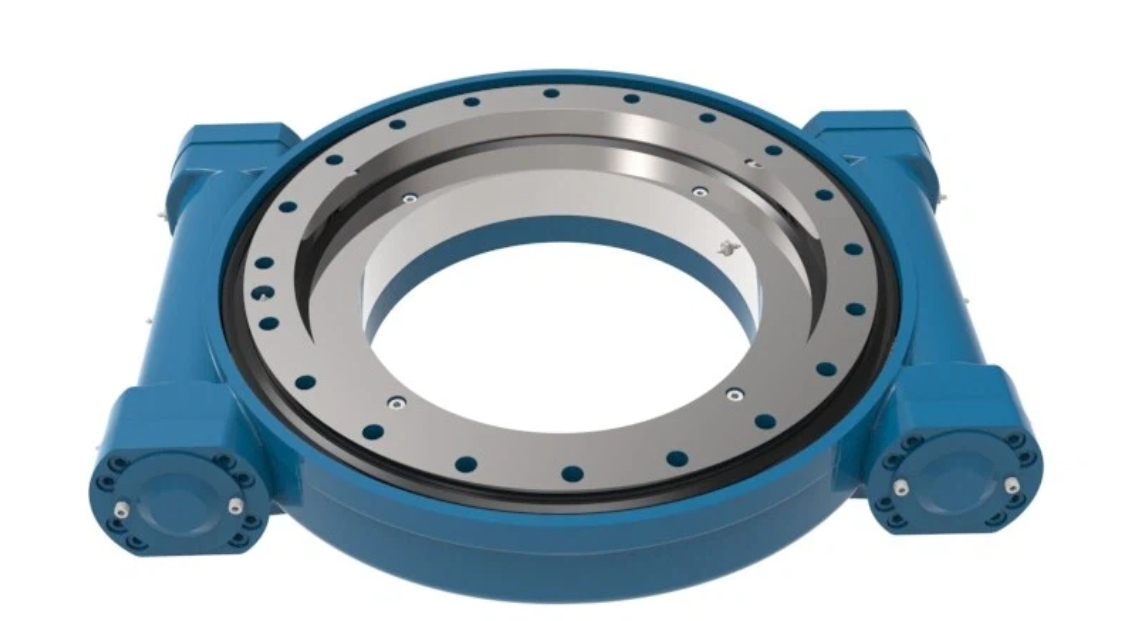
What is a slew drive? It is a compact rotation unit that combines a slewing bearing, a gear set (worm or spur), a housing and a motor interface in one package. The motor supplies the input power, and the gear set turns it into slow, high-torque rotation. That makes the motor choice a core part of how to choose slew drive hardware for any new rotating machine.
The tension is simple. Hydraulic motors pack a lot of torque into a small body, while electric motors give cleaner control and need no oil system. Pick wrong and you redesign the power train, the controls, or both.
The Short Rule Before You Run the Numbers
Start with the power source already on your machine. If the machine carries a hydraulic pump and valve block, a hydraulic motor is usually the lower-friction path. If the machine runs on grid power, batteries or a generator, electric is usually the natural fit.
Then test that first answer against three inputs: peak output torque, required slewing speed, and positioning accuracy. A hydraulic motor tends to win when space is tight and torque is high. An electric motor tends to win when you need repeatable positioning, low-speed smoothness or easy integration with a PLC.
This rule has limits. If you have not fixed the load moment, duty cycle or holding requirement yet, you cannot lock the motor type. In that case, fix those inputs first, as the next section shows.
Torque and Speed Inputs That Narrow the Field
In my 30-plus years of designing heavy machinery and power transmission, the most common early error is sizing the motor from the nameplate load alone. A slew drive sees more than the static load. It also sees friction, wind or process forces, and acceleration torque.
Step-by-step sizing sequence
- Define peak output torque. Add load-driven resistance, bearing friction, wind or external force, and the torque needed to accelerate the inertia.
- Set the target slewing speed. Use the fastest rotation the application needs, not the average.
- Pick the gear type. A worm set gives a high ratio and self-locking. A spur set gives higher efficiency and suits different duty profiles.
- Back-calculate motor demand. Motor torque equals output torque divided by gear ratio and efficiency. Motor speed equals output speed times ratio.
- Check holding and stopping. Decide whether the drive must hold a load without power, and whether you need a brake.
- Check the environment. Dust, washdown, salt air and desert heat all affect sealing and motor choice.
Step 3 matters more than most teams expect. A worm gear slew drive is self-locking in many configurations, which reduces the brake burden on either motor type. A spur-gear design shifts more of that holding job to the motor or a separate brake.
Electric vs Hydraulic Motor Comparison for Slew Drives
The table below compares the two options on the same criteria. It is qualitative on purpose. Exact figures depend on motor frame, pump, gear ratio and duty cycle, so confirm them against your own load case.
| Criterion | Electric motor | Hydraulic motor |
|---|---|---|
| Torque density | Lower per unit size. Often needs a larger gear ratio or a bigger frame for the same torque. | High torque in a compact body. Strong fit where mounting space is limited. |
| Speed control | Precise and repeatable with a drive or servo. Smooth at low speed. | Set by flow and valves. Good with proportional valves, but accuracy depends on valve quality and oil condition. |
| Available power source | Grid, battery or generator. No fluid system needed. | Needs a pump, reservoir, hoses and a prime mover on the machine. |
| Heat | Heat sits in the motor and drive electronics. Can be limited by duty cycle and ambient temperature. | Heat builds in the oil, especially with throttling. May need a cooler on long duty cycles. |
| Maintenance | Few wear items. Mainly brakes, cables and connectors. | Oil, filters, hoses, fittings and seals all need attention. Leaks are a risk. |
| Control integration | Direct link to PLC, encoder and motion controllers. Easy to log and tune. | Needs valve drivers and sensors for closed-loop work. Fine for manual or joystick control. |
Decision rules behind the table
- Choose electric when you need accurate positioning, low-speed smoothness, or a clean machine with no oil. It also fits sites where only electric power is available.
- Choose hydraulic when the machine already has a hydraulic circuit, space is tight, and shock loads are common.
- Electric does not fit when the frame size needed for peak torque will not fit your envelope.
- Hydraulic does not fit when you must hit tight positioning with no pump on board, or when oil leaks are unacceptable.
Request Your Custom Slew Drive or Bearing Spec
Tell us your load, speed, and environment — receive a tailored 100–5000 mm slewing drive or slewing bearing proposal with 3D drawings within 24 hours.
Trade-Offs by Application
The same motor logic plays out differently across machines. The cases below show the drive models and conditions we have supplied. The motor type is a separate choice, made by each customer's power system.
| Application | Supplied drive and conditions | What it means for motor choice |
|---|---|---|
| Port cranes (South Korea) | 20 units of WEA9-62-25HR single worm slew drives. Tracking precision of 0.15° or better, IP65 sealed, self-locking. | Tight tracking favors a motor and control pair that can hold fine speed. Self-locking cuts the holding load on either motor type. |
| Forestry grapple machines (British Columbia, Canada) | 30 units of WED14-86-25BHR.5 double worm slew drives. Precision of 0.13° or better. | Mobile machines often carry hydraulics already. Precision still depends on valve control and drive backlash. |
| Slewing platforms (Houston, Texas) | 100 units of SEA21-125-25HR(2). | Heavy platform inertia makes acceleration torque a key input for sizing. |
| Solar trackers (South America; US) | SP-I 0229 for Brazil, Argentina and Chile. 50 units of SP-I 0841 with IP65 for desert sites in the US. | Trackers move slowly and often at remote sites. Electric power is typically the practical source there, and sealing matters for dust. |
Two lessons stand out. First, precision targets such as 0.15° or 0.13° are a system property, not a motor property. Gear backlash, bearing preload and control resolution all count. Second, harsh sites change the sealing and corrosion questions before they change the motor question.
The Overlooked Factor: Gear Type and Sealing Limit Your Motor Options
Many teams pick a motor and then look for a drive that fits. Reverse it. The gear type and housing set the ratio, efficiency, backlash and holding behavior, and the motor must work inside those limits.
- A double worm slew drive splits load across two worms. It suits heavy or high-precision duty and can reduce motor demand per worm.
- A spur gear slew drive offers a different efficiency and speed profile. Solar tracker work is a typical use.
- Our slew drives offer protection up to IP66 and anti-corrosion ratings up to C4H. Confirm the motor, brake and connectors carry a matching rating, or the weakest part sets the site limit.
Common mistakes to avoid
- Sizing from static load and ignoring acceleration torque.
- Choosing the motor before the gear ratio, then forcing a mismatch.
- Assuming self-locking removes the need for any brake. Check the dynamic and vibration conditions.
- Specifying IP66 on the drive but leaving the motor and cable glands at a lower rating.
- Over-sizing the motor "for safety" and ending up with a heavy, costly unit that cannot hold fine speed.
Selection Rule and What to Confirm Before You Quote
Here is the final rule for how to choose slew drive and motor pairs. Choose electric when the machine has electric power, you need precise or repeatable positioning, and the frame size fits your envelope. Choose hydraulic when the machine already has a hydraulic circuit, torque per volume is the limit, and shock loads are normal.
If neither describes your machine, the missing input is usually the power source or the duty cycle. Resolve that before you compare motors.
Buyer's checklist
- Peak output torque, including friction and acceleration.
- Maximum slewing speed and acceleration time.
- Available power source: grid, battery, generator or hydraulic circuit.
- Holding requirement with power off.
- Target precision and acceptable backlash.
- Environment: dust, salt, washdown, temperature range, needed IP and C4H class.
- Control system: PLC, servo, joystick or proportional valve.
Luoyang Slewing Bearing Co., Ltd. has focused on slew bearing and slew drive R&D for more than 15 years, with designs used in 2,000+ heavy-equipment projects. Our facility is ISO 9001:2015 certified, and we hold CE marking for the European market. Every slew bearing goes through CMM inspection and dynamic load testing, as described in our slew drive quality control process.
Standard products start at one set, and customized units start at five. We return a technical proposal within 24 hours, and a 2-year extended quality warranty applies. If your torque, speed or interface needs do not match a catalog unit, a customized slew drive can fit the motor flange and ratio to your design. Send your load case and power source, and we will narrow the options with you.
Request Your Custom Slew Drive or Bearing Spec
Tell us your load, speed, and environment — receive a tailored 100–5000 mm slewing drive or slewing bearing proposal with 3D drawings within 24 hours.
 WhatsApp

 +8613903880726