



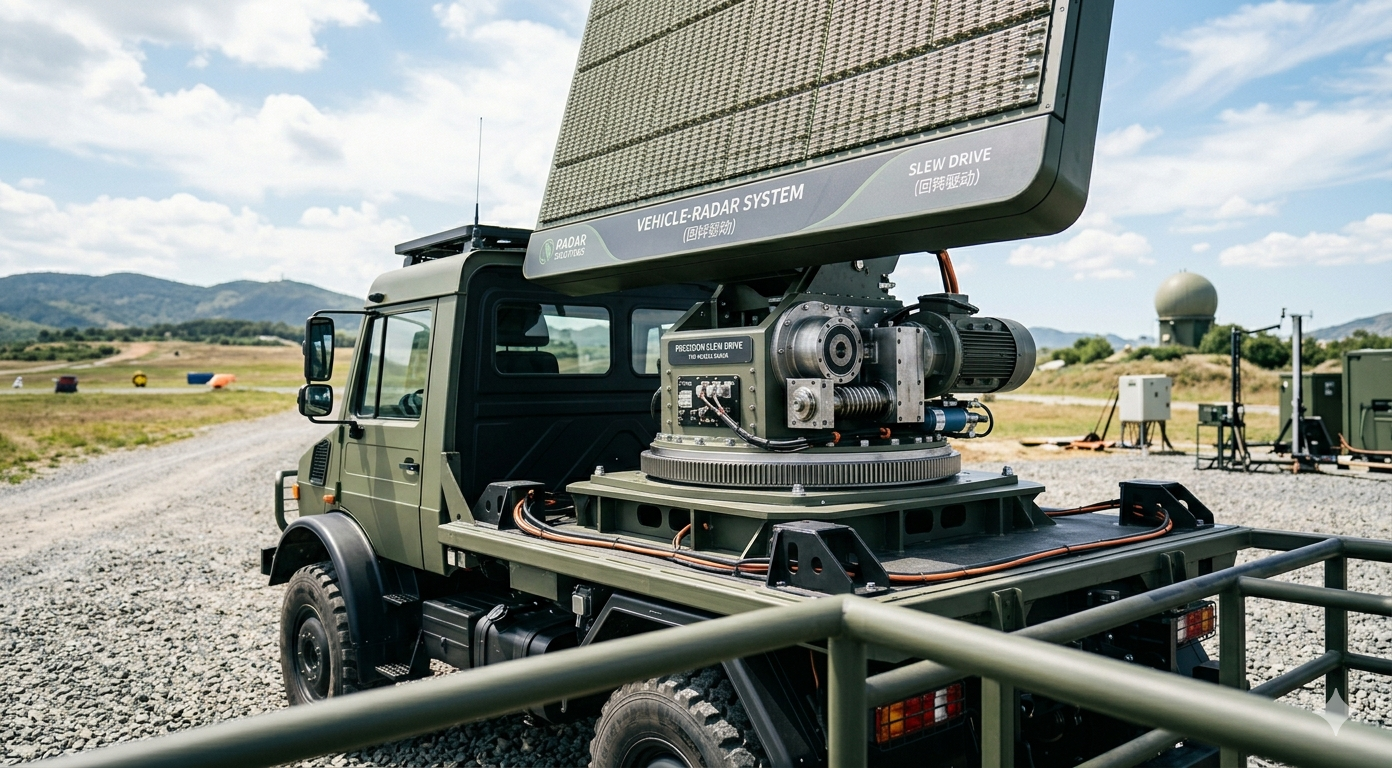
Slew Drive For Vehicle Radar
What Is a Slew Drive?
A slew drive is a compact mechanical device that enables heavy loads to rotate smoothly and precisely. The core concepts behind a slew drive include rotary motion, heavy load handling, worm gear configuration, self-locking capability, and an integrated unit design. Most slew drives on the market today use a worm gear configuration, which consists of a hardened steel worm and a bronze worm wheel. This worm gear slew drive design offers two major advantages: a high reduction ratio and self-locking capability. The high reduction ratio means the motor can turn many times while the output moves only a small amount, generating significant torque. Self-locking means the worm can turn the wheel, but the wheel cannot turn the worm. As a result, the load stays in position even when the power is disconnected, eliminating the need for a separate brake. Engineers apply slew drives across many industries, including solar tracking systems, cranes, aerial work platforms, wind turbines, and vehicle radar systems.
What Is a Slew Drive for Vehicle Radar? – Function & Importance
A Slew Drive for Vehicle Radar is a specialized version of this technology designed specifically for mounting and rotating radar sensors on moving vehicles. The main aspects of this device include radar rotation, 360-degree scanning capability, vehicle mounting, dynamic load handling, and environmental protection. These vehicles range from autonomous cars and security patrol trucks to military reconnaissance vehicles and agricultural machines. The primary function of this drive is to rotate the radar continuously or position it at specific angles, allowing the sensor to build a complete 360-degree picture of the surroundings. This capability is critical for obstacle detection, object tracking, and safe navigation.
Vehicle radar operates under demanding conditions. The vehicle travels on rough roads, climbs and descends slopes, accelerates and brakes suddenly, and faces all kinds of weather including rain, snow, dust, and extreme temperatures. A good Slew Drive for Vehicle Radar must handle all these challenges while maintaining precise rotation. It absorbs road shock and vibration, seals out contaminants, and fits within the limited space available on a vehicle roof. Without a properly designed slew drive, the radar cannot produce stable images or accurate tracking data, and the entire perception system may fail.
Key Components of a Slew Drive for Vehicle Radar
A Slew Drive for Vehicle Radar consists of several carefully engineered components that work together as a system. These key components include the worm gear set, housing, main bearing, seals, output flange, input shaft, and lubricant.
Worm Gear Set: This forms the core of the drive, using a hardened steel worm and a bronze worm wheel to achieve smooth motion and self-locking behavior. The bronze material reduces friction and wear against the steel worm.
Housing: Typically made of cast iron or aluminum, the housing holds all internal components in precise alignment while protecting them from dust, water, and mechanical impact. The housing also acts as a heat sink, dissipating the small amount of heat generated during operation.
Main Bearing: This bearing supports all loads applied to the drive, including radial loads (sideways forces), axial loads (up and down forces), and moment loads (twisting forces). It must handle both the static weight of the radar and the dynamic loads caused by vehicle movement.
Seals: Seals keep lubricant inside the drive and prevent contaminants from entering. Vehicle radar applications require heavy-duty seals that resist UV radiation, ozone, and temperature extremes.
Output Flange: This provides a precision-machined mounting surface for the radar or radar bracket. The flange connects directly to the worm wheel.
Input Shaft: The input shaft connects to a motor, typically a 12V or 24V DC motor matching the vehicle's electrical system.
Lubricant: Either grease or oil, the lubricant reduces friction, removes heat, and protects against corrosion.
All these components come pre-assembled into one ready-to-install unit, saving design time and reducing assembly errors.
How Does a Slew Drive Work for Vehicle Radar?
The working principle of a worm gear slew drive for vehicle radar follows a clear sequence. The process involves motor input, worm rotation, wheel reduction, torque multiplication, self-locking, and position feedback.
Step 1 – Motor receives command: The vehicle's computer sends a command to the motor, telling it to start rotating at a specific speed and direction.
Step 2 – Worm rotates: The motor turns the input shaft, which connects directly to the worm. The worm spins at the same speed as the motor.
Step 3 – Wheel rotates with reduction: The worm's thread-like shape pushes against the teeth of the worm wheel. Because of the geometry between the worm and wheel, the wheel rotates much more slowly than the worm. One full rotation of the worm typically advances the worm wheel by only one tooth, creating a reduction ratio that can range from 30:1 to over 100:1.
Step 4 – Torque multiplication: This high reduction ratio multiplies the motor's torque, giving the drive enough strength to rotate a heavy radar even when the vehicle is tilted on a slope.
Step 5 – Output flange turns: The worm wheel attaches to the output flange, so as the wheel turns, the flange turns as well. The radar mounted on top of the flange rotates accordingly.
Step 6 – Self-locking holds position: The self-locking property comes from the friction and angle between the worm and wheel. The worm can easily turn the wheel, but the wheel cannot turn the worm. When the motor stops, the radar stays exactly in position without any holding current or external brake. This saves energy and ensures the radar remains pointed correctly even when the vehicle hits a bump or loses power momentarily.
Step 7 – Position feedback: Many slew drives include a position sensor such as an encoder or potentiometer, which provides feedback to the computer about the exact angle of the radar. The computer uses this information to close the control loop and achieve precise positioning.
Types of Slew Drives for Vehicle Radar
Not all slew drives are the same, and different radar applications may benefit from different gear configurations. The three main types are worm gear, hypoid gear, and planetary gear. The table below summarizes the key differences.
| Type | Efficiency | Self-locking | Speed Capability | Best Application |
|---|---|---|---|---|
| Worm Gear | 30-70% | Yes | Low to medium | Most vehicle radar systems |
| Hypoid Gear | 70-90% | No (needs brake) | Medium to high | Fast scanning radars |
| Planetary Gear | 85-95% | No (needs brake) | High | High-speed, light-load radars |
Worm Gear Slew Drive: This is the most common choice for vehicle radar. It offers self-locking, which is a major safety feature. The drive holds the radar position without power, saving energy and protecting the gear from back driving. The worm gear design is also very compact, fitting into low profile housings. The main drawback is lower efficiency, but for radar applications with low duty cycles, this is usually acceptable.
Hypoid Gear Slew Drive: A hypoid gear is similar to a worm gear but with a different tooth shape. The contact between gears is smoother, giving higher efficiency and lower noise. However, most hypoid drives do not self-lock, requiring an additional brake that adds cost and complexity. Hypoid drives work well for radars that scan quickly or rotate continuously for long periods.
Planetary Gear Slew Drive: A planetary gear set uses a central sun gear, several planet gears, and an outer ring gear. This design is very efficient and very smooth. But planetary drives have no self-locking at all, and they cost more. Engineers choose planetary drives only for specialized applications. For most vehicle radar projects, the worm gear slew drive remains the preferred choice.
Key Advantages of Using a Slew Drive for Vehicle Radar
Using a dedicated Slew Drive for Vehicle Radar brings numerous benefits that explain why this technology has become the industry standard. The key advantages include self-locking, high load capacity, precise positioning, low maintenance, shock resistance, weather protection, compact mounting, and quiet operation.
Self-locking: This is the most important advantage. The drive holds the radar position without power, saves energy, and provides a fail-safe mechanism. If the vehicle loses electrical power, the radar does not swing freely or rotate unexpectedly. It stays locked in place, preventing damage.
High load capacity in a compact package: A slew drive integrates the bearing, gear set, housing, and seals into one unit that may measure only 200 mm in diameter and 100 mm in height, yet it can support a 50 kg radar while withstanding road shocks.
Precise positioning: The drive allows the radar to achieve angular accuracy within 0.1 degree or better, which is essential for tracking moving objects and building accurate environmental maps.
Low maintenance: The sealed design keeps lubricant contained and contaminants excluded, so typical service intervals range from six months to one year.
Shock resistance: Robust bearing and housing design absorbs vibration and sudden impacts from potholes, curbs, or off-road terrain.
Weather protection: Built-in seals and coatings allow the drive to operate in rain, snow, dust, and salt spray without degradation.
Compact mounting: You simply bolt the drive to the vehicle roof and bolt the radar to the output flange. No additional gearboxes, bearings, or brackets are needed.
Quiet operation: These drives run smoothly and quietly, making them suitable for vehicles that operate near people, such as security patrol vehicles.
How to Choose the Right Slew Drive for Your Vehicle Radar System
Selecting the correct Slew Drive for Vehicle Radar requires careful evaluation of several technical factors. These factors include torque calculation, load capacity, speed requirement, self-locking decision, environmental conditions, mounting space, power source, position feedback, and manufacturer support.
Torque requirement: Calculate the torque needed to rotate the radar under worst-case conditions: the vehicle tilted on a maximum slope, the radar possibly covered with ice or snow, and wind applying additional force. Use a safety factor of at least 1.5. A typical 10 kg radar might need 50 to 100 Nm of torque.
Radar weight and size: The drive must support both the static weight of the radar and dynamic loads from vehicle acceleration, braking, and cornering. Larger radar housings create more wind resistance, adding to torque requirement.
Rotation speed: Continuous scanning at 5 to 30 RPM requires smooth motion and proper heat dissipation. Point-to-point positioning needs higher acceleration and deceleration rates.
Self-locking requirement: If your system must hold position without power, choose a worm gear slew drive. Otherwise, you will need to add a separate brake, which increases cost and complexity.
Environmental conditions: Tell your slew drive manufacturer about operating temperatures, salt spray exposure, dust levels, and shock loads. They can recommend appropriate seals, lubricants, and coatings.
Mounting space: Measure available height and diameter on the vehicle roof carefully. Some vehicles require low-profile drives.
Power source: Match the drive to your vehicle's electrical system, typically 12V or 24V DC. Self-locking drives use less power because they do not need a holding brake.
Position feedback: If your system needs to know exactly where the radar is pointing, choose a drive with an integrated encoder or potentiometer.
Manufacturer support: Working with an experienced slew drive manufacturer makes a significant difference. A good manufacturer helps you calculate requirements, provides drawings and 3D models, offers customization, and stands behind their products with warranties and after-sales support.
Maintenance Tips to Extend Slew Drive Lifespan
A well-maintained worm gear slew drive can last five to ten years or more in vehicle radar service. Regular maintenance is simple but essential. The key maintenance activities include lubricant check, seal inspection, noise monitoring, exterior cleaning, bolt tightening, self-locking test, input shaft inspection, and record keeping.
Lubricant check: Every six months, open the fill port and inspect the grease or oil. It should appear clean and smooth. If it looks dark, gritty, or separated, replace it with the type recommended by the manufacturer. Never mix different lubricant types.
Seal inspection: Look around the input shaft and output flange for any signs of oil or grease weeping. A leaking seal allows lubricant to escape and contaminants to enter, leading to rapid wear. Replace damaged seals promptly.
Noise monitoring: Listen during operation. A healthy drive produces a smooth, low hum. Grinding, clicking, rattling, or chattering sounds indicate problems such as wear, contamination, or loose components. Investigate any unusual noise immediately.
Exterior cleaning: Mud, road salt, and grime can damage seals over time. Wash the drive with water and a soft brush, but avoid high-pressure spray which can force water past the seals.
Bolt tightening: Vehicle vibration can loosen mounting bolts over time. Every six months, use a torque wrench to verify that all bolts are tightened to specified values. Apply thread-locking compound for additional security.
Self-locking test: With the motor off, attempt to turn the output flange by hand. You should not be able to move it. If the flange rotates, the worm gear has worn beyond acceptable limits and the drive needs replacement.
Input shaft inspection: Check the motor coupling for wear or play. A worn coupling can cause misalignment and premature gear wear.
Record keeping: Keep maintenance records including dates, actions taken, and observations. Good records help identify patterns and predict failures before they happen.
For extreme operating conditions such as deserts, arctic regions, or coastal environments, shorten the maintenance intervals accordingly. Desert operation may require monthly cleaning. Arctic operation may need special low-temperature lubricant. Coastal operation demands corrosion monitoring and frequent cleaning.
LyraDrive: A Leading Vehicle Radar Slew Drive Manufacturer
LyraDrive is a professional one-stop slewing device manufacturer. We specialize in the design, development, customized production, sales, and service of slew drive and slewing bearing products.
For Slew Drive for Vehicle Radar, we offer complete customization based on your specific requirements. You provide the torque, speed, size, mounting interface, and environmental conditions. We then design and build the right drive for your application. We take pride in our high product quality and responsive after-sales support. Every drive undergoes thorough testing before shipment, and our team answers technical questions quickly.
If you are looking for a reliable slew drive for your vehicle radar project, please feel free to contact us. We are happy to discuss your needs and provide a tailored solution.
FAQ About Slew Drive For Vehicle Radar
Q1: Why can't I use a standard gearbox instead of a dedicated slew drive for vehicle radar?
A standard gearbox does not include the integrated bearing, housing, and seals that a slew drive provides. You would need to design and assemble these additional components yourself, which takes time and introduces potential failure points. A Slew Drive for Vehicle Radar comes as a complete, ready-to-install unit that simplifies vehicle integration. Additionally, most standard gearboxes do not offer self-locking, requiring you to add a separate brake.
Q2: How do I calculate the torque requirement for my vehicle radar system?
The torque requirement depends on the radar weight, the distance from the rotation center to the radar's center of mass, the maximum vehicle tilt angle, and wind load. As a rough guideline, a 10 kg radar with a 200 mm offset requires about 50 to 100 Nm of torque. However, we strongly recommend contacting a slew drive manufacturer like LyraDrive with your specific parameters for an accurate calculation that includes appropriate safety margins.
Q3: Can a worm gear slew drive operate in freezing temperatures?
Yes, but you need the correct lubricant. Standard grease becomes too viscous below -20°C, causing higher friction and potential damage. For arctic or cold climate operation, ask the manufacturer for low-temperature grease. With proper lubrication, a worm gear slew drive can operate reliably down to -40°C.
Q4: What are the signs that my slew drive needs replacement?
Common indicators include unusual noise such as grinding or clicking, visible lubricant leakage, loss of self-locking (the output flange rotates when you try to turn it by hand with the motor off), excessive angular play or backlash, and significantly increased motor current for the same rotation speed. If you observe any of these signs, replace the drive before it fails completely and causes system downtime.
Q5: Does LyraDrive provide custom mounting interfaces for different vehicles?
Yes, absolutely. Every vehicle has different roof structures and bolt patterns. We design the output flange and base plate to match your specific mounting interface exactly. You simply provide the dimensions, and we build the drive to fit your vehicle without the need for additional adapters or brackets.
 WhatsApp
 sales@lyradrive.com
 +8613903880726