



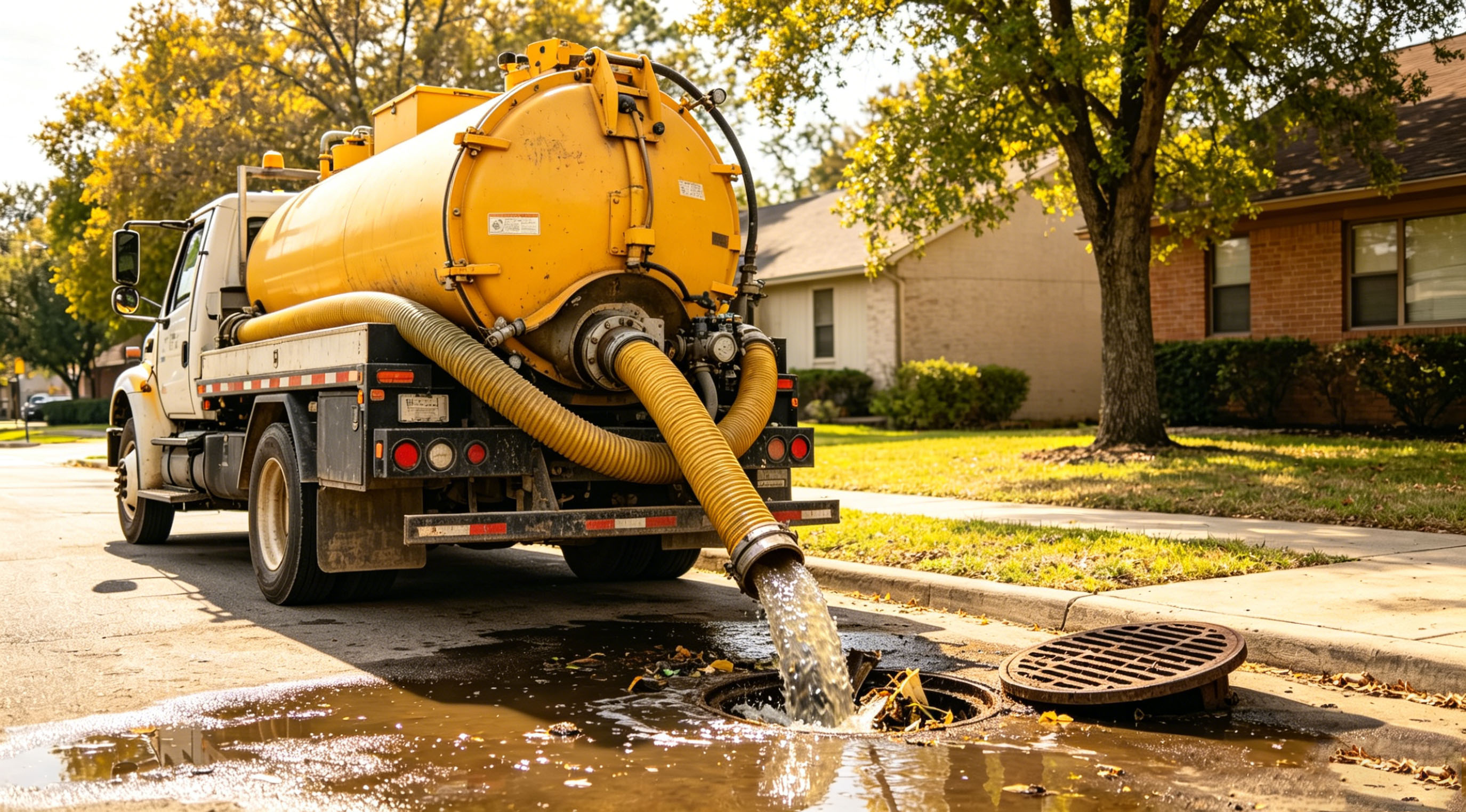
Slew Drive for Vacuum Truck
What is a slew drive for Vacuum Truck?
A slew drive is a compact, high-torque rotational device that combines a slewing ring bearing with a worm or planetary gear system inside a single housing. It is designed to handle heavy loads, high moment forces, and precise positioning in a wide range of industrial applications, from solar trackers to construction equipment.
On a vacuum truck, the slew drive is the critical component that enables the suction boom to rotate left and right — allowing the operator to reach manholes, septic tanks, or debris piles without moving the entire vehicle. Without a slew drive, the boom would have limited mobility, forcing the driver to constantly reposition the truck, which wastes time, fuel, and increases the risk of accidents on busy job sites.
Instead of relying on hydraulic cylinders that offer limited swing angles (typically 30–60 degrees) and require frequent maintenance on pins and bushings, a slew drive provides smooth, controlled, and lockable rotation, typically from ±90° up to continuous 360°. This means the operator can keep the truck parked in one safe position while the boom reaches multiple suction points in a wide arc.
In short, a slew drive for a vacuum truck is what turns a fixed suction arm into a highly maneuverable, job-site-efficient tool. It is the difference between a truck that fights the operator and one that works seamlessly with them.
Key Features of a Slew Drive for Vacuum Trucks
Below is a detailed breakdown of the key features that make a slew drive ideal for vacuum truck applications, along with the specific benefit each feature delivers on the job site.
| Feature | Benefit for Vacuum Truck |
|---|---|
| High moment load capacity | Handles boom weight + suction pull + side loads |
| Self-locking (worm gear type) | Boom stays put when engine/hydraulics are off |
| Compact height | Fits between truck chassis and boom pedestal |
| Sealed housing | Resists dust, water, and debris from job sites |
| Low maintenance | Grease interval often 500–1000 hours |
| High reduction ratio | Smooth boom positioning without jerking |
High moment load capacity – Vacuum truck booms are long, heavy, and often operate at awkward angles while pulling strong suction forces. The moment load (a combination of weight, reach, and external forces) can easily exceed 10,000 Nm on medium-duty trucks. A properly designed slew drive is built to handle these high tilting moments without binding or premature wear, thanks to its large-diameter slewing ring bearing and robust housing design.
Self-locking (worm gear type) – This is perhaps the most critical safety feature. In a worm gear slew drive, the worm can turn the gear, but the gear cannot turn the worm. This means that when the operator releases the joystick or the hydraulic pressure drops, the boom locks firmly in place. No holding brake is required, and there is zero risk of the boom swinging unexpectedly due to gravity or suction vibration. For operators working near power lines, traffic, or pedestrians, this self-locking feature provides peace of mind.
Compact height – The space between a vacuum truck's chassis and the boom pedestal is often limited to just 150–300 mm (6–12 inches). Traditional rotation solutions like large pinion gears or turntable bearings with separate gearboxes take up much more vertical space. A slew drive integrates the bearing, gear, and housing into one low-profile unit, allowing it to fit neatly into tight mounting envelopes without raising the boom's center of gravity — which would negatively affect stability.
Sealed housing – Vacuum trucks work in some of the dirtiest environments imaginable: sewage plants, construction sites, industrial waste facilities, and flood recovery zones. Water, sand, mud, and small debris are everywhere. A slew drive designed for vacuum trucks features multiple lip seals, often with scrapers, to keep contaminants out of the gear mesh and bearing raceways. This sealing extends component life dramatically compared to open gear or poorly sealed alternatives.
Low maintenance – Fleet managers love this feature. A typical slew drive requires only a simple grease refill every 500–1,000 operating hours via standard zerk fittings. No daily lubrication, no complex teardowns, and no specialized tools. For a vacuum truck that runs 2,000 hours per year, that means just two to four maintenance stops annually for the slew drive. Compare that to hydraulic cylinder pivot pins that need greasing every shift and replacement every 1–2 years.
High reduction ratio – Slew drives typically offer gear ratios from 50:1 up to 200:1 or more. This means the input motor (hydraulic or electric) can spin at high speeds while the output rotates slowly — typically 0.5 to 3 RPM. The result is incredibly smooth, precise boom movement. Operators can inch the boom into position within a fraction of a degree, which is essential when aligning with a recessed manhole or avoiding an obstacle. Without this high reduction ratio, the boom would move too fast and jerkily, making precise work frustrating and unsafe.
How Does a Slew Drive Work on a Vacuum Truck?
The operation of a slew drive on a vacuum truck follows four clear steps:
Power input – A hydraulic motor (most common) or electric motor turns the worm or pinion shaft that enters the side of the slew drive housing. On most vacuum trucks, this motor is powered by the truck's PTO (power take-off) driving a hydraulic pump.
Gear reduction – Inside the slew drive, the worm gear rotates against the external teeth of the integrated slewing ring. Because the worm has a single start (or multiple starts depending on design) and the slewing ring has many teeth, the input speed is reduced dramatically while torque is multiplied. A typical 80:1 ratio means the input turns 80 times for every single output rotation.
Rotation output – The output flange (either the inner or outer ring of the slewing bearing, depending on the model) rotates the vacuum truck's boom at typical speeds of 0.5–3 RPM. The boom is bolted directly to this output flange, so any rotation of the slew drive translates directly to boom movement.
Position holding – In worm gear designs, the system is inherently self-locking. When the operator releases the joystick, the hydraulic motor stops turning the worm. Because the worm/gear interface cannot back-drive, the boom stays exactly where it stopped — even with the hydraulic system off, the engine shut down, or the truck parked overnight. This eliminates the need for mechanical brakes, hydraulic holding valves, or continuous pressure.
On a typical vacuum truck, the slew drive is mounted vertically under the boom pivot, often inside a steel pedestal or directly between the truck frame and the boom base plate. The operator uses a joystick or remote control to command the hydraulic motor, and a flow control valve determines the rotation speed. Many modern vacuum trucks also include angle sensors or encoders on the slew drive to provide the operator with digital readouts of the boom's exact position.
Main Types of Slew Drives for Vacuum Trucks
There are four main types of slew drives used on vacuum trucks, each with distinct advantages and trade-offs:
Worm gear slew drive – The most common type for vacuum trucks. It offers self-locking capability (no brake required), high shock load resistance, and a simple, reliable design. The main downside is slightly lower efficiency (70–85%) compared to planetary designs, but for the intermittent duty cycle of a vacuum truck, this is rarely a concern. Best for 90% of standard vacuum truck applications.
Planetary slew drive – Uses a planetary gear train instead of a worm. Provides smoother rotation, higher efficiency (over 90%), and more compact width. However, planetary slew drives are not self-locking, so they require a separate holding brake or hydraulic valve to keep the boom from moving when power is off. Best for high-speed positioning applications where efficiency is critical.
Hydraulic direct-drive slew – This design uses a low-speed, high-torque hydraulic motor directly coupled to the slewing ring without a reduction gearbox. Delivers very high torque for heavy-duty hydro-excavators but requires continuous hydraulic pressure to hold position. Best for extreme-duty applications with unlimited hydraulic flow.
Electric slew drive – Powered by an electric motor rather than hydraulic. Quiet, precise, and free from hydraulic hoses and potential oil leaks. However, most vacuum trucks do not have onboard high-voltage electrical systems sufficient for continuous slew drive operation, so electric versions are typically found on hybrid or fully electric vacuum trucks. Best for noise-sensitive environments like residential or hospital zones.
For most standard vacuum trucks (20–40 m³/day suction capacity), a worm gear slew drive remains the industry standard due to its self-locking safety, simplicity, and proven durability.
Advantages of Using a Slew Drive on a Vacuum Truck
Switching from traditional cylinder rotation or open gear systems to a dedicated slew drive offers a long list of concrete advantages for vacuum truck owners, operators, and fleet managers. Below is a detailed look at each benefit.
Safer operation – Safety is the number one priority on any job site. A slew drive's self-locking capability (in worm gear designs) means the boom will never swing unexpectedly due to gravity, hydraulic pressure loss, or vibration. This eliminates a common cause of accidents: booms drifting into power lines, traffic lanes, or crew members. Additionally, because the slew drive provides smooth, controlled movement without jerking, operators are less likely to over-correct or lose control during fine positioning. Many fleets report a measurable reduction in incident rates after converting to slew drive systems.
More reach flexibility – A vacuum truck with a slew drive can rotate its boom across a wide arc — typically ±90°, ±135°, ±180°, or even continuous 360° depending on the hydraulic swivel configuration. This means the truck can be parked in a safe, stable location while the boom reaches multiple suction points. For example, when cleaning a long trench or a series of manholes along a street, the operator can clear four to six points without moving the truck once. Without a slew drive, the truck would need to be repositioned for each new suction point, adding minutes of driving and setup time per location — which adds hours to a full day's work.
Less wear and lower maintenance costs – Traditional hydraulic cylinder rotation systems rely on pins, bushings, and linkage arms that are exposed to dirt, moisture, and side loading. These components wear out quickly in vacuum truck service, often requiring new pins and bushings every 6–12 months. In contrast, a slew drive encloses all critical components — gears, bearings, seals — inside a sealed, lubricated housing. There are no exposed pivot points to grease daily, no linkage arms to bend, and no cylinder rods to scratch or corrode. The result is a system that often lasts 8–15 years with only periodic grease refills, dramatically lowering the total cost of ownership.
Compact installation – A slew drive integrates the bearing, gear, and housing into a single low-profile unit. Typical height ranges from just 80 mm (3 inches) for small units to 250 mm (10 inches) for heavy-duty models. This allows it to fit between the truck chassis and the boom pedestal without raising the boom's center of gravity — which is critical for maintaining stability during suction operations. Cylinder systems, by comparison, require linkage arms, brackets, and large pivot pins that take up significantly more space and often require custom fabrication to fit.
Higher resale value – When it comes time to sell or trade in a vacuum truck, well-maintained equipment with modern features commands higher prices. Trucks equipped with slew drive rotation systems are viewed by buyers as more capable, safer, and lower-maintenance than those with old-style cylinder rotation. Many used equipment listings specifically highlight "slew drive boom rotation" as a premium feature, similar to having a higher-flow vacuum pump or a heated water system. The investment in a quality slew drive often pays back partially or fully at resale time.
Precise boom control – The high gear reduction of a typical slew drive (50:1 to 200:1) means output rotation is slow and smooth. Operators can position the boom within 0.5 to 1 degree of accuracy, which is essential when working in tight spaces like below-grade manholes, between parked cars, or near building walls. Hydraulic cylinder rotation, by contrast, tends to be less precise because cylinder extension/retraction is linear while boom rotation is angular — small cylinder movements can cause large boom swings, and it's difficult to hold intermediate positions without drift. With a slew drive, what you command is exactly what you get, every time.
Reduced operator fatigue – A smooth, predictable, low-effort control system reduces mental and physical strain on the operator, especially during long shifts or repetitive work. Joystick-controlled slew drives require minimal effort to command, and the self-locking feature means the operator doesn't have to constantly hold the joystick in position to prevent drift. This leads to better focus, faster work, and fewer errors at the end of a long day.
Adaptability to different power sources – Slew drives are available with hydraulic, electric, or even pneumatic motor inputs. This means the same basic slew drive design can be adapted to any vacuum truck's existing power system. For diesel-hydraulic trucks, a hydraulic motor is installed. For electric or hybrid trucks, an electric motor is fitted. The slew drive itself remains unchanged, which simplifies inventory and replacement part management for fleets with mixed truck types.
How to Choose the Right Slew Drive for Your Vacuum Truck
Answer these five questions before selecting a slew drive:
Static moment load (Nm or ft-lb) – Calculate boom weight × reach length × safety factor (2–3x). For example, a 200 kg boom with 4 m reach gives 800 kg-m (7,848 Nm) before safety factor. After applying a 2.5x safety factor, you need a slew drive rated for at least 19,620 Nm.
Max rotation angle – Do you need 180°, 360°, or continuous rotation? Most vacuum trucks use ±135° to ±180° to avoid hydraulic hose twisting. Full 360° continuous rotation requires a hydraulic swivel or slip ring.
Input power – What is your hydraulic flow (L/min or GPM) and pressure (bar/PSI)? Typical vacuum truck PTO systems provide 40–80 L/min at 150–200 bar. Match the slew drive's motor displacement to your flow for optimal speed.
Mounting space – What height and bolt circle diameter is available on your truck? Measure carefully — many custom installations fail because the chosen slew drive is 10 mm too tall.
Environment – Will the truck operate in road salt (corrosion risk), wet waste (seal requirement), or dry debris (abrasion risk)? Choose seal and coating options accordingly.
General sizing guide: Light vacuum trucks (10–15 m³) typically need 3,000–5,000 Nm torque with 50:1–80:1 gear ratio. Medium trucks (15–25 m³) require 6,000–12,000 Nm with 80:1–120:1 ratio. Heavy trucks (25–40 m³) need 15,000–25,000 Nm with 120:1–160:1 ratio. All worm gear types provide self-locking.
Installation and Maintenance of Slew Drives for Vacuum Trucks
Installation tips:
Use a flat mounting surface (max 0.1 mm/m runout). Any unevenness will distort the slewing ring and cause premature failure.
Apply threadlocker to mounting bolts. Use medium-strength (blue) Loctite 243 for easy removal later.
Install a pressure relief valve if using a hydraulic motor. This protects the slew drive from over-torque if the boom hits an obstacle.
Align the boom's center of gravity over the slew drive axis as much as possible. Off-center loads increase moment forces and reduce service life.
Maintenance schedule:
Daily – Visual check for leaks, loose bolts, or unusual noise during operation.
Every 250 hours – Grease through zerk fittings using NLGI #2 lithium grease with EP (extreme pressure) additives. Pump slowly until fresh grease appears at the seals.
Every 1,000 hours – Check backlash by measuring rotational play at the boom tip. Re-torque mounting bolts to factory specifications.
Every 2 years or 3,000 hours – Inspect worm gear and bearing wear by removing the inspection port. Look for pitting, flaking, or unusual wear patterns.
Never pressure-wash directly into the seal area — water and debris forced past the seals will destroy the slewing ring bearing quickly. Use low-pressure water or steam cleaning instead, and avoid direct spray on seals.
Price of a Slew Drive for Vacuum Trucks
Pricing varies significantly based on size, brand, and customization:
Small worm slew drive (OEM, China) – 800, suitable for light-duty vacuum trucks under 15 m³ capacity. Basic sealing, standard materials.
Medium-duty brand unit (Europe/US) – 3,000, offering higher reliability, better seals, and certified materials. Recommended for commercial fleet use.
Heavy-duty large slew drive – 9,000, for 30+ m³ trucks or severe-duty applications. Includes upgraded seals, higher moment ratings, and often custom bolt patterns.
Custom-built slew drive – 12,000, with tailored dimensions, special gear ratios, unique mounting interfaces, or corrosion-resistant coatings.
Note: Prices do not include hydraulic motor, hoses, or installation labor. Typical lead time is 2 to 8 weeks, with custom orders taking longer than standard catalog items.
LyraDrive: Custom Slew Drive Manufacturer for Vacuum Trucks
LyraDrive is a professional one-stop manufacturer specializing in the design, development, customized production, sales, and service of slew drives and slewing bearings. With a strong focus on engineering support and quality, LyraDrive serves industries including truck cranes, excavators, manlifts, and commercial vehicles.
For vacuum truck applications, LyraDrive offers customized slew drive solutions tailored precisely to your boom weight, rotation angle, hydraulic flow, and mounting constraints. Whether you need a specific gear ratio, unique bolt pattern, upgraded seals for wastewater environments, or a compact design to fit tight chassis spaces, LyraDrive delivers a purpose-built slew drive — not a generic off-the-shelf part.
Looking for a reliable slew drive supplier or technical support for your vacuum truck project? Contact LyraDrive today for a custom quote and engineering recommendation.
FAQ of Slew Drives for Vacuum Trucks
Q1: Can I replace my cylinder rotation system with a slew drive?
Yes — most vacuum trucks can be retrofitted. You'll need a flat mounting plate and proper hydraulic motor sizing. Many owners complete the retrofit in one weekend.
Q2: Do I need a brake if I use a worm gear slew drive?
No. The worm gear is inherently self-locking. But always check the manufacturer's static holding torque specification to ensure it exceeds your boom's maximum moment load.
Q3: How long does a slew drive last on a vacuum truck?
With proper maintenance: 8 to 15 years or over 10,000 operating hours. The worm gear and slewing ring bearing are the wear items; both can be replaced if needed.
Q4: Can a slew drive rotate 360° continuously?
Yes — but you'll need a hydraulic swivel or slip ring for hoses and electrical lines. Most vacuum trucks use ±135° or ±180° to avoid the complexity and cost of a swivel.
Q5: What happens if debris gets into the gear?
Premature wear, increased backlash, and eventual failure. That's why sealed designs with quality lip seals and scrapers are strongly preferred for vacuum truck environments.
Q6: Which is better — hydraulic or electric slew drive for vacuum trucks?
Hydraulic is more common because vacuum trucks already have a PTO-driven hydraulic system. Electric is cleaner and quieter but adds battery, controller, and charging costs. Choose based on your truck's existing power architecture.
 WhatsApp
 sales@lyradrive.com
 +8613903880726