



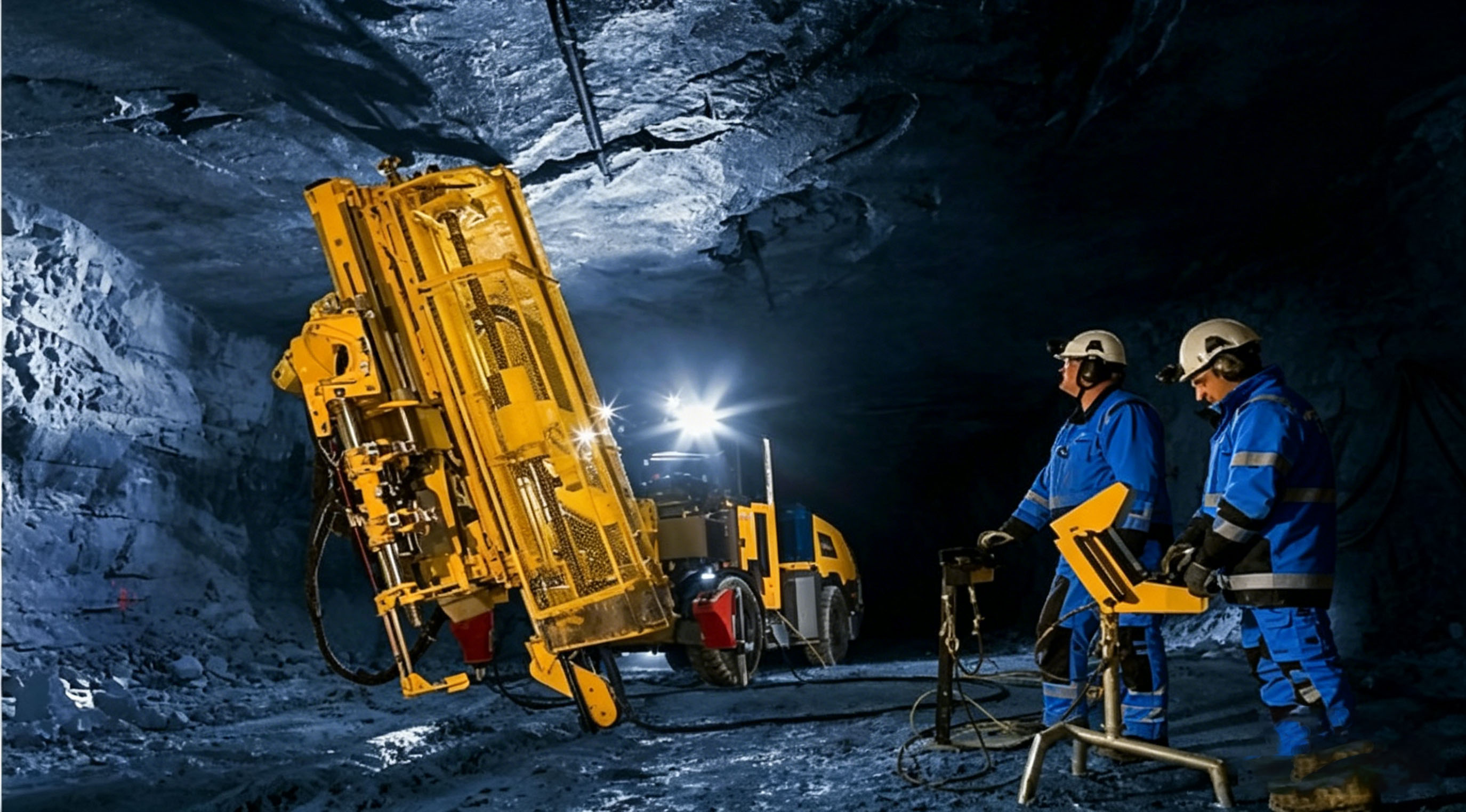
Slew Drive for Mining Rig
What Is a Slew Drive for Mining Rig?
A slew drive (also known as a slewing drive or slew bearing gearbox) is a compact mechanical device that integrates a slewing bearing, a housing, a gear train (typically a worm gear or planetary gear), and sealing components into a single unit. Its primary function is to enable controlled rotational motion while supporting heavy axial, radial, and tilting moment loads.
In a mining rig, the slew drive is a mission-critical component. It is used in applications such as:
Rotary drill rigs – to rotate the mast or drill head
Excavators and shovels – for cab or boom rotation
Stackers and reclaimers – to position conveyor booms
Underground bolting rigs – for precise angle adjustment
Without a reliable slew drive, a mining rig cannot achieve the precision, safety, or durability required in harsh mining environments.
Key Features of a Mining-Grade Slew Drive
Mining rigs operate under extreme conditions: heavy dust, water spray, temperature swings from -30°C to +50°C, constant vibration, and sudden shock loads from rock impact. A standard industrial slew drive will fail within weeks in such an environment. A mining-grade slew drive is specifically engineered to survive and perform under these brutal conditions, incorporating the following critical features:
High Load Capacity and Shock Tolerance
Mining slew drives must handle extreme axial (vertical), radial (horizontal), and tilting moment loads simultaneously – often exceeding 100 kNm of torque. But beyond static loads, the real challenge is dynamic shock. When a drill bit fractures rock or an excavator bucket hits a boulder, instantaneous loads can spike 3–5 times higher than normal operating loads. Mining-grade units use through-hardened gears, induction-hardened raceways, and high-quality bearing steel (e.g., 42CrMo4) to absorb these impacts without plastic deformation or cracking.
Self-Locking Capability (Worm Gear Designs)
For drill rigs operating on slopes or inclined surfaces, the self-locking feature of a worm gear slew drive is not a convenience – it is a safety requirement. When hydraulic pressure is lost or the motor stops, the worm geometry prevents reverse rotation. This means a multi-ton drill mast will not crash down unexpectedly, protecting workers and equipment. The self-locking ratio typically requires a lead angle smaller than the friction angle (generally achieved at reduction ratios above 30:1).
Robust Sealing and Corrosion Protection
Mining environments are aggressive. Open-pit mines generate silicate dust that acts like sandpaper on seals. Underground mines have high humidity and often acidic water. A mining-grade slew drive must feature multi-lip seals, labyrinth seals, or combination sealing systems achieving IP66 or IP67 protection. Additionally, corrosion-resistant coatings (such as zinc-nickel plating, epoxy primers, or stainless steel components) prevent rust from compromising bolt retention and bearing surfaces.
Compact Integrated Design
Unlike traditional solutions that require a separate slewing bearing, gearbox, and mounting structure, a slew drive combines all three into one unit. This integration saves valuable real estate on a mining rig, reduces weight, simplifies assembly, and eliminates alignment issues between components. For rig designers, this translates to more flexible machine layouts and lower overall manufacturing costs.
How Does a Slew Drive Work on a Mining Rig?
Understanding the working principle of a slew drive is essential for proper selection and troubleshooting. While the concept is mechanically straightforward, the engineering behind it is sophisticated. Here is a step-by-step breakdown of how a slew drive operates on a typical mining drill rig or excavator:
Step 1: Power Input
A power source – usually a hydraulic motor (most common on heavy mining rigs due to high torque density) or an electric motor (cleaner, quieter, used on smaller or electrically powered rigs) – drives the input shaft of the slew drive. Hydraulic systems typically operate at pressures of 200–350 bar, delivering smooth, controllable rotation.
Step 2: Gear Reduction and Torque Multiplication
Inside the slew drive housing, the input shaft turns a worm gear (or a pinion gear in planetary designs). This worm engages with a larger gear ring – the slewing ring's internal or external teeth. The reduction ratio is determined by the number of gear teeth and the worm lead. Typical mining slew drive ratios range from 20:1 to over 200:1. For example, at a 100:1 ratio, the input shaft must turn 100 times for the output to rotate once. This high reduction dramatically multiplies torque: a hydraulic motor delivering 500 Nm of input torque can produce 50,000 Nm (50 kNm) of output torque at the slewing ring.
Step 3: Load Support and Rotation
The slewing ring within the slew drive is not just a gear – it is a large-diameter bearing designed to support the weight of the attachment (drill mast, boom, cab) while rotating. The ring contains two rows of rolling elements (balls or rollers) that handle axial, radial, and moment loads simultaneously. As the gear teeth drive the ring, the outer housing of the slew drive – which is bolted to the rotating attachment – turns relative to the fixed base plate.
Step 4: Controlled Output Motion
The result is slow, powerful, and precise rotation. On a rotary blasthole drill rig, this allows the operator to swing the 10-ton mast from one hole position to the next without moving the tracks. On an excavator, it enables 360° cab rotation for loading haul trucks. The self-locking nature of a worm gear means that once rotation stops, the position is held mechanically – no brake required (though a brake is still recommended for safety redundancy).
The Worm Gear Advantage in Mining
Worm gear slew drives are particularly valued because they achieve high reduction in a single stage, unlike planetary gears which may require multiple stages. This simplicity means fewer failure points. Additionally, worm drives operate smoothly and quietly, with inherent shock absorption – the sliding action of the worm against the gear teeth can dampen sudden impact loads.
Main Types of Slew Drives for Mining Rigs
Not all slew drives are created equal. The right type for your mining rig depends on the application: partial rotation vs. continuous rotation, precision requirements vs. raw torque, and the need for self-locking. Below is a detailed comparison of the main types used in mining:
Worm Gear Slew Drive
The worm gear slew drive is the most common type found on mining drill rigs, bolting machines, and boom rotators. Its defining characteristic is self-locking – when the input shaft stops, the worm cannot be back-driven by the load. This makes it ideal for applications where the attachment must hold position safely without constant hydraulic pressure, such as a drill mast working on a 15° incline.
Advantages for mining: High reduction ratio (up to 200:1) in a single stage, compact footprint, inherent shock damping, and quiet operation. Backlash can be as low as 0.05° for precision drilling.
Limitations: Lower efficiency (typically 50–70%) compared to planetary designs, which means more power is lost as heat. Not suitable for continuous 360° rotation under full load for extended periods.
Planetary / Spur Gear Slew Drive
For applications requiring continuous rotation – such as conveyor stackers, reclaimers, and large excavators – the planetary slew drive is the better choice. Instead of a worm, it uses a pinion gear driving a large spur gear ring, often with multiple planetary stages for reduction.
Advantages: Higher efficiency (85–95%), smoother continuous motion, and the ability to handle very high output speeds (though mining usually favors low speed). They can also be designed with very large hollow centers for cables or hoses to pass through.
Limitations: No self-locking capability – a separate brake is always required. Multiple stages mean more components and potential failure points. Generally larger and heavier than an equivalent torque worm drive.
Hydraulic Slew Drive
In very large mining equipment – such as rope shovels, draglines, and heavy hydraulic excavators – a hydraulic slew drive is sometimes specified. This is typically a low-speed, high-torque hydraulic motor integrated directly with a planetary gear stage. The entire unit is powered by the rig's main hydraulic system.
Advantages: Extremely high torque density (can achieve 500+ kNm), infinite speed variability, overload protection (hydraulic relief valves), and no electrical components – critical for underground mining where sparks are a hazard.
Limitations: Requires a robust hydraulic system and cooling. Lower overall efficiency due to hydraulic losses. More complex maintenance (hydraulic hoses, filters, seals).
Which Type Is Right for Your Mining Rig?
| Application | Recommended Type | Key Reason |
|---|---|---|
| Rotary blasthole drill mast | Worm gear | Self-locking for safety on slopes |
| Underground roof bolter | Worm gear | Compact, precise, safe |
| Conveyor stacker / reclaimer | Planetary | Continuous rotation, higher duty cycle |
| Large hydraulic excavator (360°) | Planetary or hydraulic | High speed and torque, no self-lock needed |
| Mobile crusher feed boom | Worm gear | Hold position under vibration |
For most mining rig applications – especially those involving masts, booms, or attachments that must stay put when power is removed – the worm gear slew drive remains the industry standard. Planetary designs are reserved for continuous rotation duties where self-locking is not required.
Advantages of Using a High-Quality Slew Drive on Mining Rigs
Investing in a purpose-built mining slew drive delivers tangible benefits:
Increased safety – Self-locking prevents unexpected reverse rotation, protecting workers and equipment.
Precise positioning – Backlash as low as 0.05° enables accurate hole alignment or material placement.
Lower total cost of ownership – Longer service life (5–10 years) and fewer repairs reduce overall expenses.
Space savings – No need for separate bearing, gearbox, and mounting structure.
Energy efficiency – Worm gear designs offer high reduction in a single stage, reducing motor power requirements.
Reduced maintenance – Sealed housings keep contaminants out, extending grease intervals.
In a mining operation where unplanned downtime costs thousands of dollars per hour, a reliable slew drive is not an expense – it is an investment.
Core Factors to Consider When Choosing a Slew Drive for a Mining Rig
Selecting the wrong slew drive leads to premature failure, safety risks, and costly replacements. Consider these seven factors carefully:
Load Requirements – Calculate both static (weight of attachment) and dynamic (rotation, wind, material impact) loads. Always add a safety factor of 1.5–2x for shock loads common in rock drilling.
Operating Environment – Open pit (dust, UV, -30°C to +50°C) vs. underground (humidity, corrosive gases, confined space).
Rotation Angle – Partial rotation (e.g., 90° or 180°) favors worm gear; continuous 360° requires planetary.
Backlash Requirement – Precision drilling needs ≤0.1°; bulk material handling can tolerate higher values.
Power Source – Hydraulic (high torque density) vs. electric (cleaner, requires brake).
Mounting Interface – Bolt pattern must match your rig's structure; custom drilling is often required.
Sealing and Protection – Look for dual-lip seals, labyrinth seals, and IP66 minimum.
Always request a load chart and calculated service life from the manufacturer before purchasing.
How to Install and Maintain a Slew Drive on a Mining Rig
Installation Best Practices
Proper installation doubles the life of a slew drive:
Clean the mounting surface – Any dirt or burrs cause misalignment and premature wear.
Use grade 10.9 or 12.9 bolts – Standard bolts will fail under mining vibration.
Torque bolts in sequence – Follow a star pattern using a calibrated torque wrench.
Check gear backlash – Before final assembly, verify mesh alignment with feeler gauges or dial indicators.
Align the input shaft – Angular misalignment exceeding 0.5° destroys seals within hours.
Maintenance Schedule (Every 500–1,000 operating hours)
Regrease through fittings (500 hours)
Inspect seals for cracks or hardening (500 hours)
Check bolt torque – vibration loosens fasteners (1,000 hours)
Listen for grinding – early sign of bearing failure (daily)
Monitor input shaft seal for leaks (weekly)
Critical warning: Never use a pressure washer directed at the seal area. Water ingress is the #1 cause of premature slew drive failure in mining.
The Price of a Slew Drive for a Mining Rig
| Slew Drive Type | Typical Torque | Price Range (USD) |
|---|---|---|
| Small worm drive (light duty) | <5 kNm | $800 – $2,500 |
| Medium mining worm drive | 20–50 kNm | $3,500 – $8,000 |
| Large heavy-duty worm drive | 100–300 kNm | $10,000 – $35,000 |
| Custom planetary slew drive | 150–500 kNm | $25,000 – $70,000+ |
Additional costs: motor, adapter plate, special sealing, freight, installation support.
LyraDrive: Custom Slew Drive Manufacturer for Mining Rigs
LyraDrive is a professional one-stop slewing device manufacturer, specializing in the design, development, customized production, sales, and service of slew drives and slewing bearings. With years of engineering experience, LyraDrive provides high-quality, custom-engineered solutions for truck cranes, excavators, manlifts, and – most importantly – mining rigs.
For the mining industry, LyraDrive offers fully customized slew drive solutions. Whether you need a worm gear slew drive with enhanced self-locking for steep-angle drilling, or a planetary slew drive for continuous rotation on a stacker, LyraDrive can tailor the load capacity, gear ratio, mounting flange, sealing level, and materials to your exact specifications.
Unlike suppliers who offer only standard catalog products, LyraDrive works directly with mining engineers to solve real-world problems: high shock loads, extreme dust, limited maintenance access, and retrofit requirements for older rigs.
If you are looking for a reliable slew drive supplier or need technical support for your mining application, contact LyraDrive today. Let us engineer a solution that keeps your rigs turning – safely and reliably.
FAQ – Slew Drive for Mining Rig
Q1: How long does a mining slew drive typically last?
With proper installation and regular maintenance, 5 to 10 years. Seal life and contamination control are the main limiting factors.
Q2: Do I still need a separate brake if the slew drive is self-locking?
Yes. Self-locking provides static holding, but a separate brake is recommended for emergency stops and hydraulic system failures. Safety regulations in most mining regions require redundancy.
Q3: What grease is best for mining slew drives?
For open-pit mining, use EP lithium complex NLGI #2 with molybdenum disulfide (MoS₂). For underground mines, consult your supplier for a flame-retardant alternative.
Q4: Can LyraDrive retrofit an old mining rig with a new slew drive?
Yes. LyraDrive specializes in custom retrofits – measuring your existing mounting interface and designing a direct replacement.
Q5: What is the typical lead time for a custom mining slew drive?
Normally 15–30 days, depending on product complexity, size, and order quantity. Expedited options are available for emergency replacements.
 WhatsApp
 sales@lyradrive.com
 +8613903880726