



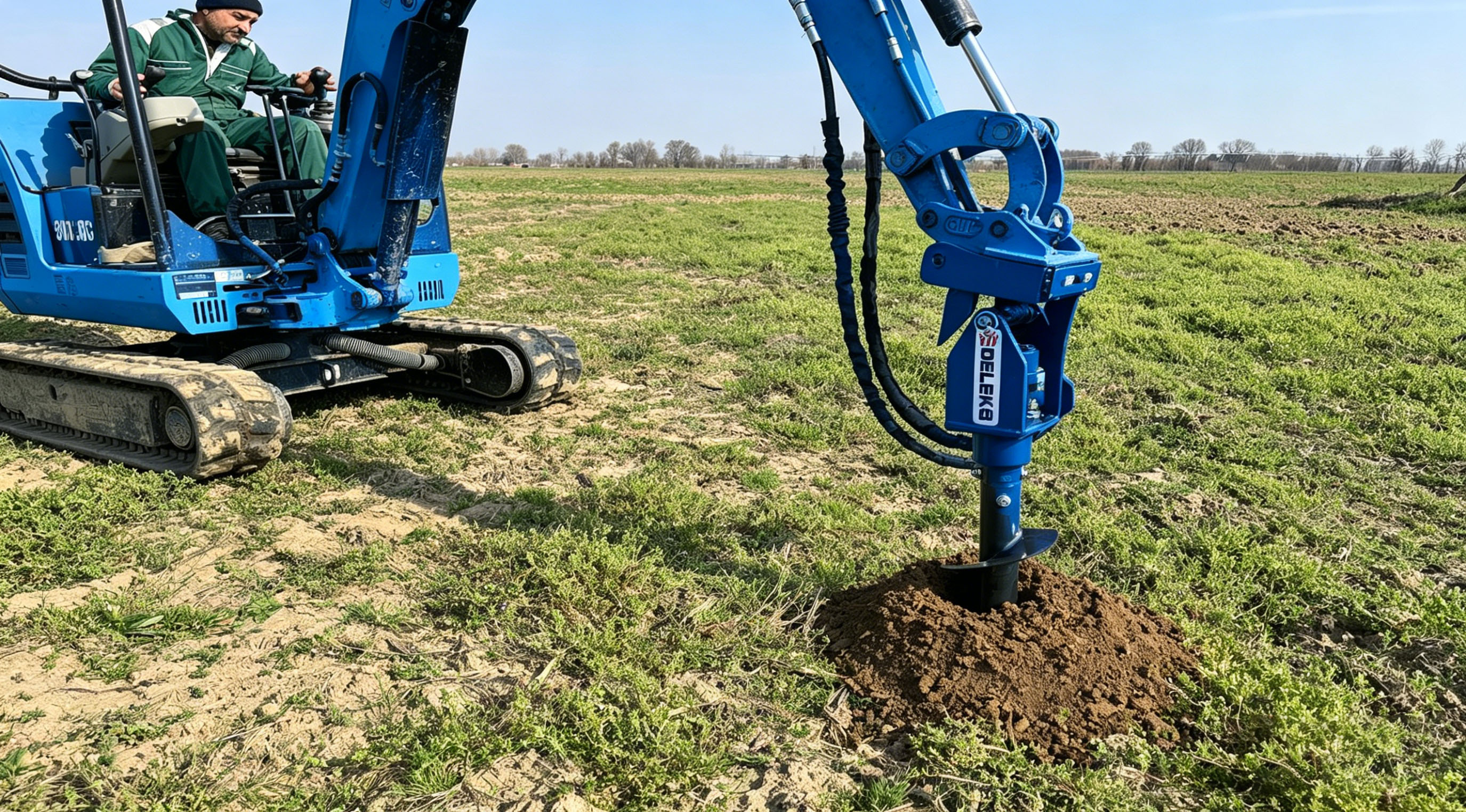
Slew Drive for Hydraulic Excavation Drill
What Is a Slew Drive for Hydraulic Excavation Drill?
A slew drive is a compact, high‑torque rotary actuator that enables controlled rotation of the drill mast or turntable on a hydraulic excavation drill. It typically consists of a worm or spur gear reduction system, a housing with integrated bearings, and sealing elements to withstand harsh drilling environments. In a hydraulic excavation drill, the slew drive connects the upper carriage (or drilling attachment) to the lower undercarriage, allowing precise angular positioning of the drill head. Without a reliable slew drive, the machine cannot maintain accurate hole alignment or efficiently move between drilling points.
How Does a Slew Drive Work in a Hydraulic Excavation Drill?
The slew drive receives hydraulic power from the machine’s main hydraulic system. A hydraulic motor (often gear or piston type) drives the input shaft of the slew drive. Inside the slew drive, the reduction mechanism – either a worm gear slew drive or a spur gear slew drive – multiplies torque while reducing rotational speed. The output flange or shaft then rotates the attached structure (e.g., the drill boom).
For a worm gear slew drive, the worm’s screw action naturally prevents back‑driving, so the drill stays in place even when hydraulic pressure is removed. For a spur gear slew drive, an external brake is engaged to hold position. The operator controls the slew drive via a pilot valve or joystick, enabling smooth start, stop, and speed variation.
Key Features of Slew Drives for Hydraulic Excavation Drills
Slew drives for hydraulic excavation drills are engineered to withstand extreme conditions that few other rotary actuators encounter. Below are the essential features in greater detail.
High Torque Density and Compact Footprint
Unlike traditional swing bearing arrangements that require a separate gearbox and pinion, a slew drive integrates the gear reduction, bearings, and housing into a single unit. A worm gear slew drive achieves reduction ratios as high as 200:1 within a compact envelope, allowing the drill mast to rotate with torque outputs exceeding 50 kN·m while occupying minimal machine width. This compactness leaves more room for hydraulic hoses, feed rails, and operator cab components.
Self‑Locking Capability (Exclusive to Worm Gear Designs)
One of the most critical features for drilling on slopes or uneven terrain is the ability to hold position without continuous hydraulic pressure. A worm gear slew drive provides inherent self‑locking due to the friction angle of the worm–wheel interface. When the hydraulic motor stops, the worm cannot be back‑driven by the load torque. This eliminates the need for an external mechanical brake and prevents dangerous mast drift, even when drilling at a 30° incline. A spur gear slew drive does not self‑lock; it requires a spring‑applied, hydraulically‑released brake to achieve the same holding effect.
Shock Load Resistance and Gear Hardening
Hydraulic excavation drills generate percussive forces (from the hammer mechanism) and vibration during rotation. Slew drives for this application use case‑hardened gears (typically 55–62 HRC on the tooth surface) and, in the case of a worm gear slew drive, a bronze worm wheel that absorbs micro‑shocks without brittle fracture. The housing is often made of high‑tensile nodular cast iron (GGG/ductile iron) to resist cracking under repetitive impact forces. Some heavy‑duty spur gear slew drive models incorporate planetary stages with carburized and ground gears for maximum fatigue life.
Advanced Sealing and Contamination Exclusion
Drilling sites are notoriously dirty – fine rock dust, mud, water jets, and even bentonite slurry can enter unprotected rotary joints. Slew drives for hydraulic excavation drills feature multi‑lip rotary seals (nitrile, FKM, or HNBR) with anti‑extrusion rings. The IP rating typically ranges from IP65 (dust‑tight and protected against low‑pressure water jets) to IP66/IP67 for immersion or high‑pressure washing. Some custom units from LyraDrive include double‑lip seals with a labyrinthine path and a grease purge fitting to actively expel contaminants during operation.
Integrated Hydraulic Motor Interface
Rather than requiring a separate coupling, most slew drives for hydraulic excavation drills come with a pre‑machined input shaft or a direct SAE flange for mounting a hydraulic motor (e.g., SAE A, B, or C). This integration simplifies alignment and reduces the number of potential leak points. A worm gear slew drive often accepts lower‑speed, high‑torque motors, while a spur gear slew drive pairs well with higher‑speed motors to maximize its efficiency advantage.
Low Maintenance and Serviceability
Modern slew drives are grease‑lubricated (often with lithium‑based EP grease) for life, or oil‑bathed with a drain/fill port. For hydraulic excavation drills that operate in remote areas, grease‑lubricated units are preferred because they require no oil changes – only periodic regreasing every 500–1000 operating hours. Some designs feature a centralised lubrication port accessible from the top of the machine, avoiding the need to crawl underneath the drill.
Thermal Stability and Cold Weather Options
Extreme ambient temperatures (‑30°C to +60°C) affect gear efficiency and seal flexibility. High‑quality slew drives use synthetic lubricants and seals rated for low‑temperature flexibility. A worm gear slew drive experiences higher sliding friction, which generates heat; this can actually be beneficial in cold climates by warming the lubricant quickly. Conversely, a spur gear slew drive runs cooler but may require a lower‑viscosity grade in arctic conditions.
Main Types of Slew Drives Used in Hydraulic Excavation Drills
Slew drives for hydraulic excavation drills are primarily classified by their gear reduction mechanism. Below are the most relevant types for this application.
Worm gear slew drive
A worm gear slew drive uses a hardened steel worm meshing with a bronze or alloy worm wheel. Its key advantage is self‑locking capability – the drill position stays fixed even when hydraulic pressure drops, which is critical for precision drilling on uneven ground. Trade‑offs include efficiency ranging from 70% to 85%, but it delivers high reduction ratios in a very compact package. This type is often selected as the main slewing actuator for medium‑duty hydraulic excavation drills where holding torque under vibration is essential.
Spur gear slew drive
A spur gear slew drive typically employs straight‑cut spur gears arranged in planetary stages. Its key advantage is higher efficiency (up to 95%) and smoother continuous rotation, making it ideal for fast positioning between drilling spots. The trade‑off is no self‑locking; an external brake (e.g., spring‑applied hydraulic release) is required to prevent unintended rotation. This type is preferred in high‑cycle, high‑speed drilling attachments where energy efficiency and rapid slewing matter more than holding torque.
Other types
Cycloidal or planetary designs are used in very large hydraulic excavation drills (e.g., 30+ ton carriers) for extreme shock load resistance, but cost and complexity are higher. Worm‑planetary hybrids are sometimes found in custom solutions, combining features of both a worm gear slew drive and a spur gear slew drive.
Summary Table
| Feature | Worm gear slew drive | Spur gear slew drive |
|---|---|---|
| Self‑locking | Yes | No (needs brake) |
| Efficiency | 70–85% | 90–95% |
| Best for | Holding position under vibration | Fast, frequent slewing |
In real‑world hydraulic excavation drills, many manufacturers use a worm gear slew drive for the main swing axis (to hold the drill head steady) and a spur gear slew drive for auxiliary movements such as tilt or feed arm rotation. Your choice depends on whether holding torque or slewing speed is the priority.
Main Advantages of Using a Slew Drive for a Hydraulic Excavation Drill
Using a dedicated slew drive instead of a conventional swing bearing + pinion + gearbox combination brings numerous operational and economic advantages. Below is a detailed breakdown.
Superior Positioning Precision
Hydraulic excavation drills must achieve repeatable hole angles to meet design specifications. A direct‑coupled slew drive eliminates cumulative backlash inherent in separate bearing‑and‑pinion systems. A precision‑ground worm gear slew drive can provide backlash as low as 0.05° (3 arc‑minutes), while a spur gear slew drive with preloaded planetary stages can achieve similar accuracy. This translates to consistent drill alignment over hundreds of holes, reducing re‑drilling and material waste.
Enhanced Safety on Sloped Terrain
Self‑locking ability is not just a convenience – it’s a safety feature. When using a worm gear slew drive, the drill mast will not swing downward even if a hydraulic line bursts or the engine stalls. This prevents the mast from striking the ground, nearby workers, or the machine’s own tracks. For a spur gear slew drive, the external brake must be fail‑safe (spring‑applied). However, the inherent self‑locking of the worm design provides a second layer of redundancy that no brake alone can match.
Reduced Maintenance and Lower Total Cost of Ownership
A slew drive integrates multiple components into one sealed assembly. Compare this to a traditional setup: swing bearing (requires periodic relubrication and bolt retorquing), separate gearbox (oil changes, seal replacements), and pinion (wear adjustment). A single slew drive – whether a worm gear slew drive or a spur gear slew drive – replaces all three. The result: fewer grease points, no gearbox oil leaks, and 40–60% less scheduled maintenance time per year. Field data from 20‑ton hydraulic drills show a reduction in rotary system downtime from 12 hours/year to just 3 hours/year after switching to an integrated slew drive.
Faster Cycle Times with Spur Gear Designs
For drilling applications that require rapid repositioning (e.g., foundation drilling, quarry pattern drilling), slewing speed directly impacts production. A spur gear slew drive offers up to 95% efficiency, meaning less hydraulic power is wasted as heat, and more flow goes into output rotation. Slewing speeds of 5–10 rpm are common, compared to 1–3 rpm for a comparable self‑locking worm gear slew drive. This allows the operator to move between holes 2–3 times faster, increasing daily hole count by 15–25%. If your operation prioritizes speed over holding torque on the swing axis, a spur gear slew drive is the better choice.
Simplified Machine Design and Lighter Weight
By eliminating separate bearing and gearbox housings, the overall rotary assembly weight decreases by 20–30%. For a typical hydraulic excavation drill (10–25 tons operating weight), this weight reduction improves track pressure, fuel efficiency, and transportation logistics. Furthermore, the compact axial height of a slew drive (often less than 150 mm) lowers the machine’s center of gravity, enhancing stability during high‑mast drilling.
Better Resistance to Shock and Vibration
The integrated bearing of a slew drive is designed specifically for high overturning moments – often up to 3–5 times the dynamic torque rating. This is critical when the drill feed force pushes the mast laterally. A worm gear slew drive spreads the load across a large‑diameter cross roller or four‑point contact bearing, while the worm‑wheel mesh absorbs axial shocks. In contrast, a separate pinion‑and‑bearing arrangement concentrates load on the pinion teeth and can suffer premature pitting. Field tests show slew drives last 2–3 times longer than conventional swing drives in percussive drilling applications.
Easier Installation and Replacement
When a slew drive fails or requires replacement, the job is straightforward: unbolt the old unit, lift it out, drop in a new or rebuilt slew drive, reconnect hydraulic lines. No need to realign separate bearings or measure gear backlash between pinion and swing ring. For a spur gear slew drive, brake adjustment is the only extra step. This modularity reduces machine downtime from days to hours – a decisive advantage for rental fleets or contractors with tight deadlines.
Customization for Unique Drill Geometries
Because manufacturers like LyraDrive offer fully custom units, you are not locked into standard bolt circles or shaft sizes. Whether you need a worm gear slew drive with a hollow shaft to pass a water swivel or a spur gear slew drive with an integrated encoder for closed‑loop positioning, custom slew drives can match exactly what your hydraulic excavation drill requires. This flexibility allows drill builders to innovate without being constrained by off‑the‑shelf components.
How to Install a Slew Drive on a Hydraulic Excavation Drill
Preparation – Clean mounting surfaces on the carrier frame and drill mast. Check that no debris enters the slew drive.
Alignment – Place the slew drive on the mounting boss. Use dial indicators to ensure the output flange is within 0.1 mm of concentricity.
Bolting – Apply thread locker to the mounting bolts. Tighten in a cross pattern to the torque specified by the slew drive manufacturer.
Hydraulic connection – Connect the hydraulic motor supply and return lines. Purge air from the lines before operation.
Brake integration – If using a spur gear slew drive, install and test the external spring‑applied/hydraulic‑release brake.
Lubrication – Fill with the recommended grease or oil through the designated port.
Test run – Rotate the slew drive slowly without load, then gradually apply full drill weight, listening for abnormal noise.
Core Factors for Choosing the Right Slew Drive for a Hydraulic Excavation Drill
Output torque – Must exceed the maximum static and dynamic moments from the drill mast, feed force, and ground reaction.
Holding torque – For slope drilling, self‑locking (worm gear type) is preferred; otherwise a brake‑equipped spur gear slew drive may suffice.
Slewing speed – Determines cycle time. Planetary spur gear slew drive offers higher speeds.
Operating environment – Dusty, wet, or extreme temperature conditions require high‑grade seals and possibly nickel‑plated housings.
Mounting interface – Bolt circle, pilot diameter, and output flange pattern must match the drill’s existing structure.
Maintenance access – Choose a drive with easily accessible grease ports or drain plugs.
Compliance – Certifications (e.g., CE, ISO 9001) may be required for certain markets.
Price Considerations for Slew Drives for Hydraulic Excavation Drills
The cost of a slew drive for a hydraulic excavation drill varies widely based on several factors. Type – A worm gear slew drive typically costs less than a high‑precision planetary spur gear slew drive of the same torque. Size and torque rating – Larger output torque (e.g., 50 kNm vs. 10 kNm) increases price exponentially. Material quality – Hardened and ground gears, premium seals, and high‑grade cast iron add to durability and cost. Customization – Non‑standard flange patterns, hollow shaft diameters, or integrated hydraulic motor adapters incur engineering and setup charges. Quantity – Single units for replacement have higher per‑unit price than OEM bulk orders. Brand – Established manufacturers with technical support often command a 15–30% premium.
Typical price range: small units (under 5 kNm) from 1,500; heavy‑duty units for 20–30 ton drills (30–80 kNm) from 10,000. Custom designs may exceed $15,000.
LyraDrive: Leading Custom Slew Drive Manufacturer for Hydraulic Excavation Drills
LyraDrive is a professional one‑stop slewing device manufacturer majored in design and development, customized production, sales and service of slew drives and slewing bearings. LyraDrive provides high‑quality and customized slew drives, slewing bearings and gear rings for truck cranes, excavators, manlifts and other applications. If you are looking for a slew drive supplier or need technical support, feel free to contact LyraDrive.
Customization highlights for hydraulic excavation drill slew drives
LyraDrive understands the unique demands of hydraulic excavation drills – frequent reversing loads, extreme dust and moisture, and limited mounting space. Our custom solutions include reinforced sealing systems (up to IP67) to keep mud and debris out; hardened worm or spur gear sets for extended life under shock loads – choose a worm gear slew drive for self‑locking or a spur gear slew drive for high efficiency; non‑standard mounting flanges and hollow shafts to match any drill model; and optional integrated hydraulic motor adapters for drop‑in replacement. We work closely with you to design a slew drive that delivers the exact torque, speed, and duty cycle your hydraulic excavation drill requires.
Let LyraDrive power your drilling performance
Whether you need a worm gear slew drive for self‑locking stability or a spur gear slew drive for high‑speed positioning, LyraDrive offers reliable, factory‑direct custom solutions. Competitive pricing, fast lead times, and expert engineering support – all from one trusted manufacturer. Contact LyraDrive today for a quote or technical consultation.
FAQ – Slew Drive for Hydraulic Excavation Drill
Q1: Can the slew drive on a hydraulic excavation drill handle continuous bi‑directional rotation without premature wear?
A1: Yes, high‑quality slew drives with hardened worm or spur gears are designed for frequent reversing. A worm gear slew drive may show slightly higher wear on the bronze wheel under continuous oscillation, but using EP (extreme pressure) grease extends life significantly. A spur gear slew drive typically experiences less friction‑related wear but requires a separate brake.
Q2: How do I know if my slew drive needs replacement rather than repair?
A2: Signs include excessive backlash (e.g., >0.5°), abnormal grinding noise, loss of holding torque (the mast drifts even with a worm gear slew drive), or visible oil leakage from damaged seals. If the housing or main gear teeth are cracked beyond minor pitting, replacement is more cost‑effective than rebuilding.
Q3: Does hydraulic pressure fluctuation affect the slew drive’s performance?
A3: Yes. Sudden pressure spikes can cause shock loads that chip gear teeth or rupture seals. For a spur gear slew drive, pressure drop may delay brake release. Always install a pressure relief valve and ensure the hydraulic motor matches the slew drive’s rated input torque.
Q4: What protection rating is recommended for a slew drive used in muddy or dusty drilling environments?
A4: At least IP65 (dust‑tight and protected against low‑pressure water jets). For immersion or heavy slurry (common in water well drilling), IP66 or IP67 with double‑lip seals and a nitrile/FKM combination is recommended. LyraDrive offers custom sealing upgrades for extreme conditions.
Q5: Does LyraDrive offer custom mounting flanges for non‑standard hydraulic excavation drill models?
A5: Absolutely. LyraDrive specializes in fully custom slew drives, including bolt circle diameter, pilot height, output shaft type (solid, hollow, or splined), and integrated hydraulic manifold ports. We can reverse‑engineer any existing worm gear slew drive or spur gear slew drive from other brands for direct replacement.
 WhatsApp
 sales@lyradrive.com
 +8613903880726