



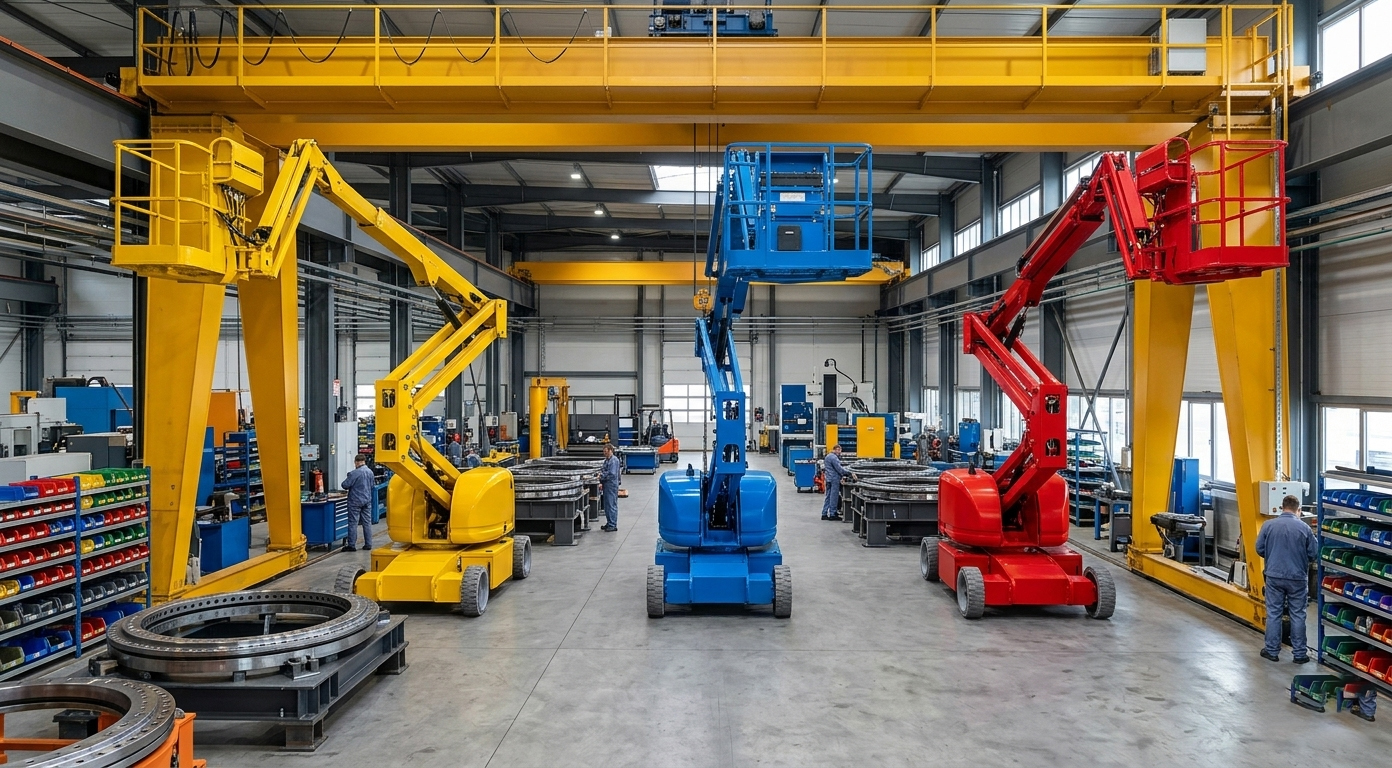
Slew Drive for Aerial Work Platforms
What Is a Slew Drive for Aerial Work Platforms?
A slew drive is a compact, pre-assembled rotational component that integrates a slewing bearing, gear train (worm or planetary), housing, and input shaft into a single unit. Its function is to transmit torque and support heavy loads while enabling precise controlled rotation.
In a high altitude operation platform — including scissor lifts, articulated boom lifts, telescopic boom lifts, and truck-mounted aerial platforms — the slew drive is installed between the chassis and the rotating upper structure. This allows the platform to rotate up to 360° without repositioning the entire machine.
Beyond convenience, the slew drive is a safety-critical component. At heights of 20 to 50 meters, any uncontrolled rotation, wobble, or mechanical failure poses serious risks. A properly designed slew drive ensures operator confidence and job site efficiency.
How Does a Slew Drive Work for Aerial Work Platforms?
To understand how a slew drive functions in an aerial work platform, it helps to break down its core components and trace the power flow.
Core components: a slewing ring (main gear) that supports axial, radial, and tilting moment loads; a worm or pinion gear that drives the slewing ring; a housing that protects internal components; an input shaft that connects to a hydraulic or electric motor; and seals that prevent contamination and retain lubricant.
Power flow: First, a hydraulic or electric motor rotates the input shaft at high speed but low torque. Second, the worm or pinion turns the main gear at ratios from 15:1 to 200:1 — this multiplies torque while reducing speed. Third, the slewing ring rotates, turning the entire upper structure. Throughout rotation, the slew drive simultaneously supports axial load (vertical weight), radial load (horizontal forces), and tilting moment (the overturning force from an extended boom).
The critical feature — self-locking: In worm gear slew drives, the worm angle is designed to prevent reverse rotation. When the motor stops, the platform cannot be forced to rotate by external loads — no external brake is required. This is unique to worm drives and the primary reason they dominate aerial platforms. Planetary drives are not self-locking and require a separate brake.
Key Features of a Slew Drive for Aerial Work Platforms
| Feature | Benefit for Aerial Platform |
|---|---|
| High tilting moment capacity | Safe operation at full boom extension |
| Compact axial height | Low center of gravity, better stability |
| Self-locking (worm type) | No drift at height, no external brake needed |
| Low backlash (<0.1°–0.3°) | Precise positioning, no wobble |
| IP65/IP66 sealing | Reliable in rain, dust, and washdown |
| Wide temperature range (-40°C to +50°C) | Global usability |
| Low maintenance | Reduced downtime, lower operating cost |
Main Types of Slew Drive for Aerial Work Platforms
Choosing the correct slew drive type requires understanding the trade-offs between self-locking, efficiency, cost, and environmental protection.
Open drive type — The slewing bearing and gear are partially exposed. Advantages include lowest manufacturing cost and easy visual inspection. Disadvantages include contaminant ingress and shorter service life in dirty environments. Best for indoor scissor lifts in clean environments.
Enclosed drive type — The entire gear train and bearing are housed within a sealed enclosure. Advantages include excellent protection against dust and water and longer maintenance intervals. Disadvantages include higher initial cost. Best for outdoor boom lifts and harsh environments.
Worm gear slew drive — Uses a worm driving a wheel with a worm angle designed for self-locking. Advantages include self-locking (most important safety feature), quiet operation, and high reduction ratio in a single stage. Disadvantages include lower efficiency (50–70%) and heat generation under continuous rotation. Best for articulated and telescopic boom lifts.
Planetary gear slew drive — Uses a planetary gear train. Advantages include high efficiency (85–95%), continuous rotation capability, and smooth torque delivery. Disadvantages include no self-locking (requires external brake) and higher complexity. Best for continuous rotation applications.
Selection rule: For safety at height, choose worm gear. For continuous rotation, choose planetary with external brake.
Advantages of Slew Drive for Aerial Work Platforms
Why do aerial platform manufacturers choose slew drives over alternative rotation mechanisms? The following advantages explain the preference.
Integrated design saves space and weight. A slew drive combines bearing, gear, housing, and seals into one unit, eliminating separately installed components. This reduces assembly time and overall platform weight — critical for truck-mounted and trailer-mounted platforms where weight limits are strict.
Predictable load ratings. Unlike field-assembled rotation systems, a factory-engineered slew drive comes with certified load ratings for axial load, radial load, and tilting moment. This allows engineers to confidently design the platform's working envelope without guesswork.
Factory-sealed lubrication. Contaminants — dust, sand, water, and pressure wash spray — are the leading cause of premature failure. A quality slew drive arrives with factory-filled lubricant and robust seals, ensuring internal components remain protected for hundreds or thousands of operating hours.
Simplified installation. Mounting a slew drive requires only a flat surface, bolts, and a torque wrench. No gear alignment, no shimming, no field lubrication setup. This reduces manufacturing time for OEMs and simplifies field replacement for maintenance teams.
Safety through self-locking. Worm gear slew drives provide mechanical self-locking — a safety advantage over hydraulic rotary actuators (which can drift due to internal leakage) and planetary drives (which require brake engagement with every move).
Cost-effective lifecycle. While a basic pinion-and-race system may have lower upfront cost, the total cost of ownership for a slew drive is often lower due to longer service life, less frequent maintenance, and reduced downtime. For fleet owners, this translates directly to higher profitability.
How Slew Drive Requirements Vary by Aerial Platform Type
Different platform types place different demands on the slew drive. Scissor lifts require compact size, cost-effectiveness, and low torque due to their low-speed, short-rotation pattern. Articulated boom lifts need worm gear drives with high tilting moment and self-locking for precise, intermittent positioning. Telescopic boom lifts demand low backlash and high dynamic torque for smooth start/stop under variable loads. Truck-mounted platforms require enclosed sealing and high IP ratings for continuous rotation possible in outdoor conditions. Trailer-mounted lifts need small size and optional manual rotation for occasional use. Understanding these variations prevents over-specification (wasting cost) or under-specification (risking safety).
Installation and Maintenance of a Slew Drive for Aerial Work Platforms
Installation best practices: Use a clean, flat mounting surface with flatness within 0.1 mm. Tighten mounting bolts in a star pattern to specified torque. Avoid impact wrenches without torque control. Ensure concentric alignment between the slew drive and turntable.
Maintenance schedule: Every 50 operating hours, perform a visual check for oil or grease leaks. Every 500 hours or 6 months, replenish grease for grease-lubricated drives. Every 12 months, check backlash, inspect seals, and re-torque bolts. Every 2–3 years, perform a full inspection for heavy-use platforms.
Common mistake to avoid: Over-greasing can rupture seals. Always follow OEM lubrication volume recommendations.
Core Factors for Choosing a Slew Drive for Aerial Work Platforms
Evaluate these six parameters when selecting a slew drive for an aerial work platform. First, torque requirement — both static (holding) and dynamic (rotating under load). Second, load ratings — axial, radial, and tilting moment (most critical for boom lifts). Third, self-locking need — if yes, choose worm gear; if no or continuous rotation, choose planetary with external brake. Fourth, environment — indoor applications can use open drives; outdoor or wet conditions require IP65+ enclosed drives. Fifth, altitude effect — above 2000 meters, lubricant viscosity and seal materials may need adjustment; consult the manufacturer. Sixth, integration — ensure compatibility with hydraulic or electric motor interfaces (flange, shaft, coupler).
Price of Slew Drive for Aerial Work Platforms
Slew drive pricing varies significantly based on size, type, precision, and customization. Small open drives for scissor lifts typically range from 400. Enclosed worm drives for boom lifts range from 1,500. Heavy-duty planetary drives range from 3,500. Custom large-size drives can cost 6,000 or more.
Key cost drivers include material quality, heat treatment processes, precision grade (backlash control), seal quality, and certifications (CE, ISO). A cheap slew drive with high backlash causes operator hesitation and accelerated wear — often costing more in downtime than the initial savings. For fleet owners, investing in quality pays off through longer service life and lower total cost of ownership.
LyraDrive: Custom Slew Drive Manufacturer for Aerial Work Platforms
LyraDrive (Luoyang Slewing Bearing Co., Ltd.) is a professional one-stop slewing device manufacturer specializing in the design, development, customized production, sales, and service of slew drives and slewing bearings. We provide high-quality, customized solutions for truck cranes, excavators, manlifts, and other applications. If you are looking for a reliable slew drive supplier or need technical support, feel free to contact LyraDrive.
LyraDrive offers fully customized slew drives tailored to the specific demands of high altitude operation platforms: any size and ratio from 15:1 to 200:1 for compact scissor lifts to large boom lifts; low backlash options down to <0.05° for precision positioning near obstacles; altitude-adapted designs with special lubricants and seals for high-altitude sites above 3000m; motor interface customization for hydraulic or electric motors with any flange or coupler; and drop-in replacements for legacy OEM models without modification.
All units are fully tested before shipment with relevant certifications. LyraDrive works directly with your engineering team to deliver custom solutions. If you need a quote or technical consultation, please contact us today.
FAQ About Slew Drive for Aerial Work Platforms
1. Can a slew drive self-lock on an inclined boom lift?
Yes — worm gear slew drives provide natural self-locking regardless of boom angle. Planetary types cannot self-lock and require a separate brake.
2. How often should I lubricate the slew drive?
For grease-lubricated drives: every 500 operating hours or 6 months. For oil-bath types: check level every 1000 hours.
3. What happens if the slew drive fails at height?
Modern aerial platforms have secondary safety brakes independent of the slew drive. A failed drive may cause rotational drift, but the platform will not spin freely. Inspect immediately.
4. Can I replace a worn slew drive with a different brand?
Yes, if the mounting bolt pattern, pilot diameter, input shaft, and torque ratings match. LyraDrive offers drop-in replacements for many OEM models.
5. Does LyraDrive offer custom slew drives for compact scissor lifts?
Yes — including low-profile, lightweight designs where height and weight are critical constraints.
 WhatsApp
 sales@lyradrive.com
 +8613903880726