



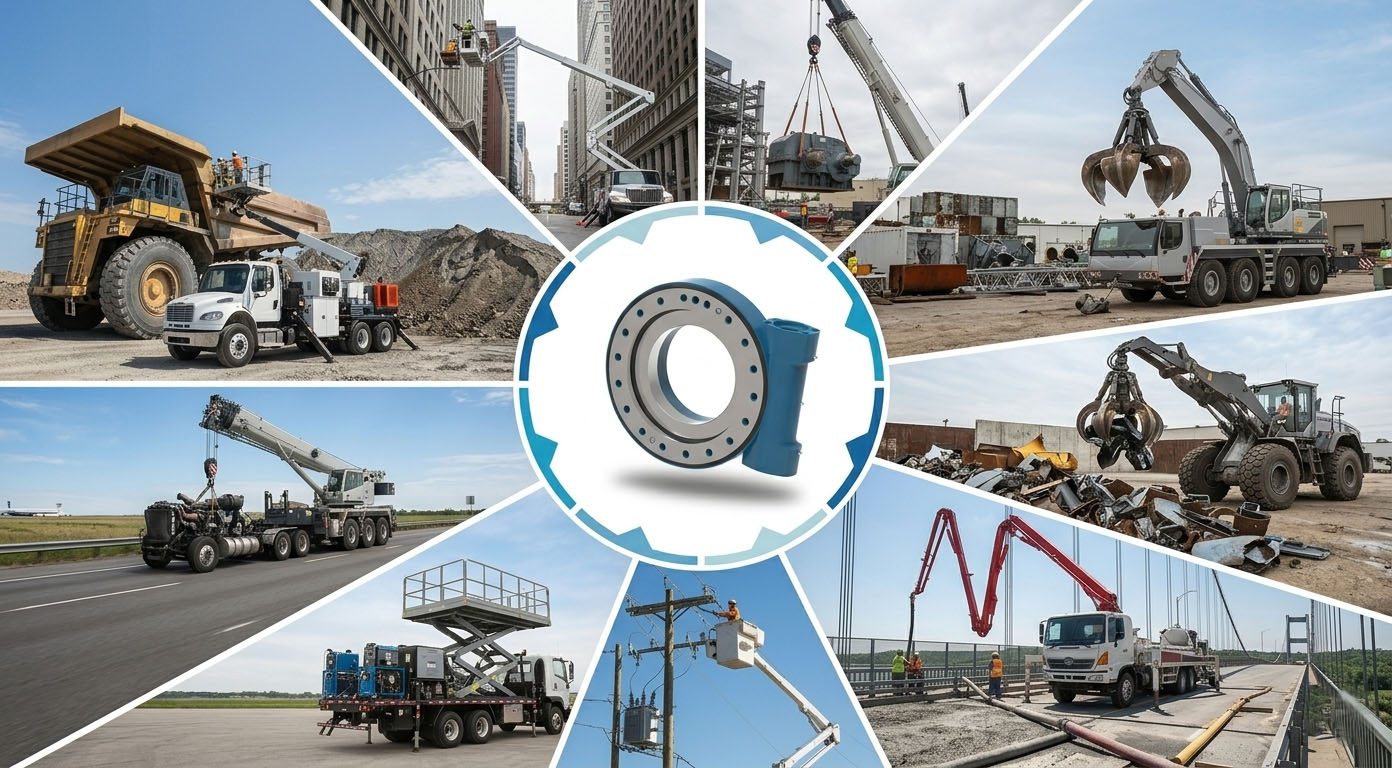
Slew Drive for Multi Functional Mechanical Service-vehicles
What Is a Slew Drive?
A slew drive is a compact, high-performance rotational device that integrates a slewing bearing, a gear train (typically worm or spur), a sealed housing, and often a hydraulic or electric motor. It enables precise, controlled rotation of heavy loads within a limited space.
For multi functional mechanical service-vehicles — including aerial bucket trucks, crane trucks, grapple loaders, concrete pump trucks, and mobile work platforms — the slew drive serves as the critical rotational joint between the vehicle chassis and the upper structure (turret, boom, or platform). It allows the working attachment to rotate smoothly, hold position under load, and operate safely in demanding field environments.
Key Features of Slew Drive for Multi Functional Mechanical Service-vehicles
A slew drive designed for multi functional mechanical service-vehicles must meet specific operational demands. The following features are essential:
High load capacity: The slew drive supports axial loads (vertical weight), radial loads (horizontal forces), and tilting moment loads (uneven weight distribution) simultaneously.
Compact integration: The slew drive combines bearing and drive mechanism into a single unit, saving valuable space on service vehicles.
High precision: Low backlash in the slew drive ensures accurate positioning of booms, buckets, or man baskets — critical for safety and efficiency.
Environmental durability: The sealed housing of the slew drive protects against dust, mud, rain, temperature extremes, and road salts.
Low maintenance: Many slew drive models are grease-lubricated for life, reducing downtime for field service vehicles.
Flexible drive input: The slew drive is compatible with hydraulic motors, electric motors, or manual operation depending on the vehicle's power system.
How Does a Slew Drive Work in Multi Functional Mechanical Service-vehicles?
The operating principle of a slew drive in a multi functional mechanical service-vehicle is straightforward yet highly engineered.
A hydraulic or electric motor drives a worm gear (or spur gear) inside the sealed housing of the slew drive. This gear rotates the slewing ring's inner or outer race, which is bolted directly to the rotating structure of the service vehicle — for example, the turret of a truck-mounted crane or the base of an aerial work platform.
The worm gear configuration provides a natural self-locking feature: when the motor stops, the load cannot back-drive the worm, meaning the boom or platform stays in position without a mechanical brake. This is a critical safety advantage provided by the slew drive for service vehicles working at height or handling heavy loads.
The rotational speed of a slew drive is typically slow (0.5–5 RPM), which is ideal for precise positioning rather than high-speed rotation. Torque output can range from a few hundred Nm to over 100,000 Nm, depending on the vehicle size and application.
Main Types of Slew Drive for Service Vehicle Applications
Different multi functional mechanical service-vehicles require different slew drive configurations. Below are the main types:
Worm Gear Slew Drive
The worm gear slew drive is the most commonly used type for multi functional mechanical service-vehicles due to its self-locking capability and compact design.
Self-locking – holds position safely without a brake
High reduction ratio in a single stage
Smooth, quiet operation
Lower efficiency (approx. 50–70%) but sufficient for intermittent service vehicle duty cycles
Best for: Aerial lifts, crane turrets, outrigger rotations
Spur Gear Slew Drive
The spur gear slew drive offers higher efficiency and faster rotation speeds, making it ideal for applications where continuous rotation is required.
Higher efficiency (approx. 90–95%)
No self-locking – requires an external brake
Faster rotation speeds possible
Best for: Continuous rotation applications, larger service cranes
Hydraulic Motor-Integrated Slew Drive
Direct bolt-on hydraulic motor
High torque density
Works directly with the vehicle's existing hydraulic system
Best for: Heavy-duty service vehicles, excavator-based platforms
Electric Motor-Integrated Slew Drive
Precise speed and position control
Lower noise and zero hydraulic leakage
Suitable for hybrid or fully electric service vehicles
Best for: Urban service vehicles, robotic attachments
Key Advantages of Slew Drive for Multi Functional Mechanical Service-vehicles
Using a dedicated slew drive instead of conventional rotational solutions — such as pinion-and-race systems or separate bearing-plus-gearbox assemblies — offers clear and measurable advantages for multi functional mechanical service-vehicles:
Simplified design: One slew drive replaces multiple individual components, significantly reducing assembly time, engineering complexity, and potential failure points in the field.
Improved safety: Self-locking worm designs (common in slew drive configurations) prevent unintended boom or platform movement even if hydraulic pressure drops or the engine stalls — a critical safety feature for working at height and heavy lifting.
Reduced maintenance: The sealed, lubricated-for-life construction of a quality slew drive minimizes field servicing. Most units require no greasing for years, reducing downtime and maintenance costs for fleet operators.
Better space utilization: The compact form factor of the slew drive leaves valuable room on the vehicle chassis for other essential systems — such as outriggers, hydraulic tanks, control valve blocks, or tool storage.
Higher reliability: A slew drive is engineered specifically for the shock loads, vibration, temperature swings, and weather exposure typical of service vehicles operating on construction sites, utilities work, or off-road terrains.
Cost-effective over lifetime: Although the upfront cost of a quality slew drive may be higher than improvised solutions, longer service intervals, fewer replacements, and reduced downtime result in a lower total cost of ownership over the vehicle's operational life.
How to Choose the Right Slew Drive for Your Service Vehicle?
Selecting the correct slew drive for a multi functional mechanical service-vehicle requires careful consideration of several key parameters. Each service vehicle application has unique demands, and matching the slew drive's capabilities to your specific operating conditions is essential for safety, efficiency, and longevity.
| Consideration | Key Question |
|---|---|
| Torque requirement | What is the maximum load moment (Nm) at the farthest reach? |
| Load type | Is the load primarily axial, radial, or combined? |
| Self-locking need | Is safety-critical load holding required without a brake? |
| Rotation speed | Is high-speed rotation or slow precision positioning needed? |
| Power source | Does the vehicle have hydraulic or electric power available? |
| Duty cycle | Will the slew drive operate continuously or intermittently? |
| Environmental conditions | Will the vehicle work in mud, salt spray, or extreme temperatures? |
| Mounting interface | Does the vehicle chassis have standard or custom bolt patterns? |
Practical tip: Always calculate the maximum tilting moment at the worst-case working radius, then add a safety factor of 1.5–2.0. For human-carrying applications (aerial lifts), use the higher safety factor. Consult with a manufacturer like LyraDrive for verification and custom sizing of your slew drive.
LyraDrive: Custom Slew Drive Supplier for Service Vehicles
Company Introduction
LyraDrive is a professional one-stop slewing device manufacturer majored in design and development, customized production, sales and service on slew drives and slewing bearings. With years of engineering experience focused on mobile equipment and service vehicles, LyraDrive has built a reputation for quality, reliability, and technical support across global markets.
Our Customization Advantages
Unlike mass-producers who offer only standard catalogs, LyraDrive specializes in tailored slew drive solutions for multi functional mechanical service-vehicles:
Custom bolt patterns to match your vehicle chassis directly — no adapter plates needed
Special gear ratios for precise speed and torque matching
Alternative sealing systems for extreme environments (dust, high-pressure washing, saltwater)
Integrated motor interfaces for your specific hydraulic motor or electric servo motor
Modified housing dimensions to fit tight vehicle layouts
Prototype to production support with fast lead times
A Simple Message for Your Next Project
Whether you are designing a new aerial platform, upgrading a fleet of crane trucks, or solving a rotational failure on existing service vehicles — LyraDrive provides engineering support and custom slew drive solutions built to perform. Contact us with your load requirements and mounting constraints. We deliver more than a component; we deliver a slew drive tailored to your service vehicle.
FAQ of Slew Drive for Service Vehicles
Q1: Why is self-locking critical for a service vehicle slew drive?
Self-locking prevents the boom, platform, or crane from rotating backward when the motor stops. This is essential for safety during lifting, positioning, and working at height — especially when hydraulic pressure could drop or the engine stalls.
Q2: Can I replace a worm drive with a spur gear type on my existing service vehicle?
Technically yes, but you must add an external parking brake and recalculate torque requirements. Worm drives are self-locking; spur gears are not. For most service vehicles, replacing a worm slew drive with a spur gear type introduces safety risks unless the control system is redesigned.
Q3: How to calculate the required torque for a multi-functional service vehicle?
Torque (Nm) = Load (N) × Working Radius (m). For example, a 500 kg load (≈4900 N) at 2 m radius requires 9,800 Nm. Always add a safety factor (1.5–2.0) and include the weight of the boom or platform itself. LyraDrive's engineering team can verify your slew drive torque calculations.
Q4: What maintenance does a slew drive need for off-road service vehicles?
Most modern slew drives are sealed and grease-lubricated for life. Under normal conditions, no periodic regreasing is required. For extreme off-road use (mud, water submersion, abrasive dust), annual inspection of seals and mounting bolts is recommended. Do not pressure-wash directly at seal lips.
Q5: Does LyraDriv provide custom solutions for unique service vehicle designs?
Yes — that is our core strength. LyraDrive offers fully custom slew drives including special housings, non-standard gear ratios, integrated motor mounts, modified sealing arrangements, and custom bolt patterns. Contact us with your vehicle drawings or load specifications for a prompt engineering proposal.
 WhatsApp
 sales@lyradrive.com
 +8613903880726