



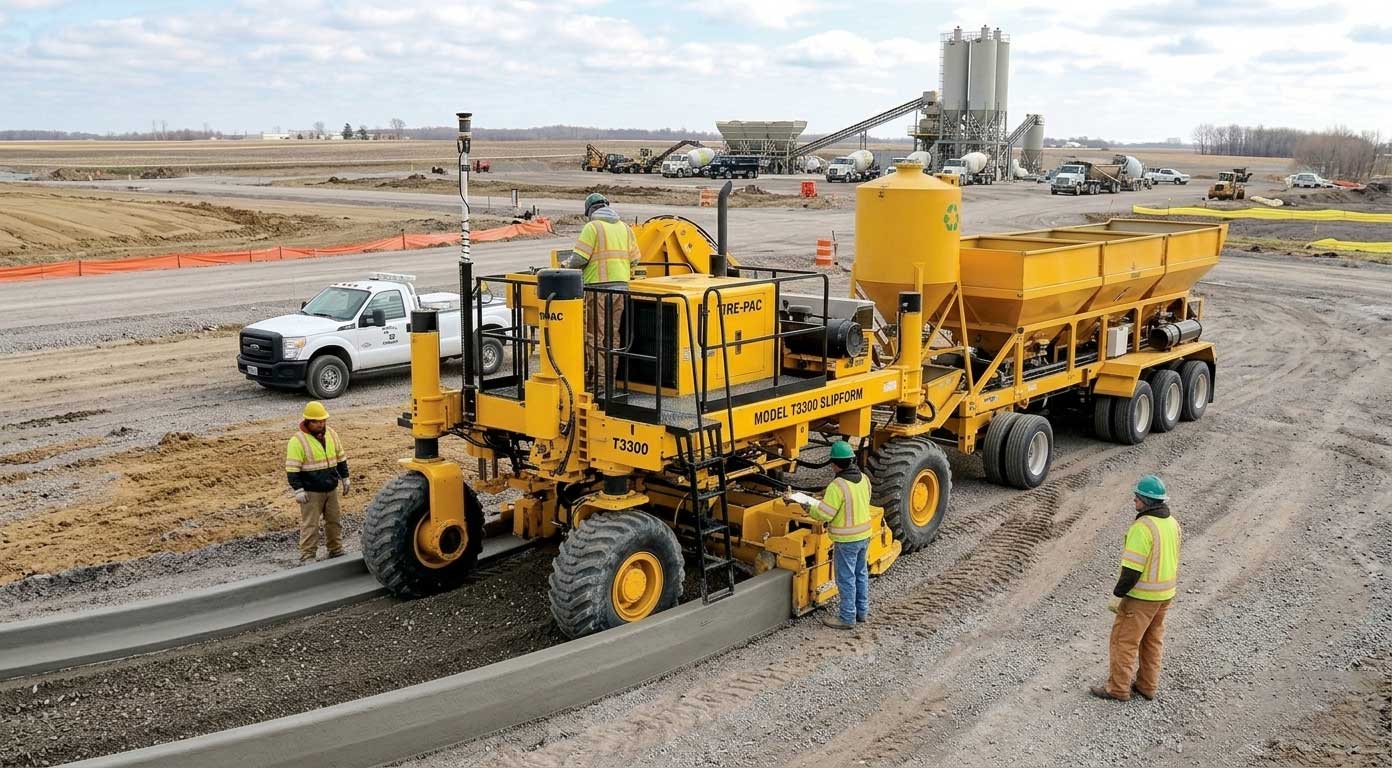
Slew Drive for Tire Slipform Concrete Paver
What Is a Slew Drive in a Tire Slipform Concrete Paver?
A slew drive is a compact, high-performance rotational bearing and gearbox combination that enables controlled oscillation and steering in heavy machinery. In a tire slipform concrete paver, the slew drive is the critical component that allows the machine to pivot its wheel assemblies, adjust its mould alignment, and follow complex paving paths with precision.
The slew drive is typically mounted between the chassis and the wheel steering knuckles or between the mould frame and the main body. Unlike traditional kingpin or hydraulic cylinder steering systems, the slew drive provides 360-degree rotational capability and infinite positioning accuracy. This makes it indispensable for modern slipform pavers that need to pour concrete curbs, barriers, gutters, and drainage channels without fixed forms.
Key Features of the Slew Drive for Slipform Pavers
The slew drive used in tire slipform concrete pavers is engineered to withstand extreme conditions. Below are its most important features:
Compact design and high-load capacity of the Slew Drive – Despite its small footprint, a slew drive can handle high radial, axial, and tilting moment loads simultaneously. This is essential because the paver's mould applies continuous lateral pressure while the machine moves forward.
Sealed housing of the Slew Drive for concrete and dust resistance – Slipform paving generates fine concrete slurry, dust, and water spray. The slew drive is equipped with multi-lip seals and often an IP65 or higher protection rating. This prevents contaminants from entering the gear cavity, extending service life significantly.
High precision and zero backlash options – For applications requiring exact profile matching, precision slew drives with preloaded gears eliminate play, ensuring that the mould follows the stringline or sensor reference without deviation.
Main Functions of the Slew Drive in Slipform Paving
The slew drive performs two primary functions in a tire slipform concrete paver:
Steering and direction control provided by the Slew Drive – Each wheel or wheel group can be independently steered via a hydraulic motor driving the slew drive. This allows the paver to navigate curves, roundabouts, and transitions smoothly. Some pavers use slew drives on all four or six wheels for crab steering, coordinated steering, or front-only steering modes.
Mould alignment and grade following enabled by the Slew Drive – Beyond steering, the slew drive adjusts the mould's horizontal and vertical position relative to the chassis. As the paver moves along a predefined alignment, sensors send signals to the control system, which commands the slew drive to make micro-adjustments. This ensures that fresh concrete is placed exactly where required, with consistent cross-slope and grade.
Common Types of Slew Drive Used on Tire Slipform Pavers
There are two dominant types of slew drive found on tire slipform concrete pavers. Each has distinct advantages depending on the machine size and application.
| Type | Typical Application | Key Advantage |
|---|---|---|
| Worm gear Slew Drive | Small to medium pavers (curbs, gutters) | Self-locking, lower cost |
| Planetary gear Slew Drive | Large pavers (barriers, highways) | Higher efficiency, higher torque density |
Worm gear Slew Drive – This type uses a hardened worm meshing with a bronze or hardened gear ring. The worm gear slew drive is inherently self-locking, meaning it holds position without a brake when the hydraulic motor stops. This is useful for pavers working on slopes. However, its efficiency is lower (typically 60–75%), and it generates more heat during continuous steering.
Planetary gear Slew Drive – Featuring multiple planetary gears inside a ring gear, this design offers high efficiency (90–95%) and excellent torque-to-weight ratio. Planetary slew drives are preferred on large slipform pavers that need to steer heavy moulds (e.g., 2m tall concrete barriers). They do not self-lock, so an external brake or hydraulic valve is required.
How the Slew Drive Works in a Tire Slipform Paver?
Understanding how the slew drive functions helps operators and maintenance personnel optimize its performance.
Hydraulic motor input and gear reduction inside the Slew Drive – The paver's hydraulic system supplies oil to a hydraulic motor mounted directly on the slew drive's input shaft. The motor rotates at high speed (typically 1000–3000 rpm) but low torque. Inside the slew drive, a multi-stage gear train (worm or planetary) reduces the speed dramatically—often to 0.5–5 rpm at the output. At the same time, torque is multiplied by the reduction ratio (commonly 40:1 to 200:1). The output flange or housing rotates the wheel knuckle or mould arm accordingly. A typical hydraulic circuit follows this sequence: pump → control valve → hydraulic motor → slew drive input → gear reduction → output rotation.
Oscillating or fixed mounting configurations of the Slew Drive – Some pavers use a fixed slew drive where the output rotates continuously without vertical compliance. Others incorporate an oscillating mounting that allows the wheel to follow ground irregularities while still transmitting steering torque. Oscillating slew drives are more complex but improve traction and reduce frame stress on uneven terrain.
Advantages of the Slew Drive Over Traditional Steering Systems
Compared to traditional steering linkages or separate hydraulic cylinders, the slew drive offers several compelling advantages for tire slipform concrete pavers.
High precision in concrete placement from the Slew Drive – Traditional systems often suffer from play in ball joints, tie rods, and kingpins. A slew drive eliminates almost all mechanical backlash (especially with preloaded designs). This translates to tighter tolerance on concrete profiles, reducing material waste and rework.
Low maintenance and long service life of the Slew Drive – A well-designed slew drive requires only periodic grease changes and seal inspection. There are no tie rod ends to replace, no kingpin bushings to ream, and no frequent realignments. Many slew drives on slipform pavers last over 10,000 operating hours before requiring overhaul.
Space efficiency and simplified mounting – A single slew drive replaces multiple components: steering cylinder, pivot bearings, kingpin, and tie rod. This frees up space underneath the paver for cleaning and sensor mounting.
Better resistance to contamination – Hydraulic cylinder rods are exposed to concrete slurry, which abrades rod seals and leads to leaks. Slew drives have no reciprocating external rods; only a rotating sealed housing contacts the environment.
| Feature | Traditional Steering | Slew Drive |
|---|---|---|
| Mechanical backlash | 0.5–2° typical | <0.1° (zero backlash option) |
| External moving parts | Rods, pins, bushings | None (sealed rotation) |
| Maintenance interval | 200–500 hours | 1000–2000 hours |
| Contamination vulnerability | High (cylinder rod) | Low (sealed housing) |
How to Choose the Right Slew Drive for a Tire Slipform Concrete Paver?
Selecting the correct slew drive requires evaluating several technical parameters. Below are the key decision factors.
Key selection criteria: load, torque, and speed – First, calculate the maximum static and dynamic loads. Include the weight of the mould, concrete pressure, and steering forces from uneven ground. Second, determine the required output torque: typically 3,000–20,000 Nm for small pavers and up to 80,000 Nm for large barrier pavers. Third, specify the slew speed. Most slipform applications need only 1–3 rpm at the output because steering adjustments are gradual.
Environmental considerations: sealing and corrosion protection – Always choose a slew drive with high-grade seals (double lip with labyrinth) and a corrosion-resistant coating (zinc primer or epoxy). If the paver works in freezing conditions, specify low-temperature grease and seals rated for -30°C or lower.
Mounting interface and input options – Verify that the slew drive's mounting flange matches your wheel knuckle or mould arm. Also, confirm the input shaft type (splined, keyed, or ISO flange) is compatible with your hydraulic motor.
Control system integration – For modern pavers with CAN bus or analog sensors, choose a slew drive that can accommodate a built-in encoder or potentiometer for position feedback. This enables closed-loop control without external sensors.
If you are unsure, most manufacturers (including LyraDrive) provide free sizing assistance based on your machine's dimensions and operating conditions.
LyraDrive: Custom Slew Drive Manufacturer for Your Project
LyraDrive is a professional one-stop manufacturer specializing in the design, development, customized production, sales, and service of slew drive and slewing bearing solutions across multiple industries. Beyond construction equipment like truck cranes, excavators, and manlifts, LyraDrive also provides high-quality customized slew drive solutions specifically for tire slipform concrete pavers – from mounting interfaces and gear ratios to sealing systems. Whatever your project requires, LyraDrive delivers the right slewing solution. [Contact LyraDrive] for technical support or a quote on your next custom slew drive.
FAQ about Slew Drive for Tire Slipform Concrete Paver
Q1. How often does the Slew Drive need maintenance?
Under normal slipform paving conditions (8–10 hours per day, no submerged operation), the slew drive should be regreased every 500 hours or monthly. A full oil change (for planetary types) or grease replacement (for worm types) is recommended every 2000 hours or annually. Seal inspection should be performed weekly, especially after working with high-slump concrete.
Q2. Can a worn Slew Drive be repaired or must it be replaced?
It depends on the damage. Minor wear on seals, bearings, or the worm/gear teeth can often be repaired by replacing individual components. However, if the housing is cracked or the main bearing race is spalled, replacement is more cost-effective. LyraDrive offers both rebuild kits and exchange units to minimize downtime.
Q3. What happens if the Slew Drive fails during paving?
A sudden slew drive failure (e.g., sheared gear teeth or seized bearing) will lock the affected wheel or mould arm. The paver will lose steering control on that axle. Most modern pavers have redundant steering axles, allowing the operator to limp to a service area. However, catastrophic failure typically requires towing. This is why preventive maintenance and using a high-quality custom slew drive are essential.
Q4. Does the Slew Drive work with any hydraulic motor brand?
Yes, as long as the motor's output shaft and mounting flange match the slew drive's input interface. Common pairings include Danfoss, Eaton, Parker, Rexroth, and Kawasaki motors. When ordering a custom slew drive from LyraDrive, you can specify your motor model, and LyraDrive will machine the input to fit perfectly – including spline profiles, pilot diameters, and bolt patterns.
 WhatsApp
 sales@lyradrive.com
 +8613903880726