



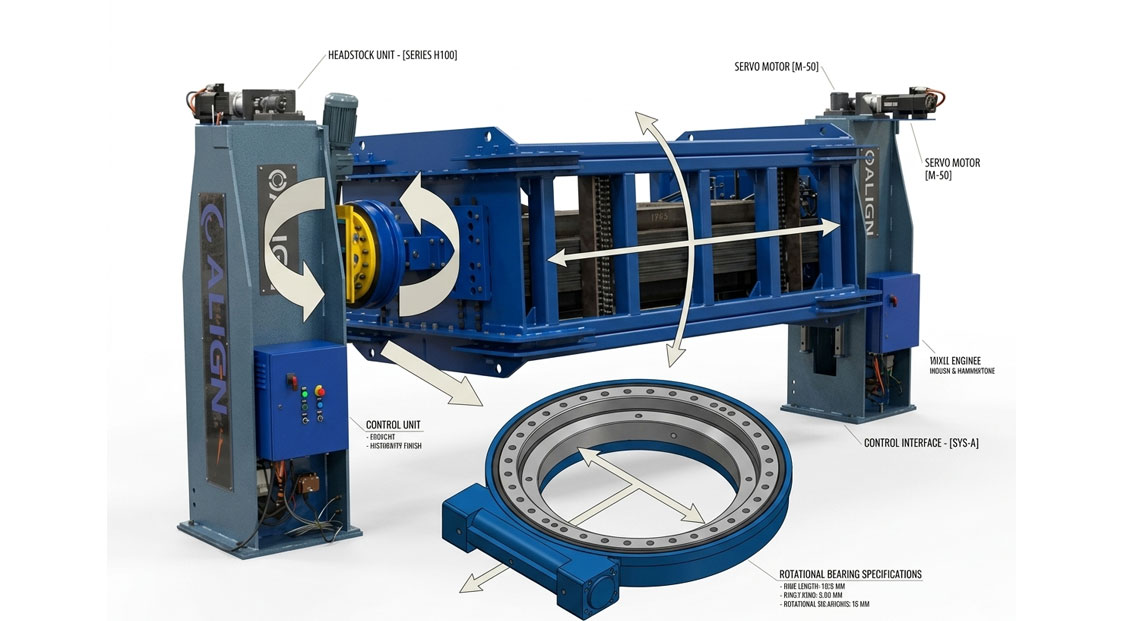
Slew Drive for Weld Positioning
What Is a Slew Drive for Welding Applications?
A slew drive is a compact, high-performance rotational device that combines a bearing, a gear train (usually a worm gear or planetary gear), and a housing into a single unit. In welding applications, slew drives are used to position heavy workpieces precisely and safely for manual, semi-automatic, or robotic welding operations.
Common equipment that relies on slew drives includes welding positioners, turntables, manipulators, and tilt-rotate tables. The primary function is simple but critical: to rotate or tilt the workpiece so that the weld joint is always presented to the torch at the optimal angle. Without precise rotation, achieving consistent weld penetration, bead appearance, and overall quality becomes significantly more difficult — especially on complex or large fabrications.
In short, a slew drive acts as the "rotational backbone" of a welding positioning system.
Key Features of Slew Drives in Welding Environments
Welding environments are harsh. Slew drives used in these conditions must offer more than just rotation — they need specific features to survive and perform reliably.
High rotational accuracy and repeatability – Welding requires the workpiece to return to exact positions repeatedly, especially in automated or robotic cells. Backlash is typically kept to a minimum (often <0.1°).
Resistance to weld spatter and thermal effects – Spatter is molten metal that can bond to exposed surfaces. Good slew drives use protective coatings and seals to prevent spatter from entering the gearbox.
Compact design with high load capacity – Floor space in welding shops is valuable. Slew drives deliver high torque and load capacity in a small form factor, allowing integrators to build more compact positioners.
Sealing and protection against dust, debris, and moisture – Grinding dust, metal shavings, and coolant mist are common. High-grade seals (e.g., double-lipped or labyrinth seals) keep contaminants out and lubricants in.
Common Structural Types of Slew Drives for Welding
Not all slew drives are the same. Depending on your welding machine design, you may need one of the following configurations.
Single-axis slew drives
These provide rotation around one axis — typically the horizontal plane (like a turntable). They are the simplest and most common type for basic welding positioners.
Dual-axis slew drives
These offer both rotation and tilt (often 135° or more). They are used in more advanced positioners that need to orient a workpiece in almost any direction, reducing the need for re-clamping.
Open vs. enclosed designs
Open designs are lighter and easier to maintain but less protected against spatter and dust.
Enclosed designs feature sealed housings that keep contaminants away from gears and bearings — strongly recommended for welding environments.
Gear types: worm gear vs. planetary gear
Worm gear slew drives provide natural self-locking, meaning the load won’t back-drive the motor when power is off. This is essential for tilt axes or holding heavy parts.
Planetary gear slew drives offer higher rotational speeds and greater efficiency but lack self-locking. They are better suited for continuous rotation applications where speed is more important than holding torque.
How Does a Slew Drive Work in a Welding System?
Understanding the basic operation helps with proper selection and troubleshooting.
A motor (electric, hydraulic, or pneumatic) drives the input shaft of the slew drive. Inside the housing, the input shaft turns a worm gear (or planetary gears), which engages with a large ring gear. The ring gear is integrated with the output flange or housing. As the worm turns, the output flange rotates at a reduced speed but with multiplied torque.
In a welding system, this output flange is bolted directly to the table or arm that holds the workpiece. A CNC or PLC controller sends signals to the motor driver, commanding precise rotation angles and speeds. For example, a welding positioner may rotate continuously at 1–3 RPM while the operator or robot welds a circular seam. Then, it may index to a new position every 90 degrees for multi-pass welding.
Many modern systems also include encoders or limit switches integrated with the slew drive, providing closed-loop feedback to the controller for accurate positioning.
Advantages of Using a Slew Drive for Welding Positioning
Why choose a dedicated slew drive over a simple geared motor or a rotary table? Here are the practical benefits for welding operations.
Improved weld consistency and reduced rework – Consistent rotation speed and position accuracy directly translate to uniform weld beads and fewer defects.
Hands-free positioning for operator safety – Welders no longer need to manually flip or rotate heavy parts, reducing ergonomic injuries and accident risks.
High rigidity under dynamic welding loads – Slew drives maintain stiffness even when weld forces or operator-applied pressure is present. There is no "wobble" that could ruin a weld.
Long service life with minimal backlash – Properly designed slew drives maintain low backlash for years, even in daily shop floor use.
Easy integration with robotic welding cells – Most slew drives accept standard motor mounts and encoder feedback, making them plug-and-play for robotic integrations.
How to Choose the Right Slew Drive for Your Welding Machine
Selecting a slew drive is not a one-size-fits-all decision. Consider these engineering parameters carefully.
Load capacity
Calculate the total weight of the heaviest workpiece plus the fixture or table. Then add a safety margin (typically 1.5× to 2×). Never operate at the absolute maximum rating continuously.
Torque requirements
You need enough output torque to start rotating the load (breakaway torque) and keep it moving smoothly. Welding processes like submerged arc may add drag, so include that in your calculation.
Duty cycle
A welding turntable used for light fabrication may run 10 minutes per hour. A heavy-duty positioner in a production line could run continuously. Match the slew drive’s duty rating to your actual use.
Environmental factors
Welding means heat (nearby arcs can radiate significant heat), spatter, and conductive dust. Look for heat-stable grease, high-temperature seals, and spatter-resistant coatings.
Mounting interface
The bolt pattern, pilot diameter, and flange dimensions must match your existing table or frame. Custom adapter plates can solve mismatches, but it is cheaper to select correctly upfront.
Optional features
Limit switches (for travel limits), encoders (for position feedback), and corrosion-resistant coatings (for humid or outdoor welding environments) add functionality but also cost. Choose only what you actually need.
Installation Tips for Slew Drives in Welding Equipment
Correct installation prevents premature failure. Follow these practical tips.
Preparing the mounting surface
The mounting surface must be flat and rigid. Use a dial indicator to check flatness (typically within 0.05 mm for the entire mounting face). Uneven surfaces distort the housing and cause binding or premature bearing wear.
Proper bolt torque and locking methods
Use grade 10.9 or higher bolts. Tighten in a star pattern to the torque specified by the manufacturer. Apply thread-locking compound or use locking washers to prevent loosening from vibration.
Connecting drive motor and control system
Align the motor shaft carefully with the slew drive input shaft. Misalignment creates heat, noise, and rapid seal wear. Use a flexible coupling if there is any risk of misalignment during operation.
Grounding against arc welding currents
This is critical and often overlooked. Welding current can pass through the slew drive bearings if the workpiece is not properly grounded directly to the welding power supply. This causes arc pitting (electrical discharge machining) on bearing surfaces, quickly destroying the drive. Always install a grounding brush or slip ring that bypasses the slew drive.
Maintenance Best Practices
A well-maintained slew drive can last a decade or more in welding service.
Regular lubrication
Use the grease type recommended by the manufacturer (often lithium-based or synthetic for high-temperature welding environments). Regrease at intervals specified in the manual — typically every 3–6 months for moderate use, or monthly for heavy-duty continuous operation.
Inspecting seals for weld spatter buildup
Spatter that accumulates around seals can harden into sharp edges that cut the sealing lip. Carefully chip away spatter without prying directly against the seal. Do not use metal tools that could damage the rubber.
Checking backlash and gear wear
Periodically measure rotational backlash with a dial indicator. A gradual increase is normal, but a sudden jump indicates possible gear damage or loose mounting bolts.
Cleaning around rotating parts
Remove grinding dust and metal chips from exposed surfaces daily. Use compressed air and a soft brush — never high-pressure washers that could force water past seals.
When to replace vs. repair a slew drive
If only the seals or grease are bad, repair is economical. If the bearing raceways or gear teeth are pitted or worn beyond tolerance, replacement is usually cheaper than rebuilding.
LyraDrive: Custom Slew Drive Manufacturer for Welding Applications
LyraDrive is a professional one-stop slewing device manufacturer, majored in design and development, customized production, sales and service on slew drives and slewing bearings. If you need a customized slew drive for your welding positioner, turntable, or manipulator, LyraDrive provides high-quality and tailored solutions for applications ranging from truck cranes and excavators to manlifts and — critically — welding equipment.
Whether you require a specific bolt pattern, a unique output flange, enhanced sealing for spatter protection, or a self-locking worm gear design for a tilt axis, LyraDrive can deliver. If you are looking for a reliable slew drive supplier or need technical support for a new welding machine design, feel free to contact LyraDrive.
FAQ of Slew Drives in Welding Machine
Q1: Do I need a self-locking slew drive for my welding positioner?
A: Yes, especially for tilt axes or when holding heavy workpieces without continuous motor power. Worm gear slew drives offer natural self-locking, which prevents the table from dropping under gravity when power is off.
Q2: Can a standard slew drive withstand welding spatter and heat?
A: Standard units may suffer seal damage and spatter ingress. For welding applications, look for enhanced sealing (e.g., multi-lipped seals) and spatter-resistant coatings. LyraDrive offers customized sealing solutions for harsh welding environments.
Q3: How do I prevent electrical damage to the slew drive from the welding arc?
A: Use proper grounding directly on the workpiece or table. Never allow welding current to pass through the slew drive bearings. Install a grounding brush or slip ring to bypass the drive. This is a mandatory step, not an option.
Q4: What is the typical lifespan of a slew drive in a welding turntable?
A: With regular lubrication, proper grounding, and routine spatter cleaning, a quality slew drive can last 8–10 years in moderate-duty welding operations. Heavy continuous use with poor maintenance may reduce this to 2–3 years.
 WhatsApp
 sales@lyradrive.com
 +8613903880726