



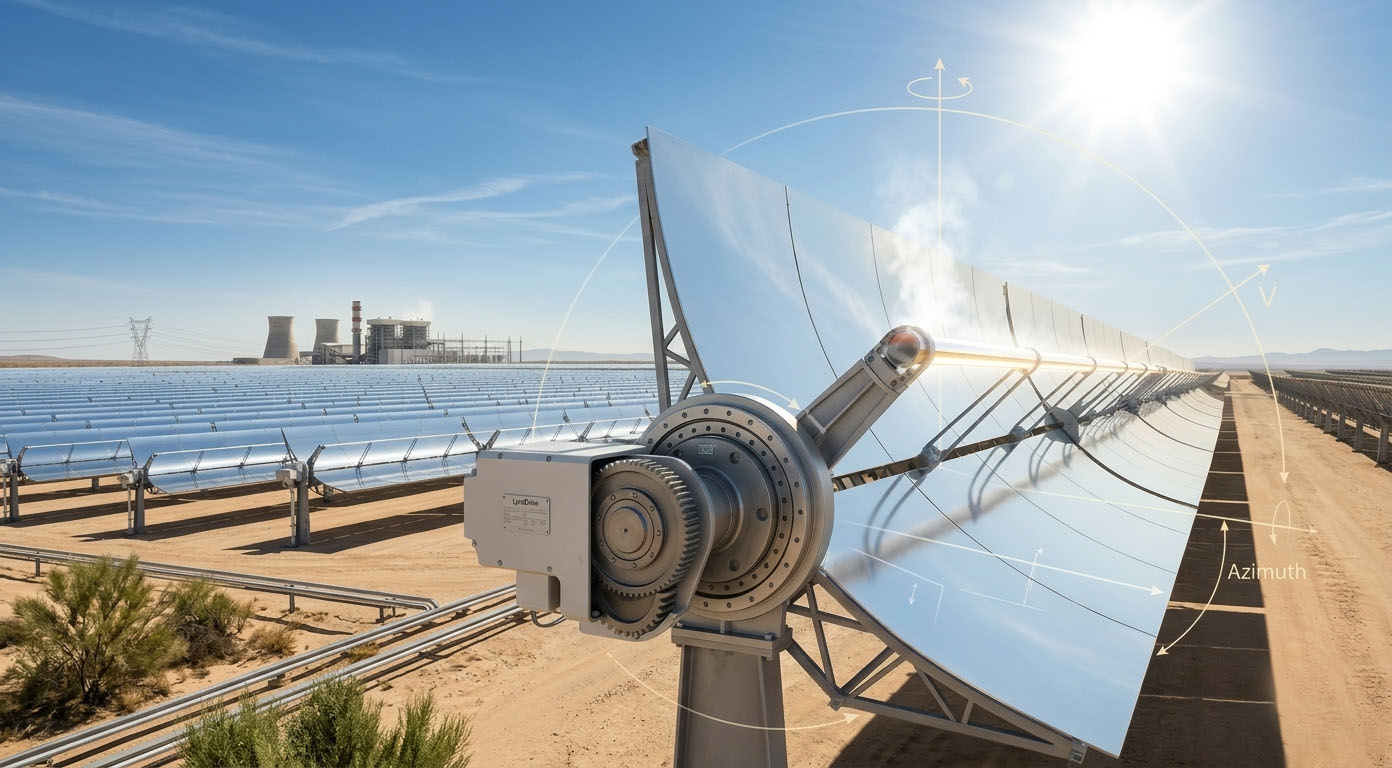
Slew Drive For Photoelectric Heating
As the global transition toward renewable energy intensifies, photoelectric heating—specifically Concentrated Solar Power (CSP) and large-scale solar thermal arrays—has become a cornerstone of sustainable industrial and residential heating. However, the efficiency of these systems hinges on one critical mechanical ability: the ability to follow the sun with pinpoint accuracy. This is where the slew drive comes into play.
http://googleusercontent.com/image_generation_content/18
What is a slew drive for Photoelectric Heating?
In the engineering context of photoelectric heating, a slew drive is not a "catalogue item" but a foundational rotary-structural node. It is a highly integrated, sealed, precision-manufactured joint that forms the critical dynamic interface between a fixed support pillar and a dynamic collector structure (such as a parabolic trough or heliostat). Its core definition lies in its unique architectural blend: it is simultaneously a high-capacity structural bearing, a torque-amplifying gearbox, and an all-weather, sealed enclosure.
Unlike standard gearboxes optimized for speed or purely axial transmission, a slew drive for photoelectric heating must manage a complex interplay of forces and accuracy constraints customised specifically for concentration. We must define it by three hyper-critical, deeply engineered specifications:
Advanced Anti-Overturning Capacity (High-Moment Preload)
The defining challenge in concentration systems is not moving the structure; it is stabilizing it against external forces while it rotates. Massive mirror arrays, sometimes exceeding $100\text{m}^2$ of surface area per heliostat, are essentially "sails" mounted on the slew drive. Wind, striking these at an angle, generates massive overturning moments—leverage trying to rip the joint out of alignment. A specialized solar slew drive utilizes a large-diameter slewing bearing as its core, often a preloaded double-row ball or crossed roller design. This preloading ensures zero initial play, maximizing the bearing’s ability to absorb these dynamic moment loads without Flex, which would ruin focus. The entire unit is designed to resist overturning moment torques many times its own weight.
Deep Backlash Control (Sub-Degree Tracking Precision)
In Central Receiver Tower systems, accuracy is everything. Sunlight must be focused precisely onto a small receiver point atop a central tower. A backlash of just $0.1^{\circ}$ at the drive, when extended across a $100\text{m}$ focal length, creates a $17\text{cm}$ deviation at the receiver—significant energy lost from the primary focus point. Used for concentration, a slew drive must guarantee minimal backlash. High-precision units often use specialized manufacturing techniques, such as enveloping worm gears (increasing the number of gear teeth simultaneously engaged), to achieve incredibly tight control. Premium "zero-backlash" drives achieve <$0.01^{\circ}$ of precision, essential for high-concentration heliostats.
Integrated, Critical Self-Locking Under Dynamic Load
Solar thermal fields operate stop-and-go for 12+ hours daily. During a sudden wind event, or if a standard motor fails, the drive must firmly and automatically hold the array in its current position to prevent uncontrolled rotation or catastrophic structural damage. A specialized solar slew drive typically utilizes a worm gear system designed to be "self-locking" under static and many dynamic load scenarios. The geometry of the worm (the smaller drive gear) and the worm wheel (the large bearing ring gear) ensures that forces exerted by wind against the mirror structure cannot rotate the worm backwards—a vital safety feature that linkage systems or spur gear systems lack.
How Does a Slew Drive Work for Photoelectric Heating?
The primary goal of photoelectric heating is to concentrate solar energy to create heat. To do this efficiently, the collectors must stay perpendicular to the sun’s rays throughout the day.
The slew drive is connected to a motor (electric or hydraulic). As the sun moves across the sky, a controller sends signals to the motor, which turns the worm gear inside the slew drive. This gear then rotates the outer ring of the bearing, which is attached to the solar collectors. Because of the high gear ratio inherent in worm drives, the slew drive provides immense torque at low speeds, allowing it to move heavy heating structures with sub-degree precision.
Core Types of Slew Drive for Photoelectric Heating
Depending on the specific system architecture, different types of drives are utilized:
Single-Axis Slew Drives: These rotate the collectors along one axis (usually East-West). They are cost-effective and ideal for simpler solar thermal troughs.
Dual-Axis Slew Drives: These allow for rotation on both the horizontal and vertical axes. These are essential for high-concentration systems (like solar towers) where the mirrors must track the sun’s altitude and azimuth simultaneously.
Worm Gear Slew Drives: The most common type for heating systems due to their self-locking feature, which prevents the panels from moving under heavy wind loads.
Key Features of Slew Drive for Photoelectric Heating
When evaluating slew drives for photoelectric heating, look for these eight critical features:
High Self-Locking Torque
The self-locking ratio must exceed the maximum back-driving torque from wind, snow, or array imbalance. A safe margin is 1.5x the calculated worst-case load. Low-quality drives may "creep" over time – unacceptable for precise thermal targeting.Low & Consistent Backlash
Backlash (the free play between worm and gear teeth) directly affects tracking accuracy. For standard flat-panel thermal heating, 0.2°–0.5° backlash is acceptable. For concentrated thermal systems (CSP or parabolic dishes), 0.05°–0.1° is required. Premium slew drives can maintain this accuracy for years.High Moment Load Capacity
Solar arrays are rarely perfectly balanced. The slew drive must handle tilting moments caused by wind pushing on one side of a large panel, or uneven snow accumulation. Always check the "tilt moment" specification (kN·m) – not just axial load.Wide Operating Temperature Range
Photoelectric heating installations face everything from desert heat (+50°C) to freezing winters (-30°C). The grease, seals, and housing material must perform across this entire range. Standard commercial grease fails below -10°C – a common hidden failure point.Corrosion & UV Resistance
Outdoor exposure for 15+ years demands protection. Look for:1. HDG (hot-dip galvanized) or epoxy coating on housing
2. Stainless steel or coated worm shaft
3. UV-resistant rubber seals (not ordinary nitrile)
Compact Design & Low Profile
Space under or behind solar collectors is limited. A good slew drive should have an axial height under 150mm for typical applications, allowing easy integration without modifying panel frames.Low Maintenance Intervals
Ideally: grease once every 2 years, with no other service required. Sealed-for-life designs are available but typically have lower load ratings. A balanced approach is a regreasable drive with extended intervals.Smooth, Jerk-Free Rotation
Hydraulic or chain drives can produce "stick-slip" motion – small jerks as friction releases. Slew drives, with continuous gear engagement, rotate smoothly. This is particularly important for thermal systems with rigid pipes or glass receivers that can crack under vibration.
Advantages of Using Slew Drive in Photoelectric Heating Systems
Integrating a dedicated slew drive offers several distinct benefits:
Increased Energy Yield: Active tracking facilitated by slew drives can increase thermal energy collection by up to 30-40% compared to fixed-tilt systems.
Space Efficiency: Because the system is more efficient, you can generate more heat from a smaller land area.
Structural Stability: Slew drives are designed to handle "overturning moments"—the force exerted by wind hitting a large flat surface—protecting the entire heating infrastructure.
Simplified Installation: As a self-contained unit, it reduces the need for complex multi-component assemblies.
How to Choose the Right Slew Drive for Photoelectric Heating?
Choosing a drive isn't just about size. You must consider:
Load Requirements: Calculate the total weight of the panels plus the potential wind and snow loads in your specific location.
Tracking Accuracy: High-concentration systems require drives with minimal backlash (the "play" between gears).
Environmental Rating: Look for an IP65 or IP66 rating to ensure longevity in dusty or rainy climates.
Gear Ratio: Determine the motor speed and the required rotation speed to ensure the drive provides the right torque profile.
How to Maintain Slew Drive for Photoelectric Heating?
While slew drives are designed for longevity, a simple maintenance routine can double their lifespan:
Lubrication: Periodically replenish the grease to reduce friction and prevent wear on the gear teeth.
Bolt Inspection: Check the mounting bolts every 6-12 months to ensure they haven't loosened due to thermal expansion or vibration.
Seal Integrity: Inspect the seals for cracks or leaks; if moisture gets inside, it can lead to internal corrosion.
LyraDrive: A Customized Slew Drive Supplier for Photoelectric Heating
LyraDrive is a professional one-stop slewing device manufacturer majored in design and development, customized production, sales and service on slew drives and slewing bearings. We don't believe in a "one size fits all" approach. Whether you are building a specialized photoelectric heating array or a massive industrial thermal field, we provide customized, high-quality slew drives that match your specific torque and precision needs.
Choosing LyraDrive means choosing core components that are "tailor-made" for your project. Let our professional engineering and high-quality products empower your photoelectric heating system with accurate tracking and efficient operation. Contact us today to start your journey toward customized, high-efficiency energy!
FAQ
Q: Can a slew drive handle high wind loads?
A: Yes. High-quality slew drives are engineered with a high "tilting moment torque" capacity specifically to resist the forces exerted by wind on large solar collectors.
Q: Does a slew drive require a special motor?
A: Most slew drives are versatile and can be paired with DC motors, AC motors, or even stepper motors, depending on your control system requirements.
Q: How long do these drives typically last?
A: With standard maintenance, a professional-grade slew drive in a photoelectric heating system can operate reliably for 20 to 25 years.
Q: Why is a worm gear preferred over a spur gear for solar heating?
A: Worm gears offer better self-locking capabilities and a higher gear ratio in a smaller space, which is critical for the slow, precise movement required for solar tracking.
 WhatsApp
 sales@lyradrive.com
 +8613903880726