



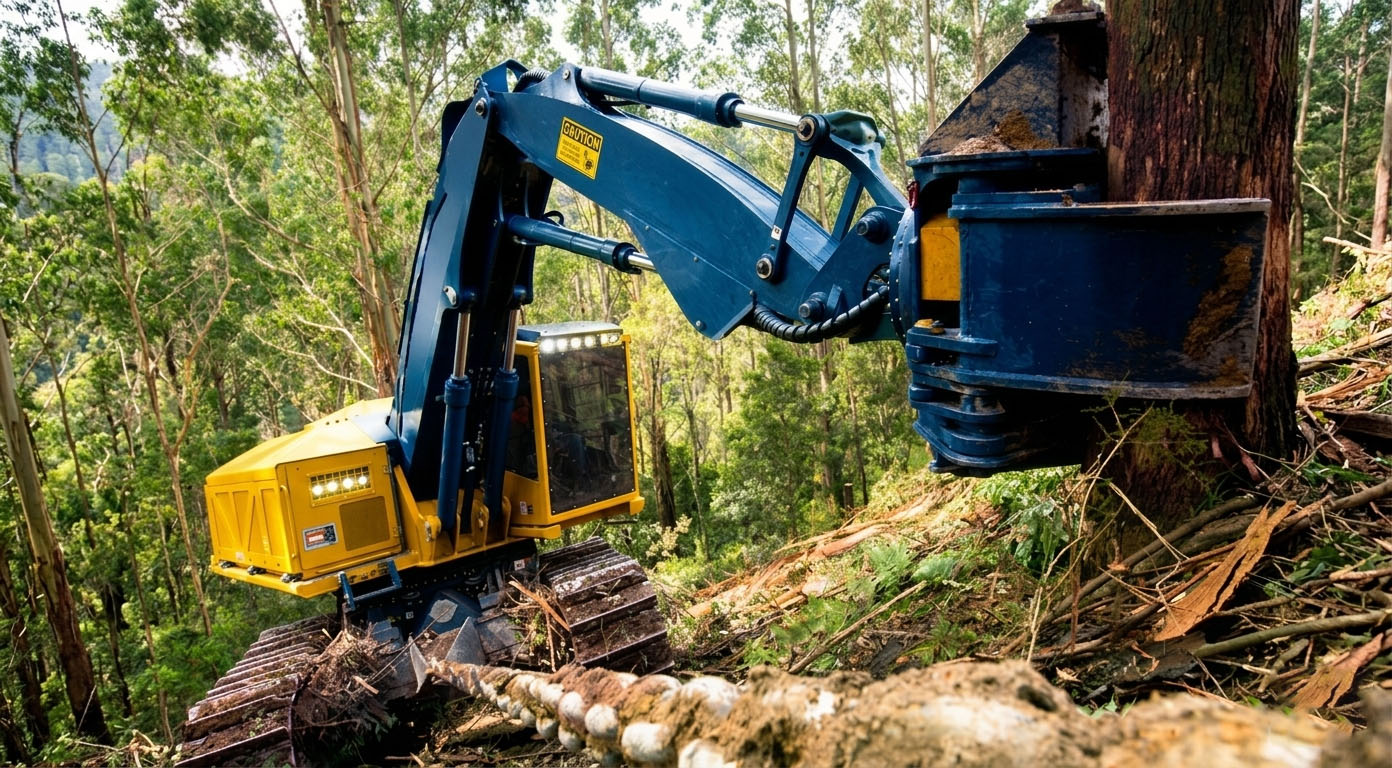
Slew Drive for Forestry Machinery
What is a Slew Drive for Forestry Machinery?
A slew drive is a compact, high-performance rotational bearing assembly that combines a slewing bearing, a worm gear (or other gearing system), a housing, and often a hydraulic or electric motor. In the context of forestry machinery, a slew drive is the critical component that enables controlled rotational movement of attachments such as grapples, saws, mulching heads, and cranes.
Unlike standard rotation systems found in general industrial equipment, forestry slew drives are specifically engineered to withstand the extreme conditions of timber harvesting and land clearing operations. They provide precise rotational control under heavy shock loads, continuous operation in dust-laden environments, and reliable performance despite exposure to moisture, mud, and temperature extremes.
In a typical forestry machine—such as a harvester or forwarder—the slew drive is mounted between the boom and the attachment, allowing the attachment to rotate 360 degrees or within a defined range. This rotational capability is essential for positioning grapples around tree trunks, angling saw cuts, or maneuvering mulching heads into tight spaces.
Key Features of Slew Drives for Forestry Machinery
Forestry-grade slew drives incorporate several distinctive features that set them apart from standard industrial units:
Heavy-duty sealing systems: The most critical feature. Forestry operations generate enormous amounts of sawdust, wood chips, bark fragments, and dirt. These contaminants will quickly destroy an unprotected slew drive. High-quality forestry slew drives utilize double-lipped, high-durometer wiper seals that actively scrape away debris while retaining lubricant.
Robust housing construction: Another essential feature. The housing must withstand impacts from falling timber, rocks, and incidental contact with stumps and terrain. Forestry slew drives typically feature reinforced housings made from high-strength cast iron or steel.
Corrosion resistance: Cannot be overlooked. Forestry machinery operates in wet conditions—rain, snow, mud, and high humidity. Salt-treated roads in winter logging operations add another layer of corrosion risk. Special coatings, zinc plating, or stainless steel components are commonly employed.
High shock load capacity: Fundamental. When a grapple closes on a hardwood log or a mulching tooth strikes a hidden rock, the slew drive experiences instantaneous torque spikes. Forestry slew drives are engineered with safety factors significantly higher than standard industrial drives.
Self-locking capability: A valuable feature in worm-gear slew drives. When the motor stops, the worm gear naturally locks, preventing unintended rotation. This is particularly important for grapple positioning and crane operations where load holding is critical.
Types of Slew Drives for Forestry Machinery
Slew drives are available in several mechanical configurations, each with distinct characteristics that suit different forestry applications:
Worm gear slew drives : The most common type used in forestry machinery. This design uses a worm shaft that engages with a worm wheel integrated into the slewing bearing. Key advantages include high torque output, compact size, and inherent self-locking capability—meaning the drive holds its position when the motor stops. This self-locking feature is critical for harvester heads, grapples, and forestry cranes where load holding prevents unintended movement. The primary limitation is lower efficiency (typically 40-70%) compared to other gear types.
Double-worm slew drives: A more advanced configuration featuring two worm gears operating in parallel. This design reduces backlash and improves positioning accuracy while maintaining self-locking properties. Double-worm slew drives are ideal for precision-critical applications such as grapple saws, robotic forestry attachments, and computer-controlled harvesting systems where repeatable positioning accuracy is essential.
Spur gear slew drives: Use direct gear engagement between a pinion and the ring gear without a worm intermediary. They offer higher rotational speeds and greater efficiency (up to 95%) but do not provide self-locking. Spur gear drives are less common in mainstream forestry applications but are suitable for continuous rotation tasks such as disc mulchers, flail mowers, and land-clearing attachments where high speed is prioritized over load holding.
Which type is best for forestry? For the vast majority of forestry applications—harvesters, forwarders, grapples, and cranes—the worm gear slew drive is the optimal choice due to its self-locking capability, high torque density, and proven reliability in harsh environments. Double-worm designs are recommended for precision-critical operations, while spur gear drives are best limited to high-speed, continuous-rotation attachments.
How Does a Slew Drive Work in Forestry Machinery?
The working principle of a slew drive is relatively straightforward yet highly effective. At its core, a worm gear—driven by a hydraulic motor or electric motor—engages with a larger ring gear integrated into the slewing bearing. As the worm rotates, it progressively moves the ring gear, producing smooth, controlled rotation of the attached forestry implement.
In a typical forestry application, the hydraulic system of the base machine supplies oil to the slew drive's motor. The operator controls flow direction and flow rate via the machine's joystick or control panel, determining both rotation direction and speed. When the operator releases the control, the self-locking nature of the worm gear holds the attachment firmly in place—a critical safety feature when positioning a grapple or saw.
The integration of the slew drive into forestry machinery varies by application:
In a harvester head: The slew drive is often mounted directly above the saw and feed rollers, allowing the entire head to rotate for angled felling cuts.
In a forestry crane: The slew drive sits at the base of the crane or at knuckle joints, enabling multi-axis positioning.
In a mulching attachment: The slew drive allows the cutting head to follow ground contours while maintaining optimal cutting angle.
Modern forestry slew drives increasingly incorporate sensors and feedback systems, providing rotation position data to the machine's control system. This enables programmable rotation limits, automatic positioning sequences, and enhanced safety features.
Common Applications of Slew Drives in Forestry Machinery
Slew drives are found in a wide range of forestry equipment, enabling critical rotational functions across the harvesting and land-clearing workflow:
Harvester heads: One of the most common applications. The slew drive mounts directly above the feed rollers and saw, allowing the entire harvester head to rotate up to 360 degrees. This enables operators to fell trees at precise angles without repositioning the base machine—essential for directional felling and optimizing timber yield.
Forwarder grapples: Slew drives integrated into forwarder cranes provide smooth, controlled rotation of the grapple. This allows the operator to pick, orient, and place logs with precision during bunching and loading operations. The self-locking feature is particularly valuable here, preventing unintended log drop during transport.
Forestry cranes (knuckle boom cranes): Multi-axis positioning requires slew drives at both the base of the crane (providing main rotation) and at intermediate knuckle joints. Each slew drive contributes to the crane's overall reach and maneuverability in dense forest conditions.
Mulching heads and brush cutters: Slew drives enable the cutting head to rotate for edge trimming, ditch cleaning, and contour following. This is especially important for right-of-way maintenance, where the attachment must adapt to varying ground slopes and vegetation densities.
Grapple saws (stroke saws): These attachments combine a grapple for holding timber with a saw for cutting. A slew drive allows the entire unit to rotate, helping operators square up cuts or position the saw blade precisely against the trunk—reducing waste and improving cut quality.
Tree shears and felling heads: Slew drives provide rotational positioning for shearing operations, allowing the operator to approach the tree from the optimal angle. This improves cutting efficiency and reduces the risk of fiber pull or splitting.
Flail mulchers and disc mulchers: In land-clearing applications, slew drives allow the mulching attachment to oscillate or rotate as needed, following ground contours and working around obstacles such as stumps, rocks, and standing trees.
Understanding these applications helps equipment owners and operators recognize where a high-quality, forestry-grade slew drive makes the most significant difference in productivity and reliability.
Core Advantages of Slew Drives for Forestry Machinery
The adoption of slew drives in forestry machinery delivers numerous operational and economic benefits:
Precision positioning: A primary advantage. Forestry operations demand accuracy—whether aligning a grapple with a log, setting a saw cut angle, or positioning a mulching head along a right-of-way. Slew drives provide smooth, controllable rotation with minimal backlash, enabling operators to work efficiently even in tight spaces.
Increased productivity: Follows directly from precise control. Operators spend less time repositioning the entire machine and more time processing timber. A single machine equipped with a high-quality slew drive can often accomplish work that would otherwise require multiple repositioning moves.
Reduced maintenance costs: Result from robust design. While a standard slew drive might fail within months in forestry service, a properly specified forestry-grade slew drive can operate for thousands of hours with minimal intervention. The superior sealing systems keep contaminants out, while heavy-duty bearings and gears resist wear.
Enhanced operator safety: A critical advantage. The self-locking feature of worm-gear slew drives prevents unintended attachment rotation. Additionally, smooth, predictable rotation reduces the risk of sudden load shifts that could destabilize the machine or endanger ground personnel.
Compact design: Allows manufacturers to integrate slew drives into space-constrained forestry attachments without sacrificing performance. A single slew drive replaces complex combinations of gears, bearings, and housings, simplifying both initial manufacturing and field service.
How to Choose the Right Slew Drive for Forestry Machinery?
Selecting the appropriate slew drive for a forestry application requires careful consideration of several factors:
Load ratings: The starting point. You must evaluate both static and dynamic loads—including the weight of the attachment, the weight of the material being processed, and the shock loads generated during operation. A reputable manufacturer will provide torque and moment load ratings, and you should apply an additional safety factor for forestry service.
Sealing effectiveness: A top priority. Ask specific questions: Does the slew drive feature double-lipped seals? What is the durometer rating of the wiper material? Are additional protective covers available for extreme conditions?
Gear ratio selection: Affects both rotation speed and holding torque. A higher gear ratio provides greater torque and stronger self-locking but slower rotation. A lower ratio offers faster positioning but reduced torque. The optimal ratio depends on your specific application—grapple rotation typically benefits from higher ratios, while crane swing might favor lower ratios.
Mounting interface compatibility: Matters for retrofit applications. Measure your existing bolt pattern, pilot diameter, and clearance dimensions. If you are designing new equipment, standard interfaces simplify future replacement, but custom interfaces can optimize packaging.
Environmental factors: May be relevant beyond dust and moisture. Will the machine operate in extreme cold requiring specialized lubricants? Is saltwater exposure possible in coastal or waterway operations? Does the application involve abrasive materials like sand or volcanic soils?
Manufacturer reputation and support: Should influence your decision. Look for manufacturers with demonstrated experience in forestry applications, willingness to provide engineering support, and availability of replacement parts and service documentation.
Installation and Maintenance of Slew Drives for Forestry Machinery
Installation begins with a thorough inspection of the mounting surface. The mounting structure must be flat, clean, and free of burrs or weld splatter. Use a dial indicator to verify flatness—typical requirements are within 0.1 mm per 100 mm of diameter. Apply the recommended thread-locking compound to mounting bolts and tighten them in a cross pattern to the specified torque value. Never reuse mounting bolts that have been torqued previously.
During installation, protect the seal lips from damage. Sharp edges on mounting flanges or debris on the mating surface can nick or tear the seals, compromising their effectiveness from day one. Some manufacturers provide protective shipping covers that should remain in place until the final moment of installation.
Maintenance for forestry slew drives centers on three primary tasks:
Lubrication intervals: Depend on operating intensity and environmental conditions. For typical forestry service, grease replenishment every 500 to 1,000 operating hours is recommended. However, in extremely dusty or wet conditions, more frequent lubrication—perhaps every 200 to 300 hours—is advisable. Use the grease type specified by the manufacturer; many require lithium-complex or polyurea-based greases with extreme-pressure additives.
Seal inspection: Should occur at every lubrication service. Look for signs of wear, cracking, or gap formation between the seal lip and the sliding surface. Damaged seals allow contamination ingress and lubricant egress, leading to rapid failure. Replace seals immediately if damage is observed.
Bolt torque verification: Often overlooked but critically important. Vibration and thermal cycling can progressively loosen mounting bolts. Annually—or more frequently in high-vibration applications—check bolt torque against the manufacturer's specification. Loose bolts allow micro-movement that accelerates wear on both the slew drive and the mounting structure.
Price Factors of Slew Drives for Forestry Machinery
The price of a forestry-grade slew drive varies considerably based on multiple factors. Understanding these factors helps buyers make informed purchasing decisions.
Size and load capacity: The most significant price drivers. Larger slew drives capable of handling higher moment loads and greater torque require larger bearings, heavier housings, and more substantial gears—all of which increase material and manufacturing costs. A small slew drive for a grapple might cost several hundred dollars, while a large unit for a forestry crane can exceed several thousand.
Customization requirements: Add to cost. Standard, off-the-shelf slew drives are the most economical option. However, custom bolt patterns, special seal configurations, unique gear ratios, or non-standard materials increase engineering and production costs. For many forestry applications, however, the additional investment in customization pays dividends in reliability and service life.
Sealing system sophistication: Directly influences price. Basic single-lip seals are inexpensive but inadequate for forestry. Double-lipped wipers, labyrinth seals, and optional protective covers add cost but are essential for demanding environments. Consider this a necessary investment rather than an optional upgrade.
Material choices: Affect both price and performance. Standard cast iron housings with basic coatings are most affordable. High-strength alloy housings, stainless steel components, and specialized corrosion-resistant coatings add incremental cost—but may be justified in corrosive environments.
Manufacturing volume and supply chain: Play a role. Small-batch custom production is more expensive per unit than high-volume standard production. Working with a manufacturer that maintains forestry-specific inventory can reduce both cost and lead time.
Total cost of ownership: Should be considered alongside purchase price. A lower-priced slew drive that fails annually, requiring replacement and causing machine downtime, is ultimately more expensive than a higher-quality unit that operates reliably for years. Forestry operations are typically better served by investing in quality upfront rather than economizing on initial purchase.
LyraDrive: Custom Forestry Machinery Slew Drive Manufacturer
LyraDrive is a professional one-stop manufacturer of slew drives and slewing bearings, integrating design, custom production, sales, and service. With years of engineering expertise, LyraDrive has become a trusted partner for OEMs and end users across the heavy machinery industry.
To address the unique challenges of forestry applications—extreme dust, moisture, vibration, shock loads, and continuous operation—LyraDrive offers fully customized slew drives for equipment such as harvesters, forwarders, grapple saws, forestry cranes, mulching heads, and tree processing attachments. Our customization capabilities include mounting interfaces (custom bolt patterns and flange designs), gear configurations (internal/external gearing, pitch, and tooth profile), seal systems (double-lipped, high-durometer wipers for debris and moisture protection), as well as corrosion-resistant coatings, high-strength alloy materials, and tailored ratio and torque output. Every slew drive is engineered to deliver optimal performance and long-term reliability in harsh forestry environments.
If you are looking for the right forestry slew drive, contact us today. LyraDrive provides professional technical support and custom solutions to help your forestry machinery perform reliably under the most demanding conditions.
FAQ – Slew Drives for Forestry Machinery
Q1: Can a standard industrial slew drive be used in forestry machinery?
A: Not recommended. Forestry applications involve extreme dust, moisture, shock loads, and continuous operation that exceed the design parameters of standard units. Using a non-forestry-grade slew drive typically results in rapid seal failure, premature wear, and unexpected downtime.
Q2: What maintenance is required for a forestry slew drive?
A: Regular grease replenishment (every 500–1,000 operating hours, or more frequently in severe conditions), seal inspection at each lubrication service, and annual bolt torque verification. Damaged seals should be replaced immediately to prevent contamination ingress.
Q3: How do I protect the slew drive from debris like sawdust and mud?
A: Choose a slew drive with double-lipped, high-durometer wiper seals specifically designed for forestry service. In extreme conditions, additional protective covers or shields can be installed. Regular cleaning of the exterior seal area also helps extend seal life.
Q4: Can LyraDrive provide custom mounting flanges for forestry equipment?
A: Yes. LyraDrive offers full customization of mounting interfaces, including custom bolt patterns, pilot diameters, and flange designs to fit existing forestry machinery or new equipment designs.
Q5: What is the typical lead time for a custom forestry slew drive from LyraDrive?
A: Standard modifications typically require 2–4 weeks. Fully custom designs—including unique mounting interfaces, special gear configurations, and custom sealing systems—generally require 6–8 weeks, depending on complexity and current production schedule.
 WhatsApp
 sales@lyradrive.com
 +8613903880726