



Hydraulic or Electric? Selecting the Optimal Slew Drive for Your Machinery
Introduction
In the world of modern construction and heavy machinery, the ability to control rotation precisely and powerfully is fundamental. Whether it's a crane positioning a heavy beam or an excavator digging a trench, the component at the heart of this motion is the slew drive. It's the critical mechanism that enables smooth, controlled rotation under immense loads.
As technology advances, engineers and equipment buyers face a key decision: which power source is best for their application—hydraulic or electric? This article will break down both types of slew drives, exploring how they work, their pros and cons, and ultimately, how to choose the optimal solution for your specific needs.
What is a Slew Drive and How Does It Work in Modern Machinery?
A slew drive is a geared transmission device designed to handle radial, axial, and moment loads while providing rotational movement to a platform or structure. Think of it as a high-strength, precision rotary bearing combined with a gear system.
In simple terms, a motor (either hydraulic or electric) provides high-speed, low-torque power to the slew drive. Inside the drive, a gear system—often a worm gear or a planetary gear set—reduces that speed dramatically while multiplying the torque. This powerful, slow-speed rotation is then transferred to the machinery's upper structure, allowing it to swing, turn, or position loads with accuracy and stability. You'll find slew drives in excavators, cranes, aerial work platforms, wind turbines, and even solar tracking systems.
What is a Hydraulic Slew Drive?
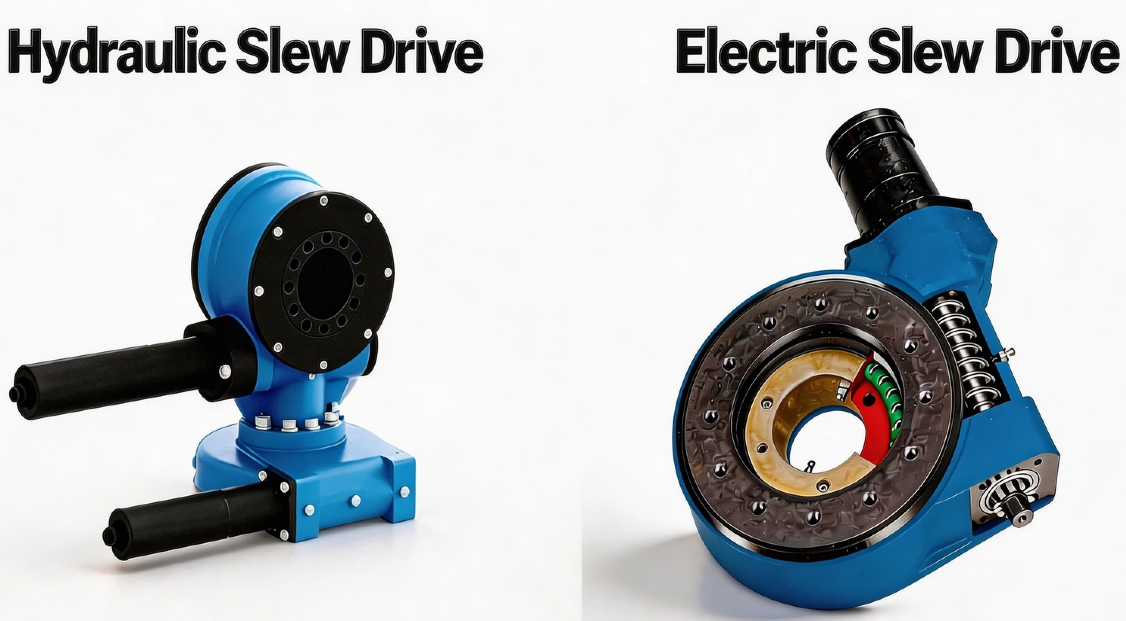
A hydraulic slew drive is powered by pressurized fluid. In this system, a hydraulic motor—connected to the machine's hydraulic pump and reservoir—provides the rotational force. The motor is typically integrated directly with the slew drive's gearbox, creating a compact and powerful unit. This type of drive is the traditional choice for heavy-duty off-highway equipment, valued for its robustness and raw power.
How Do Hydraulic Slew Drives Work?
The operation of a hydraulic slew drive is based on the principles of fluid power. A hydraulic pump, driven by a diesel engine or an electric motor, pressurizes oil and sends it through hoses and control valves to the hydraulic motor on the slew drive.
The pressurized oil acts on pistons or vanes inside the motor, causing its shaft to rotate. This shaft turns the first stage of the internal gear system (like a worm or sun gear), which then drives the larger output gear. The rotation of this final gear is what turns the machine's superstructure. The flow and pressure of the oil are controlled to manage the speed and torque of the rotation, offering smooth and powerful motion even under heavy, uneven loads.
What is an Electric Slew Drive?
An electric slew drive uses an electric motor as its power source. This motor is typically a high-torque AC or DC motor that receives power from a generator, a battery pack, or direct connection to the grid. The motor is flange-mounted to the gearbox, creating an electromechanical drive unit. With the rise of hybrid and fully electric machinery, these drives are becoming increasingly popular for applications requiring precision, efficiency, and clean operation.
How Do Electric Slew Drives Work?
In an electric system, a motor controller (or drive) takes electrical energy from the source and modulates its voltage, current, and frequency to control the electric motor's speed and torque. When commanded, the motor shaft spins, driving the internal gear reduction of the slew drive. This gear reduction, similar to the hydraulic type, converts the high-speed, relatively low-torque motor output into the high-torque, low-speed rotation needed to swing heavy loads. The controller allows for instant response, precise positioning, and features like soft-start and stop, which reduces mechanical stress.
Hydraulic Slew Drives – Advantages & Disadvantages
Advantages:
Exceptional Torque Density: Hydraulic motors can generate immense torque relative to their size, making them ideal for the heaviest lifting and digging applications.
Proven Durability: These systems are built to withstand extreme conditions, including shock loads, vibration, dust, and mud. They are the industry standard for demanding environments.
Reliable High-Torque at Low Speeds: Hydraulics excel at providing smooth, powerful, and consistent torque even when stalling under load, without damaging the motor.
Simple On-Site Repairs: Mechanics are generally very familiar with hydraulic systems. Repairs often involve replacing hoses, seals, or motors, which can be done in the field.
Disadvantages:
Lower Energy Efficiency: Hydraulic systems suffer from inherent inefficiencies due to fluid friction, pressure drops, and heat generation, typically operating at 60-70% efficiency.
Regular Maintenance Requirements: They require consistent upkeep, including checking fluid levels, inspecting hoses for leaks, and changing filters and oil to prevent contamination and failure.
Potential for Environmental Contamination: Leaks from hoses, seals, or fittings can release hydraulic oil into the environment, posing a risk of soil and water contamination.
Higher Noise Levels: Hydraulic power units and motors can be significantly noisier than their electric counterparts.
Electric Slew Drives – Advantages & Disadvantages
Advantages:
Superior Energy Efficiency: Electric motors convert over 90% of their input energy into mechanical power. This reduces energy consumption, lowers heat generation, and can significantly cut operating costs.
Minimal Maintenance: With fewer moving parts, no fluids to change, and no hoses to leak, electric drives drastically reduce maintenance time and costs. The main tasks are often just bearing lubrication and software checks.
Precision and Control: Electric drives offer exceptional speed and positioning control. They respond instantly to commands, allowing for smooth acceleration, precise stopping, and programmable motion profiles.
Clean and Quiet Operation: They produce zero on-site emissions and run much more quietly, making them perfect for indoor use, urban environments, and applications with strict noise and pollution regulations.
Disadvantages:
Power and Torque Limitations for Heavy-Duty Use: While improving rapidly, electric motors and their power sources (batteries) need to be significantly larger to match the brute-force torque of hydraulics in the heaviest continuous-duty applications.
Battery Dependency and Charging: For mobile applications, the operating time is limited by battery capacity, and recharging takes significantly longer than refueling a diesel-hydraulic machine.
Higher Initial Investment: The upfront cost of high-power electric motors, sophisticated controllers, and large battery packs can be higher than a comparable hydraulic system.
Performance in Extreme Temperatures: Battery performance, in particular, can drop significantly in very cold conditions, potentially limiting operational capability.
Direct Comparison Table: Hydraulic vs. Electric Slew Drive
| Feature | Hydraulic Slew Drive | Electric Slew Drive |
|---|---|---|
| Power Source | Pressurized fluid from a pump | Electricity from a battery, generator, or grid |
| Torque Output | Very high, excellent at low speeds | High, but can be limited for extreme heavy-duty |
| Efficiency | Lower (approx. 60-70%) | High (over 90%) |
| Control Precision | Good, smooth and proportional | Excellent, instant and highly accurate |
| Maintenance Needs | High (fluid, seals, filters, hoses) | Low (bearings, electrical checks) |
| Environmental Impact | Risk of oil leaks, higher emissions | Zero on-site emissions, cleaner operation |
| Noise Level | Higher | Lower |
| Best For | Heavy lifting, harsh environments | Precision tasks, clean/quiet areas, efficiency |
Best Application Scenarios for Each Type
Hydraulic Slew Drives are Best For:
Heavy Construction & Mining: Large excavators, crawler cranes, and drilling rigs where brute force and durability in extreme conditions are non-negotiable.
Off-Highway Vehicles: Equipment operating in remote areas where immediate, high-torque power is needed continuously and on-site electrical charging is unavailable.
Applications with High Shock Loads: Tasks involving intermittent, jarring movements that hydraulic systems can absorb better.
Electric Slew Drives are Best For:
Aerial Work Platforms (AWPs) & Booms: Where smooth, precise positioning, quiet operation, and zero emissions are critical for working near people or indoors.
Material Handlers in Controlled Environments: Indoor factories, warehouses, or recycling facilities where cleanliness and low noise are priorities.
Renewable Energy Systems: Solar trackers and wind turbines, where efficiency, low maintenance, and programmable control are key benefits.
Urban Construction & Light-Duty Machinery: Equipment that must comply with strict city noise and emission regulations.
How to Choose Between Hydraulic and Electric Slew Drives
Making the final choice comes down to carefully evaluating your specific application against the strengths of each technology. Here is a simple guide to the decision-making process:
1. Define Your Torque and Duty Cycle: Is your application continuous heavy lifting (e.g., a mining shovel) or intermittent positioning (e.g., an aerial lift)? If it's the former, hydraulics are the proven choice. If it's the latter, electric drives are highly competitive and often superior.
2. Evaluate Your Operating Environment: Will the machine work in a remote quarry, an indoor facility, or a city center? Harsh, remote locations favor the rugged simplicity of hydraulics. Clean, indoor, or regulated urban environments strongly favor electric drives.
3. Analyze Total Cost of Ownership: Look beyond the initial purchase price. Factor in long-term energy costs, expected maintenance intervals and costs, and potential downtime. Electric drives often win here due to higher efficiency and lower maintenance.
4. Consider Sustainability Goals: If your company has targets for reducing emissions or noise pollution, an electric slew drive solution is the clear path forward.
5. Assess Power Availability: Can your machine provide a continuous supply of high-pressure hydraulic fluid, or is it more feasible to provide a high-power electrical connection and battery bank?
LyraDrive: Your Partner for High-Performance Slew Drives
At LyraDrive, we understand that every machine and application has unique demands. As a leading Chinese manufacturer specializing in slew drives and slewing bearings, we are dedicated to providing the perfect rotational solution for your needs.
Our comprehensive product range includes all major types of slew drives:
Hydraulic Slew Drives: Built for the most demanding heavy-duty applications, delivering unmatched torque and reliability.
Electric Slew Drives: Engineered for precision, efficiency, and clean operation, ideal for the next generation of electric machinery.
Worm Gear Slew Drives: Offering smooth, self-locking action for applications requiring high reduction ratios in a compact form.
Spur Gear Slew Drives: Designed for higher speed and continuous rotation applications where efficiency is paramount.
We pride ourselves on delivering high-performance solutions. Whether you need a standard model or a fully customized design to meet specific torque, speed, mounting, or environmental requirements, our team of experts is ready to work with you. From material selection to precision manufacturing, we ensure every slew drive we produce provides the strength, durability, and accuracy your machinery demands.
Choose LyraDrive for a partnership that combines engineering excellence with a commitment to your success. Contact us today to discuss your project and discover the optimal slew drive solution.
FAQ of Hydraulic and Electric Slew Drives
Q1: Can an electric slew drive really replace a hydraulic one in an existing machine?
A: In many cases, yes, but it depends on the application. Electric slew drives can directly replace hydraulic ones if the torque, speed, and mounting dimensions match. However, you must also consider the power source—ensuring your machine can provide the necessary electrical power and control systems. Retrofitting often requires integrating a motor controller and possibly a larger electrical supply. It's always best to consult with a slew drive manufacturer like LyraDrive to assess feasibility and requirements.
Q2: Which type of slew drive lasts longer—hydraulic or electric?
A: Both can have long service lives when properly maintained, but their longevity depends on different factors. Hydraulic drives are extremely durable in harsh environments but require regular maintenance (fluid changes, seal inspections) to prevent wear and contamination. Electric drives have fewer wearing parts and generally need less maintenance, but their lifespan depends on the quality of electrical components like bearings and the motor controller. In clean, controlled applications, electric drives often have a longer operational life with minimal intervention.
Q3: Are hydraulic slew drives being phased out in favor of electric ones?
A: Not at all. While electric drives are gaining popularity—especially in urban, indoor, and precision applications—hydraulic drives remain the dominant choice for heavy-duty, off-highway machinery like large excavators, mining equipment, and heavy cranes. The two technologies will continue to coexist, each serving the applications where they perform best. Many equipment manufacturers are also developing hybrid solutions that combine the strengths of both systems.
Q4: How do extreme temperatures affect each type of slew drive?
A: Hydraulic drives perform well across a wide temperature range when using the correct grade of hydraulic fluid. In extreme cold, special low-viscosity fluids may be needed, and warm-up times may be required. Electric drives are also capable in extreme temperatures, but their performance is heavily influenced by the power source. If powered by batteries, cold temperatures can significantly reduce battery capacity and efficiency. The electric motor itself, however, can operate in very cold conditions with proper lubrication and component selection.
Q5: What are the hidden costs I should consider when choosing between hydraulic and electric?
A: For hydraulic systems, hidden costs often include regular fluid replacement, filter changes, hose replacements, and potential cleanup from leaks. Energy inefficiency also translates to higher fuel or power costs over time. For electric systems, the initial investment in batteries, controllers, and charging infrastructure can be substantial. Battery replacement after several years is another significant cost to factor in. A thorough total cost of ownership analysis should include these long-term expenses, not just the purchase price.
Q6: Can LyraDrive provide custom slew drives for unique applications?
A: Absolutely. At LyraDrive, we specialize in providing both standard and fully customized slew drive solutions. Whether you need specific torque ratings, special mounting configurations, corrosion-resistant materials for marine environments, or unique gear ratios, our engineering team can design and manufacture a slew drive that meets your exact requirements. We work closely with customers to ensure optimal performance for any application.
Q7: How do I determine the right size and torque capacity for my application?
A: Selecting the correct slew drive involves calculating the maximum loads (axial, radial, and moment loads), duty cycle, operating speed, and environmental factors. It's a critical step to ensure safety and performance. The engineering team at LyraDrive can assist you with these calculations and help you select the most suitable model from our extensive product range or design a custom solution tailored to your machinery
 WhatsApp
 sales@lyradrive.com
 +8613903880726