



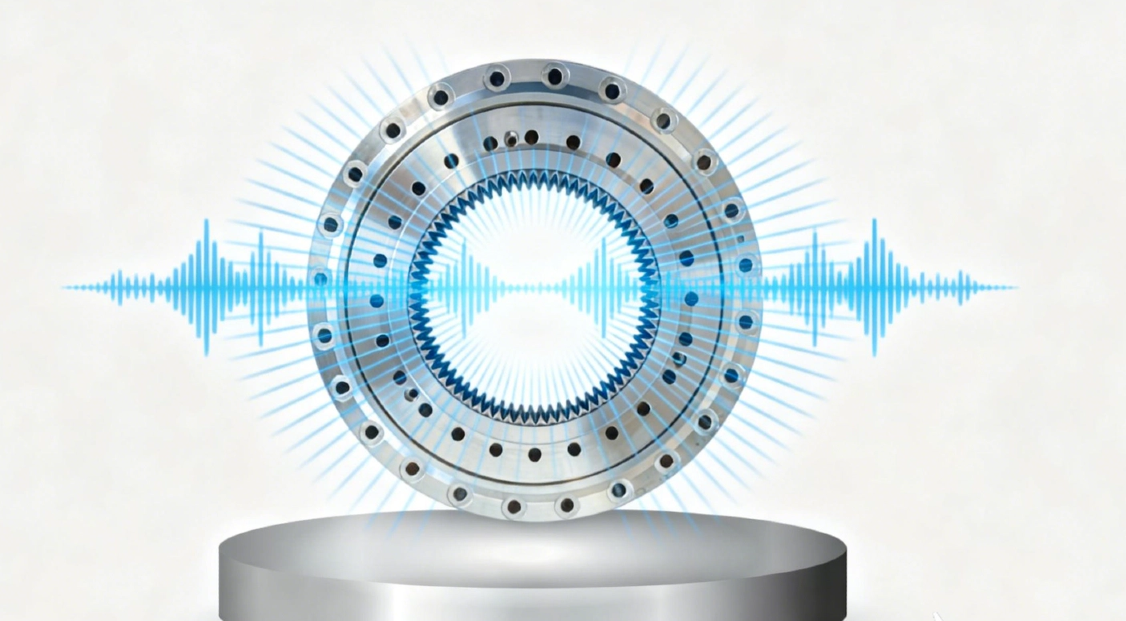
How to Reduce Slewing Bearing Gear Noise?
What is Slewing Bearing?
A slewing bearing is not your typical bearing. Unlike standard bearings that primarily handle radial or axial loads, a slewing bearing is a large-scale bearing designed to handle combined loads—axial, radial, and tilting moment loads—simultaneously. It enables smooth, controlled, and continuous rotational movement between heavy machinery components. Characterized by its large diameter, integrated gear (either internal or external), and mounting holes, it is a fundamental component for machinery requiring rotation under significant weight and stress.
How Does a Slewing Bearing Work?
At its core, a slewing bearing functions as a rotational joint. The bearing consists of an inner ring and an outer ring, with rolling elements (balls or rollers) seated in raceways between them. This assembly minimizes friction during rotation. The integrated gear, which is cut directly onto one of the rings, interacts with a pinion (a small driving gear). When the pinion is driven by a motor, it meshes with the slewing bearing gear, causing the entire bearing and the structure attached to it (like a crane boom or an excavator cab) to rotate. Its ability to support heavy loads while rotating makes it indispensable in many industrial applications.
Applications of Slewing Bearing
Slewing bearings are the workhorses of rotation in heavy-duty industries. Common applications include:
Construction Machinery: Excavators, cranes, and concrete pump trucks.
Renewable Energy: Wind turbine yaw and pitch systems.
Material Handling: Stacker-reclaimers, turntables, and robotic arms.
Defense and Aerospace: Radar platforms, missile launchers, and telescope mounts.
Industrial Equipment: Large welding manipulators, index tables, and heavy-duty rotators.
Causes of Gear Noise in Slewing Bearings
Gear noise in slewing bearings is often a symptom of an underlying issue. The primary causes include:
Poor Gear Meshing: Incorrect backlash (the clearance between mating gear teeth) is a leading cause. Excessive backlash creates impact noise, while insufficient backlash leads to high friction and whining sounds.
Improper Lubrication: Inadequate, incorrect, or degraded lubricant fails to create a proper protective film between the gear and pinion teeth, resulting in metal-to-metal contact and increased noise.
Gear Damage: Wear, pitting, spalling, or misalignment of the gear teeth disrupts the smooth rolling action, causing vibration and audible grinding or knocking.
Installation Errors: Non-parallel alignment between the slewing bearing gear and the pinion, incorrect preload, or an unlevel mounting surface force the gears into improper contact.
Contamination: Dirt, dust, or debris in the gear mesh acts as an abrasive, accelerating wear and creating grinding noises.
Impact of Gear Noise in Slewing Bearings
Ignoring gear noise can lead to severe consequences beyond mere annoyance:
Accelerated Wear: Noise indicates abnormal friction and impact, which rapidly wears down gear teeth.
System Failure: Progressive damage can lead to catastrophic gear or bearing failure, resulting in unplanned downtime.
Reduced Efficiency: Noise and vibration signify energy loss, forcing the drive system to work harder.
Safety Hazards: Sudden failure of a critical rotational component can pose serious safety risks to operators and equipment.
Increased Costs: Significant repair costs, production losses, and premature component replacement all contribute to higher total cost of ownership.
How to Reduce Slewing Bearing Gear Noise?
Proactive maintenance and precise engineering practices are essential for minimizing gear noise. The following detailed strategies address both operational maintenance and fundamental design considerations to achieve long-term quiet operation:
Optimize Lubrication Protocol: Select a high-viscosity, extreme-pressure (EP) grease specifically formulated for slow-speed, high-load gear applications. The grease must have excellent adhesion and anti-wear properties. Implement a scheduled lubrication regimen based on operating hours, load cycles, and environmental conditions. Critical step: During re-lubrication, rotate the bearing slowly to allow the fresh grease to fully circulate and displace old, contaminated grease from the entire gear mesh path. Insufficient lubrication volume is a common oversight; ensure the gear teeth are adequately coated.
Achieve Precision Alignment and Backlash Control: This is arguably the most critical factor. Use dial indicators and laser alignment tools—not just visual checks—to verify that the mounting surface for the slewing bearing is perfectly level and flat within the manufacturer's tolerance. The alignment between the pinion and the bearing gear must ensure both correct center distance and parallelism. Backlash should be meticulously set according to specifications using a feeler gauge or dial indicator. Remember that thermal expansion and settling under load can alter initial settings; a slight re-check after the initial run-in period (e.g., 50-100 hours) is highly recommended.
Implement a Proactive Inspection Routine: Move beyond reactive maintenance. Establish a schedule for regular inspections that includes:
Visual Inspection: Look for signs of abnormal wear patterns (pitting, spalling, polishing), cracks, or plastic deformation on gear flanks.
Auditory and Vibration Monitoring: Document baseline noise and vibration levels. Any significant change is an early warning indicator.
Wear Debris Analysis: For critical applications, periodically check lubricant samples for metal particles, which can signal wear before it becomes audible.
Manage Operational Best Practices: Engineer operational procedures to minimize stress. Avoid shock loads and sudden directional changes, which cause instantaneous peak stresses on gear teeth. If possible, implement controlled acceleration and deceleration ramps in the drive system. Consistently operate within the rated load and speed capacity of the bearing. Overloading, even momentarily, can cause permanent deformation in the gear tooth profile, leading to permanent noise issues.
Ensure Rigorous Contamination Control: Protect the gear mesh interface. Inspect and maintain seals regularly. In harsh environments, consider adding secondary protective covers or scrapers. Before applying new grease, clean the old grease and any visible debris from the gear teeth to prevent abrasive paste from forming. The goal is to maintain a clean, sealed lubrication environment for the gear mesh.
Custom Slewing Bearings Solutions by LyraDrive
LyraDrive is a professional one-stop slewing device manufacturer majored in design and development, customized production, sales and service on slewing bearings and slewing drives. The LyraDrive team has been deeply involved in the design, manufacturing and application of slewing drives, slewing bearings and worm gear drives for more than 15 years, majored in the design and manufacture SE slew drives, WE slew drives, SP series gear slewing drives.
We understand that optimal gear performance is engineered from the start. We offer tailored solutions that directly address noise reduction, including:
Custom Gear Geometry: Precision grinding gear teeth for superior surface finish and accurate profile to ensure smooth, quiet meshing.
Material Selection: Recommending and using specialized steel grades and heat treatment processes to enhance gear durability and noise characteristics.
Integrated Design Support: Collaborating on the design of the entire rotational system—including the bearing, gear, and pinion mounting—to ensure perfect alignment and optimal performance from the outset. Our expertise spans our SE series slewing drives, WE series slewing drives, and SP series gear slewing drives, ensuring the right solution for your specific needs.
FAQ of Slewing Bearings Gear Noise
Q: Can I use any grease on my slewing bearing gear?
A: No. Always use the lubricant type and viscosity grade recommended in the manual. Using the wrong grease can lead to poor performance, increased noise, and premature failure.Q: How often should I check the gear backlash?
A: It should be checked during initial installation, after the first 50-100 hours of operation (run-in period), and then at regular intervals as part of preventive maintenance, such as every 500-1000 operational hours or as specified by the manufacturer.Q: Is some gear noise normal?
A: A consistent, low hum is typically normal. However, any sudden change in noise level, or the appearance of knocking, grinding, or screeching sounds, indicates a problem that requires immediate investigation.Q: What is the most critical step to prevent noise during installation?
A: Ensuring absolute parallelism between the pinion shaft and the plane of the slewing bearing gear, along with achieving the precise center distance, is paramount. This sets the foundation for correct backlash and smooth operation
 WhatsApp
 sales@lyradrive.com
 +8613903880726