



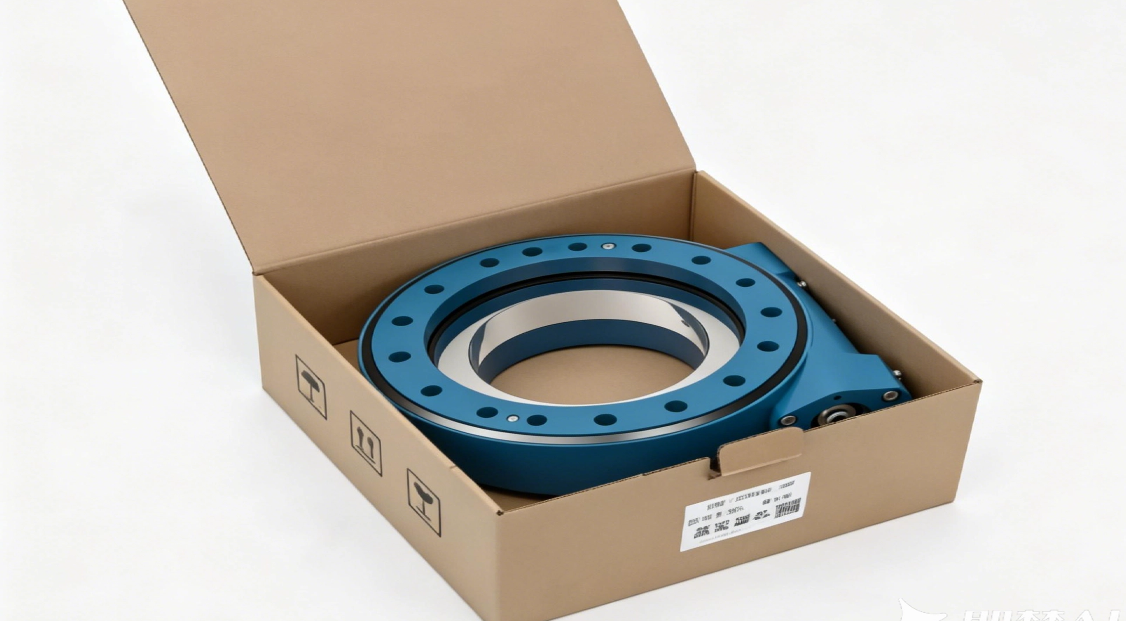
How to Properly Package a Slew Drive?
What is Slew Drive?
A slew drive is a sophisticated power transmission device that combines a high-precision worm gear mechanism with a robust slewing bearing into a single integrated unit. This compact assembly serves as a fundamental component for enabling controlled rotational movement in heavy machinery. Unlike standard rotational drives, a slew drive is specifically engineered to handle exceptional loads—managing axial forces, radial stresses, and substantial tilting moments simultaneously. The unique configuration allows for precise angular positioning with remarkable torque output from a relatively small form factor, making it the preferred solution for applications where space constraints meet demanding mechanical requirements. Its self-locking characteristic, inherent in the worm gear design, provides additional safety by preventing back-driving under load conditions.
How Does It Work?
The operational principle of a slew drive centers on the interaction between a hardened worm screw and a large-diameter worm gear integrated into the bearing raceway. When the worm screw is rotated—typically by an electric, hydraulic, or pneumatic motor—it engages with the gear teeth, causing the outer structure of the bearing to rotate smoothly around its axis. This mechanical advantage allows a small input force to generate tremendous output torque. Key advantages stemming from this design include:
Exceptional Load Capacity in Minimal Space: The integration of bearing and gearbox eliminates the need for separate support structures, offering an extremely high torque-to-size ratio.
Inherent Safety Through Self-Locking: The lead angle of the worm gear creates a natural braking effect, securely holding heavy loads in position without continuous power input or external brakes.
Superior Positioning Accuracy and Rigidity: Precision-ground gearing and optimized bearing preload minimize backlash, enabling exact angular control and exceptional stiffness under varying loads.
Enhanced Durability and Sealed Protection: Modern slew drives feature advanced sealing systems that protect critical internal components from contaminants, while high-grade materials ensure longevity even in harsh operating environments.
Applications of Slew Drive
The versatility and robustness of slew drives make them indispensable across multiple sectors requiring reliable and powerful rotational motion:
Renewable Energy: In solar tracking systems, they provide the precise, daily movement needed to optimize panel orientation. In wind turbines, they facilitate the crucial yaw (nacelle rotation) and pitch (blade angle adjustment) functions.
Heavy Machinery and Construction: They form the core rotational mechanism for crane booms, excavator superstructures, concrete pump booms, and drilling rigs, offering smooth swing motion under immense loads.
Industrial Automation and Robotics: Utilized in the base rotation of robotic arms, automated welding stations, turntables, and material handling equipment, where precision and repeatability are paramount.
Agricultural and Infrastructure: Power the rotation of large center-pivot irrigation systems and are critical in the positioning mechanisms of satellite communication antennas and radar installations.
Why is Proper Packaging of Slew Drives Critical?
Given their precision engineering and critical role in machinery, the packaging of a slew drive is far more than a shipping formality—it is a vital extension of the quality assurance process. Inadequate protection during transit can lead to consequences that compromise the entire unit: shock or vibration can cause micro-misalignments in gear meshing, leading to premature wear, increased noise, and reduced efficiency. The ingress of moisture, dust, or chemical contaminants can corrode finely finished surfaces, degrade specialized lubricants, and damage seals. Proper packaging, therefore, acts as a controlled environment that preserves the component's factory-calibrated condition, ensuring it arrives at its destination with its performance integrity fully intact, ready for immediate and reliable service.
What to Consider Before Packaging?
Developing an effective packaging strategy requires a thorough analysis of the entire journey from factory floor to final installation:
Logistics Chain Analysis: The chosen mode (air, sea, road) and estimated duration of transit dictate the level of protection needed. Ocean freight demands superior corrosion resistance, while road transport focuses more on shock absorption.
Environmental Risk Assessment: Potential exposure to salt spray, high humidity, extreme temperatures, or dusty conditions must inform the choice of barrier materials and desiccants.
Product Specifications: The physical dimensions, weight distribution, center of gravity, and location of vulnerable components (like shafts or sensor ports) directly influence the design of internal cushioning and external bracing.
Storage and Handling Protocols: Will the packaged unit be stored in an uncontrolled warehouse? How will it be handled (manual vs. forklift)? Answers guide decisions on crate strength, weatherproofing, and lifting point design.
Customer-Specific Requirements: Some industries or clients have standardized packaging, labeling, or documentation procedures that must be integrated.
How to Package a Slew Drive Correctly?
A comprehensive, multi-stage packaging process ensures optimal protection:
Step 1: Initial Cleaning and Port Sealing: The drive undergoes a meticulous cleaning to remove all machining oils, particles, and fingerprints. Every opening—including shaft ends, lubrication ports, and breather valves—is fitted with durable plastic or metal plugs and protective tape to create an airtight seal against contaminants.
Step 2: Application of Corrosion Inhibitors: All exposed metal surfaces are treated with a high-quality rust-preventative oil or covered with VCI (Vapor Corrosion Inhibitor) film. VCI emits a protective vapor that forms a molecular layer on metal, providing long-term corrosion defense even within enclosed spaces.
Step 3: Primary Cushioning and Immobilization: The unit is wrapped in anti-static foam or air-cell cushioning material. It is then placed into a precisely die-cut foam or polyethylene cavity within a heavy-duty, multi-layer corrugated cardboard box or a lightweight plywood case. This custom cavity holds the drive firmly, preventing any shifting that could cause impact damage.
Step 4: Internal Environment Control: Multiple desiccant silica gel bags are placed inside the package and secured away from direct contact with the product. A humidity indicator card is often included to provide a visual check of the internal moisture levels upon arrival.
Step 5: Final Sealing and External Crating: The inner box is securely sealed. For heavy or long-distance shipments, this box is then placed into a custom-engineered wooden crate. The crate features internal blocking and bracing made of lumber to absorb major impacts, and is often lined with a waterproof membrane. Externally, it is clearly marked with handling icons, part numbers, weight, and orientation arrows.
Materials and Methods for Packaging Slew Drives
Selecting the right materials and employing proven methods are fundamental to ensuring the complete protection of slew drives during transit and storage. This section details the essential components and techniques used in professional packaging.
Core Packaging Materials:
Protective Coatings & Wraps:
VCI (Vapor Corrosion Inhibitor) Paper/Film: This is a critical material. It slowly releases corrosion-inhibiting vapors that form a protective molecular layer on all metal surfaces within the enclosed space, providing long-term defense against rust and oxidation, especially during sea freight.
Anti-Corrosion Spray/Oil: A high-performance, temporary rust preventative is applied to exposed metal surfaces for additional protection during the initial handling and shipping phases.
Polyethylene Stretch Wrap: Used to create a tight, moisture-resistant barrier around the inner package or the unit itself before crating.
Cushioning and Immobilization Materials:
Custom-Cut Polyethylene or Polyurethane Foam: This is the gold standard for primary cushioning. Precisely cut cavities hold the slew drive snugly, preventing any movement within its box and absorbing shock and vibration.
Bubble Wrap or Air-Cell Cushioning: Used for wrapping components, filling void spaces, or providing an additional protective layer.
Edge Protectors and Corner Guards: Made of cardboard or foam, these protect vulnerable protrusions like shaft ends or mounting flanges from impact.
Structural Packaging:
Heavy-Duty, Multi-Wall Corrugated Cardboard Boxes: Used for smaller to medium-sized drives. They offer excellent strength-to-weight ratios and are often used as the inner box.
Plywood Cases (Tri-Wall or更高强度): For heavier units, plywood cases provide more rigidity than cardboard and are used as the immediate outer container before crating.
Engineered Wooden Crates: Constructed from fumigation-treated lumber (e.g., ISPM 15 compliant for international shipping), these provide the ultimate structural protection for large, heavy drives or long-distance shipments. The design includes internal blocking and bracing.
Sealing and Environment Control:
Desiccant (Silica Gel) Bags: Placed inside the sealed package to actively absorb moisture and control humidity, preventing condensation.
Humidity Indicator Cards: Provide a visual check of the moisture level inside the package upon receipt.
High-Strength Packing Tape and Nails/Staples: For secure sealing of boxes and crates.
Standard Packaging Methods:
The Multi-Layer (Cocoon) Method: This is the most common and effective approach. It involves building layers of protection:
Layer 1 (Surface): Anti-corrosion treatment and port sealing.
Layer 2 (Cushion): Wrapping in soft material and placement in a custom-cut foam insert within a sturdy box.
Layer 3 (Environment): Addition of desiccants and sealing of the box.
Layer 4 (Structure): Placement of the sealed box into a braced wooden crate for heavy shipments. Each layer addresses a specific type of hazard (contamination, shock, moisture, impact).
VCI Blanket Wrap Method: For certain configurations, the drive can be tightly wrapped in multiple layers of VCI-impregnated foam or blanket, then secured with straps, creating a protective cocoon that combines cushioning and corrosion inhibition before being placed in a crate.
Custom Void-Fill and Bracing: The space between the inner package and the outer crate is not left empty. It is systematically filled with dunnage bags (air pillows), blocking lumber, or foam to ensure the inner box is completely immobilized, eliminating any potential for shifting during handling.
By strategically combining these materials—from active corrosion inhibitors to structural crating—with systematic methods like the multi-layer cocoon approach, a slew drive is provided with a comprehensive defensive system tailored to survive the rigors of the global supply chain.
Carefully Packaged by LyraDrive
LyraDrive is a professional one-stop slewing device manufacturer majored in design and development, customized production, sales and service on slewing bearings and slew drives. The LyraDrive team has been deeply involved in the design, manufacturing and application of slewing drives, slewing bearings and worm gear drives for more than 15 years, majored in the design and manufacture SE series slew drives, WE series slewing drives, SP series gear slewing drives.
we extend our commitment to quality into every stage of delivery. Our packaging protocol is not one-size-fits-all; it is a customizable service based on a detailed analysis of your project's logistics. From applying specialized protective coatings for coastal environments to designing reusable crates for easier field handling, our goal is to ensure that every LyraDrive component arrives in pristine, factory-fresh condition. We collaborate with clients to develop the most efficient and secure packaging solution, safeguarding your investment and supporting seamless project integration.
FAQs on How to Package Slew Drives
Q: Can I reuse the original packaging for shipping a defective unit back?
A: Absolutely, and it is strongly advised. The original packaging was specifically designed to protect that particular unit. Reusing it ensures all custom cushioning and bracing perfectly fits the drive again, offering the highest level of protection for its return journey. Inspect the packaging for any damage and replace inner materials if necessary.
Q: How should I store a packaged slew drive before installation?
A: Ideal storage conditions are a clean, dry, and temperature-controlled indoor environment. The package should be kept on a pallet to avoid ground moisture. Do not remove the outer plastic wrapping if present, as it provides a moisture barrier. Avoid stacking other heavy materials on top of the crate.
Q: What is the first thing I should do upon receiving a packaged slew drive?
A: Conduct a thorough external inspection of the shipping container for any signs of crushing, puncture, or water staining. Document any damage with photos before accepting the shipment. Once in a suitable workspace, carefully unpack, retaining all padding and desiccants for potential reuse. Only remove protective plugs and caps immediately prior to installation to prevent contamination.
Q: Are special markings required on the package?
A: Critical markings are essential for safe handling. These include: "Fragile," "This Side Up" (with arrows), "Keep Dry," the net and gross weight, and the center of gravity symbol for heavy items. Clear part numbers and serial numbers should also be visible for easy identification.
Q: Does LyraDrive offer different packaging tiers?
A: Yes, we provide scalable packaging options. We can recommend a standard, cost-effective solution for domestic, low-risk shipments or engineer a premium, heavy-duty crate with enhanced environmental protection for complex international logistics. Our team will propose the optimal balance of security and cost for your specific needs.
 WhatsApp
 sales@lyradrive.com
 +8613903880726