



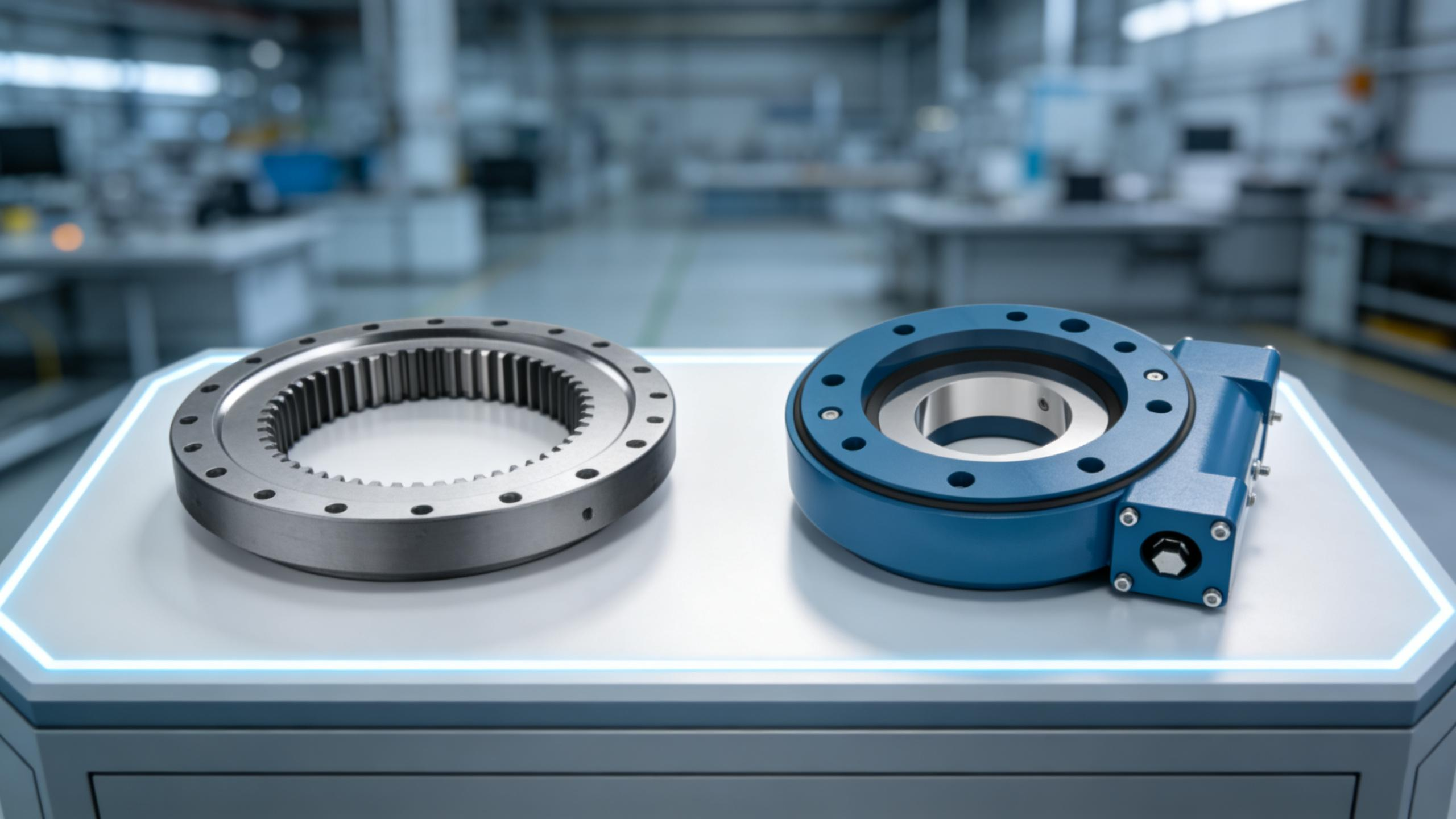
How to Choose : Slew Drive or Slewing Bearing?
Selecting the correct rotational component can mean the difference between a machine that performs reliably for years and one plagued with downtime and maintenance issues. This guide provides a clear framework for understanding the distinct roles of slew drives and slewing bearings and making the optimal choice for your specific needs.
What Are Slew Drives and Slewing Bearings?
A Simple Analogy
Think of a slewing bearing as the robust, high-capacity "wheel and axle" for heavy structures—it enables smooth rotation. A slew drive is like the complete "power steering and axle assembly"—it provides both the rotation and the controlled force to make it happen, all in one compact package.
Core Definitions
Slewing Bearing: A large-diameter rotational bearing engineered to support immense combined loads—axial (thrust), radial (side), and moment (tipping)—simultaneously. It is a foundational component that creates a low-friction rotational interface but requires an external source (like a motor and gearbox) to be driven.
Slew Drive: An integrated electro-mechanical system that combines a slewing bearing with a built-in gearbox (typically a worm gear set) and often a mounting interface for a motor. It is a self-contained unit that delivers high-torque, controlled rotational motion from a standard power input.
How Do They Work?
The Role of the Slewing Bearing
The slewing bearing's internal structure—featuring raceways filled with balls or rollers—is designed to minimize rolling friction. This allows a massive upper structure to turn smoothly on a stationary base while carrying heavy, off-center loads. Its primary job is to manage force, not create motion.
The Role of the Slew Drive
The slew drive adds the element of power transmission. An input motor turns a worm screw, which meshes with gear teeth cut directly into the slewing ring. This worm gear design provides a very high gear ratio in a single stage, translating a small input force into a massive output torque. A key advantage is its natural self-locking feature: the system holds its position securely when power is off, a critical safety benefit in many applications.
Slew Drive vs. Slewing Bearing: Knowing the Key Difference
Integrated System vs. Core Component
This is the fundamental distinction. A slew drive is a ready-to-install solution; you provide power and controls, and it outputs precise rotation. A slewing bearing is a core building block; you must design and source the motor, gear reducer, couplings, and mounting structure around it. The slew drive offers design simplicity and space savings.
When to Use Which?
Choose a Slewing Bearing when your application involves very large diameters, custom or complex drive train requirements, or passive/ manually-assisted rotation. Common in large cranes, excavator swing rings, and wind turbine nacelles.
Choose a Slew Drive when you need a compact, powered solution with built-in high reduction gearing, positional holding, and simplified assembly. Ideal for solar trackers, aerial work platforms, radar antennas, and robotic axes.
Where Are They Used? Common Applications
Applications of Slewing Bearings
Heavy Machinery: Mobile cranes, tunnel boring machines, ladle turrets.
Wind Energy: Main yaw and blade pitch bearings.
Medical: Rotating platforms for CT and MRI scanners.
Industrial: Turntables for welding, assembly, or material handling.
Applications of Slew Drives
Renewable Energy: Single-axis and dual-axis solar tracker drives.
Aerial Access: Rotation mechanism for boom lifts and scissor lifts.
Defense & Communications: Positioning drives for satellite dishes and radar systems.
Automation: Rotary axes for robotic arms, indexers, and heavy-duty positioners.
Therefore, the functions and application scenarios of slewing bearings and slewing drives are different, but they can also be used at the same time in some mechanical equipment to achieve more flexible and efficient rotation functions.
What to Think About Before You Choose: Key Selection Factors
Load Capacity (Axial, Radial, Moment): This is paramount. You must calculate the maximum static and dynamic forces from all directions. Underestimating loads is the most common cause of premature failure.
Speed and Precision Requirements: Determine the required rotational speed and the level of positional accuracy (e.g., backlash, repeatability). High-precision applications demand different designs than simple slewing functions.
Gear Ratio and Driving Torque: For slew drives, the needed output torque and speed define the required gear ratio. The self-locking ability of the worm gear is also a key torque-related consideration.
Environmental Conditions: Will the unit operate in extreme temperatures, heavy dust, constant moisture, or corrosive (marine/chemical) environments? This dictates sealing standards (IP rating), lubrication type, and material coatings.
Mounting and Installation Space: Evaluate the physical constraints. Slew drives often save significant space by integrating multiple components into a single, compact envelope with pre-machined mounting surfaces.
Your Step-by-Step Selection Guide
Step 1: Define Your Application’s Core Requirements
Clearly outline the machine's function, duty cycle, rotation range (full 360° or limited arc), and control method (manual, automated, variable speed).
Step 2: Assess the Need for an Integrated Drive
Ask: "Would a pre-assembled, tested drive unit simplify my design, save space, and reduce assembly time and risk?" If yes, focus on slew drives.
Step 3: Calculate Loads and Torque
Work with your engineering team to perform a complete load analysis. For slew drives, also calculate the required output torque at the slew ring.
Step 4: Match with Environmental Demands
Translate the operating environment into technical specs: IP67 sealing for water resistance, special grease for low-temperature operation, or anti-corrosion treatments.
Step 5: Partner with an Expert Manufacturer
Engage with a technical supplier early. Their expertise can validate your calculations, suggest optimizations, and prevent costly specification errors.
Why Partner with LyraDrive? Your Professional Solution
At LyraDrive, we specialize in the design and manufacturing of high-performance slew drives and slewing bearings for demanding industrial applications. As your dedicated partner in motion control, we combine precision engineering with practical expertise to deliver solutions that enhance your equipment's reliability and performance.
Our Core Products: Engineered for Excellence
Slew Drives: Our integrated drive systems are built for efficiency and durability. Featuring compact worm gear slew drive designs and high-torque capabilities, they offer smooth, controlled rotation with reliable self-locking functionality - perfect for applications requiring precise positioning and power transmission.
Slewing Bearings: We manufacture robust bearings that handle complex load combinations with exceptional stability. Available in various configurations including ball-type and cross-roller designs, our bearings provide the foundation for reliable rotational movement in even the most challenging environments.
Our Manufacturing Advantages: Why Choose LyraDrive
Vertical Integration: We control the entire manufacturing process from material selection to final assembly, ensuring consistent quality and complete traceability.
Advanced Engineering: Our team utilizes state-of-the-art design software and follows rigorous testing protocols to validate performance under real-world conditions.
Quality Assurance: Every component undergoes multiple inspection stages, adhering to international standards to guarantee reliability and longevity.
Comprehensive Support: Beyond Standard Products
Custom Engineering Services: We understand that standard solutions don't always fit unique challenges. Our engineering team works closely with clients to develop customized designs - from specialized sealing solutions for extreme environments to modified gear ratios for specific torque requirements.
Technical Consultation: Beyond providing products, we offer expert guidance on selection and integration. Our engineers can help you analyze load requirements, evaluate environmental factors, and determine the optimal configuration for your application.
Professional Selection Support: Making the Right Choice
Choosing between a slew drive and slewing bearing involves more than just comparing specifications. At LyraDrive, we provide:
Application Analysis: We review your specific use case to recommend the most suitable solution - whether it's a complete slew drive system or a slewing bearing integrated with your existing drive components.
Load Calculation Assistance: Our engineers can help verify your load calculations and suggest appropriate safety factors based on industry experience.
Lifecycle Considerations: We provide guidance on maintenance requirements, lubrication schedules, and expected service life to help you plan for long-term reliability.
Cost Optimization: By understanding your complete system requirements, we can recommend solutions that balance performance with value, avoiding both over-engineering and under-specification.
Your Partner in Success
When you choose LyraDrive, you're selecting more than just components - you're gaining a technical partner committed to your project's success. From initial concept through to installation and beyond, we provide the expertise and support needed to ensure optimal performance and reliability.
Ready to find the perfect rotational solution? Contact LyraDrive today for a personalized consultation with our engineering team.
 WhatsApp
 sales@lyradrive.com
 +8613903880726