



How to Choose the Right Slew Drive for Your Application
What is Slew Drive?
A slew drive is a compact, all-in-one rotational power transmission unit. It is an integrated assembly that combines a high-capacity slewing bearing with a precision gearbox—typically a worm gear mechanism—all housed within a single, robust casing. Unlike a simple slewing bearing that only supports a rotating load, a slew drive actively drives and controls that rotation with significant torque and accuracy. This integrated design makes it a fundamental component for enabling precise, heavy-duty rotational motion in countless industrial and technological applications, from solar trackers following the sun to cranes lifting massive loads.
How Does Slew Drive Work?
The operation of a slew drive centers on the worm gear principle. The core components are the worm screw (input) and the ring gear (output). When a motor rotates the worm screw, its threads engage with the teeth of the large ring gear. Due to the high gear ratio, multiple rotations of the worm are required to turn the ring gear just once. This design provides a massive mechanical advantage, converting the motor's high-speed, low-torque input into a powerful, slow, and highly controllable output rotation. A key benefit is the potential for self-locking; the friction in the worm gear often prevents back-driving, meaning the load cannot force the drive to rotate backward, holding position securely without an additional brake.
Key Features of Slew Drives
High Load Capacity: Designed to simultaneously manage large axial forces (along the axis), radial forces (perpendicular to the axis), and overturning moments (tipping forces).
Compact & Integrated Design: Unifies the bearing, gearing, and often the mounting structure into one pre-assembled unit, saving design time, space, and weight.
High Precision & Low Backlash: Offers precise positional control with minimal play between gears, which is critical for repeatable accuracy in automation.
Durability & Sealing: Many models feature enclosed housings with high IP (Ingress Protection) ratings, safeguarding internal components from dust, water, and harsh environmental conditions for reliable, long-term operation.
Versatile Configuration: Available in various sizes, gear ratios, and with single or dual output shafts to suit a wide range of mechanical requirements.
Applications of Slew Drives
Slew drives are the cornerstone of controlled heavy rotation across diverse sectors:
Renewable Energy: Essential for the pitch and yaw control of wind turbine blades and for rotating solar tracker panels to maximize sun exposure.
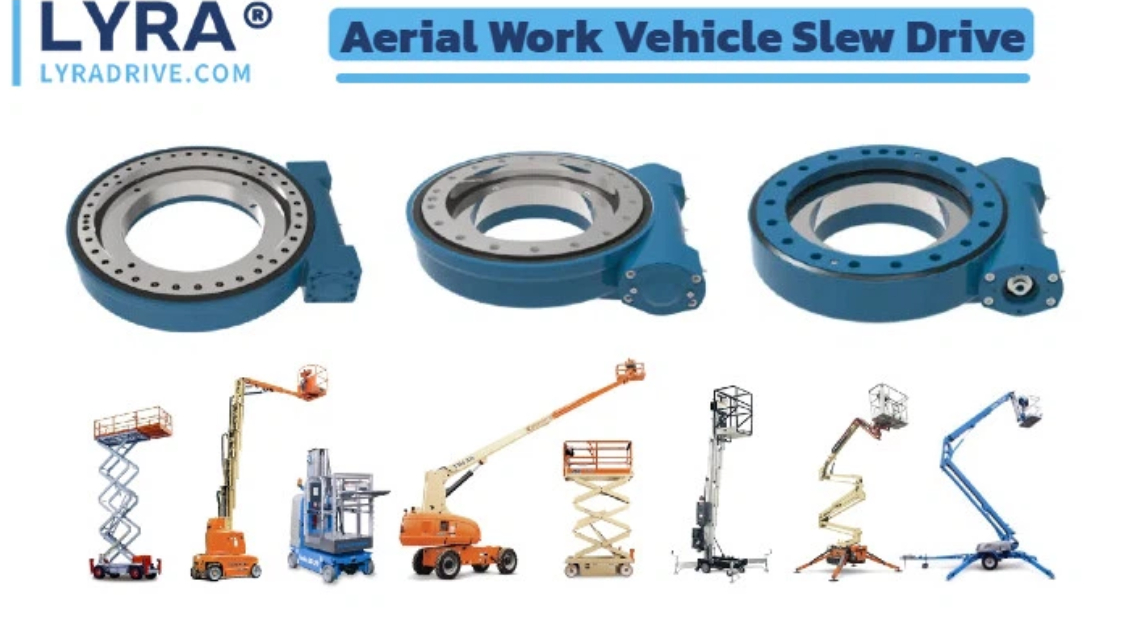
Construction & Material Handling: Used in mobile cranes, excavator attachments, and aerial work platforms for precise boom and platform positioning.
Industrial Automation & Robotics: Provide the foundational rotation for welding manipulators, assembly turntables, and robotic bases.
Defense & Aerospace: Enable the precise movement of radar antennae, satellite communication dishes, and weaponry tracking systems.
Medical & Specialized Equipment: Found in heavy-duty medical imaging machines (like CT scanners) and telescope mounts.
Key Considerations for Selecting Slew Drives
Selecting the optimal slew drive requires a careful analysis of your application's specific demands:
Load Requirements: Precisely calculate or estimate the maximum axial load, radial load, and overturning moment the drive will need to support during operation. These are the primary factors determining the drive's size and series.
Motion & Performance Needs: Determine the required output rotational speed, positioning accuracy (backlash tolerance), and duty cycle. High-precision applications demand drives with specialized gearing.
Environmental Conditions: Assess the operating environment. Will the drive be exposed to dust, moisture, extreme temperatures, or corrosive elements? This dictates the necessary sealing (IP rating) and potential material coatings.
Installation Constraints: Evaluate the available physical space for the drive, including mounting footprint and height restrictions. The required mounting orientation (horizontal or vertical) also influences model selection.
Power Source Compatibility: Ensure your motor (electric, hydraulic) can provide the necessary input torque and speed to efficiently drive the selected slew drive. A mismatch can lead to poor performance or failure.
How to Choose the Right Slew Drive: A Step-by-Step Guide
Following the considerations from Section 5, this guide provides direct, actionable choices for your selection process.
1. For Performance & Load Requirements:
The required force and precision dictate the drive's core capabilities.
For light to moderate loads in standard applications, a compact, economical standard-duty drive is the optimal choice, providing reliable performance without over-engineering.
For heavy loads, high dynamic forces, or when extreme positioning accuracy is critical, you must select a heavy-duty, high-precision drive. These models are built with reinforced structures, high-grade bearings, and optimized gear profiles to ensure stability, durability, and repeatable accuracy under stress.
2. For Installation Form & Space Constraints:
The physical integration dictates the drive's configuration.
For standard horizontal rotation (e.g., turntables), select a model with a horizontal output flange or shaft. Always verify the bolt-hole mounting pattern matches your base structure.
For vertical-axis rotation, choose a model explicitly designed for vertical installation. It is crucial to confirm that its lubrication system and seal design are validated for this orientation to prevent premature wear or failure.
When space is extremely limited, look for low-profile, internal gear, or compact external gear designs that maximize power density within a minimal envelope.
3. For Operational Environment:
The working conditions dictate the drive's protection level.
In a clean, controlled indoor setting, a cost-effective open or semi-enclosed design is often sufficient, allowing for better heat dissipation.
In harsh, dirty, or wet outdoor/industrial environments, a fully enclosed drive with a high IP rating (e.g., IP65, IP66) is non-negotiable. This sealed housing protects the internal gears and bearings from contaminants and moisture, guaranteeing longevity and reliable operation.
4. For Rotation Direction Requirements:
The complexity of motion dictates the drive's output configuration.
For simple, single-plane rotation, a standard single-axis slew drive is perfectly adequate. The desired motion is achieved by installing it horizontally or vertically.
For equipment requiring complex motion in two planes (e.g., simultaneous tilt and pan), a dual-axis slew drive is the integrated solution. This provides a more efficient and compact alternative to using two separate single-axis units.
5. For Power Source Matching:
This ensures the system operates as intended.
The fundamental rule is that the slew drive's required input torque and speed must fall within the output capability of your chosen motor (electric or hydraulic).
To choose correctly, compare the motor's performance curve with the drive's specified "rated input torque" and "maximum input speed." The motor should supply slightly more torque than the drive requires at the operating point. Avoid under-powering (which causes stalling) or grossly over-powering (which is inefficient). Consulting with technical experts for verification is always recommended.
Final Recommendation:
The most reliable path to a perfect match is to partner with a professional slew drive engineer. Provide them with your complete set of requirements—loads, environment, space, and motor specs. They can perform final verification calculations and recommend the optimal standard or custom solution for reliable, efficient, and cost-effective performance.
Your Expert Slew Drive Partner: LyraDrive
LyraDrive is a leading professional manufacturer dedicated to the design and production of high-performance slew drives. We specialize in delivering high-quality, durable, and reliable drive solutions, including robust worm slew drives, versatile WE slew drives, compact WED slew drives, and fully customized slew drives engineered to meet your unique design specifications and challenging working conditions.
We are not just a manufacturer; we are your dedicated engineering partner for all rotational motion challenges. Our mission is to transform your application requirements into the perfect drive solution, ensuring optimal performance, longevity, and value.
Professional Selection Solutions Tailored for You
Navigating the complexities of slew drive selection can be daunting. At LyraDrive, we simplify this process by offering expert, end-to-end support. When you partner with us, you gain direct access to our team of experienced application engineers.
Simply share your key project parameters—such as load calculations, environmental conditions, space constraints, and power source details. Our experts will conduct a thorough, complimentary selection analysis and technical validation. We cross-reference your needs with our extensive product portfolio and engineering knowledge to recommend a drive that provides the ideal balance of performance, durability, and cost-effectiveness. Whether your project requires a standard model or a bespoke design, we ensure the solution is not just a component, but a perfect fit for your system's success.
FAQ on Slew Drive Selection
Q1: What is the difference between a slew drive and a slewing bearing?
A: A slewing bearing is primarily a load-supporting component that must be driven by an external motor and gearbox. A slew drive is a complete, ready-to-install system that integrates the bearing, the gearing (usually a worm gear set), and often the housing into one unit that both supports the load and provides the driving force.
Q2: How do I decide between a standard and a high-precision drive?
A: The choice depends on your positional repeatability needs. Use a standard drive for general rotation where exact stopping points are not critical (e.g., a material turntable). Choose a high-precision, low-backlash drive for applications like solar tracking, robotics, or radar pointing, where even minute deviations are unacceptable.
Q3: Can I install any slew drive vertically?
A: Not all models are suited for vertical installation. You must select a drive specifically designed and tested for vertical operation. Vertical mounting affects lubrication distribution and load on certain components, so using a validated model is essential for longevity.
Q4: What does the IP rating mean for a slew drive?
A: The IP (Ingress Protection) rating indicates the level of sealing against solids and liquids. For example, a drive rated IP65 is "dust-tight" and protected against low-pressure water jets from any direction, making it suitable for most outdoor applications.
Q5: I'm not sure about my load calculations. Can you help?
A: Absolutely. Providing engineering support is a core part of our service at LyraDrive. Our engineers can help you review your application, clarify load conditions, and ensure the selected drive is correctly sized. Partnering with experts is the best way to mitigate risk and ensure project success.
 WhatsApp
 sales@lyradrive.com
 +8613903880726