



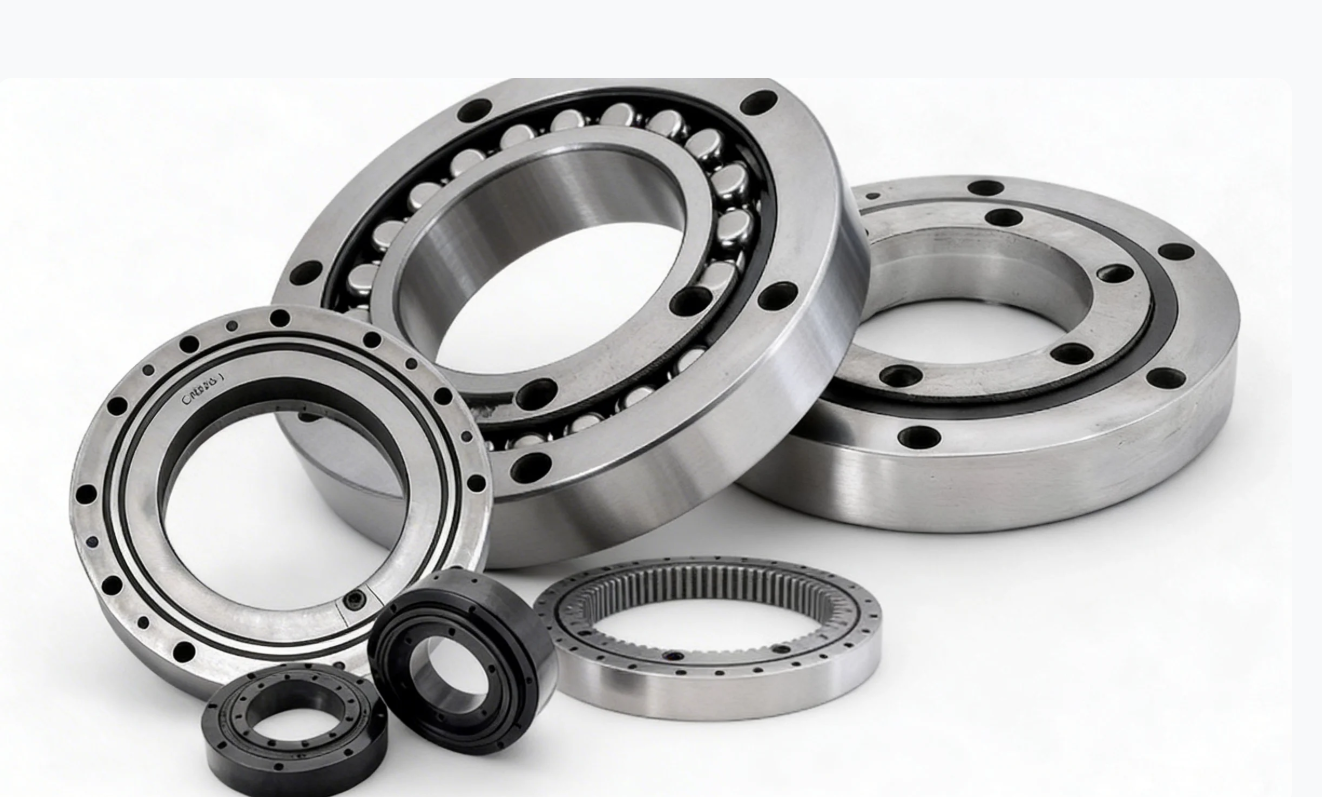
How Do I Choose Right Slewing Bearings?
Introduction
Slewing bearings, also known as slewing rings or turntable bearings, are a unique type of bearing designed to facilitate rotational movement in heavy machinery while simultaneously handling axial loads, radial loads, and moment loads. Unlike standard bearings that typically manage one or two types of forces, a slew bearing excels at managing the complex combination of all three. These components are critical for enabling smooth, 360-degree pivoting in everything from massive construction cranes to precision medical scanners.
Choosing the correct slewing bearing is a critical engineering decision. Selecting a bearing that is too small can lead to catastrophic failure, while overspecifying can result in unnecessary costs and wasted space. This guide will walk you through the fundamentals, key selection factors, and a step-by-step process to ensure you select the perfect slewing ring for your specific application.
What is a Slewing Bearing?
A slewing bearing is a large-diameter rotational component that connects two structural elements of a machine, allowing one part to rotate relative to the other. Its primary function is to support heavy loads while maintaining smooth, consistent rotation. These bearings are characterized by their large ring size relative to their cross-section and the presence of mounting holes for direct integration into machinery structures.
Components of a Slewing Bearing
Understanding the parts of a slewing bearing helps clarify how it functions:
Inner and Outer Rings: These form the main structural body, typically made of high-strength steel. One ring connects to the fixed structure (like a vehicle chassis), while the other connects to the rotating part (like a crane arm).
Rolling Elements: Located between the rings, these can be steel balls or cylindrical rollers. They facilitate rotation and distribute the load.
Spacers or Cages: These components separate the rolling elements, preventing friction and ensuring even load distribution.
Seals: Protective shields that keep contaminants like dust, water, and debris out while retaining lubrication.
Mounting Holes: Precision-drilled holes that allow the bearing to be bolted securely to the machinery.
Gearing (Optional): Many slewing rings feature integral internal or external gear teeth, allowing a pinion to drive the rotation automatically.
Lubrication Fittings: Access points for regular grease maintenance.
Key Types of Slewing Bearings
Slewing bearings are categorized primarily by the type and arrangement of their rolling elements. While numerous specialized variations exist, the vast majority of applications are covered by four fundamental designs. Choosing the correct type is the first step in the selection process:
Single Row Slewing Ring Ball Bearings: This is the most common and versatile design. The raceway is engineered so that each ball contacts the rings at four distinct points. This four-point contact allows a single row of balls to effectively handle axial loads, radial loads, and moment loads simultaneously. It is the go-to choice for general-purpose applications where space and budget are key considerations.
Double Row Ball Slewing Ring Bearings: As the name suggests, this design utilizes two separate rows of steel balls. Distributing the load across two rows significantly increases the bearing's load capacity and rotational stability compared to a single-row design. It is ideally suited for medium-duty applications requiring higher performance without moving to a larger roller-type bearing.
Crossed Roller Slewing Bearings: This design replaces balls with cylindrical rollers arranged perpendicularly in a single raceway. The crossed orientation provides exceptional rigidity and moment load resistance in a very compact cross-section. It is the preferred choice for applications demanding high precision, such as industrial robotics, medical imaging equipment, and machine tool indexing tables.
Three-row Roller Slewing Bearings: This is the highest performance design, engineered for extreme-duty applications. Unlike other types, axial loads, radial loads, and moment loads are each handled by a dedicated, independent row of rollers. This separation of load paths eliminates compromise and delivers the maximum possible load capacity and service life, making it essential for the largest excavators, wind turbines, and offshore cranes.
Slewing Bearing Application
Slewing bearings are ubiquitous in any industry requiring heavy rotation:
Cranes: Mobile cranes, tower cranes, and harbor cranes rely on slewing rings for lifting and positioning.
Wind Turbines: Yaw bearings rotate the nacelle to face the wind, and pitch bearings adjust the blade angles.
Construction Equipment: Excavators, aerial work platforms, and concrete pumps.
Robotics: Industrial manipulators and collaborative robots requiring high precision.
Medical Equipment: CT scanners and surgical tables needing silent, smooth motion.
Transport Vehicles: Turntables on rail cars and truck-mounted forklifts.
Industrial Machinery: Indexing tables, antenna systems, and radar platforms.
Factors to Consider When Selecting a Slewing Bearing
Selecting the right bearing goes beyond just matching dimensions. You must analyze the interface between the bearing and your specific operating conditions.
A. Load Types and Accurate Calculation
The bearing must withstand three distinct force types simultaneously:
Axial Load (Fa): The vertical thrust pushing down or lifting up.
Radial Load (Fr): Horizontal forces trying to push the rings sideways.
Moment Load (M): Tilting forces that attempt to overturn the bearing.
Theoretical Loading Analysis begins with material science. The choice of raw material and the depth of raceway hardening (typically 50-60 HRC) dictate the static load capacity. Larger diameter bearings inherently support higher moments.
Actual Loading Analysis is critical. You must account for interference and fits; bolting a bearing to a non-flat surface can distort the raceway and cause premature failure. Adhering to fit standards prevents misalignment and ensures the bearing retains its geometry under torque.
B. Rotational Speed
Most slewing bearings operate at very low speeds (intermittent rotation). However, if your application requires continuous or high-speed rotation, you must account for it. High speeds generate heat and require specific cage materials and grease formulations to prevent "wobble" or vibration.
C. Precision and Accuracy
If you are building a medical robot or a radar system, the bearing must have minimal runout and high positional repeatability. Standard construction bearings have higher tolerances, while precision-ground crossed rollers are necessary for exacting tasks.
D. Environmental Conditions
Consider where the machine lives. Is it in a heated factory or an Arctic wind farm? High temperatures thin out lubricant; extreme cold solidifies it. For marine environments or wastewater treatment, standard seals are insufficient. You must consider stainless steel coatings or specialized seals to prevent corrosion and contamination ingress.
E. Total Cost of Ownership
The lowest purchase price is rarely the cheapest option. Consider the total cost of ownership. A bearing with superior seals and premium lubrication intervals may cost more upfront but will last significantly longer and require less maintenance downtime than a budget alternative.
F. Supplier Capabilities
A bearing is only as good as the engineering behind it. The supplier must demonstrate proven expertise, robust quality control, and the ability to meet custom specifications. Consistent reliability and on-time delivery are just as important as the technical specifications on paper.
How to Choose the Right Slewing Bearings ?
Moving from theory to practice, follow these nine steps to lock in your final selection:
Step 1: Identify Equipment Requirements
Document your machine's "vitals." List the maximum axial/radial/moment loads, average rotational speed, required accuracy (runout tolerance), and the specific environmental hazards (humidity, salt spray, dust). Also define the operational life expectancy and physical space constraints.
Step 2: Calculate Maximum Bearing Loads
Do not just calculate for normal working conditions. Identify the maximum static and dynamic loads. Consider extreme weather events, emergency stops, testing procedures, and assembly/disassembly forces. Simplify these complex force vectors into a single equivalent force acting at the bearing's center point.
Step 3: Apply Service Factors
Multiply your calculated bearing forces by the Service Factor. This factor accounts for shock loads and frequency of use. For example, a mobile crane handling scrap metal in a shipyard experiences far more impact than a tire-mounted crane on a construction site. Refer to standard tables—if your specific application isn't listed, choose a similar one or consult an engineer.
Step 4: Gear Requirements
If your bearing requires an integral gear, determine the required gear capacity. Analyze dynamic loads vs. static loads, loads on inclines, and overload testing conditions. The gear teeth must survive the duty cycle under peak torque, not just average torque.
Step 5: Mounting Arrangements
Decide where the pinion drive and load structures attach. Will the pinion drive the outer ring while the structure supports the inner ring? Or vice versa? This arrangement affects whether the gear teeth are exposed to the environment or protected inside the housing. Consider bolt access for maintenance.
Step 6: Review Bearing Styles and Cross-sections
Compare your load data against the dynamic and static load curves of different bearing types. A crossed roller might offer the rigidity you need in a smaller space, while a three-row roller might be necessary for extreme moment loads.
Step 7: Preliminary Selection of Bearing
Plot your operating forces (including the service factor) on the manufacturer's rating curve. All force combinations must fall below the curve. Ensure the maximum thrust rating of the bearing exceeds three times your maximum operating thrust force. If the bearing doesn't meet these criteria, you must move up in size or change the bearing type.
Step 8: Gear Size and Quality Check
Verify the gear module, tooth count, and face width against your torque demands. Confirm the material hardness meets wear requirements. Check the gear quality against AGMA or ISO standards and confirm the backlash is acceptable for your control system.
Step 9: Final Confirmation
Before finalizing, double-check that the chosen slewing ring meets all identified load, speed, accuracy, and environmental requirements simultaneously.
Customize High-quality Slewing Bearings at LyraDrive
At LyraDrive, we specialize in the engineering and manufacturing of high-performance slew drives and slewing bearings. We understand that off-the-shelf solutions rarely fit perfectly.
Our slewing bearing product line is designed to cover the full spectrum of industrial demand. We offer:
Single Row Slewing Ring Ball Bearings: The economical, versatile choice for standard applications.
Double Row Ball Slewing Ring Bearings: Increased stability and load sharing for medium-duty cycles.
Crossed Roller Slewing Bearings: High rigidity and precision in a compact profile.
Three-row Roller Slewing Bearings: Maximum load capacity for the most demanding heavy-lift applications.
Where LyraDrive truly excels is in customization. We recognize that your project has unique geometry, load, and interface requirements. We offer flexible customization on:
Gear Options: Internal, external, or non-geared rings cut to your exact module and backlash specifications.
Material Selection: Tailored steel grades and heat treatment depths to match your environmental and stress demands.
Mounting Configuration: Custom hole patterns, thread types, and seal grooves.
Sealing & Lubrication: Specialty seals and grease formulations for extreme temperatures or food-grade environments.
Whether you need a standard bearing modified or a complete custom engineering solution, LyraDrive delivers precision, durability, and performance.
FAQ of selecting a right slewing bearing
Q: How do I know which type of slewing bearing is best for my application?
A: Start with your load requirements. Single row ball bearings suit general-purpose, medium loads. Double row ball bearings offer higher stability. Crossed roller bearings provide precision and rigidity. Three-row roller bearings deliver maximum capacity for extreme heavy-duty applications. Match the type to your dominant load and precision needs.
Q: What happens if I choose a slewing bearing that is too small?
A: Selecting an undersized bearing is a common and costly mistake. It leads to raceway fatigue, premature wear, bolt failure, and potential catastrophic machine failure. Always apply proper service factors and verify your load calculations against the manufacturer's rating curve before finalizing.
Q: How do I calculate the exact load my slewing bearing needs to handle?
A: You must consider three forces simultaneously: axial load, radial load, and moment load. Do not calculate only for normal operation—include extreme weather, emergency stops, testing conditions, and assembly forces. Simplify these vectors into a single equivalent force at the bearing's center point for accurate comparison.
Q: When should I consider a custom slewing bearing instead of a standard one?
A: Consider customization when your application has unique mounting hole patterns, non-standard gear teeth requirements, special material needs for extreme environments, or specific seal and lubrication demands. If a standard bearing requires significant modification, a custom solution often delivers better long-term value.
Q: What is the most common mistake engineers make when selecting a slewing bearing?
A: The most frequent error is underestimating moment loads and neglecting to apply appropriate service factors. Many engineers also overlook the importance of mounting surface flatness and bolt preload, which directly impact bearing performance and lifespan regardless of the bearing quality itself.
 WhatsApp
 sales@lyradrive.com
 +8613903880726