



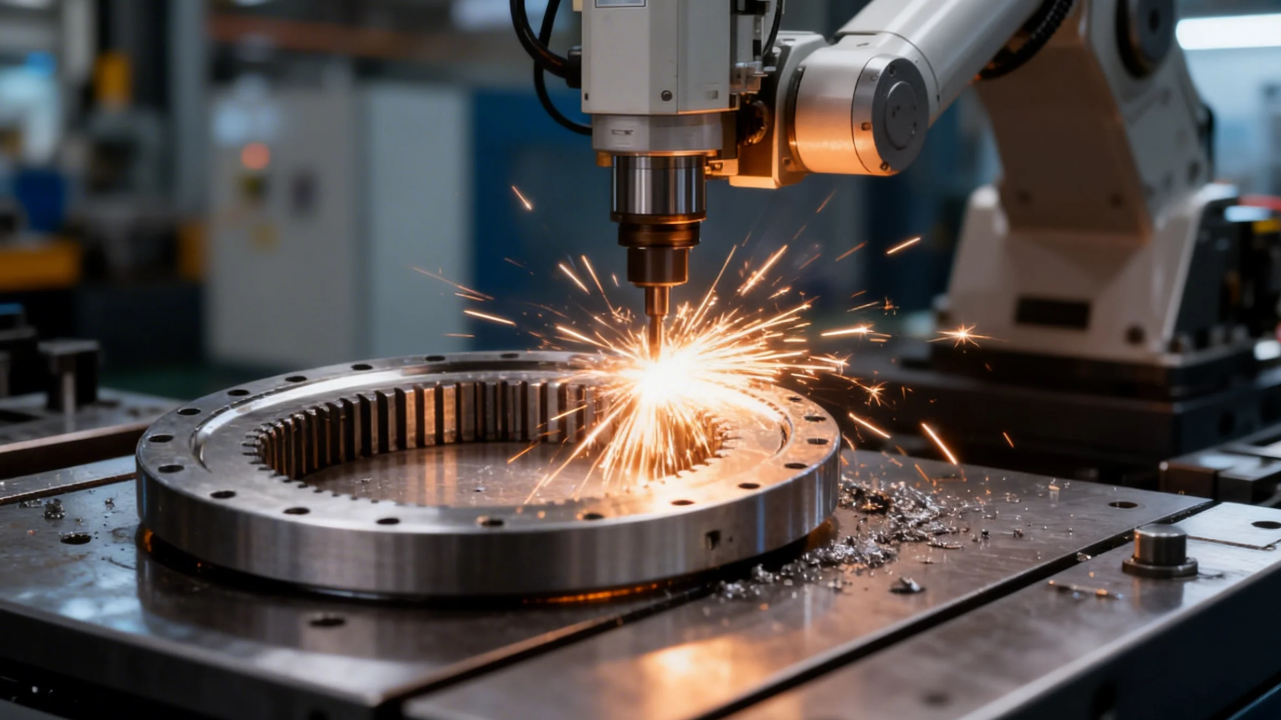
How Are Slewing Bearings Manufactured?
What is a Slewing Bearing?
A slewing bearing is a rotational rolling-element bearing that typically consists of an inner ring and an outer ring, one of which usually incorporates a gear. Unlike standard small bearings, slewing bearings are large in diameter and relatively thin in cross-section. They are designed to handle not just one type of force, but complex combinations of tilting moments, radial forces, and axial forces simultaneously.
Components of a Slewing Bearing
Despite their size, the basic components of a slewing bearing are similar to precision rolling bearings. The main structure includes:
• Inner Ring and Outer Ring: Usually made from surface-hardened steel (such as 50Mn or 42CrMo).
• Rolling Elements: Steel balls or cylindrical rollers that carry the load.
• Cage/Spacer: Separates the rolling elements to prevent friction and ensure even spacing.
• Sealing Strips: Protect the internal raceways from dust, water, and debris.
• Mounting Holes: Drilled into the rings for direct connection to equipment.
• Lubrication Fittings: Grease nipples and oil channels for maintenance.
How Does a Slewing Bearing Work?
A slewing bearing works by facilitating low-speed, high-torque rotation. The inner ring is typically bolted to a fixed structure (like a vehicle chassis), while the outer ring (often with teeth) is bolted to the rotating part (like a crane arm). As the rolling elements travel along the hardened raceways, they distribute heavy loads evenly, allowing the heavy top structure to rotate smoothly and precisely.
Slewing Bearings Applications
Due to their unique load-bearing capacity, slewing bearings are essential in various industries:
•Construction Machinery: Excavators, tower cranes, and concrete pumps.
• Renewable Energy: Wind turbine blade pitch and yaw systems, solar tracker drives.
• Medical Equipment: CT scanners and radiotherapy machines requiring silent, precise rotation.
• Port & Marine: Ship cranes, unloaders, and offshore platform equipment.
• Industrial Robotics: Positioning tables and welding rotators.
How Are Slewing Bearings Manufactured?
The manufacturing of a slewing bearing is a complex marriage of metallurgy and precision machining. Unlike standard bearings that are batch-produced, large slewing rings often undergo strict individual process control. Below are the detailed steps involved in creating a high-performance slewing bearing.
5.1 Raw Material Preparation & Cutting
The journey begins with raw steel. While small bearings often use through-hardened chromium steel, slewing bearing rings are typically made from surface-hardened steel, most commonly 50Mn or 42CrMo. Other materials such as S48C and 5CrMnMo are also used depending on specific application requirements. These materials offer excellent toughness in the core and high wear resistance on the surface after treatment.
Steel bars or billets are first cut to specific lengths using carbide saw blades. These blades are chosen for their extreme hardness and heat resistance, ensuring clean cuts without introducing micro-cracks into the material. Carbide saw blades possess excellent properties including high hardness, wear resistance, strength, toughness, heat resistance, and corrosion resistance.
5.2 Forging and Ring Rolling
The cut billet is heated in a forging furnace until it is malleable. It is then pressed into a rough round cake shape. This initial forging is critical—it forms the bearing ring blank and compacts the internal grain structure of the steel. The organization structure of the raw materials becomes denser and the flow linearity becomes better, which can significantly improve the reliability and service life of the bearing.
Following this, the cake is pierced and rolled on a ring rolling machine to form a ring-shaped steel ring. This process expands the diameter to the specified size and further enhances the internal structure of the steel, improving its strength, plasticity, impact toughness, and other mechanical properties. It is important to note that the quality of the forging process directly affects raw material utilization rates and consequently impacts production costs.
5.3 Rough Turning (Machining)
The forged ring is mounted on a machine tool for rough turning. During this stage, operators remove the black skin (scale) from the forging and machine the basic geometric shape. The critical raceway grooves—the tracks on which the balls or rollers will run—are turned out at this stage. The main purpose is to make the shape of the ferrule after the final product the same, creating conditions for later grinding machine processing.
If the bearing includes a gear (external or internal), the ring is fixed on a gear milling machine to cut the teeth at this rough stage.
5.4 Heat Treatment (Quenching & Tempering)
This is the heart of the manufacturing process. The machined ring undergoes heat treatment to achieve the required hardness. Through quenching operation, the strength and hardness of the steel are significantly improved, enhancing the wear resistance, fatigue strength, and toughness of the metal.
Using induction hardening or flame hardening techniques, the raceway surface and gear teeth (if applicable) are heated rapidly and then immediately quenched (cooled with water or polymer). This creates a hard, wear-resistant martensitic layer on the surface while leaving the core of the ring tough and ductile to absorb shock loads.
The heat treatment process directly affects the uniformity of carburization in the bearing ring. Proper heat treatment is vital; if done incorrectly, it can lead to distortion or cracking. After quenching, the ring is tempered to relieve internal stresses and stabilize the metallurgical structure. This step is crucial for bearing reliability and service life.
5.5 Hole Processing (Drilling & Tapping)
Once hardened, the ring is prepared for mounting. Slewing bearings do not use press fits; they are bolted directly to structures. Therefore, high-precision mounting holes are drilled into the end faces of both the inner and outer rings.
When drilling the mounting holes, operators must carefully determine the center and cutting angle. Various equipment can be used including drilling machines, hand-held electric drills, and hand drills. Using CNC drilling machines or radial arm drills, operators drill and then tap threads (or countersink plain holes) according to the blueprint. Precision at this stage ensures that the bearing aligns perfectly with the mating structure in the field.
5.6 Fine Grinding (Hard Turning)
Heat treatment often causes slight deformation. To restore precision, the ring undergoes finishing. This process trims and refines the fine parts of the roughly formed bearing after hole processing to ensure the refinement of the appearance.
Instead of traditional abrasive grinding, modern slewing bearing manufacturing often utilizes hard turning with CBN (Cubic Boron Nitride) tools. The raceways are precisely cut to their final dimensions with mirror-like surface finishes. The raceway surface of the steel ring is finished once again to modify any deformation caused by previous processes. This step directly determines the rotational flexibility, running noise, surface precision, and load distribution accuracy of the bearing.
5.7 Assembly
With all components finished and inspected, assembly begins. The parts including outer ring, inner ring, rolling elements, and cage that have been processed through various stages are assembled together. The process typically involves:
Placing the cage segments into the outer ring.
Inserting the rolling elements (steel balls or rollers) through a specific loading hole or inserting spacer blocks.
Attaching the inner ring.
Filling the bearing with the calculated amount of butter/grease and inserting sealing strips.
Assembling a complete set of finished bearings according to different technical and precision requirements.
5.8 Testing & Packaging
Every finished bearing undergoes rigorous inspection. The factory inspector performs sampling and inspection of qualified products. Critical checks include running torque tests to ensure smooth rotation, gear runout inspection to verify tooth contact and precision, axial and radial runout confirmation, sealing integrity checks, and noise/vibration detection.
After passing inspection, the finished bearing is coated with a heavy-duty anti-rust oil to prevent corrosion. It is then carefully packaged and wrapped for shipment. Qualified products are issued with a certificate of conformity before being released for sale.
Summary of Manufacturing Process Flow:
| Step | Process Name | Key Objective | Critical Quality Control |
|---|---|---|---|
| 1 | Material Cutting | Precise billet sizing | Crack-free cutting, dimension accuracy |
| 2 | Forging & Ring Rolling | Grain flow optimization, blank forming | Proper fiber flow, no forging defects |
| 3 | Rough Turning | Basic shape & raceway forming | Raceway geometry, concentricity |
| 4 | Heat Treatment | Surface hardness achievement | Hardness depth, minimal distortion, carburization uniformity |
| 5 | Hole Processing | Mounting feature creation | Hole position accuracy, thread quality |
| 6 | Fine Grinding/Hard Turning | Final raceway precision | Surface finish, dimensional tolerance |
| 7 | Assembly | Component integration | Cleanliness, grease volume, seal fit |
| 8 | Testing & Packaging | Quality verification | All test parameters within spec |
Customize High-quality Slewing Bearings at LyraDrive
At LyraDrive, we are a specialized manufacturer dedicated to the production of high-performance slew drives and slewing bearings. While our slew bearings integrate the bearing, housing, and worm gear into a single sealed unit, our slewing bearing division focuses on delivering precision-engineered rings that meet the most demanding industrial applications.
Our slewing bearing product line is designed to cover the full spectrum of industrial demand. We offer:
Single Row Slewing Ring Ball Bearings: The economical, versatile choice for standard applications.
Double Row Ball Slewing Ring Bearings: Increased stability and load sharing for medium-duty cycles.
Crossed Roller Slewing Bearings: High rigidity and precision in a compact profile.
Three-row Roller Slewing Bearings: Maximum load capacity for the most demanding heavy-lift applications.
Our Customization Capabilities
Drawing from the robust manufacturing principles outlined in Section 5—specifically our expertise in 50Mn and 42CrMo material selection, optimized forging flow lines, and precise induction hardening—LyraDrive offers tailored solutions across multiple parameters:
Dimensions and Load Capacity: We can modify outer diameter, inner diameter, cross-section, and raceway diameter to fit your spatial constraints while adjusting load capacity through reinforced raceways or additional rolling elements.
Gear Options: Custom-cut internal or external teeth are available, with full or partial segments, in various modules to match your specific rotation ratio requirements.
Material and Coating: Beyond standard 50Mn and 42CrMo, we offer special alloys for high-temperature environments and specialized anti-corrosion coatings for marine or chemical plant applications.
Sealing and Lubrication: From standard labyrinth seals to heavy-duty rubber seals and triple-lip designs, we customize sealing systems for your operating environment. Lubrication options include standard grease, food-grade grease, high-temperature grease, and central lubrication port integration.
Accessories: We can integrate custom mounting bolts, lifting holes, proximity sensor slots, and other accessories to provide turnkey solutions for smart machinery integration.
Whether you need a single custom prototype or a high-volume production run, our engineering team works directly with you to ensure the bearing design integrates seamlessly with your machinery. We handle every stage in-house—from material selection and forging through heat treatment, precision machining, and final assembly—ensuring complete quality control and traceability.
FAQ on Slewing Bearing Manufacturing
Q1: What is the typical lead time for a custom slewing bearing?
A: Lead time varies based on complexity and size. Typically, a custom forged bearing can take 8–16 weeks from design approval to shipment, depending on heat treatment and gear cutting schedules.
Q2: How do you prevent distortion during heat treatment?
A: We use specialized induction hardening fixtures and controlled quenching rates. Additionally, we allow for stock removal during the hard turning phase to correct any minor geometric changes caused by quenching.
Q3: What is the difference between a slewing bearing and a standard bearing?
A: Slewing bearings are large, slow-rotating, and specifically designed to handle moment (tilting) loads. They feature integrated mounting holes and often include gear teeth, whereas standard bearings are usually press-fit into housings.
Q4: Can a damaged raceway be repaired?
A: Minor surface damage can sometimes be re-ground or hard-turned oversize, requiring matching oversized rolling elements. However, severe cracking or brinelling usually necessitates replacement, as the hardened case depth may be compromised.
Q5: Why is 50Mn steel commonly used for slewing bearings?
A: 50Mn offers excellent hardenability and wear resistance after induction hardening at a reasonable cost. It provides the necessary surface hardness to resist indentation from rolling elements while maintaining a tough, ductile core.
Q6: What is the typical service life of a slewing bearing?
A: With proper installation, lubrication, and maintenance, a quality slewing bearing can last 10-20 years or more in normal duty cycles. Heavy-duty continuous operation applications may require inspection and potential replacement sooner.
Q7: How often should slewing bearings be lubricated?
A: Lubrication intervals depend on duty cycle, environment, and operating hours. Typical recommendations range from every 100 hours for severe service to every 500 hours for normal operation.
Q8: What causes slewing bearing noise during operation?
A: Noise can indicate contamination in the raceways, inadequate lubrication, raceway surface damage, or foreign material ingress. Regular maintenance and proper sealing are essential for quiet operation.
8. Conclusion
Manufacturing a slewing bearing is a sophisticated process that transforms raw steel into a precision component capable of moving thousands of tons. From the initial forging that aligns the grain structure and improves material density, to the delicate art of induction hardening and the micron-level accuracy of raceway grinding, every step demands expertise, precision, and rigorous quality control. The selection of appropriate materials, careful heat treatment, and meticulous assembly all contribute to the final performance and reliability of the bearing.
At LyraDrive, we combine this traditional craftsmanship with modern CNC technology and metallurgical science to deliver slewing bearings that offer exceptional longevity, operational safety, and smooth performance. Our comprehensive range—from single row ball bearings to heavy-duty three-row roller designs—ensures that we can match the exact requirements of any rotating application.
We invite you to explore how our custom engineering capabilities can solve your unique motion control challenges. Whether you require a standard configuration or a fully customized solution with specific materials, gear cuts, or accessory integration, our team is ready to engineer a slewing bearing that fits your exact world and performs flawlessly within it.
Contact LyraDrive today to discuss your slewing bearing requirements with our engineering team.
 WhatsApp
 sales@lyradrive.com
 +8613903880726