



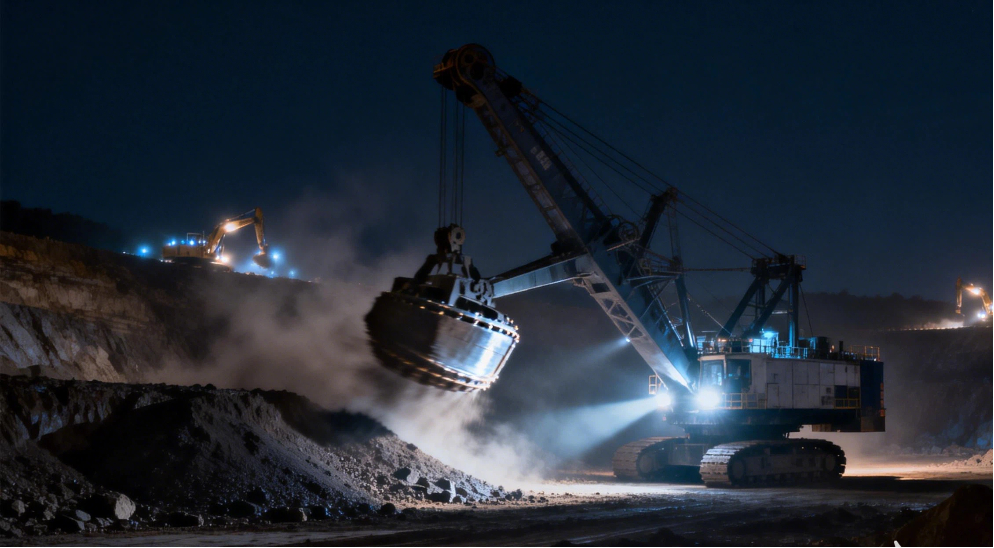
Heavy-Duty Slewing Ring for Mining Machines
What Are the Key Requirements for Slewing Rings in Extreme Mining Conditions?
Mining machines, such as hydraulic shovels, bucket wheel excavators, and rotary drills, operate in extremely harsh and heavy-load conditions—constant exposure to dust, rock fragments, variable temperatures, and extreme torque. At the core of these machines’ rotational systems lies the heavy-duty slewing ring, a critical component that enables 360-degree rotation of working mechanisms (e.g., shovel booms, drill heads) while bearing massive axial, radial, and overturning loads. Unlike slewing rings for general construction equipment, those for mining must withstand higher stress, stronger corrosion, and longer continuous operation. This article clarifies the application characteristics of heavy-duty slewing rings in mining machines and provides a detailed selection guide, supported by practical data and industry standards.
Application Characteristics of Heavy-Duty Slewing Rings in Mining Machines
Mining-specific working conditions impose unique requirements on slewing rings, distinguishing them from those used in other fields. The key characteristics are as follows:
1. Ultra-High Load-Bearing Capacity
Mining machines handle enormous loads daily. A 100-ton hydraulic shovel, for instance, generates a peak overturning moment of 8,000–12,000 kN·m during digging, while the axial load from the upper structure and working mechanism can exceed 5,000 kN. Heavy-duty slewing rings for mining must therefore have exceptional static and dynamic load capacities—their rated static capacity (C0) is usually above 20,000 kN, and rated dynamic capacity (C) exceeds 10,000 kN, which is 3–5 times higher than that of construction equipment slewing rings.
2. Resistance to Harsh Environmental Erosion
Underground and open-pit mines are filled with dust, abrasive particles, and corrosive substances (e.g., acidic water, mineral salts). These contaminants easily infiltrate slewing rings, causing premature wear and failure. Additionally, open-pit mines face extreme temperature fluctuations (-30℃ in cold regions to 60℃ in hot areas), which test the material stability of slewing rings. High-quality mining slewing rings typically adopt multi-layer sealing structures and corrosion-resistant materials to cope with these challenges.
3. Long Service Life and Low Maintenance Demand
Mining operations are usually continuous (24/7 shifts) to maximize productivity, and equipment downtime can result in losses of tens of thousands of dollars per hour. Heavy-duty slewing rings for mining must have a fatigue life of at least 20,000 working hours, and their design should minimize maintenance frequency. Unlike construction equipment that requires grease replenishment every 25–50 hours, mining slewing rings with advanced lubrication systems can extend lubrication intervals to 200–300 working hours.
4. Strong Impact Resistance
Mining machines often encounter unexpected impacts, such as hard rock collisions during digging or loading. These impacts generate instantaneous shock loads that are 1.5–2 times the normal working load. Slewing rings must be structurally robust to resist such impacts without cracking or deformation—this relies on optimized roller/ball arrangement and high-toughness materials.
How to Select Heavy‑Duty Slewing Rings for Extreme Mining Applications?
Selecting the right heavy-duty slewing ring requires a systematic analysis of load characteristics, environmental conditions, machine types, and performance parameters. The following steps provide a comprehensive guide:
1. Accurately Calculate Loads and Determine Safety Factors
Load calculation is the foundation of selection. Mining machines bear complex combined loads, so it is necessary to use FEA (Finite Element Analysis) to simulate actual working conditions and calculate equivalent static/dynamic loads. The safety factor (fs) for mining slewing rings must be higher than that for construction equipment due to harsh conditions:
Open-pit mining machines (e.g., bucket wheel excavators): fs = 1.6–1.8
Underground mining machines (e.g., roadheaders): fs = 1.8–2.0
High-impact equipment (e.g., hydraulic breakers): fs = 2.0–2.2
For example, a 150-ton hydraulic shovel requires a slewing ring with C0 ≥ 25,000 kN and C ≥ 12,000 kN to ensure safety under peak loads, with the equivalent dynamic load controlled below C/fs.
2. Select the Appropriate Structural Type
The structural type of slewing rings directly affects their load-bearing capacity and adaptability to mining conditions. Three main types are commonly used:
Three-Row Roller Slewing Ring
This type has three rows of rollers (one radial and two axial), which separate axial, radial, and moment loads independently. It is the first choice for ultra-heavy-load mining machines, such as 100-ton+ hydraulic shovels and large bucket wheel excavators. It can withstand overturning moments up to 20,000 kN·m and axial loads over 15,000 kN, with excellent impact resistance. However, it is heavier and has higher manufacturing costs.
Crossed Roller Slewing Ring
Rollers are arranged crosswise at 90 degrees, offering high rigidity and precision. It is suitable for medium-heavy mining machines with high positioning accuracy requirements, such as rotary drills and underground roadheaders. Its radial load capacity is 4–5 times that of ball-type slewing rings, and the maximum static capacity can reach 18,000 kN. It is lighter than three-row roller types, making it ideal for underground equipment with weight restrictions.
Double-Row Tapered Roller Slewing Ring
Tapered rollers provide strong axial and moment load-bearing capacity, with good wear resistance. It is used in medium-load mining machines, such as small hydraulic shovels (50–80 tons) and load-haul-dump (LHD) machines. The rated overturning moment ranges from 5,000–10,000 kN·m, balancing performance and cost.
3. Optimize Material and Heat Treatment
Material selection is crucial for withstanding heavy loads and corrosion. The raceway and rollers of mining slewing rings are typically made of high-strength alloy steel 42CrMo, which has a tensile strength of 1,080–1,250 MPa and yield strength of ≥ 930 MPa. After quenching and tempering, the surface hardness is controlled at HRC 58–62 to improve wear resistance, while the core remains tough to resist impacts.
For corrosive mining environments (e.g., coastal or acidic mines), the slewing ring surface can be treated with galvanizing or chrome plating, which increases corrosion resistance by 3–4 times. Some high-end products adopt stainless steel raceways (316L) to withstand salt spray corrosion for over 1,000 hours.
4. Enhance Sealing and Lubrication Systems
A reliable sealing system prevents dust and water intrusion. Mining slewing rings should adopt a combination seal structure of labyrinth seal + rubber seal + metal baffle. This multi-layer design reduces dust intrusion rate to less than 0.1%, far better than single-layer seals. The sealing material should be nitrile rubber (NBR) or fluororubber (FKM), which can withstand extreme temperatures and chemical corrosion.
Lubrication must adapt to continuous operation. Lithium-based grease with high viscosity (ISO VG 460) is recommended for mining, with a dropping point of ≥ 220℃ and good adhesion. Automatic lubrication systems are preferred, which periodically inject grease according to working hours, reducing manual maintenance and ensuring uniform lubrication. For low-temperature environments (-30℃), low-temperature grease (ISO VG 220) should be used to avoid solidification.
5. Verify Manufacturer Qualifications and Testing Standards
Mining slewing rings require strict quality control, so manufacturers must have ISO 9001 and API 610 certifications. Reputable manufacturers conduct rigorous tests, including load test, fatigue test, and sealing test. The fatigue test should simulate 20,000 working hours of continuous operation to ensure no cracks or deformation. Additionally, manufacturers should provide on-site maintenance guidance and quick spare parts supply to minimize downtime.
Conclusion
Heavy-duty slewing rings are the "rotational heart" of mining machines, and their performance directly determines operational safety and efficiency. Selecting the right product requires integrating load calculation, structural type, material treatment, sealing lubrication, and manufacturer qualifications. By following the above guide and prioritizing durability, impact resistance, and corrosion resistance, mining enterprises can reduce equipment failure rates by 30–40% and extend slewing ring service life. In the competitive mining industry, a well-selected heavy-duty slewing ring is not just a component investment, but a guarantee for stable and efficient production.
Our Advantage: Professional One-Stop Slewing Device Manufacturer
Luoyang Lyra Drive Slewing Bearing Co., Ltd. (Lyra Drive) is a professional one-stop slewing device manufacturer, focusing on the R&D, customized production, sales and service of slewing bearings and slewing drives. It provides high-quality products tailored to the needs of the mining industry. With over 15 years of in-depth experience in the design, manufacturing and application of slewing drives, slewing bearings and worm gear drives, the team specializes in developing and producing core products such as SE series slewing drives, WE series slewing drives, SP series gear-type slewing drives, as well as single-row ball, double-row ball and three-row cylindrical roller slewing bearings.
Relying on profound industry accumulation and exquisite technology, it accurately matches the harsh and heavy-load operating characteristics of mining machinery, providing reliable core component solutions for the industry.
For any professional matters concerning mining machinery, please feel free to contact us at your convenience. Our team will strive to provide you with the most professional and optimized solutions.
 WhatsApp
 sales@lyradrive.com
 +8613903880726