



How to Choose the Right Slewing Bearing for Construction Equipment?
What Is Slew Bearing?
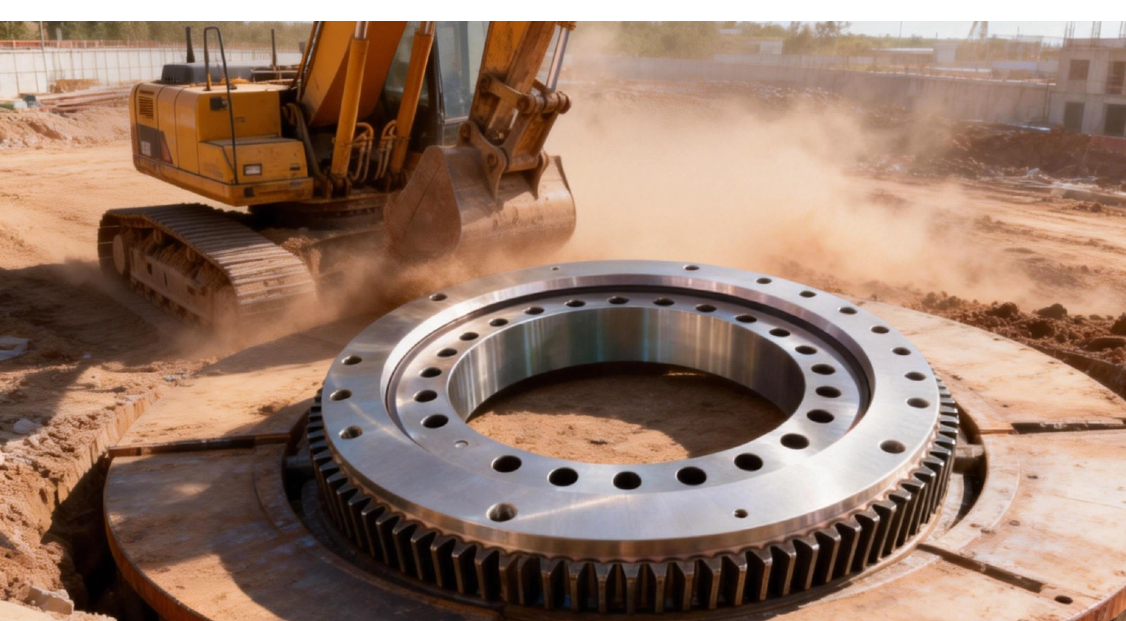
A slewing bearing is a core mechanical component that enables rotational movement between two structures in construction equipment, such as cranes, excavators, and concrete pumps. It bears axial, radial, and moment loads simultaneously, directly affecting the equipment’s stability, safety, and service life. Choosing the right slewing bearin is not just about matching dimensions—it requires a comprehensive analysis of working conditions, load characteristics, and environmental factors. This article breaks down the key steps and considerations with practical data to guide informed decisins.
Analyze Load Types and Magnitudes
Load is te primary factor determining slewing bearing selection. Construction equipment typically faces three types of loads: axial loads (vertical weight), radial loads (horizontal stress), and overturning moments (torque from off-center loads). Accurate load calculation, supported by simulation tools like FEA (Finite Element Analysis), is essental.
Different equipment has distinct load demands. For example, tower cranes mainly bearaxial loads from lifted weights, while excavators endure strong overturning moments during digging. The selection must also consider safety factors (fs), which vary by equipment working type:
Light-duty (e.g., stackers): fs = 1.00–1.15
Medium-duty (e.g., tower cranes): fs = 1.15–1.30
Heavy-duty (e.g., excavators): fs = 1.30–1.45
Extra-heavy duty (e.g., tunnel boring machines): fs = 1.45–1.70
Rated static capacity (C0) and dynamic capacity (C) are critical parameters provided by manufacturers. For static working conditions (rotational speed < 10 rpm, e.g., concrete pumps), the actual load must be ≤ C0 / fs. For dynamic conditions (rotational speed > 10 rpm, e.g., excavator upper structure), calculate the equivalent dynamic load and ensure it does not exceed C. For instance, a 20-ton excavator usually requires a slewing bearing with C0 ≥ 800 kN and C ≥ 450 kN to handle peak overturning moments of 350–400 kN·m.
Match Rotational Speed and Precision Requirements
Construction equipment operates at varying rotational speeds, which influence bearing material selection and lubrication design. Most equipment (excavators, cranes) has low rotational speeds (0.5–15 rpm), while some special equipment like aerial work platforms may reach 20–30 rpm. High-speed operation generates more heat and friction, requiring bearings with high wear resistance.
Precision grade is another key factor. For equipment requiring precise positioning, such as tower cranes and concrete placing booms, choose slewing bearings with precision grades P5 or P4. These grades control radial runout within 0.02–0.05 mm, ensuring stable load distribution. For general equipment like loaders, P6 or P7 grades are sufficient, with radial runout of 0.05–0.10 mm, balancing cost and performance.
Select the Appropriate Structural Type
Slewing bearings for construction equipment mainly have four structural types, each with unique advantages for specific scenarios:
1. Single-Row Ball Slewing Bearing
It has a simple structure, light weight, and low cost, suitable for light to medium loads. For example, small excavators (5–10 tons) and stackers often use this type. Its axial load capacity is 2–3 times the radial load capacity, with a maximum dynamic capacity of 500 kN.
2. Double-Row Ball Slewing Bearing
With two rows of balls, it bears axial, radial loads, and overturning moments simultaneously. It is widely used in medium-duty equipment like tower cranes and 15–30 ton excavators. The rated overturning moment can reach 1500–3000 kN·m, which is 1.5–2 times that of single-row ball bearings.
3. Crossed Roller Slewing Bearing
Rollers are arranged crosswise, offering high rigidity and precision. It is ideal for heavy-duty equipment with high precision requirements, such as tunnel boring machines and large cranes. Its radial load capacity is 3–4 times that of ball bearings, and the maximum static capacity can exceed 5000 kN.
4. Three-Row Roller Slewing Bearing
It has three rows of rollers (one radial and two axial), designed for extra-heavy loads. Used in large excavators (≥50 tons) and port cranes, it can withstand overturning moments up to 10,000 kN·m and axial loads over 8000 kN, but it is heavier and more expensive.
Consider Environmental Working Conditions
Construction sites are often harsh, so environmental factors directly affect bearing durability.
For high-dust environments (e.g., demolition sites), choose bearings with labyrinth seals and grease injection systems. Labyrinth seals can reduce dust intrusion by 80% compared to ordinary seals. For humid or marine environments, use stainless steel or galvanized bearings with corrosion resistance—304 stainless steel bearings can resist salt spray corrosion for more than 500 hours.
Temperature is another factor. For low-temperature areas (-20℃ to -40℃), select low-temperature grease (viscosity grade 220) to avoid grease solidification. For high-temperature environments (≥60℃), use heat-resistant materials like 42CrMo steel, which maintains mechanical properties at temperatures up to 120℃.
Optimize Lubrication and Sealing
Proper lubrication reduces friction and wear, extending bearing life. The lubrication frequency depends on working hours: for heavy-duty equipment, grease should be replenished every 25–50 working hours; for light-duty equipment, every 100–150 working hours. Lithium-based grease is the most commonly used, with a dropping point of 180–200℃ and good water resistance.
Sealing performance prevents contamination and grease leakage. Combination seals (rubber + metal) are recommended for harsh conditions, as they have a leakage rate of less than 0.5% compared to single rubber seals (leakage rate 3–5%).
Verify Manufacturer Qualifications and After-Sales Service
Choose manufacturers with ISO 9001 certification and rich experience in construction equipment. Reputable manufacturers provide detailed load test reports—for example, the bearing’s fatigue life should be ≥ 10,000 working hours for medium-duty equipment. After-sales service is also important: timely maintenance guidance and spare parts supply can reduce downtime by 30%.
Conclusion
Selecting the right slewing bearing requires integrating load analysis, speed precision, structural type, environmental adaptability, and lubrication sealing. By following the steps above and using data to support decisions, you can ensure the bearing matches the equipment’s working conditions, improving operational safety and reducing maintenance costs. Remember, a reasonable selection is more cost-effective than replacing bearings frequently—investing in the right slewing bearing can increase equipment service life by 20–30%.
Slewing Bearing Manufacturer
Luoyang Slewring Bearing Co., Ltd. (Lyra Drive)is a professional one-stop slewing drives and slewing bearings manufacturer majored in design and development, customized production, sales and service on slewing bearings and slewing drives. The lyra drive team has been deeply involved in the design, manufacturing and application of slewing drives, slewing bearings .
Our products are widely used in industrial automation slewing, medical equipment, storage equipment, engineering machinery and other fields.Let us help you achieve seamless and reliable rotation in your projects.
 WhatsApp
 sales@lyradrive.com
 +8613903880726