



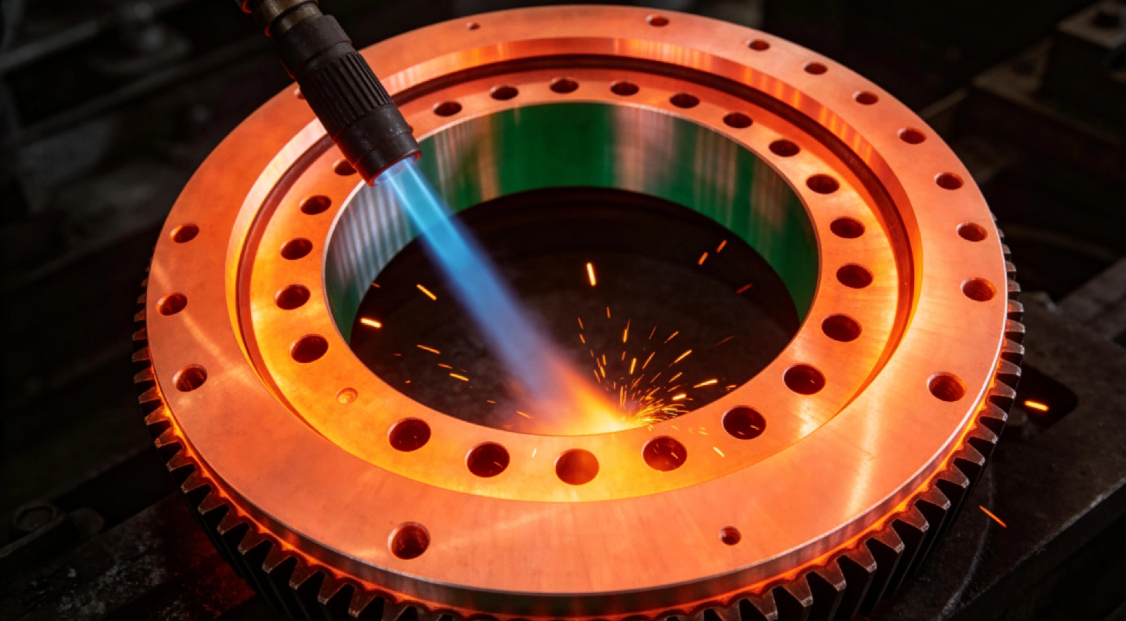
Heat Treatment for the Slewing Bearing
What is Slewing Bearing?
A slewing bearing, often called a "slewing ring," is not a typical bearing. It's a large-scale, precision bearing that can handle immense loads from multiple directions—axial, radial, and tilting moment loads—simultaneously. It enables slow-rotation or oscillating movement between two critical structures, like a crane's upper deck and its undercarriage or a wind turbine's nacelle and tower.
How Does a Slewing Bearing Work?
Think of it as the robust "joint" at the heart of heavy machinery. Its fundamental job is to support heavy loads while enabling smooth, controlled rotation. It typically consists of an inner ring and an outer ring (one often with gear teeth), rolling elements (balls or cylindrical rollers), and seals. This design allows for compact, efficient power transmission, replacing complex systems of multiple conventional bearings. Application scenarios are everywhere heavy lifting and precise rotation are needed: excavators, wind turbines, medical scanners, and radar antennas.
Key Characteristics of Slewing Bearings
Their performance is defined by exceptional Load Capacity, the ability to handle combined forces. Precision ensures smooth, predictable rotation. Rigidity minimizes deformation under heavy loads, maintaining alignment and gear mesh accuracy. Durability and reliability in harsh environments are paramount.
The Central Role of Heat Treatment
Why is Heat Treatment Critical for Slewing Bearing Performance?
The raw forged steel of a slewing bearing is strong but not yet ready for its demanding life. Heat treatment is the transformative process that gives it the "superpowers" needed for longevity. It is the cornerstone of performance, directly linking wear resistance, contact fatigue strength, and ultimate service life. By altering the steel's internal structure, it hardens critical contact surfaces like raceways and gear teeth to resist wear and surface pitting. Crucially, it also enhances gear tooth hardness and toughness, allowing them to withstand heavy, repetitive shock loads without cracking. Without proper heat treatment, a slewing bearing would fail prematurely.
Fundamentals of Material and Process
Material Selection and Its Interaction with Heat Treatment
The choice of steel dictates the heat treatment path. Common high-strength alloy steels include 42CrMo and 50Mn. 42CrMo, with its alloying elements, is ideal for carburizing—a process that infuses carbon into its surface, creating an extremely hard, wear-resistant exterior while maintaining a tough, shock-absorbing core. 50Mn is often used for quenching and tempering (through hardening), which provides uniform high strength and hardness throughout the material. The material chemistry fundamentally determines which heat treatment method will unlock its optimal properties.
Detailed Heat Treatment Process
Common Heat Treatment Methods for Slewing Bearings: An Overview
Selecting the right heat treatment method is a strategic decision that balances performance requirements, material properties, and cost. Here’s a closer look at the most common techniques
Surface Hardening (Induction Hardening): This method uses an alternating electromagnetic field to generate heat only in a precisely defined area of the component, such as the gear teeth or a specific section of the raceway. It is a fast, energy-efficient process that minimizes distortion because the bulk of the part remains cool. After rapid localized heating, the area is immediately quenched, resulting in a hardened surface layer while preserving the original, tougher core material in the non-heated zones. This is ideal for components where wear resistance is needed only on specific functional surfaces.
Through Hardening (Quenching & Tempering): In this process, the entire slewing bearing ring is uniformly heated to a high temperature (austenitizing temperature) and then rapidly cooled (quenched) in oil or another medium. This creates a very hard but brittle microstructure throughout the component. To reduce brittleness and relieve internal stresses, the part is then tempered—reheated to a lower temperature and held for a specified time. The result is a uniform, high level of hardness and strength across the entire cross-section of the material. Steels like 50Mn are well-suited for this method, which provides excellent overall load capacity but may not offer the same extreme surface wear resistance as case hardening for the heaviest applications.
Carburizing (Case Hardening): This is a thermochemical process and is often considered the gold standard for high-performance, heavily loaded slewing bearings. The component is heated in a carbon-rich atmosphere (gas carburizing) for an extended period, allowing carbon atoms to diffuse into the surface layer of the steel (typically 1-5 mm deep). After this "carburizing" phase, the part is quenched and tempered. The outcome is a sophisticated gradient: an extremely hard, wear-resistant "case" on the surface, seamlessly transitioning to a tough, ductile, and shock-absorbing core. This dual-property structure makes carburizing exceptionally valuable for raceways subjected to rolling contact fatigue and for gear teeth that must withstand high bending and impact loads. Alloy steels like 42CrMo are commonly used for this process.
How is Heat Treatment Performed on Slewing Bearings?
The execution of heat treatment, especially for large slewing bearings, is a precise and multi-stage science. Here is a detailed breakdown of the key stages:
1. Pre-cleaning & Preparation: Components are thoroughly cleaned to remove any grease, oil, or contaminants that could cause uneven heating or surface defects during treatment.
2. Heating: The bearing ring is slowly and uniformly heated in a computer-controlled furnace to a precise target temperature. The heating rate is critical; too fast can cause thermal stress and distortion, especially in large, asymmetric parts. For carburizing, temperatures typically range between 880°C to 950°C.
3. Soaking/Diffusion: This is the "hold" phase. The component is maintained at the target temperature to ensure the entire cross-section reaches a uniform temperature and microstructure (austenite). In carburizing, this is when the crucial carbon diffusion occurs. The soaking time can range from several hours for smaller bearings to multiple days for large-diameter rings, directly controlling the depth of the hardened case.
4. Cooling (Quenching): The component is rapidly transferred from the furnace to a quench tank (containing oil, polymer, or sometimes water). This rapid cooling transforms the austenitic structure at the surface into a very hard phase called martensite. The quenching medium and agitation are carefully controlled to achieve maximum hardness while minimizing the risk of quench cracks or excessive distortion.
5. Tempering: Immediately after quenching, the part is very hard but also highly stressed and brittle. Tempering reheats it to a much lower temperature (typically 150°C - 250°C for carburized parts, higher for through-hardened) for several hours. This vital step relieves internal stresses, increases toughness and ductility, and stabilizes the microstructure, providing the final, optimal balance of hardness and toughness.
6. Post-Treatment Cleaning & Stress Relieving: After tempering, parts are cleaned. Sometimes an additional low-temperature stress-relief treatment is performed, particularly for very large or complex geometries, to ensure dimensional stability before final machining.
Specific Component Focus:
For Raceways: The primary goal is to achieve a deep, uniformly hard case (via carburizing) to resist sub-surface shear stresses that cause pitting and spalling. The hardness profile from the surface to the core is meticulously controlled.
For Gear Teeth: The focus is on achieving high surface hardness on the flanks for wear resistance, combined with sufficient core toughness at the tooth root to prevent cracking under bending loads. This often requires precise control of the carburizing atmosphere and pattern, or the use of specialized induction hardening gear-by-gear.
What Should Be Noted During the Heating Process?
Successful heat treatment depends on mastering these practical considerations:
Temperature Uniformity Control: Modern furnaces use multiple, independently controlled heating zones and sophisticated airflow systems to ensure the entire massive ring heats evenly. A temperature differential of more than a few degrees can lead to uneven transformation and subsequent distortion.
Preventing Distortion: Distortion is the enemy of precision bearings. It is managed through a combination of: Proper Fixturing (sometimes using special racks or supports during heating/quenching), Controlled Heating & Cooling Rates, and Symmetrical Part Design. The residual stresses from prior forging and machining must also be managed.
Preventing Oxidation and Decarburization: Exposure to air at high temperatures causes scaling (oxidation) and loss of surface carbon (decarburization), which ruins the hardened layer. This is prevented by using Protective Atmosphere Furnaces (with inert or carbon-rich gases) or Vacuum Furnaces. These technologies keep the surface chemistry pristine throughout the process.
Quality Assurance and Performance Verification
Quality Control and Testing After Heat Treatment
Every batch undergoes rigorous verification:
Hardness Testing: Surface and core hardness are measured to confirm they meet specifications.
Metallographic Analysis: A sample is examined under a microscope to verify the depth of the hardened case, the microstructure (e.g., martensite), and ensure no defects.
Non-Destructive Testing (NDT): Ultrasonic Testing checks for internal flaws. Magnetic Particle Inspection reveals surface cracks that could lead to failure.
The Value of Heat Treatment and FAQs
The Impact of Heat Treatment on Service Life and Failure Prevention
Proper heat treatment is the primary defense against early failures. It dramatically reduces pitting (contact fatigue) on raceways and wear on gear teeth. By eliminating soft spots and internal stresses, it prevents catastrophic failures like spalling or ring cracking, ensuring the bearing reaches and exceeds its designed lifespan.
FAQ on Slewing Bearing Heat Treatment
Q: Can you re-heat-treat a worn slewing bearing?
A: No. The process is integral to the initial manufacturing. Re-heating would distort the component and is not feasible in the field.Q: How do I know if the heat treatment was done correctly?
A: Rely on the manufacturer's test certificates (for hardness, microstructure). Reputable suppliers perform these tests and provide documentation.Q: What's the difference between hardened raceways and hardened gear teeth?
A: While both aim for high hardness, gear teeth often require a specific hardness profile to balance root toughness with flank hardness, sometimes involving a separate or specialized process.
LyraDrive's Reliable Product and Service
LyraDrive is a manufacturer Can Provide You with High-Performance Slewing drives and slewing Bearings
LyraDrive is a leading supplier of high-quality slew drives and bearings. At LyraDrive, we engineer longevity into every bearing. Our advanced heat treatment technology—utilizing computer-controlled atmosphere furnaces and strict process protocols—ensures optimal microstructure and performance for your specific application. We commit to documented quality at every step, from material certification to final inspection.
Our customization capabilities allow us to tailor the heat treatment profile (case depth, hardness gradient) to your unique load and duty cycle demands. Partner with us for reliable, high-performance slewing bearing solutions backed by proven expertise and unwavering quality commitment.
 WhatsApp
 sales@lyradrive.com
 +8613903880726