



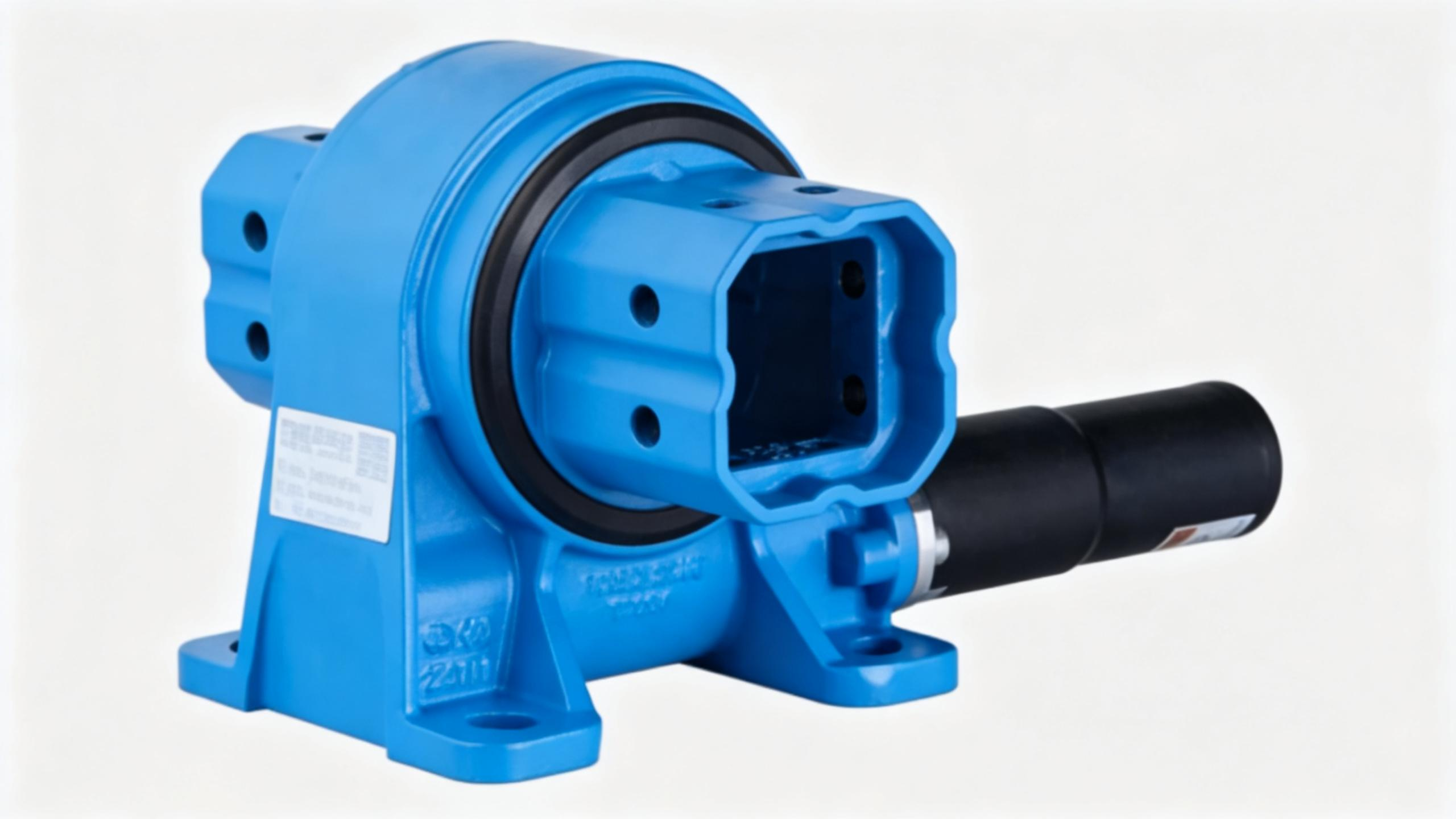
What is Slew Drive Motor?
A slew drive motor is the integrated power unit that combines an electric or hydraulic motor with a precision gear reduction system and a heavy-duty slewing bearing. This compact package is specifically engineered to deliver high-torque, low-speed rotational movement for applications requiring controlled 360-degree rotation under substantial loads. Unlike conventional motors, it functions as a complete motion system component, designed to handle axial forces, radial loads, and tilting moments simultaneously while providing accurate positioning. Slew drive motors form the operational core of equipment ranging from solar trackers to construction machinery.
How Does a Slew Drive Motor Work?
The operation follows a precise mechanical sequence that transforms input power into controlled rotational force:
Power Initiation: A control signal activates the motor, which begins rotating its output shaft at high speed with relatively low torque.
Torque Multiplication: This rotation enters a worm gear system, where reduction ratios typically between 50:1 and 300:1 convert the high-speed input into powerful, slow-rotation output. The gear system multiplies torque by a corresponding factor.
Load Rotation: The amplified torque transfers to the slewing bearing's gear teeth, causing the entire attached structure to rotate smoothly on its axis.
Position Security: The worm gear geometry provides natural self-locking, preventing back-driving and holding the load securely when power stops.
Precision Control: Optional encoders provide position feedback, enabling closed-loop control for applications requiring exact positioning.
The Role of the Slew Drive Motor in a Slewing Drive
The motor serves as the critical power generation component that enables the entire slewing drive system to function:
Primary Power Conversion
Transforms electrical or hydraulic energy into mechanical motion
Provides the initial rotational force that the gear system amplifies
System Performance Foundation
Determines the speed and torque characteristics of the entire drive
Establishes the efficiency baseline for the complete system
Operational Intelligence Hub
Incorporates sensors for position, temperature, and load monitoring
Provides the interface for control systems and safety protocols
Durability Integration
Designed to withstand the same environmental conditions as the complete drive
Engineered for compatibility with the gear system's lubrication and sealing
Types and Characteristics of Motors Used in Slew Drive
| Motor Type | Torque Range | Speed Range | Key Advantages | Typical Applications |
|---|---|---|---|---|
| Hydraulic Motors | 2,000–100,000 Nm | 0–30 RPM | Highest power density, excellent overload capacity, robust construction | Excavators, heavy cranes, offshore equipment |
| AC Electric Motors | 500–20,000 Nm | 0–15 RPM | High reliability, low maintenance, good efficiency (85–95%), compatible with standard power grids | Solar trackers, industrial rotators, conveyor systems |
| DC Brushless Motors | 200–10,000 Nm | 0–50 RPM | Excellent speed control, high positioning accuracy (±0.05°), fast response | Robotic systems, antenna positioning, medical equipment |
Performance Specifications:
Temperature Range: Standard units operate at -20°C to +40°C; specialized units available for -40°C to +85°C
Protection Ratings: IP65 for standard outdoor use, IP67/IP68 for severe environments
Service Life: 20,000-40,000 operating hours with proper maintenance
Efficiency: Modern electric motors achieve 90-96% efficiency; hydraulic systems achieve 80-90%
Application of Slew Drive Motor
Solar Energy Systems
Dual-axis trackers increase energy yield by 35-45% versus fixed systems
Typical requirements: 1,500-8,000 Nm continuous torque, 0.1-1 RPM speed range
Automatic stowing features for storm protection
Construction and Material Handling
Excavators: 5,000-30,000 Nm torque for 360° continuous rotation
Cranes: Precise load positioning with ±0.1° repeatability
Manlifts: Smooth, controlled platform rotation for operator safety
Wind Energy
Yaw drive systems for turbine orientation control
Requirements: 15,000-60,000 Nm torque, extreme weather durability
Predictive maintenance capabilities through condition monitoring
Industrial Automation
Welding positioners with 0.01° positioning accuracy
Assembly line rotators with 10,000+ hour service life
Custom solutions for specialized manufacturing processes
How to Select the Right Slew Drive Motor?
1. Load and Motion Analysis
Calculate required torque: T = (Load × Radius × Friction Coefficient) + (Inertia × Acceleration)
Include safety factors of 1.5-2.0 for dynamic loads and unexpected conditions
Determine speed requirements based on operational cycles and productivity needs
2. Environmental Assessment
Temperature extremes and cycling requirements
Exposure to moisture, dust, chemicals, or salt spray
Altitude considerations for electrical components
Seismic or vibration requirements
3. Performance Specifications
Duty cycle classification (continuous, intermittent, periodic)
Positioning accuracy and repeatability needs
Dynamic response characteristics
Efficiency targets and energy consumption limits
4. Integration Requirements
Physical space constraints and mounting configuration
Control system compatibility (voltage, communication protocols)
Maintenance accessibility and service interval requirements
Regulatory compliance and certification needs
5. Total Cost Considerations
Initial purchase price versus lifetime operating costs
Energy consumption calculations for electric motors
Maintenance and service requirements
Expected service life and warranty coverage
LyraDrive Supplies High-Performance Slew Drives for Demanding Applications
At LyraDrive, we specialize in engineering and manufacturing advanced slew drive solutions that deliver exceptional performance, reliability, and value. Our expertise combines precise mechanical design with intelligent motor integration to create solutions that excel in the most challenging applications.
Our Technical Capabilities:
Custom Engineering: We design drives tailored to your specific torque, speed, space, and environmental requirements
Advanced Motor Integration: We optimize the interface between motor and gear system for maximum efficiency and longevity
Quality Manufacturing: Our production facilities maintain ISO 9001 certification with rigorous quality control at every stage
Testing and Validation: Every drive undergoes comprehensive testing to verify performance specifications and durability
Performance Advantages:
Higher Efficiency: Our optimized designs achieve 3-8% better efficiency than standard solutions
Extended Service Life: Premium components and precise manufacturing deliver 25-40% longer operational life
Reduced Maintenance: Advanced sealing and lubrication systems extend service intervals by 30-50%
Enhanced Safety: Integrated safety features exceed industry standards for personnel and equipment protection
Application-Specific Solutions:
Whether you need high-torque hydraulic drives for construction equipment or precision electric drives for solar tracking systems, LyraDrive provides solutions engineered for your specific challenges. Our engineering team works directly with customers to develop optimized solutions that deliver superior performance and reliability.
Global Support and Service:
With technical support centers and service partners worldwide, we provide comprehensive support throughout the equipment lifecycle—from initial design consultation through installation, maintenance, and eventual upgrade or replacement.
FAQ of Slew Drive Motor
What maintenance do slew drive motors require?
Regular maintenance typically includes lubrication system inspection every 500-2,000 hours, seal condition checks, and electrical connection verification. Complete service with bearing inspection and gear wear analysis is recommended every 10,000-20,000 operating hours.
How do I calculate the torque needed for my application?
The basic calculation is: Required Torque = (Load Force × Distance from Center) + (Friction Forces) + (Acceleration Forces × Safety Factor). For complex applications with multiple forces, consult with engineering specialists who can perform dynamic load analysis.
Can slew drives operate in extreme temperatures?
Yes, with proper specification. Standard units operate from -20°C to +40°C. For extreme conditions (-40°C to +85°C or higher), special materials, lubricants, and design considerations are required. LyraDrive offers solutions for arctic to desert environments.
What's the difference between hydraulic and electric slew drives?
Hydraulic drives offer higher power density and natural overload protection but require hydraulic power systems. Electric drives provide precise control, higher efficiency, and simpler installation but may require larger packages for equivalent torque. The choice depends on application requirements and existing infrastructure.
How long do slew drive motors typically last?
With proper application, installation, and maintenance, quality slew drive motors can achieve:
Hydraulic systems: 15,000-25,000 hours before major overhaul
AC electric systems: 20,000-40,000 hours
DC brushless systems: 25,000-50,000 hours
These lifespans assume appropriate load conditions and regular maintenance.
What certifications should I look for?
Essential certifications include CE marking for European markets, UL certification for North America, and ISO 9001 quality management. Specific applications may require additional certifications such as IECEx for explosive atmospheres or special environmental ratings for marine or offshore use.
Can existing equipment be retrofitted with upgraded slew drives?
Yes, retrofitting is often possible and can significantly improve performance, efficiency, and reliability. Key considerations include mounting compatibility, control system integration, and power supply requirements. LyraDrive offers retrofit assessment services to evaluate upgrade possibilities.
 WhatsApp
 sales@lyradrive.com
 +8613903880726