



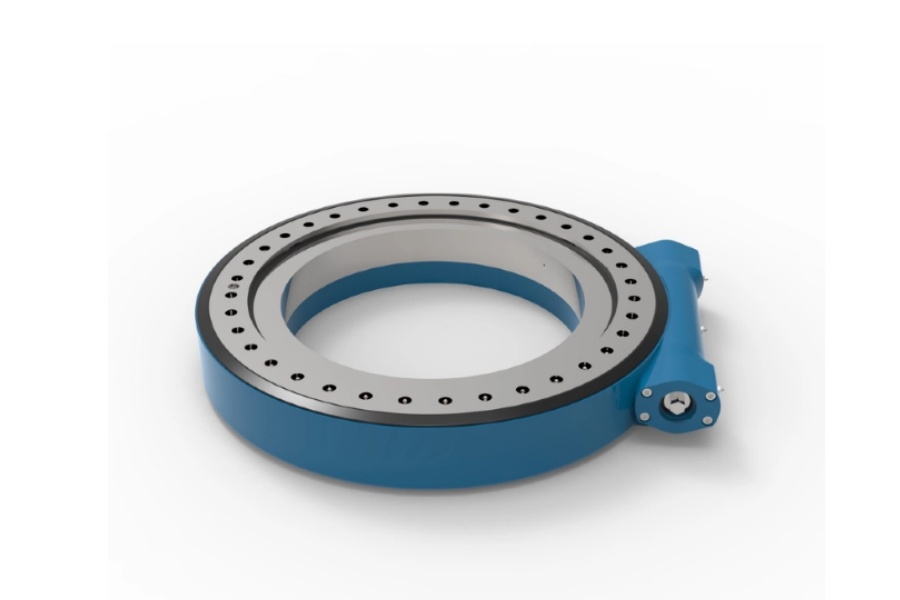
What is a slew drive? A slew drive is a compact rotary transmission unit that combines a slewing bearing, gear set, housing, and drive interface to rotate equipment under load. Before you buy slew drive units for an OEM project, the mistake to avoid is comparing only the quoted unit price while leaving customization, verification, freight, import charges, and field-failure exposure outside the calculation.
A low ex-works offer can look attractive until the buyer adds export packing, shipping, customs duties, incoming inspection, redesign work, or replacement costs. For purchasing teams comparing domestic and export suppliers, the better question is not “Which quote is cheapest?” It is “Which offer produces the lowest acceptable landed cost for the required duty cycle and delivery plan?”
Luoyang Slewring Bearing Co., Ltd. supplies Slew Drive, slewing bearing, and customized slew drive solutions for industrial rotation applications. Our scope includes standard and customized products, with standard-product MOQ from one set and customized-product MOQ from five sets, which can help buyers qualify a design before committing to a larger release.
Start by separating the quote basis from the actual purchase decision
The first decision is to identify what each supplier’s price actually covers. A quoted price may be based on the product alone, while another quote may include a different material, coating level, inspection scope, motor interface, or export package. These offers cannot be compared as like-for-like prices.
Ask every supplier to state the commercial basis in writing: product configuration, quantity, currency, delivery term, package type, and validity period. This fits any buyer with preliminary offers from multiple suppliers. It does not replace an engineering review when the application has uncertain load, speed, mounting, or environmental conditions.
Use a quote-normalization sheet before comparing unit prices
| Quote item to normalize | What the buyer should confirm | Why it changes cost | When it matters most |
|---|---|---|---|
| Drive configuration | Single worm, double worm, or spur gear arrangement; rotation interface; mounting pattern | Different drive layouts have different manufacturing and application costs. | Crane, excavator, tracker, turntable, and steering applications |
| Material selection | Housing, bearing, and gear material proposed for the working condition | Material should match load, speed, and environment rather than follow a default selection. | Marine, mining, corrosive, or cyclic-load service |
| Protection and corrosion level | Requested sealing and corrosion-protection requirement | A lower initial price may exclude the protection needed for the installation site. | Outdoor, coastal, dusty, and wet locations |
| Testing and records | Inspection items, acceptance criteria, and records supplied with the order | Missing evidence can shift verification work and risk to the buyer. | OEM qualification and safety-sensitive equipment |
| Packaging and delivery term | Export package, shipping point, freight responsibility, and insurance responsibility | Freight and damage exposure may not be visible in a product-only quote. | International shipments and long transit routes |
For example, a port crane buyer should not compare a sealed self-locking worm drive against a basic rotary unit without checking the same operating requirements. A South Korean port equipment manufacturer placed a repeat order for 20 WEA9-62-25HR single worm slew drives for port crane systems, specified for IP65 sealing, self-locking operation, and tracking precision of no more than 0.15°. That case supports the need to compare configuration details, but it does not establish that the same model fits every crane.
When the application needs greater resistance to load-induced movement or requires a specific rotation arrangement, compare the offered design against the intended duty. A Double Worm Slew Drive may be appropriate where the application requires that drive arrangement, while a single-worm option may suit another system. The correct choice depends on the engineering requirement, not on the lowest component price.
A landed-cost model separating base price, customization, testing, packaging, freight, duties, and failure risk
The useful landed-cost model starts with the base unit price, then adds every cost required to put an accepted unit into service. Buyers should request each line separately where possible. If a supplier cannot provide a line-item value, mark it as an allowance and record the assumption used.
| Landed-cost element | What it includes | Buyer action | Cost risk if omitted |
|---|---|---|---|
| Base unit price | The standard slew drive in the stated configuration and quantity | Confirm model, quantity, drive orientation, and delivery term. | Comparing unlike models as if they were equivalent |
| Customization | Changes to interfaces, dimensions, materials, coatings, or application-specific design details | List each requested deviation in the RFQ and ask whether it is included. | Late engineering changes and unplanned tooling or machining charges |
| Testing and documentation | Requested inspection, test scope, reports, and acceptance evidence | Define who pays for special verification and what records are required. | Receiving parts without proof needed for internal release |
| Packaging | Export packing, preservation, labeling, and handling protection | Confirm package method for the route and loading method. | Transit damage, moisture exposure, or relabeling work |
| Freight and insurance | Inland handling, ocean or air freight, insurance, and destination delivery where applicable | Obtain a freight estimate based on actual package dimensions and shipment timing. | Budget gaps caused by route changes or incomplete shipping assumptions |
| Duties and import charges | Applicable duty, tax, brokerage, port charges, and local clearance costs | Verify classification and destination charges with the importer or broker. | Unexpected cash outlay at customs clearance |
| Failure-risk cost | Downtime, removal, replacement freight, field labor, and possible project delay | Review warranty terms, inspection evidence, and supplier response commitments. | A low purchase price becoming expensive after installation |
The model is not a claim that every cost will apply to every order. A buyer collecting a sample for bench evaluation may have little customization expense, while a project with a nonstandard interface may require more engineering and approval work. The purpose is to expose costs before a purchase order is issued.
At Luoyang Slewring Bearing Co., Ltd., standard products can be ordered from one set, and sample orders are welcome for testing and evaluation. For customized products, the stated MOQ is five sets. This helps when a buyer needs to confirm fit or operating behavior before a program release, but final acceptance requirements still need to be agreed for the specific order.
Use failure-risk cost as a commercial review item, not a vague contingency
Failure risk should be discussed in practical terms: what evidence is supplied before shipment, what warranty applies, and how quickly technical questions receive a response. Our facility is ISO 9001:2015 certified, and our listed quality process includes CMM three-coordinate inspection and dynamic load testing for every slewing bearing. We also provide a two-year extended quality warranty, a 48-hour technical response commitment, and free replacement for confirmed manufacturing defects.
These points can reduce uncertainty for buyers who need documented supplier controls. They do not remove the buyer’s responsibility to specify the operating condition, confirm installation suitability, and agree on the warranty boundary for the project.
Request Your Custom Slew Drive or Bearing Spec
Tell us your load, speed, and environment — receive a tailored 100–5000 mm slewing drive or slewing bearing proposal with 3D drawings within 24 hours.
Match the drive type to the application before asking for the final price
The best cost reduction is often avoiding the wrong product configuration. A drive selected only because it has a lower base price can create higher costs through inadequate protection, poor interface fit, or a redesign after testing. Start with the application function, then narrow the product type.
- Single worm slew drive: Consider it for equipment that needs controlled rotary movement and self-locking characteristics where specified. The South Korean port crane case using WEA9-62-25HR is a relevant example. Do not assume all single-worm designs provide the same precision, sealing, or capacity.
- Double worm slew drive: Consider it when the machine design calls for a double-worm arrangement and higher rotation stability is required by the application. A Canadian forestry equipment manufacturer used WED14-86-25BHR.5 double worm slew drives for grapple machines, with precision no more than 0.13°. This case is specific to that equipment and is not a universal forestry specification.
- Spur gear slew drive: Consider it for applications designed around spur gear transmission. South American solar projects in Brazil, Argentina, and Chile used SP-I 0229 spur gear slew drives for single-axis solar trackers, with reported energy-yield improvement up to 40%. Energy yield depends on the entire tracker and site design, so the result should not be applied to unrelated projects.
- Customized design: Consider a Customized Slew Drive when the standard mounting, interface, material selection, or environmental protection does not meet the equipment requirement. Custom work is not the best option if a standard model already meets the approved design and schedule.
Material selection is also part of price control. Luoyang Slewring Bearing Co., Ltd. works with ductile cast iron, alloy steel, stainless steel, and forged alloy steel, selected according to load, speed, and environment. A buyer should request the material basis for the offered configuration instead of specifying a premium material without a working-condition reason.

Check supplier evidence that affects acquisition risk
Supplier evidence matters when the drive will be installed in equipment that is difficult to service, shipped internationally, or subject to a formal customer release process. The practical test is whether the supplier can connect its capability to the quoted product and provide records that the buyer can review.
Luoyang Slewring Bearing Co., Ltd. was established in 2012 and operates six production lines in an 8,000 m² manufacturing facility with CNC machining centers and CMM three-coordinate inspection. The stated annual capacity is 100,000 sets, with a three-day rapid-prototyping capability, a nine-day standard production cycle, and technical proposals available within 24 hours. These facts help a buyer assess fit for an inquiry; they are not a substitute for confirming the schedule of a particular order.
Evidence questions to add to the RFQ
- State the exact slew drive model or describe the required mounting, rotation, and environmental conditions.
- Ask whether the quote is for a standard product or a customized configuration.
- Request the proposed material and protection approach, especially for outdoor, marine, mining, or dusty installations.
- Define the inspection documents, test requirements, and acceptance criteria needed before shipment.
- Confirm the delivery basis, package responsibility, freight estimate, and import-cost owner.
- Ask for the warranty terms and the process for handling a confirmed manufacturing defect.
- For a first purchase, decide whether a sample order is needed before the production release.
A buyer evaluating inspection evidence can review the supplier’s stated Slew Drive Quality Control scope and then identify any additional project-specific records needed. This is especially useful when the buyer’s quality team must release the product before installation. It does not mean that a web-page description alone meets a customer’s unique qualification requirement.
Avoid quote-comparison mistakes that create hidden landed costs
Most purchasing errors happen when technical, commercial, and logistics assumptions are kept in separate conversations. The following checks help a procurement manager turn a preliminary offer into a decision-ready comparison.
- Mistake: comparing only FOB, EXW, or product-only figures. Better approach: record the delivery term and add the costs that sit outside it. This applies to export purchases; a local delivered-price order may need a shorter model.
- Mistake: treating “custom” as a single line item. Better approach: list each change, such as interface, coating, or material requirement. This is less necessary when a confirmed standard model is used without changes.
- Mistake: assuming a protection rating without placing it in the specification. Better approach: state the required protection level in the RFQ. Our slew drives can provide protection up to IP66 and anti-corrosion rating up to C4H, but the needed level must match the actual environment.
- Mistake: accepting generic test language. Better approach: identify the inspection and documentation needed for order release. Standard inspection may not cover every customer-specific test.
- Mistake: ignoring replacement logistics. Better approach: review warranty coverage alongside the cost and time needed to remove, ship, reinstall, and recommission a unit. Warranty is valuable, but it does not automatically cover every downstream project cost.
For buyers sourcing heavy-duty equipment components, a documented track record can provide additional context. Luoyang Slewring Bearing Co., Ltd. has supplied 150 WED17-104-25HR double worm slew drives to a Houston, Texas engineering machinery manufacturer for heavy-duty wheel steering systems, and 50 SP-I 0841 units to a U.S. renewable energy equipment manufacturer for utility-scale solar tracker systems with IP65 protection for desert sites. These are relevant references for similar use cases, not proof that a new project has identical requirements.
Use a final release checklist before issuing the purchase order
The final release should combine engineering approval and procurement approval. That prevents a commercial team from approving a low quote that lacks a required technical item, and prevents engineering from approving a design without checking delivery and import exposure.
| Release check | Decision standard |
|---|---|
| Configuration confirmed | Model, drive type, mounting interfaces, direction, and required protection are stated in the order documents. |
| Price basis confirmed | Base unit price, customization, testing, packaging, freight, duties, and risk assumptions are visible in the comparison. |
| Quality evidence agreed | Inspection scope, documents, and acceptance criteria are clear before production release. |
| Commercial terms agreed | MOQ, lead-time expectation, warranty scope, delivery term, and responsibility for logistics are reviewed. |
| Supplier fit checked | The supplier’s capability, technical response process, and relevant application references fit the project need. |
| Open risks assigned | Each unresolved item has an owner, due date, and decision path before the purchase order is issued. |
If you plan to buy slew drive products for cranes, solar trackers, forestry equipment, turntables, or other rotating machinery, use the landed-cost model before selecting the lowest number on the quotation. A properly compared offer makes the tradeoffs visible: product configuration, verification level, shipping exposure, and the support available if a manufacturing defect is confirmed.
Lewis is a Senior Mechanical Design Engineer with more than 30 years of experience in heavy machinery and power transmission design, including slewing bearings, slew drives, worm gear reducers, CAD modeling, tolerance verification, and material selection across more than 200 heavy-equipment projects.
Request Your Custom Slew Drive or Bearing Spec
Tell us your load, speed, and environment — receive a tailored 100–5000 mm slewing drive or slewing bearing proposal with 3D drawings within 24 hours.
 WhatsApp

 +8613903880726