



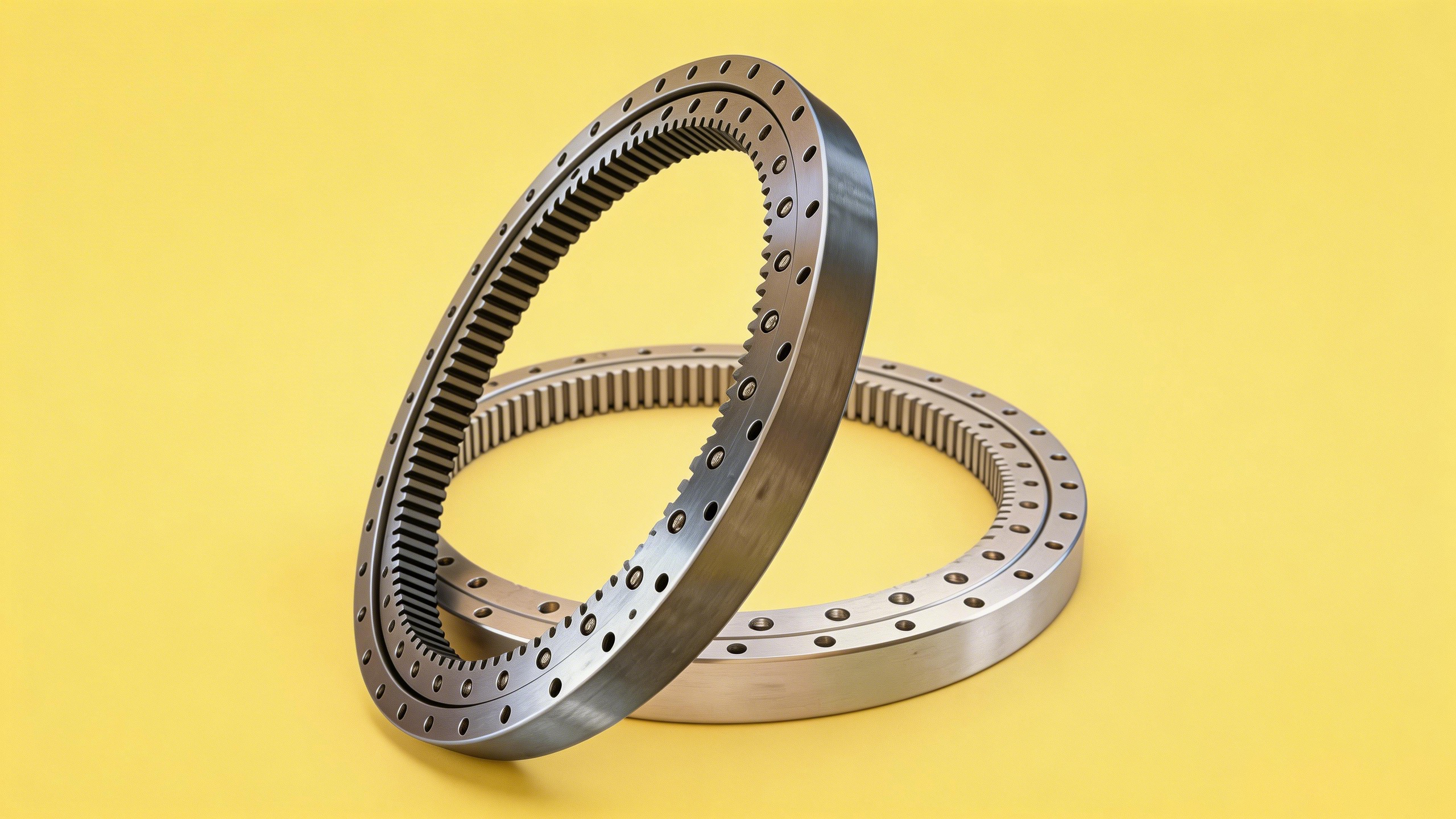
A Comprehensive Analysis of Light Load Slewing Bearings
What is Slewing Bearing?
A slewing bearing, also known as a slewing ring or turntable bearing, is a large-scale rolling-element bearing designed to support heavy, slow-rotation or slow-oscillation equipment under complex combined loads.
Concept & Definition: Unlike standard bearings that primarily support rdial or axial loads, slewing bearings are engineered to simultaneously handle high axial loads, radial loads, and tilting moments. They typically consist of an inner ring, an outer ring, rolling elements (balls or cylindrical rollers), seals, and often an integrated gear (internal or external). Their core function is to act as a robust, load-bearing rotational joint between two structures.
Working Principle: The bearing enables smooth, controlled rotation. The rolling elements circulate within precisely machined raceways, minimizing friction. When an integrated gear is present, it meshes with a motorized pinion to provide the driving force for powered slewing motion.
Key Application Fields: They are fundamental components in industries requiring robust rotational movement under heavy loads, including construction machinery (excavators, mobile cranes), renewable energy (wind turbine yaw and pitch systems), material handling (stackers, reclaimers), and industrial robotics.
What is Light Load Slewing Bearing?
A Light Load Slewing Bearing is a specialized sub-category of slewing ring engineered for applications where minimizing mass and space is a critical design constraint, without sacrificing essential performance. Its primary distinction from a standard slewing bearing lies in its optimized strength-to-weight ratio.
While a standard bearing prioritizes maximum load capacity and durability within a robust, often heavier cross-section, a light load slewing bearing achieves comparable or suitably high load ratings through advanced engineering focused on material efficiency and compact design. It is the optimal choice for mobile equipment, aerospace subsystems, and automated machinery where reduced weight translates directly into enhanced efficiency, portability, and dynamic response.
Design Features of Light Load Slewing Bearings
The design of a Light Load Slewing Bearing is a precise exercise in performance optimization through intelligent engineering. Key features that differentiate it from standard designs include:
Advanced, High-Strength Materials: Utilizes high-grade, low-alloy steels or specialized alloys that provide exceptional yield strength and fatigue resistance at a lower density than the materials often used in heavier, standard-duty bearings.
Optimized Cross-Section & Compact Profile: Features a significantly slimmer and more refined cross-section compared to the bulky, rectangular profile common in standard bearings. This reduces material use and overall envelope size, saving critical space and weight in the host assembly.
Precision Raceway Geometry: Incorporates sophisticated multi-point contact ball raceways or optimized roller paths. This design efficiently distributes loads across a smaller contact area, allowing the bearing to handle required loads with less mass, unlike standard bearings which may rely on larger contact areas and more material.
Integrated & Modular Design: Often designed as a complete functional unit. Mounting holes, lubrication ports, and sealing systems are directly incorporated into the bearing rings, eliminating the need for additional, heavy support housings or adapters—a common requirement with standard bearings.
Targeted Heat Treatment: Undergoes specialized heat treatment processes (e.g., case hardening) focused on raceways and gear teeth. This creates a hard, wear-resistant surface over a tough core, achieving necessary durability without the need for massive material thickness.
Advantages of Light Load Slewing Bearings
The advantages of Light Load Slewing Bearings are direct benefits of their optimized design, offering solutions where standard bearings would impose performance penalties.
Significant Weight Reduction: This is the most direct advantage. Compared to a standard slewing bearing of similar diameter, a light load series version can be up to 30-50% lighter, leading to substantial benefits in fuel economy, payload capacity, and ease of handling.
Space & Envelope Optimization: Their compact design frees up valuable space, enabling more innovative and streamlined machine architectures. This contrasts with standard bearings, which often dictate larger installation spaces.
Superior Performance-to-Weight Ratio: Delivers excellent load capacity and moment resistance relative to its mass. This makes it possible to achieve desired rotational performance while drastically lowering the system's overall inertia.
Enhanced System Efficiency: The reduced rotating mass requires less torque and power to accelerate, decelerate, or hold position, contributing to lower energy consumption and smaller drive components.
Improved Dynamic Response: Lower inertia allows for faster start-stop cycles and more precise positioning in automated and robotic applications, a key differentiator from heavier standard bearings.
Types of Light Load Slewing Bearings
Light load slewing bearings are primarily categorized by their rolling element configuration and contact mechanics, each offering distinct advantages for specific load and precision requirements.
1. Single-Row Four-Point Contact Ball Bearing
This is the most versatile and commonly used type in light load applications. A single row of balls makes contact with the raceways at four points, enabling it to efficiently handle combined axial, radial, and moment loads simultaneously. Its primary advantages are an exceptionally compact cross-section and low weight, making it ideal for applications where space and mass are at a premium, such as compact robotic joints and solar tracker axles.
2. Crossed Roller Slewing Bearing
Featuring cylindrical rollers arranged in a single layer with their axes alternating at 90°, this design provides superior rigidity, rotational precision, and higher moment load capacity compared to single-row ball types of a similar diameter. The line contact of rollers offers minimal elastic deformation. It is the preferred choice for high-precision rotary tables, indexing heads, and medical imaging equipment where accuracy and stiffness are critical.
3. Wire Race Bearing (An Ultra-Lightweight Specialty)
Representing the pinnacle of lightweight design for moderate loads, wire race bearings use hardened steel wires as raceways for the rolling elements. This construction results in extremely low friction, smooth operation, and minimal rotational torque. They are specialized solutions for precision instruments, optical tracking mounts, and applications where friction and weight must be absolutely minimized.
4. Flanged Slewing Bearings: These bearings have integral flanges on the inner or outer ring, which allows for simplified mounting directly onto structures, often used in light-duty applications requiring compact designs
5. Thin-Section Slewing Bearings: Designed with a very low cross-section, these save weight and space in applications where load requirements are minimal.
Choosing the Right Type:
For optimal weight and space savings under combined loads, choose the Single-Row Four-Point Contact Ball type.
For maximum precision, rigidity, and moment resistance, choose the Crossed Roller type.
For ultra-low friction and smooth motion in precision instruments, consider the specialized Wire Race bearing
Key Applications of Light Load Slewing Bearings
These bearings are enablers of modern, efficient design across sectors where standard bearings would be over-engineered or detrimental to system goals.
Mobile & Compact Equipment: Lightweight excavator attachments, compact aerial work platforms (AWPs), and telehandler turntables, where reducing the upper structure weight improves stability and transportability.
Solar Tracking Systems: Single-axis and dual-axis trackers for photovoltaic panels. The use of light load bearings minimizes the structural mass of the tracker, reducing foundation costs and the energy required for daily movement.
Advanced Robotics & Automation: Rotary joints for collaborative robots (cobots), automated guided vehicles (AGVs), and precision indexing tables. Their low inertia is crucial for speed and accuracy.
Aerospace & Defense: Gimbals for satellite communication antennas, targeting systems on UAVs (drones), and sensor platforms. Every gram saved is critical here.
Medical & Simulation Equipment: CT scanner gantries and flight simulator platforms, where smooth, precise, and reliable rotation is required without excessive mass.
Portable Industrial Tools: Heavy-duty, manual-rotation positioning equipment used in field maintenance and fabrication.
LyraDrive: Customized Light Load Slewing Bearing Manufacturer
At LyraDrive, we specialize in engineering and manufacturing high-performance slew drives and custom slewing bearings. We understand that the choice between a light load and a standard bearing is application-critical. Our expertise lies in providing the optimal, custom-engineered solution for your specific needs.
Our Core Product Expertise:
Slew Drives: We integrate precision slewing bearings with high-efficiency gearing, compact motors, and brakes to create a complete, packaged rotary drive system. Whether your application demands the efficiency of a Light Load Slewing Bearing or the brute strength of a Heavy Load Slewing Bearing, our slew drives are configured accordingly.
Custom Slewing Bearings – The Full Spectrum: We manufacture the exact bearing your design requires:
Light Load Slewing Bearings: For applications where weight is a primary constraint. Our engineers optimize every feature to deliver maximum performance with minimal mass.
Heavy Load Slewing Bearings: Built for maximum load capacity and longevity in the toughest environments, such as mining and heavy lifting.
Specialized Application Bearings: We design bearings for specific industry needs, including high-cycle Truck Crane Slewing Bearings, impact-resistant Excavator Slewing Bearings, and bearings for marine or corrosive environments.
The LyraDrive Advantage – From Concept to Solution:
We are more than a manufacturer; we are a design and engineering partner. Our process begins with understanding your application's unique load, speed, environmental, and interface requirements. We then custom-design the bearing or slew drive that offers the perfect balance of performance, weight, and cost. We provide comprehensive (one-stop) services, encompassing FEA analysis, prototyping, testing, manufacturing, and lifelong technical support. Partner with LyraDrive to ensure your rotating motion solution is not just a component, but a catalyst for your product's success.
FAQs About Light Load Slewing Bearings
Q1: What is the main difference between a Light Load and a Standard Slewing Bearing?
A1: The core difference is the design priority and resulting strength-to-weight ratio. A Standard Slewing Bearing is designed for maximum load capacity and durability, often resulting in a heavier, more robust cross-section. A Light Load Slewing Bearing is engineered to meet specific (often high) load requirements with the absolute minimum weight and space, using advanced materials and optimized geometry. It's about optimal application fit.
Q2: Is a light load slewing bearing less durable or strong?
A2: Not necessarily. Durability and strength are functions of design, material, and manufacturing quality. A properly engineered light load slewing bearing, using high-strength alloys and precision hardening, will reliably meet its designed load ratings and service life. The "light load" refers to efficient design within its load class, not inferior performance. It is as strong as it is designed to be for its intended duty cycle.
Q3: How do I decide if I need a light load or a standard bearing?
A3: The choice depends on your primary design drivers. Choose a Light Load Slewing Bearing if: system weight, inertia, space, or energy efficiency are critical (e.g., mobile equipment, robotics, solar trackers). Choose a Standard/Heavy Load Slewing Bearing if: ultimate load capacity, extreme shock loads, and maximum longevity in a harsh, stationary environment are the top priorities, and weight is a secondary concern.
Q4: Can light load slewing bearings be used in harsh conditions?
A4: Yes, their environmental suitability is determined by their sealing, lubrication, and surface treatment specifications—not solely by their "light load" designation. They can be equipped with multi-lip seals, corrosion-resistant coatings (e.g., zinc-nickel plating), and special grease to perform reliably in outdoor, dusty, or moderately corrosive environments.
Q5: Why should I consider a custom light load slewing bearing from LyraDrive?
A5: Catalog bearings are a compromise. A custom solution from LyraDrive ensures every aspect—materials, heat treatment, seal type, gear geometry, mounting details—is optimized for your application. This results in a perfectly integrated component that enhances your product's performance, reliability, and competitiveness, whether you need a lightweight innovator or a heavy-duty workhorse.
 WhatsApp
 sales@lyradrive.com
 +8613903880726