



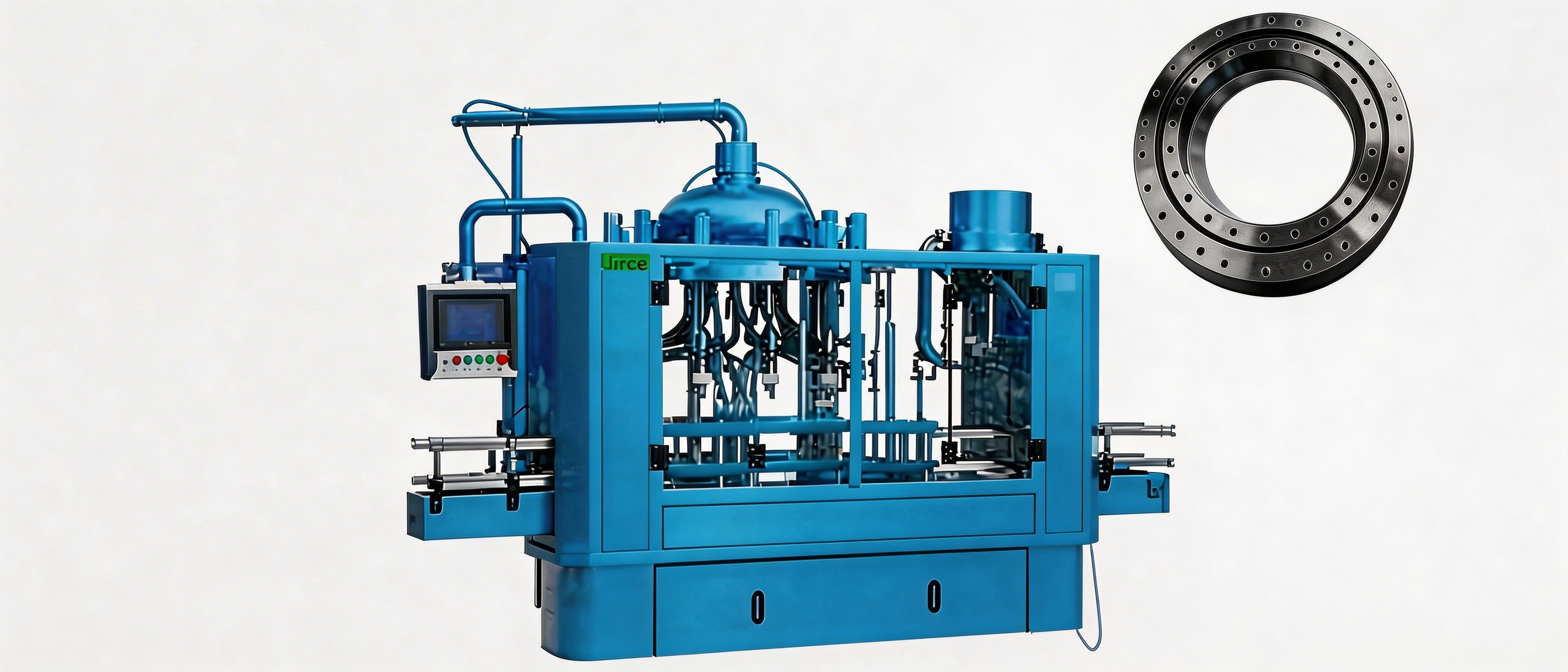
Application Analysis of Light Load Slewing Bearings
What Is Slewing Bearing?
A slewing bearing, often referred to as a slewing ring or turntable bearing, is a large-sized rolling-element bearing that can simultaneously accommodate axial and radial loads as well as tilting moments. Typically, its structure integrates an inner ring, an outer ring, and rolling elements (balls or rollers). It enables smooth rotational movement between two main parts of a machine, such as a base and a superstructure. This is why it is a critical component in machinery ranging from construction cranes and wind turbines to medical equipment and aerial work platforms. When this bearing is combined with a worm gear and a housing to form a drive unit, it is commonly known as a slew drive.
What Is Light Load Slewing Bearing?
A light load slewing bearing, also known as a light-duty slewing ring, is a specialized type of slewing bearing designed for applications with lower load and moment requirements. It shares the same fundamental operating principles as standard slewing bearings—typically using a four-point contact ball design—but is engineered with a reduced weight profile. The primary goal of this bearing is to provide a cost-effective, lightweight, and compact rotation solution for machinery where using a heavy-duty industrial bearing would be over-engineering. This makes it an ideal structural component for various light industrial and commercial machines.
Structure of Light Load Slewing Bearings
The structure of a light load slewing bearing closely mirrors that of a standard single-row four-point contact ball slewing bearing, but with optimizations for weight reduction. Key structural elements include:
Rings: It consists of an inner ring and an outer ring, typically made from materials like 50Mn, 42CrMo, or C45 steel. To save weight, the cross-section of these rings is often thinner and has a lower profile compared to heavy-duty versions.
Rolling Elements: Single row of balls.
Raceway: The raceways are designed so that the balls make contact with the raceway at four points (hence "four-point contact"). This unique geometry allows a single row of balls to handle axial loads from both directions, radial loads, and tilting moments effectively.
Separator/Spacer: A spacer or cage is usually placed between the balls to prevent them from contacting each other, reduce friction, and ensure even load distribution.
Sealing: Integral seals are fitted to protect the raceway and rolling elements from contaminants like dust, moisture, and food particles, which is crucial for many light-load applications.
Gearing (Optional): Like their larger counterparts, light load slewing bearings are available in versions with external gear teeth, internal gear teeth, or without gear teeth (plain), depending on whether they will be driven by a pinion or a slew drive.
Design Features and Benefits of Light Load Slewing Bearings
Light load slewing bearings offer several distinct advantages thanks to their specialized design:
Lightweight Construction: Their most significant feature is their reduced weight, which lowers the overall mass of the machinery they are installed in, leading to easier handling and potentially lower shipping costs.
Compact and Low Profile: The slim cross-section and low height allow for integration into machines with limited space, contributing to a more compact final product design.
Cost-Effectiveness: By using less material and being designed for lower load requirements, they provide a more economical solution compared to standard heavy-duty slewing bearings.
High Flexibility and Smooth Rotation: The optimized design ensures flexible, low-torque rotation, which is essential for precise positioning and efficient operation in light machinery.
Integrated Functionality: The open center allows for the passage of cables, hoses, or other components through the bearing, making it a true structural and rotational joint.
Easy Maintenance: Sealed raceways typically require only periodic re-lubrication, simplifying maintenance schedules for end-users.
Versatility: Available with or without gear teeth, providing flexibility in how the rotation is driven—either by a pinion gear or a complete slew drive unit.
Typical Applications of Light Load Slewing Bearings
The unique characteristics of light load slewing bearings make them suitable for a wide array of applications across various industries. Their reliability, compactness, and clean operation are particularly valued in the following sectors:
Food Machinery
In the food processing industry, hygiene, reliability, and smooth motion are paramount. Light load slewing bearings are ideal components in this sector for several reasons. They are commonly found in food filling and packaging turntables, where containers need to be indexed and rotated precisely for filling, capping, and labeling. The sealed design of these bearings prevents food particles, liquids, and cleaning agents from entering the raceway, thus avoiding contamination and ensuring long service life. They are also used in mixing and blending equipment where a vessel or agitator arm requires smooth, low-friction rotation. The use of suitable lubricants (often food-grade) ensures that the bearing operates safely within a food production environment. Their corrosion-resistant material options and the ability to withstand frequent washdowns make them a reliable choice for maintaining stringent hygiene standards.
Canning Machinery
Canning lines are high-speed, continuous operations that demand precision and durability. Light load slewing bearings play a crucial role in the rotary components of this machinery. A primary application is in the large rotary turrets and star wheels that move cans through various stations—from filling and seaming to sterilization and labeling. These bearings must support the weight of the turret and the cans while ensuring precise, vibration-free rotation at consistent speeds. The compact design allows for the machinery to be built more efficiently, saving valuable floor space. Furthermore, the ability of these bearings to handle combined loads (radial from the can flow, axial from the weight, and moments from off-center loading) is essential for maintaining the alignment and timing required for high-speed canning processes, preventing jams and ensuring product integrity.
Environmental Machinery
Environmental technology relies on robust and reliable equipment, often operating in outdoor or demanding conditions. Light load slewing bearings are key components in several types of environmental machinery. For instance, in water and wastewater treatment plants, they are used in rotating scraper bridges for sedimentation tanks and clarifiers. These bridges rotate slowly, 24/7, to move sludge towards collection points. The light load bearing supports the bridge structure and ensures smooth, continuous rotation with minimal maintenance. In screening equipment, they facilitate the oscillation or rotation of drums that separate solids from liquids. Their corrosion resistance (often achieved with protective coatings or materials) and sealed-for-life options make them highly suitable for the moist and chemically active environments found in these applications, ensuring long-term, trouble-free operation.
Car Parking Systems
With increasing urbanization, automated and mechanical car parking systems (stack parking, tower parking, etc.) have become essential space-saving solutions. Light load slewing bearings are fundamental to the operation of these systems. In a typical rotary parking system, the bearing is used in the turntable mechanism that rotates cars to align with the entry/exit point or to move them into a vacant parking space. The bearing must support the significant weight of a vehicle while providing smooth, quiet, and precise rotation. Its compact and lightweight nature allows for a thinner and more space-efficient turntable design, maximizing the number of parking spots within a given footprint. The four-point contact design efficiently handles the combined axial load (vehicle weight) and tilting moment (as the car drives onto the turntable), ensuring safe and reliable operation for thousands of cycles.
Material Selection for Light Load Slewing Bearings
Choosing the right material is critical for the performance, durability, and cost-effectiveness of a light load slewing bearing. The material must provide adequate strength and wear resistance while contributing to the bearing's lightweight nature. The selection process involves balancing traditional steel options with emerging lightweight alternatives based on specific application requirements.
Traditional Steel Materials
50Mn Steel: This is a high-quality carbon structural steel widely used for slewing bearing rings. It offers excellent strength and toughness and responds well to induction hardening, which is necessary to create a durable raceway surface. It is a standard, cost-effective choice for many light-load applications such as food machinery and car parking systems.
42CrMo Steel: This is a chromium-molybdenum alloy steel known for its high fatigue strength and good impact resistance. It offers superior mechanical properties compared to 50Mn, especially in larger sizes or applications with slightly higher loads or shock loading. It is also through-hardening and can be induction hardened for the raceway, making it ideal for environmental machinery that may encounter variable operating conditions.
C45 Steel (or 1045): This is a medium carbon steel often used for less demanding light-load applications. While it provides good strength and wear resistance in its normalized or hardened condition, it is typically used when cost savings are the primary driver and load conditions are very low.
Aluminum and Advanced Lightweight Materials
In addition to traditional steel options, aluminum alloys are playing an increasingly important role in specialized light-load slewing bearing applications, following two main technological approaches:
Aluminum with Engineering Plastic Sliding Elements: This innovative design, exemplified by products like the igus PRT series, uses a hard-anodized aluminum ring as the base, combined with high-performance engineering plastic sliding elements (such as igludur®). This combination offers:
Extreme Lightweighting: Up to 60% lighter than traditional steel bearings, making it crucial for robotics, medical devices, and aerospace equipment.
Maintenance-Free Dry Operation: The self-lubricating plastic elements eliminate the need for grease or oil, ensuring clean operation ideal for food machinery or cleanroom environments.
Excellent Corrosion Resistance: The anodized aluminum provides superior protection against moisture and chemicals.
Limitations: Load capacity is typically lower than equivalent steel rolling bearings, and operating temperature is generally restricted to -50°C to +60°C. This design suits high-speed, low-load applications requiring cleanliness and precision.
Ultra-High-Strength Aluminum Alloy Bearing Rings: For aerospace and defense applications, manufacturers can customize slewing bearings using high-strength aluminum alloys like 7075-T6 as the main ring material. After heat treatment, these alloys offer exceptional strength-to-weight ratios. In such designs, the raceways may still use steel inserts or stainless steel to ensure wear resistance, though this customization comes at a higher cost.
Aluminum Components in Traditional Bearings: Even in conventional steel slewing bearings, the cage or separator is sometimes manufactured using cast aluminum alloys (e.g., ZL102) . This reduces rotating inertia and noise without compromising the main load-carrying capacity of the bearing.
Material Treatments
Regardless of the base material, proper surface treatment is essential:
For steel raceways, induction hardening to a specific depth and hardness (typically 55-62 HRC) provides a wear-resistant surface for the rolling elements.
For aluminum components, anodizing creates a hard, corrosion-resistant surface.
Steel rings may also receive protective coatings such as phosphating, zinc plating, or primer/paint to enhance corrosion resistance, which is particularly important for applications in food, environmental, or outdoor settings.
Material Selection Guide
| Material Choice | Key Advantages | Typical Applications | Considerations |
|---|---|---|---|
| 50Mn / 42CrMo Steel | High strength, excellent load capacity, cost-effective, good wear resistance | Food machinery, canning equipment, environmental machinery, parking systems | Heavier weight, requires regular maintenance (lubrication) |
| C45 Steel | Very low cost, good machinability | Very light loads, cost-sensitive or simple equipment | Limited load capacity and fatigue life |
| Aluminum + Plastic Sliding Elements | Extreme lightweight, fully maintenance-free, clean operation, corrosion-resistant | Medical devices, cleanrooms, light assembly, drones | Lower load capacity, temperature limitations |
| High-Strength Aluminum Alloy | High strength combined with light weight, excellent corrosion resistance | Aerospace, defense, racing, high-end robotics | Highly customized, higher cost |
How to Choose Light Load Slewing Bearings for Your Applications?
Selecting the correct light load slewing bearing involves a careful analysis of your application's specific requirements. Here are the key steps and factors to consider:
Determine Load Requirements: Calculate all forces acting on the bearing. This includes the axial load (weight of the rotating structure), radial load (side forces), and most importantly, the tilting moment (the overturning force). Use these values to generate a load moment diagram.
Assess Operating Conditions: Consider the environment (indoor/outdoor, temperature, humidity, exposure to dust or chemicals), the required rotational speed (RPM), and the duty cycle (continuous or intermittent operation).
Define Precision and Mounting Needs: Determine the required rotational accuracy and running smoothness. Consider the mounting arrangement—will you use flange mounting bolts, and what are the interface dimensions of your machine? The "open center" is a standard feature, but ensure the inner diameter is sufficient for your needs.
Select Gear Type (If Needed): Decide if your application requires an external gear, internal gear, or no gear. If gearing is needed, specify the module, number of teeth, and gear quality.
Consult with Experts: Use the manufacturer's selection software or, better yet, provide your application details to an experienced manufacturer. They can perform the necessary calculations to recommend the optimal bearing size and type.
Consider the Drive: If you need to actively rotate the bearing, you will likely require a slew drive. In this case, the choice of bearing and drive should be coordinated to ensure perfect meshing and overall system performance.
LyraDrive: Get Light Load Slewing Bearing 3D Drawing for Your Application
When it comes to sourcing high-quality, reliable light load slewing bearings, LyraDrive stands out as a trusted partner. With over 15 years of manufacturing experience, LyraDrive is a professional manufacturer specializing in slewing bearings and slew drives. We are committed to providing engineered solutions that meet the precise demands of your machinery.
Our extensive product range covers all major slewing bearing types to ensure we have the right fit for any light-load or heavy-duty application:
Single Row Ball Slewing Ring Bearings
Double Row Ball Slewing Ring Bearings
Three-row Roller Slewing Bearings
Crossed Roller Slewing Bearings
Light Type Series (our specialty for light load applications)
Flange Type Series
What truly sets LyraDrive apart is our commitment to engineering support and customization. We understand that every machine is unique. That is why we strongly encourage our customers to provide sample data, 2D drawings, or 3D models of their application interface. Once we receive your information, our skilled engineering team utilizes advanced 3D technology to analyze, model, and integrate our bearing into your specific assembly. This process allows us to verify fit, function, and performance before any manufacturing begins. The result is a perfectly matched slew drive or slewing bearing that delivers optimal performance, longevity, and seamless integration into your equipment.
FAQ of Light Load Slewing Bearing Application
Here are some frequently asked questions about applying light load slewing bearings:
Q: What is the main difference between a standard slewing bearing and a light load slewing bearing?
A: The primary difference lies in their load capacity and weight. A light load slewing bearing is designed with a thinner, lower-profile cross-section using less material. This makes it lighter and more cost-effective for applications with lower forces, whereas standard bearings are built for heavy industrial loads.
Q: Can a light load slewing bearing handle both radial and axial loads?
A: Yes. Most light load slewing bearings use a four-point contact ball design, which allows a single row of balls to effectively handle axial loads in both directions, radial loads, and tilting moments simultaneously.
Q: What does "four-point contact" mean?
A: It refers to the geometry of the raceway. Under a pure axial load, each ball makes contact with the raceway at four distinct points (two on the inner ring and two on the outer ring). This design provides high load capacity within a compact space.
Q: Do I need to use a separate gear with the bearing, or can it be driven directly?
A: It depends on your design. The bearing itself is a rotational joint. If you need to actively rotate it, you can either:
Purchase a bearing with integrated gear teeth (internal or external) and drive it with a small pinion gear.
Integrate it with a complete slew drive unit, which combines a worm gear and housing with a slewing bearing for a self-contained, high-torque rotation solution.
Q: How do I maintain a light load slewing bearing?
A: Maintenance is generally simple. Most bearings come with grease fittings (zerks). Regularly re-lubricating the bearing with the recommended grease, according to the manufacturer's schedule (which depends on duty cycle and environment), is the primary maintenance task. The seals help keep contaminants out and lubricant in.
Q: The light load slewing bearing will be used in a food processing area. Are there special options available?
A: Absolutely. For food machinery applications, you can request bearings with food-grade grease, specialized seals to prevent ingress of washdown water and particles, and corrosion-resistant coatings or materials (like 42CrMo with protective coating) to withstand frequent cleaning with aggressive agents.
Q: Can LyraDrive help me if I only have a rough idea of what I need?
A: Yes, definitely. You can provide us with your application details, including loads, speeds, environment, and interface dimensions. Even better, send us your existing drawings or samples. Our engineering team can use 3D analysis to design the optimal light load slewing bearing or slew drive for your specific needs. We can then provide you with a 3D drawing for your approval before manufacturing.
Q: How long is the lead time for a custom light load slewing bearing?
A: Lead times vary depending on the complexity and size of the order. However, because LyraDrive has 15 years of experience and a well-established supply chain, we are able to offer competitive lead times. For a precise timeline, it is best to contact us directly with your specific requirements.
 WhatsApp
 sales@lyradrive.com
 +8613903880726