



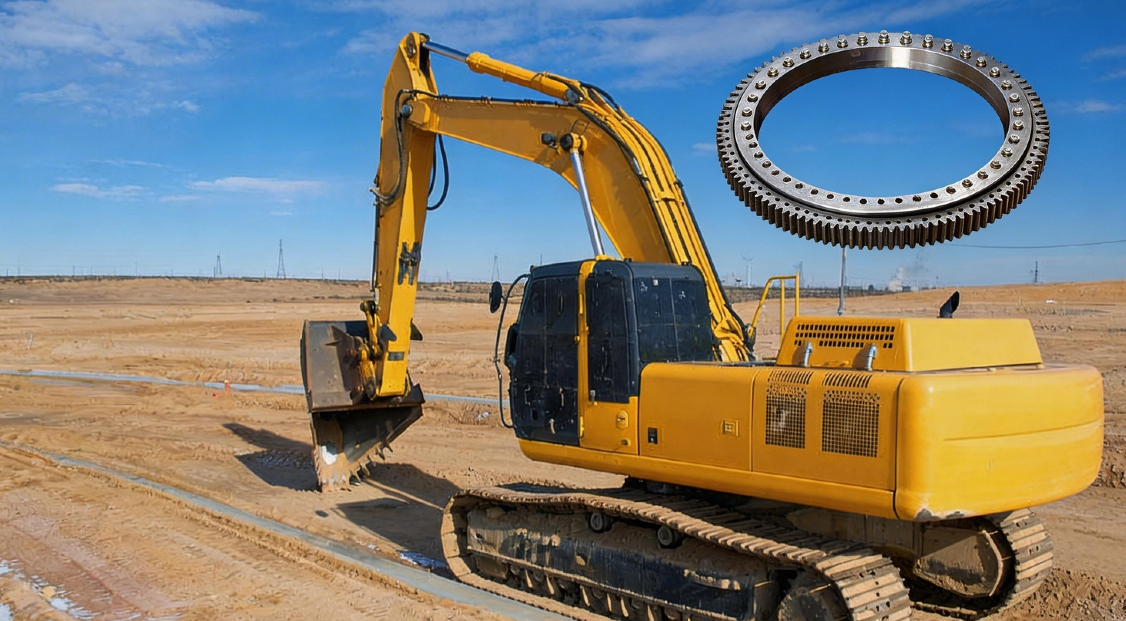
What Type of Slewing Bearings Can Be Used on an Excavator?
What are Slewing Bearings for an Excavator?
A slewing bearing for an excavator is a large, heavy-duty rotational element that forms the pivotal connection between the machine's upper structure (the house, cab, and boom) and its lower structure (the tracks or undercarriage). Unlike standard bearings, it is engineered to simultaneously manage complex, combined loads: the immense weight of the upper body (axial load), the side forces from digging (radial load), and the powerful tipping force created by the extended boom (tilting moment). Essentially, it is the "hip joint" of the excavator, enabling the top part of the machine to swing smoothly and continuously 360 degrees while supporting the entire upper structure and withstanding
Main Types of Slewing Bearings
Slewing bearings are categorized based on their rolling element and raceway design. The main types include single-row four-point contact ball bearings, double-row ball bearings, crossed roller bearings, and three-row roller bearings. Each type offers different load handling capabilities and rotational characteristics, making them suitable for various applications.
How Does a Slewing Bearing Work in an Excavator?
In an excavator, the slewing bearing is the critical connection between the upper carriage (housing the cab, engine, and boom) and the undercarriage (tracks). Its inner ring is typically bolted to the undercarriage, while the outer ring (which may have integrated gear teeth) is bolted to the upper carriage. A hydraulic motor drives a small pinion gear that engages with the teeth on the bearing's outer ring. This action forces the entire upper structure to rotate smoothly and precisely on the lower structure, allowing for digging, dumping, and repositioning.
Key Advantages of Using Slewing Bearings in an Excavator
High Load Capacity: They are specifically engineered to simultaneously withstand enormous axial forces from the excavator's weight, radial forces from digging, and the massive tilting moment created by the extended boom and bucket.
Smooth 360° Rotation: They enable the full, continuous rotation required for efficient operation.
Space-Efficient Design: The integrated gear teeth and bolt holes combine load support and drive functions into a single, compact unit.
Durability and Reliability: Designed for long service life in harsh environments with proper maintenance.
How to Choose the Right Slewing Bearing for Your Excavator?
Selecting the correct slewing bearing is crucial for performance and longevity.
Key Factors to Consider:
Load and Excavator Size: The machine's weight and operating weight (class, e.g., 5-ton, 20-ton, 50-ton) is the primary indicator of the magnitude of forces the bearing must endure.
Operating Conditions: Harsh environments like quarries or mines demand bearings with enhanced seals and material durability compared to general construction use.
Tilting Moment: This is the most critical load. It's the product of the digging force and the distance from the bearing's center, causing a tipping force that the bearing must resist.
Rotational Speed and Precision: Excavators require smooth, controlled rotation, but not high speed. Standard precision classes are usually sufficient.
Mounting Structure: The dimensions and rigidity of the upper and lower frames dictate the bearing's required bolt hole pattern and overall size.
Environmental Factors: Exposure to dust, water, and extreme temperatures will influence the choice of sealing and lubrication.
Basic Selection Process:
Calculate Static and Dynamic Loads: Determine the maximum axial, radial, and tilting moment loads expected during the most demanding operations.
Consult Load Capacity Curves: Manufacturers provide static and dynamic load capacity curves for each bearing model. The calculated loads must fall safely within these curves.
Consider the Gear: If the bearing includes a gear, the torque from the hydraulic motor and the gear strength must be matched to the application.
Account for Safety Factors: Apply appropriate safety factors based on the application's criticality and operating conditions.
What Type of Slewing Bearings Can Be Used on an Excavator?
The specific type of slewing bearing used depends heavily on the excavator's size and the intensity of its workload. Here is a breakdown of the common types:
Single-Row Four-Point Contact Ball Slewing Bearings: This is the most common type for small to medium-sized excavators (e.g., mini-excavators up to 15-20 ton class). They feature a single set of balls running in hardened raceways machined to a Gothic arch profile, allowing them to handle axial loads from both directions, radial loads, and a significant tilting moment within a compact and cost-effective design.
Double-Row Ball Slewing Ring Bearings: Used in some mid-range applications, this design uses two rows of balls of different diameters to separate the load paths. One row primarily handles axial loads, while the other handles radial and tilting moment loads, potentially offering increased stability in certain designs.
Crossed Roller Slewing Bearings: These bearings use cylindrical rollers arranged perpendicularly in a single raceway, separated by a spacer. This design offers high rotational precision and rigidity, and can handle substantial radial and tilting loads. They are sometimes found in applications requiring smoother, more precise swing control, though they are less common in standard excavators than ball or three-row types.
Three-Row Roller Slewing Bearings: This is the standard choice for large, heavy-duty excavators (e.g., 50-ton class and above, especially in mining). They have three independent raceways: two axial raceways (one for each direction) and one radial raceway, each filled with large cylindrical rollers. This separation of load paths allows for the highest possible load-carrying capacity and longest service life under extreme conditions like hard rock mining.
Flanged Ball Slewing Bearings: These are variations where one of the rings (usually the inner) includes an integrated flange with mounting holes. This design can simplify the mounting structure for the upper carriage or attachment in specific compact or specialized excavator designs.
Essential Maintenance Tips for Excavator Slewing Bearings
Proper maintenance is vital to maximize the lifespan of your excavator's slewing bearing.
Regular Lubrication: The most critical task. Grease must be applied frequently to create a protective film between rolling elements and raceways, and to push out old, contaminated grease and debris. Always follow the manufacturer's recommended intervals and grease type.
Bolt Torque Checks: The mounting bolts that secure the bearing to the excavator frames can loosen over time due to vibration and load. Periodically check and retighten them to the specified torque using a calibrated torque wrench.
Inspect Seals: Regularly check the integrity of the rubber seals. Damaged seals allow contaminants like dust, sand, and water to enter, rapidly accelerating wear.
Monitor for Play and Noise: Unusual noises (grinding, cracking) or excessive free play in the swing motion are early warning signs of internal wear or damage.
Check Gear Mesh: If the bearing has an integral gear, inspect the teeth for abnormal wear, chipping, or pitting. Ensure proper lubrication on the gear teeth as well.
LyraDrive: High-Quality Slewing Bearings Manufacturer
LyraDrive is a professional manufacturer dedicated to providing high-performance rotation solutions. We specialize in both slew drives and slewing bearings, offering a comprehensive range of products to meet diverse customer needs.
Our slewing bearing product line is extensive and includes:
Flanged Ball Slewing Bearings
Double Row Ball Slewing Ring Bearings
Three-row Roller Slewing Bearings, and more.
All LyraDrive slewing bearings are engineered for durability, precision, and high load capacity. We understand that every excavator application has unique requirements. That's why we not only offer standard products but also provide customization services to design and manufacture slewing bearings that perfectly match your specific machinery and performance criteria.
Whether you need a complete slew drive assembly or a standalone slewing bearing, LyraDrive is your reliable partner for quality and innovation. Choosing LyraDrive means choosing the best partner for your business, ensuring your excavators operate with maximum efficiency and reliability.
FAQ of Choosing Slewing Bearing for an Excavator
Q1: My excavator is 20 tons. What type of slewing bearing should I use?
A1: A 20-ton excavator would typically use a Single-Row Four-Point Contact Ball Slewing Bearing. This type offers an excellent balance of load capacity, compactness, and cost-effectiveness for this machine class. For more severe duty cycles, a Double-Row Ball design might also be considered.
Q2: How often should I grease the slewing bearing?
A2: As a general rule, it should be greased every 8-50 hours of operation, depending on the working conditions. In dusty or wet environments, greasing should be more frequent (e.g., daily). Always turn the excavator while greasing to distribute the grease evenly. Consult your excavator's manual for the exact interval and grease specification.
Q3: How can I tell if my slewing bearing needs replacement?
A3: Key indicators include: excessive free play (you can feel a "clunk" when starting/stopping swing), rough or jerky rotation, unusual grinding or cracking noises during operation, and visible metal flakes in the old grease. If any of these signs appear, have the bearing inspected immediately.
Q4: Can I replace the slewing bearing myself?
A4: Replacing a slewing bearing is a complex and heavy maintenance task. It requires specialized lifting equipment, precise tools for bolt tensioning, and knowledge of proper alignment procedures. It is highly recommended to have this work performed by a qualified service center to ensure safety and prevent damage to the excavator.
Q5: Can LyraDrive provide a custom slewing bearing for my specific excavator model?
A5: Yes, absolutely! At LyraDrive, we specialize in providing tailored solutions. We can design and manufacture slewing bearings to your exact specifications, including custom dimensions, gear teeth parameters, mounting hole patterns, and seal configurations. Whether you need a replacement or a custom design for a new machine, LyraDrive can deliver the perfect high-performance solution. Contact us with your requirements.
 WhatsApp
 sales@lyradrive.com
 +8613903880726