



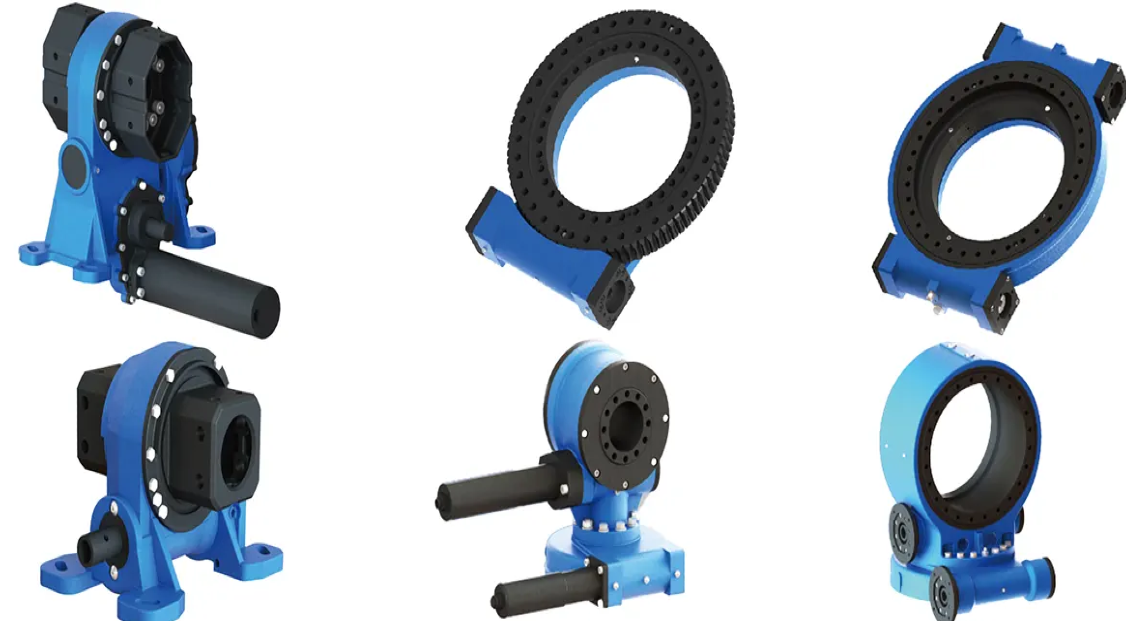
How to Choose the Right Slew Drive: A Comprehensive Analysis from Type to Parameters
What are Slew Drives?
Slew drives are compact, integrated gearbox mechanisms engineered to handle the complex demands of heavy-duty rotation. Unlike simple bearings, they are designed to simultaneously manage axial loads (thrust), radial loads, and tilting moment loads. Essentially, they function as the precision pivot point, allowing large structures like crane booms, excavator arms, and solar arrays to rotate smoothly and hold their position securely under immense stress. They combine the functions of a slewing bearing, a speed reducer, and often a self-locking mechanism into a single, robust unit.
The Basic Structure of Slew Drives
A typical slew drive is an assembly of precision components working in concert:
Housing: A sturdy casing, often made of high-strength cast iron or steel, that protects internal parts and provides a rigid mounting structure.
Gear Set: The heart of the drive. This usually consists of a worm and worm wheel (for worm gear drives) or a pinion and spur gear (for spur gear drives), responsible for power transmission and speed reduction.
Integrated Slewing Bearing: A large-diameter, specialized bearing that allows for smooth rotation while supporting the substantial axial, radial, and moment loads. It is often an integral part of the gear set, with the gear teeth cut directly onto the bearing race.
Seals: High-quality, multi-lip seals are critical. They protect internal components from harsh environmental contaminants like dust, water, and ice, while retaining essential lubricants to ensure a long service life.
Input Shaft: The connection point for the prime mover, which can be an electric motor, a hydraulic motor, or even a manual hand crank. It transmits power into the gear set.
The Design Features of Slew Drives
Modern slew drives are marvels of mechanical engineering, featuring:
Integrated Functionality: By combining a bearing, gear, and housing, they simplify machine design, reduce parts inventory, and save valuable space.
Inherent Self-Locking: A key feature of most worm gear designs is the ability to self-lock. This means the load cannot drive the motor backward, providing a natural safety brake that prevents uncontrolled descent of loads, a critical feature for lifting applications.
High Load Density: Their compact design belies their incredible strength. They are engineered to handle immense forces within a relatively small envelope.
Application Versatility: They can be customized with various gear ratios, backlash levels (from standard to zero-backlash for precision), seal materials, and surface coatings to suit almost any environment or performance requirement.
Main Types of Slew Drives
Slew drives are primarily categorized by their internal gearing and the power source they are designed for:
By Gearing Type:
Worm Gear Slew Drives: These are the most common type, prized for their high torque output, exceptionally smooth and quiet operation, and inherent self-locking capability. They are the go-to choice for applications demanding precision control and safety, such as cranes, aerial lifts, and solar tracking systems.
Spur Gear Slew Drives: Utilizing straight-cut gears, these drives offer higher efficiency and faster rotational speeds compared to worm drives. They are better suited for continuous rotation applications where speed is prioritized over self-locking, such as certain industrial turntables and indexing tables.
Electric Slew Drives: Designed to be paired with an electric motor, these are ideal for applications requiring clean, quiet, and easily controllable operation. They are common in indoor industrial machinery and solar trackers.
Hydraulic Slew Drives: Driven by a hydraulic motor, these provide immense power and are incredibly robust. They are the standard choice for heavy-duty outdoor mobile equipment like excavators, offshore cranes, and forestry machinery, where high torque and resistance to shock loads are paramount.
By Power Source:
How Does a Slew Drive Work?
The operating principle is a study in mechanical advantage. A motor (electric or hydraulic) turns the input shaft, which rotates a small gear—either a worm or a pinion. This small gear meshes with the teeth of a much larger gear ring, which is integrated with the slewing bearing. As the small gear turns, it drives the large ring, creating a significant gear reduction. This reduction multiplies the motor's torque output while simultaneously reducing its speed, providing the immense rotational force needed to pivot heavy loads in a slow, controlled manner.
Applications of Slew Drives
The robustness and precision of slew drives make them indispensable across a wide spectrum of industries:
Renewable Energy: The backbone of solar tracking systems (both single-axis and dual-axis) and critical for wind turbine blade pitch control.
Construction & Material Handling: Essential for the rotation of crane booms, excavator houses, aerial work platforms, and mobile man lifts.
Industrial Automation: Used in robotic arms, rotary tables, welding positioners, and heavy-duty conveying equipment.
Defense & Aerospace: Found in radar systems, satellite communication antennas, missile launchers, and gun turrets.
Marine & Offshore: Deployed in ship cranes, offshore platform equipment, and ROV launch and recovery systems, where corrosion resistance is critical.
How to Choose the Right Slew Drive: A Comprehensive Analysis from Type to Parameters
Making the optimal choice requires a methodical evaluation of your specific application. Here is a detailed guide to navigate the decision-making process:
1. Understand Your Application Requirements
Begin by creating a detailed profile of your machine's operational demands:
Load Analysis: Precisely calculate the maximum axial load (vertical thrust), radial load (side load), and most critically, the tilting moment load (the turning force) that the drive will encounter. Include dynamic loads and safety factors.
Operational Profile: Define the required rotation speed (degrees per second or RPM), the duty cycle (how often it rotates), and the required precision.
Environmental Conditions: Will the drive operate in extreme heat, freezing cold, dusty deserts, or salt-spray marine environments? This dictates seal types, lubricants, and housing materials.
Power Source: What is the available prime mover? The drive's input shaft must be compatible with your electric or hydraulic motor.
2. Choose the Appropriate Slew Drive TypeWith your application requirements clearly defined, the next step is matching the drive's mechanical design to your core operational needs. The gearing type fundamentally determines the drive's performance characteristics, from torque output to operational speed and safety features.
Prioritize worm gear slew drives for lifting and precision positioning applications. Their inherent self-locking feature is indispensable when holding a load safely is paramount, such as in cranes, aerial lifts, and boom systems. This design prevents back-driving, meaning the load cannot descend due to gravity without motor power, providing a natural safety brake. Additionally, worm gear drives excel in applications requiring smooth, quiet operation and high torque at reduced speeds, making them ideal for solar tracking and precise angle control.
Select spur gear slew drives for high-speed and continuous rotation applications. When your machinery demands faster rotational speeds and higher operational efficiency, spur gear designs deliver superior performance compared to worm gear alternatives. They experience less friction during operation, translating to lower energy consumption and reduced heat generation. Applications such as industrial turntables, indexing tables, and certain material handling equipment benefit from the higher speed capacity and efficiency of spur gear drives, though it's important to note they typically do not offer the self-locking feature of worm gear designs.
Choose an electric slew drive when your application requires high precision positioning, operates in clean, indoor environments, or benefits from simple integration with existing electrical systems. They are ideal for solar trackers, industrial automation, and applications where low noise and zero emissions are priorities.
Choose a hydraulic slew drive for heavy-duty outdoor applications where conditions are harsh. They excel in environments with extreme dust, mud, vibration, or potential submersion. When you need immense torque from a compact package or already have hydraulic infrastructure on your machinery (like excavators or cranes), hydraulic drives are the reliable, rugged choice.
3. Determine the Essential Technical ParametersThis is the quantitative heart of the selection process:
Load Capacity (Static & Dynamic): The drive's rated capacities must exceed your calculated loads. Static capacity is the limit for non-rotating conditions; dynamic capacity is for continuous operation.
Output Torque: This must be sufficient to accelerate and move the load under all expected conditions.
Gear Ratio: Select a ratio that converts your motor's speed and torque into the desired output speed and torque. A higher ratio means more torque but slower rotation.
Backlash: Define the required precision. Low or zero backlash is essential for precise positioning in applications like radar or antenna systems, while standard backlash is acceptable and more economical for general lifting.
4. Delve into Key Performance ParametersBeyond the basics, understanding these deeper parameters ensures long-term reliability:
Breakaway Torque: The initial torque required to start the drive moving from a standstill. High breakaway torque can stress the motor and drivetrain.
Efficiency: The ratio of output power to input power. Worm gears are less efficient (especially at higher ratios) than spur gears, which impacts motor sizing and heat generation.
Service Life (L10 Life): The calculated lifespan, often defined as the number of revolutions or hours until 90% of a group of identical bearings are expected to still be operational. This is crucial for predicting maintenance intervals.
Operating Temperature Range: Ensure the drive's internal components and lubricants are rated for your environmental extremes.
5. Evaluate Material and Manufacturing QualityThe quality of materials and workmanship directly dictates lifespan:
Look for hardened and ground gear teeth for maximum wear resistance.
Inspect the quality of the bearing raceways and the type of rolling elements (ball or roller) used.
High-quality nitrile or polyurethane seals with metal shields are essential for contamination resistance.
6. Verify Compatibility and Customization OptionsYour drive must integrate seamlessly with your machine. Check all mounting dimensions, shaft configurations, and input flange patterns. If standard products don't fit, a manufacturer's ability to provide customization—such as special paint, corrosion-resistant coatings, integrated encoders, or hollow bore designs for cables and hydraulics—is vital.
7. Plan for Installation and MaintenanceConsider the total lifecycle:
Installation: Understand the requirements for mounting surface flatness, bolt torque, and initial lubrication.
Maintenance: Establish a schedule for re-lubrication and seal inspection. Easy access to grease fittings is a practical design advantage.
Monitorability: In critical applications, consider if there are options for integrating sensors to monitor temperature, vibration, or lubricant condition.
8. Carefully Select Your SupplierThe final and most strategic step is choosing a partner. Look for a supplier that offers:
Engineering Support: They should help you verify your calculations and select the optimal model.
Quality Certifications: Adherence to international standards (like ISO) is a must.
Proven Track Record: A history of successful applications in your industry is invaluable.
After-Sales Service: Availability of spare parts, repair services, and technical support is crucial for long-term peace of mind.
LyraDrive: High-quality Slew Drives Supplier in China
At LyraDrive, we believe that a successful project starts with a perfect partnership. As a premier supplier of high-quality rotation solutions in China, we are dedicated to providing more than just standard components. We offer precision-engineered slew drives and slewing bearings designed to meet the exact demands of your unique application.
Our extensive product portfolio includes a full spectrum of gearing technologies, such as single worm slew drives, double worm slew drives for enhanced torque and precision, and spur gear slew drives for high-speed efficiency. However, our true strength lies in customization. We understand that standard catalog products don't always fit. That's why we work closely with our clients to develop tailor-made solutions, whether it involves modifying mounting interfaces, developing specialized seal packages for extreme environments, or integrating unique features like hollow bores or custom paint finishes.
When you choose LyraDrive, you are not just purchasing a product; you are gaining a dedicated partner committed to excellence, reliability, and your operational success. We combine advanced manufacturing capabilities with expert engineering consultation to deliver the optimal, cost-effective solution for your machinery. For performance you can rely on and a partnership you can trust, choose LyraDrive.
FAQ of Choosing the Right Slew Drive
Q: What is the most important factor when choosing a slew drive?
A: While all factors are interconnected, accurately determining your load requirements—particularly the tilting moment load—is the most critical first step, as it underpins every other specification.
Q: What does "self-locking" mean and do I need it?
A: Self-locking, or irreversibility, means the drive cannot be back-driven by the load. It holds its position without an external brake. It is essential for safety in lifting applications (like cranes and aerial lifts) to prevent the load from falling if power is lost. It's less critical for applications like solar tracking, where the drive is always under motor control.
Q: How often should a slew drive be lubricated?
A: Lubrication frequency is highly dependent on the application's duty cycle, speed, and operating environment. Always follow the manufacturer's specific guidelines. However, a common best practice is to perform an initial check and re-grease after the first 50-100 hours of operation, and then every 3 to 6 months or after a specified number of operating hours thereafter.
Q: What is the difference between static and dynamic load capacity?
A: Static load capacity refers to the maximum load the drive can withstand when stationary (or under very slow, oscillating movement) without causing permanent deformation to the bearing raceways. Dynamic load capacity is the maximum load it can handle while in continuous rotation over a defined lifespan, affecting bearing fatigue life.
Q: Can I get a slew drive with a hollow bore to pass through cables or hydraulic lines?
A: Yes, absolutely. This is a very common customization. Many applications, particularly in solar tracking, robotics, and material handling, require a hollow bore design to allow wiring, hoses, or pneumatic lines to pass directly through the center of the drive. At LyraDrive, we specialize in customizing our slew drives to accommodate such requirements, ensuring a clean and protected installation.
 WhatsApp
 sales@lyradrive.com
 +8613903880726