



What are Single-row Crossed Roller Bearings?
What are Single-row Crossed Roller Bearings?
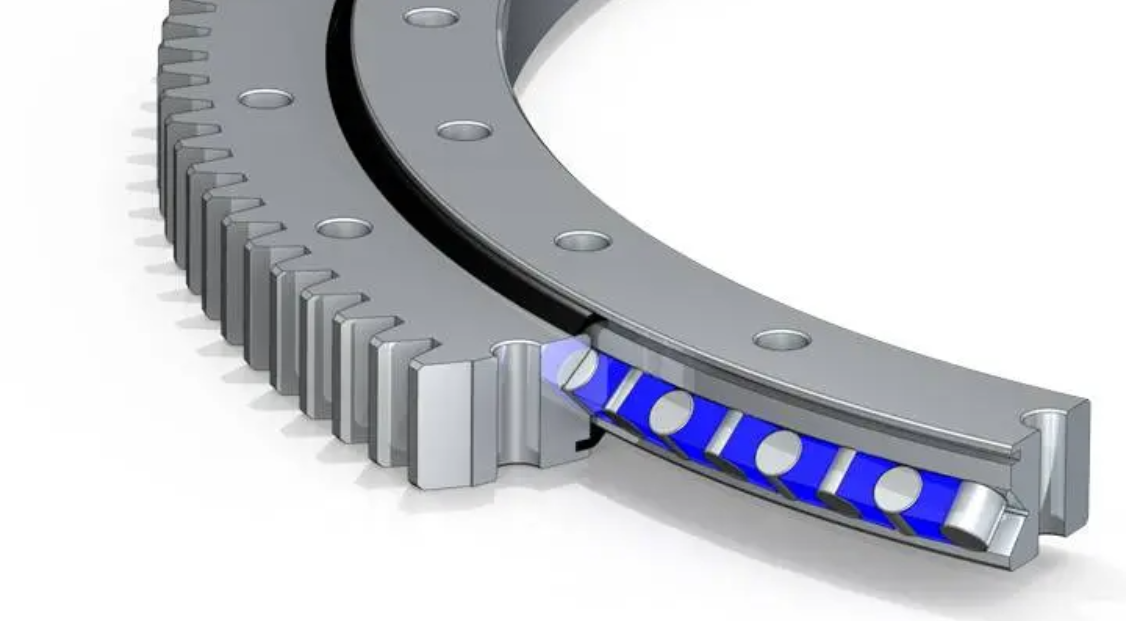
Single-row crossed roller bearings are a specialized type of rotational bearing engineered to handle demanding applications. Unlike traditional bearings, they are designed to support high loads in multiple directions simultaneously while delivering exceptional precision and rigidity. The unique feature of these bearings is their arrangement of cylindrical rollers. Instead of being placed parallel to each other, the rollers are positioned perpendicular (at a 90-degree angle) in a single row, with their axes alternating between adjacent rollers. This crossed configuration allows a single bearing to effectively manage radial loads (forces perpendicular to the shaft), axial loads (forces parallel to the shaft), and moment loads (tipping forces) all at once.
Features of Single-row Crossed Roller Bearings
These bearings offer a distinct set of advantages that make them indispensable in modern machinery:
High Load Capacity in All Directions: The crossed roller design provides a large contact surface between the rollers and raceways. This allows the bearing to carry significant radial, axial, and moment loads, making it incredibly versatile.
Compact and Space-Saving Design: Because one bearing can manage forces that would typically require multiple bearing arrangements, the overall design of your machinery can be much more compact and lightweight.
Exceptional Rigidity and Precision: The preloaded, crossed roller arrangement minimizes elastic deformation under load. This results in very high rotational accuracy and stiffness, which is critical for applications where precise movement is non-negotiable.
Low Maintenance: Thanks to their robust construction and efficient load distribution, these bearings are built for durability and typically require minimal maintenance over their long service life.
Smooth Rotation: The rolling motion of the cylindrical rollers ensures low frictional torque, enabling smooth and consistent rotational movement even under heavy loads.
How Does a Single-row Crossed Roller Bearing Work?
The working principle is based on converting sliding friction into rolling friction. The bearing sits between two components—typically an inner and outer ring (or raceway). As one component rotates relative to the other, the cylindrical rollers roll within the raceways. The alternating perpendicular arrangement of the rollers is key: it allows the bearing to capture and distribute loads coming from any direction. When a radial load is applied, a set of rollers is perfectly oriented to carry it. Similarly, when an axial or moment load is applied, the perpendicular rollers engage to support it. This ensures that the load is always distributed optimally, providing stability and smooth, efficient rotation.
Detailed Types of Single-row Crossed Roller Bearings
To meet the needs of various applications, these bearings come in several configurations:
Standard Bearings: The basic type, designed for general high-load, high-precision applications.
High-Rigidity Bearings: These feature enhanced internal geometry or materials to provide even greater stiffness for applications like machine tools where any deflection is unacceptable.
Sealed Bearings: Equipped with integral seals on both sides to keep out contaminants like dust and moisture, and to retain lubrication, making them ideal for harsh environments.
Bearings with Gears: For applications requiring direct drive and torque transmission, the inner or outer raceway can be manufactured with integrated gears.
Internal Gear: The gear teeth are cut into the inner raceway's surface.
External Gear: The gear teeth are cut into the outer raceway's surface.
Structure of Single-row Crossed Roller Bearings
The construction of a single-row crossed roller bearing is elegant in its simplicity, consisting of a few key components:
Inner and Outer Raceways: These are the main structural rings. They are precision-ground to provide smooth, accurate paths for the rollers.
Cylindrical Rollers: The rolling elements themselves, arranged alternately perpendicular to each other.
Spacer or Cage: A critical component that separates the rollers, maintains their precise alternating alignment, and ensures even load distribution. It prevents roller-to-roller contact and guides them smoothly through the load zone.
Seals (Optional): Typically made of rubber or similar materials, these are fitted into grooves in the raceways to protect the internal workings.
Gears (Optional): Machined directly onto the inner or outer diameter of a raceway, these turn the bearing into a functional component of a power transmission system, such as in a slew drive.
Applications of Single-row Crossed Roller Bearings
The unique properties of these bearings make them the preferred choice in many high-tech and heavy-duty industries:
Robotics: Used in robot joints, wrists, and bases for precise, smooth, and stiff movement.
Machine Tools: Essential components in rotary tables, indexing tables, and the spindles of CNC milling and grinding machines.
Medical Equipment: Found in precision diagnostic devices like CT scanners and MRI machines, where smooth and accurate rotation is critical.
Aerospace & Defense: Used in satellite positioning mechanisms, radar systems, and turrets for their reliability and precision under demanding conditions.
Industrial Automation: Ideal for rotary indexers, assembly lines, and packaging machinery.
Renewable Energy: Employed in the yaw and pitch control systems of wind turbines, often integrated into slew drives.
Key Factors for Choosing a High-Quality Single-row Crossed Roller Bearing
Selecting the right bearing is crucial for performance and longevity. Consider these factors:
Load Analysis: Accurately determine all radial, axial, and moment loads your application will generate.
Precision Requirements: Define the required rotational accuracy and rigidity. High-precision applications demand bearings manufactured to tight tolerances.
Operating Conditions: Consider environmental factors like temperature, contamination, and required lubrication.
Integration: Decide if you need a sealed unit or an integrated gear for your slew drive or other mechanism.
Material and Manufacturing Quality: Choose bearings from manufacturers using high-grade materials and rigorous quality control processes.
Technical Support: A knowledgeable supplier can be invaluable in helping you select, install, and maintain the correct bearing for your specific needs.
How to Maintain Single-row Crossed Roller Bearings
Proper maintenance will significantly extend the life of your bearing:
Regular Inspection: Periodically check for any unusual noise, vibration, or play in the system. Inspect seals for damage.
Proper Lubrication: Maintain the correct type and amount of lubricant as specified by the manufacturer. Re-lubrication intervals depend on the application's duty cycle and environment.
Protect from Contamination: Ensure seals are intact to prevent ingress of dirt, chips, or other abrasive particles.
Correct Mounting: Ensure the bearing is mounted on a flat, rigid surface and that mounting bolts are tightened to the correct torque to avoid distortion.
LyraDrive: Get Single-row Crossed Roller Bearing 3D Drawing for Your Application
Finding the perfect bearing for your unique application is critical. LyraDrive is a professional manufacturer of Single-row Crossed Roller Bearings and slewing bearings. We specialize in the design and manufacture of high-quality slew ring bearings, precision bearings, slew drives, and custom bearings for a vast array of industries, including construction, engineering, mining, marine, chemical, military, wind turbine, medical equipment, and many others.
We understand that every project is different. That's why we offer a collaborative approach to design. When you provide us with your specific requirements, application data, or sample drawings, our engineering team can utilize advanced 3D technology to bring your concept to life. We can take your initial ideas or reference samples and create a detailed 3D model of the bearing or slew drive perfectly suited to your needs. This process allows us to analyze fit, function, and performance within your assembly virtually, ensuring that the final product is flawless. By simulating real-world conditions and integrating your specifications into our design, we eliminate guesswork, reduce development time, and guarantee that the delivered component meets the highest standards of quality and performance. From initial concept to final production, LyraDrive is your partner for precision motion solutions.
FAQabout Single-row Crossed Roller Bearings
Q: What is the main difference between a single-row crossed roller bearing and a conventional ball bearing?
A: The primary difference lies in the rolling elements and their arrangement. Single-row crossed roller bearings use cylindrical rollers arranged perpendicularly, which provides a larger contact area with the raceways. This allows them to handle significantly higher loads (radial, axial, and moment) simultaneously and with greater rigidity compared to conventional ball bearings, which typically use point contact and are often designed to handle primarily one type of load.
Q: Can a single-row crossed roller bearing replace two bearings in my existing design?
A: In many cases, yes. Because one crossed roller bearing can manage combined loads, it is often used to simplify machinery designs that would otherwise require a matched pair of bearings (like two angular contact ball bearings). This can save significant space, reduce weight, and simplify assembly. However, you should always consult with an engineer or bearing specialist to verify the load requirements of your specific application.
Q: How do I choose between a bearing with internal gears or external gears for my slew drive?
A: The choice depends on your drive system's configuration. An internal gear (teeth on the inner race) is typically used when the driving pinion is located outside the bearing's center, or when you need a more compact design with the drive mechanism positioned within the bearing's inner diameter. An external gear (teeth on the outer race) is common when the driving pinion is inside, or when the outer ring needs to be rotated by a stationary drive source. The available space and mounting arrangement are the deciding factors.
Q: What does "maintenance-free" mean for these bearings?
A: Some single-row crossed roller bearings are described as "maintenance-free" because they are factory-filled with high-quality grease and equipped with effective, long-life seals. For many applications, this means they do not require re-lubrication during their service life. However, "maintenance-free" does not mean "inspection-free." Regular checks for seal integrity, unusual noise, or play are still recommended to ensure long-term reliability. For heavy-duty or high-speed applications, periodic re-lubrication may still be necessary.
Q: How important is the cage or spacer in these bearings?
A: The cage is a critical component. Its role is to maintain the precise alternating spacing between the cylindrical rollers. This prevents the rollers from rubbing against each other, reduces friction and heat, guides the rollers smoothly through the load zone, and ensures even load distribution. A high-quality cage is essential for achieving the bearing's rated speed, precision, and service life.
Q: What kind of precision can I expect from a single-row crossed roller bearing?
A: These bearings are known for their high precision. They are manufactured to strict tolerances (like ABMA classes or ISO grades) that define the allowable runout. Depending on the grade, they can provide rotational accuracy in the range of a few micrometers, making them suitable for applications like machine tool spindles, rotary tables, and precision measuring equipment.
Q: My application operates in a dusty environment. What should I look for?
A: For dusty or contaminated environments, you should select a bearing with integral, high-quality seals. These seals, often made of rubber, create a tight barrier that prevents particles from entering the bearing and damaging the precision-ground raceways and rollers. A sealed bearing will have a much longer and more reliable life in such conditions.
 WhatsApp
 sales@lyradrive.com
 +8613903880726